City
Could the Downtown Relief Line finally become reality?
In case you missed it yesterday, a report published by the Toronto Transit Commission says Toronto needs make construction of a new east-west subway a priority over all other transit projects. Without a Downtown Relief Line, the Yonge subway will be completely unable to manage the projected ridership increases in the coming years, it says.
As city hall watchers will know, the DRL has been long been a dream of writers, transit planners and straphangers caught in the rush-hour crush. The line's history is almost as old as underground transportation in Toronto itself, with origins in the nixed Queen subway line and the 1985 "Network 2011" plan that also called for Sheppard and Eglinton West lines to support the existing subways.
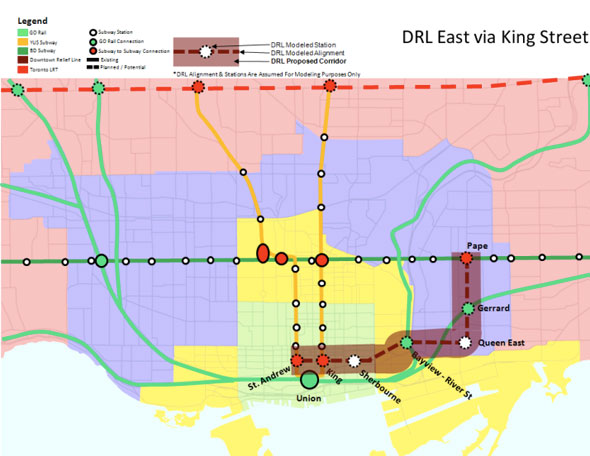
The big question, as it was then, is whether the TTC can actually get the thing built. The report offers several different versions of the DRL, the cheapest coming in at around $3.2 billion to connect King and Pape stations. The most desirable, and most expensive, option - a line from Dundas West to Flemingdon Park via St. Andrew and King - could set the TTC back a gigantic $8.3 billion.
Now that new ways of funding new transit projects are starting to make it onto the table, a renewed push for the line could gain some traction if it's supported by taxpayers. The fact the proposed subway doesn't serve Scarborough and Etobicoke directly could be a sticking point for some, however.
Yesterday, the University of Toronto's Institute on Municipal Finance and Governance (IMFG) published a report outlining some of the lessons Toronto and the wider area could learn from other American cities as it tries to push forward with new transit.
The salient point appears to be that someone at the provincial level needs to take the wheel and steer support, funding, and construction of any new work. Without strong leadership and grassroots public consultation, new projects are unlikely to gain traction, it says.
As always, the core issue is money. City manager Joe Pennachetti outlined 10 ways of securing new transit funds earlier this month with estimates on how much each tool could conceivably raise. Here's a list of the big-ticket items:
- 1 per cent personal income tax - $1.4 billion
- 1 per cent sales tax - $1.3 billion
- 1 cent a kilometre highway toll - $1.5 billion
- A parking tax of $365 a space - $1.08 billion
If this latest version of the Downtown Relief Line - a connection from Dundas West to St. Andrew, King and Pape at least - is to become a reality one or more of these charges will have to become a reality. The TTC's report says Metrolinx should make the DRL the top priority in its Big Move strategy, a project that's still $2 billion a year short.
The provincial agency currently estimates relief for the Yonge line to be 16 to 25 years off. By then, the TTC says, the Yonge line will have reached critical mass and started hindering access to the city. If something's going to happen, it needs to happen now.
Images: TTC


Discussion
82 Comments
Sort By Oldest First / Newest First
Subscribe
Can't wait til all those condos that are under construction get built. If people think the TTC is overcrowded now... LOL just wait.
People who live outside of the old City of Toronto have already proven with their Rob Ford votes that they put low taxes above infrastructure investments. Why would they care if we can commute more easily?
If we hadn't amalgamated, just imagine how many more things would have gotten done in this city! With a municipal government that represents only people who actually live in the city, not folks who drive in to make a living.
I support money going into DRL
It's like saying we won't get a new sewage plant even when it's overcapacity. This is a basic need for the city. Just wait until a few people die from overcrowding on YUS. Then it will get done.
Second, the part I think the planners have totally missed is their projection for the Yonge line and how busy it is. They are on crack. I think they came up with their estimates by looking solely at spreadsheets and not by actually riding the rails. As a ‘burbanite (the former North York) with a Metropass who rides the Yonge line to and from work downtown every weekday, I am hard pressed to understand how the they conclude the Yonge line will reach capacity by 2030 and there will be 50% more riders.
I challenge one of those planners to hang out on the NB King platform at 5:15pm on a weekday and tell me there is room for 50% more people. Not to mention the train wreck that is Y&B in either the morning or evening rush. And then there are those poor souls buying shiny new condos near Yonge and Eg who are finding out that 3 out of 4 trains rolling through Eg SB at 8:30am are already sardinded so full that most people on the Eg platform can’t actually get on the train.
For all the ‘burb comments, the TTC and its overlords have been the author of the TTC’s own demise for going on 25 years. Far too many grand plans and politicians playing trains (or streetcar) while ignoring the explosive growth within the City.
Third, I had to laugh today at The Star and Roy James advocating ripping down the Gardiner. Awesome idea, let’s do that. And let’s not build a DRL for 30 years. And lets add in 20k more condo units in the downtown core. And let’s see how well the Yonge line works after all that. A**.
Amalgamate the TTC and Metrolinx, slap a road tax on and get digging.
- like the DRL, the 2nd Ave subway line is primarily a relief line to take pressure off the overburdened 4-5-6 line that runs under Lexington Ave and has to serve the entire east half of Manhattan Island. You could call it the Manhattan Relief Line.
- like the DRL, the 2nd Ave subway will not be long enough to be a direct line from the suburbs. It will run almost 14 km in its completed form but not cross the river into the Bronx or Brooklyn. Simply costs too much to get out to those inner suburbs.
- like the DRL, the line will have to be built in phases. Just for the first phase, comparable to DRL's King to Pape, it is taking 9 years to build. Nine years!
- the funding for the first phase is primarily via a New York State bond and $1.3 billion from the federal government. Would Queens Park and Ottawa do the same for the DRL?
Toronto residents are quick to support and criticize ideas without any real world context. There is a universe outside the Toronto bubble, and when it comes to the DRL the appropriate case study is the 2nd Ave Line. (There are not exactly many choices, anyway, since the only other subway under construction in North America is the DC metro extension to Virigina, a direct parallel to the Spadina line extension to Vaughan.)
The DRT will probably not be built. Sadly the people of Toronto and its council do not have the will. Unfortunately it always comes down to money and nobody wants to pay for it.
Remember there's always tomorrow....
However, Rob Ford's "no tax increases" means he will be against it. He'll want "private" money to build it, which is not going to happen, if he has his way unless city council sees the light.
BTW. The report says that it should be "subway". However, it does not say if it should be a heavy rail subway or a light rail subway.
NIMBYs won't have it though.
Yeah, amalgamation has ruined this town.
TTC answered to and was funded by Metro Toronto and not the City prior to amalgamation. Which is one of the reasons everyone droning on about the burbs and amalgamation wrecking the TTC do not know what they are talking about.
"On January 1, 1954, the Toronto Transportation Commission was renamed the Toronto Transit Commission and public transit was placed under the jurisdiction of the new Municipality of Metropolitan Toronto"
But I'm 30 something now, and will likely be close to retirement before this thing ever gets built...sad. Nothing of note ever gets accomplished in this shit hole, apart from cookie cutter glass boxes. I hate this city (but love it at the same time :S)
Create jobs in Scarborough/North York/Etobicoke.
That way people from Scarborough/North York/Etobicoke stay in S/NY/E and wont have a need to take the subway to go downtown.
This is better than focusing things downtown which the usual cowards with no integritity whatsoever STeve Munro, TTCriders and so forth will go on.
Making and keeping jobs locally. That way downtowners stay downtown for work, suburbinites stay in the suburbs for work. voila
In less than two weeks, we can have all the transit woes solved.
The downtown core has put two and two together, the suburbs hasn't.
Then tell everyone you know who lives in the GTA to do the same. If you have the time and are good at organizing then join an existing group advocating for this, or start your own. Politicians just do what we tell them to do, and if the majority of people tell them what they want and how to pay for it then they'll do it.
The next federal and municipal elections are a few years away. Simply tell your Mayor, Councillor and MP that unless the DRL is underway by then, you won't be voting for them. The next provincial election is probably pretty soon, so tell your MPP that they could get your vote by supporting a motion for the transit initiative or something.
Like the recent articles on the "missing" Section 37 funds, a full accounting of how the Development Charges are being spent should be demanded.
Developers are paying a lot of money per unit (which in turn effectively gets passed onto the buyer as a hidden tax") to develop these condos, but no one seems to ask what happens to it once it gets to City Hall!
The money collected by development charges go to all the things that you would think they should (Infrastructure, Transit, Parks, Social Services) for new development, but the problem is that the fees are too low.
The City reviewed the rates about 4 years ago and found that they were quite low compared to neighbouring municipalities, and recommended that they be raised gradually over a few years. Since then, it took some time for a new bylaw to be passed, and rates were basically frozen (I think they even went down one year). Now, they are starting to go up to where they should be. Unfortunately, years worth of extra fees during a building boom were missed because of the delay.
It's up to us, the voters to put this on the front burner NOW and not later, it will never get cheaper.
i didn't know the drl is proposed to run from pape station. that's just awesome because i live right there!
to tell you the truth, with the way rush hour is now (especially at yonge and bloor) and how many commuters are projected to be using the ttc within the near future, i couldn't care which station it start or stops at...just build the darn thing already!!!
While we need the DRL, we also need Transit City built as was originally intended, and for EVERYBODY to contribute taxes towards the building of these much-needed projects-grumbling about 'being overtaxed' and 'public transit is a waste of money and should be privatized' should be dismissed and people should commit to this endeavor, even if they don't take public transit. (And no, we don't need those new stinky articulated buses, either!)
They can and should do that... but really all that changes is outside rush hour transit use... which isn't really a problem... a DRL line would directly affect rush hour transit use.
Looking at the initial portion of the line from Downtown to Pape, we have a much cheaper and easier alternative. The line would begin underground at Danforth avenue and continue in a tunnel until it meets the railway corridor near Gerrard, where there will probably be a station. Either before or after the station, it can rise to an at-grade or elevated alignment along the side of the railway corridor, with stations at Queen and Sherbourne before ending at a station built overtop of the Union station go bus terminal. Further extensions west can be done alongside the railway corridor at grade or on elevated structures in places where each is appropriate.
The only part of the line that has to be underground is the section directly south of Danforth avenue and north to the East York town centre. Everything else can be elevated or at grade.
Further question for any transit experts out there: Why is it that other cities across the pond have much more intricate and connected subway/rail systems? London Underground lets get absolutely anywhere because of the myriad of connecting stops and just the vastness of their system. Is it just a funding discrepency? A head start in years? Popular opinion towards transit?
Now, it's a funding discrepancy which allows them to continue to build while we don't. So it's technically both, but we don't have the luxury of KMs of cheaply (relatively) built track.