City
What Toronto can learn from how other cities fund transit expansion
The Greater Toronto Area needs to be taught a lesson when it comes to developing, funding, and building new transit projects in the 416 and beyond, according to a new report.
According to the University of Toronto's Institute on Municipal Finance and Governance, IMFG to its buddies, Toronto and the surrounding region can learn from other North American cities in several key areas when it comes to pushing its transit funding conversation forward.
Most notable, perhaps, is the call for strong leadership on the Greater Toronto and Hamilton Area's transportation needs on a provincial level. Right now its hard to point to the public figure at the controls of the region's various transit projects who might be able to champion support for new funding.
"To really advance the discussion you do need political leadership on a regional basis that really engages local leaders," says André Côté from IMFG. "In all sorts of places you'll have situations like here where you have a whole series of local operators run by the different municipalities but you need some type of leadership at a regional level through the transit authority or the higher order of government."
The report itself points to leaders in California and Utah that were able to steer public opinion in favor of funding transit expansion with taxes and fees. In Salt Lake City, the Utah Transportation Authority persuaded drivers to back new projects with the tagline "Even if you don't ride it, you use it."
We might not even be that far off - there are some indications people already support small sales taxes in principle. Increasingly, we're discussing ways of paying for new infrastructure, and that's definitely something positive.
It's easy to believe our needs are different from those elsewhere, especially given Toronto's checkered past when it comes to bringing necessary transit projects to fruition. Côté says it's possible a lack of a clearly-defined master plan even in the wake of recent subway vs light rail debates could be a fundamental part of the problem. In reality, the report says, we're anything but unique.
"I think the take-home lesson is our region is not niche," Côté continues. "The challenges we face with transportation are similar to what's faced in other city regions and they've all found ways to work through these issues and make the much-needed investments to improve their quality of life and economic potential. It's a positive message."
Here are some of the other key lessons from in the report:
- Focus on the passenger by providing "seamless" new technologies (Presto, anyone?)
- More grassroots consultations with local residents
- Public-private partnerships can provide "efficiencies" (not fully-funded subways) and spread risk
- Transit taxes or charges must be directed solely to improving regional connections.
Do you agree with these suggestions - do we need a leader to help steer the ship? Could we do more as a region to talk transit funding in a rational, pro-active way? Are we on the right track at the moment?
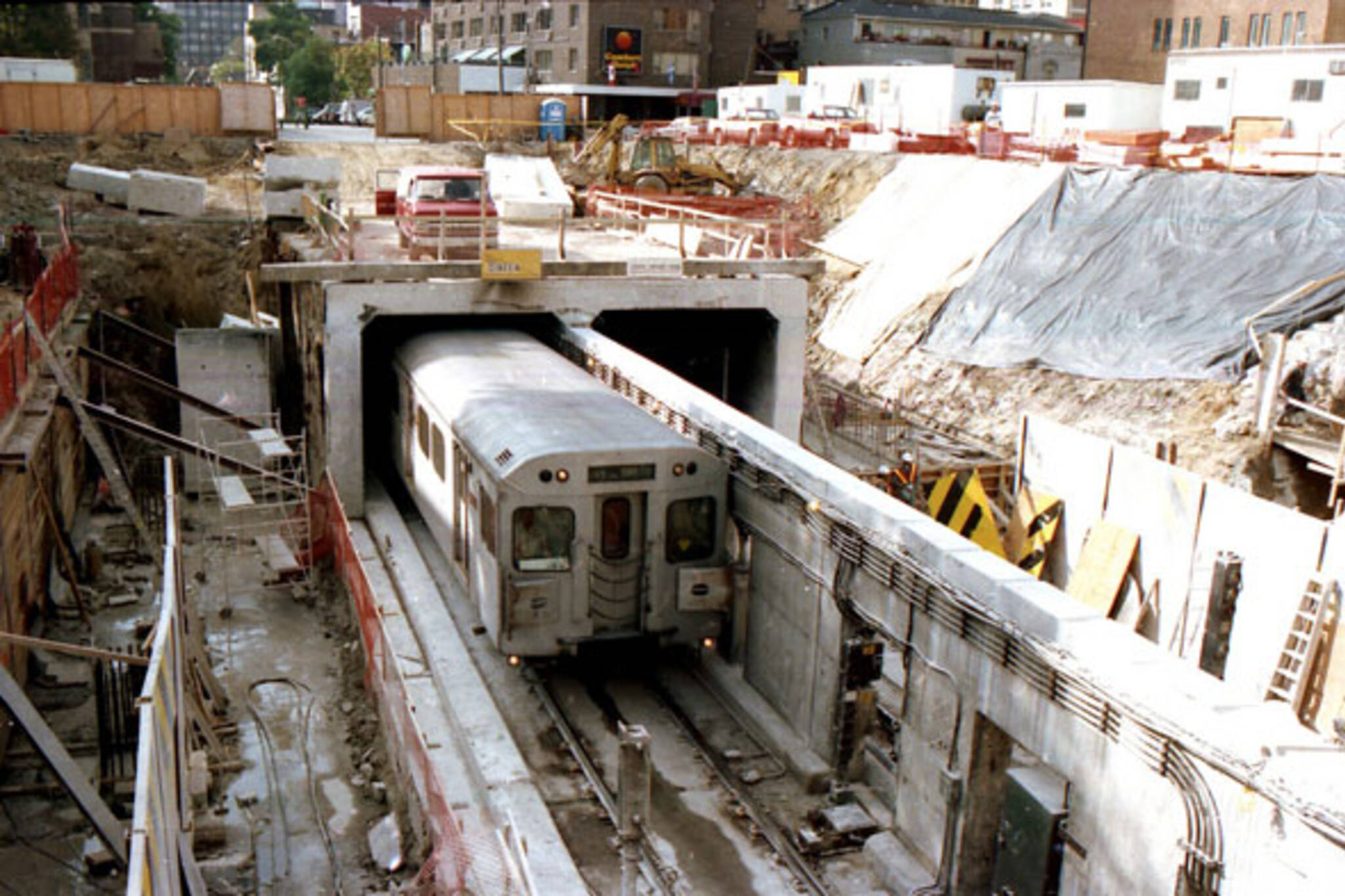
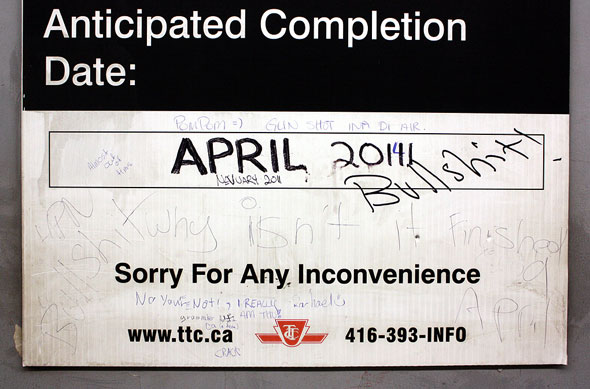
Photos: "Yonge subway enters Bloor station, 1994" by jer1961, and "The Public Has Spoken" by MrDanMofo in the blogTO Flickr pool.


Discussion
38 Comments
Sort By Oldest First / Newest First
Subscribe
Toronto's too divided politically to ever have a solution come from here. Mike Harris' grand plan worked!
Even if I took the TTC I would still need a car so depreciation and insurance don't count.
Regardless in the end the TTC is still over priced and under serviced. Kill the union, drop the outrageous salaries paid for unskilled labor and build new underground subways.
The real problem is the same its always been - funding. We are grossly underfunded in transit compared to just about any other city with a similar-sized or larger transit system. And yet we praise Hudak for makig vague statements about building subways despite (a) having been part fo the government that killed Eglinton and reduced Sheppared to a stump almost 20 years ago and (b) has made no commitment whatsoever to paying for these subways he claims he wants to build.
The fact is, even if you got rid of the union, you'd still have to pay people to operate the system, and even if you accept that a non-unionized staff would be smaller and paid less, Do you really think those savings would pay for meaningful transit expansion? At most, those savings might amount to a few million dollars a year (and that's probably stretching it) - not enough to make any serious dent in our transit situation. That kind of money would only buy a few buses or a streetcar, which would still need people to drive them. It sure as heck won't pay for subways.
The fact is, those same conservative politicians who rail against the unions as the reason why the TTC isn't what it could be are feeding you a line of crap. Blaming the union is simply a red herring to distract from the almost complete gutting of transit funding that we've experienced in the last 20+ years from higher levels of government (which not surprisingly, has coincided with the general degradation of the TTC which was once considered one of the best transit systems in North America).
I'm not saying that there aren't cost savings to be found - I'm just saying those "efficiencies" won't come close to funding the kind of meaningful transit expansion this city needs. Its time for some honesty in terms of what it will take to get the transit we need - people have to stop believing the fiction that (1) finding "efficiencies" will get subways built or (ii) the private sector will rescue us by building all of the transit we'll ever need. It ain't happening.
We need to privatize the TTC.
AfuckingMEN
The chance to build a downtown relief line is ignored.
Also, Sean is dreaming in Technicolor if he thinks that subways can be built all over Toronto-newsflash, Sean, with a few exceptions, they can't. The ONLY ones that could (and should) be built are the DRL and (maybe) a line down Queen Street, plus maybe also an extension of the Sheppard Stubway. Most of the city would have to be served by what David Miller wanted to build, Transit City as there's no urbanized density in suburban Toronto, except that the man that you love so much cancelled Transit City when he became mayor.
I would urge you and everybody else who thinks like you to please turn off (if you partake of them) Fox News and Sun News Channel, stop reading the Toronto Sun and the National Post, and try and find a source of info that ISN'T neocon blabber about 'being taxed to death' and 'government waste' and 'unions are the source of trouble in North America today'- you'll be mentally better for it. Also, I'd suggest that you and your fellow neocons try and take 'studycations' (study vacations) of Europe and Scandinavia so you can learn what a society really should and could be.
Someones views differ then yours and you make random assumptions about them and attack. Then you proceed to talk down to ever Torontonian by saying their is something wrong with our society. If we don't live up to your standards as a society then you can leave and head to your this utopia you call Europe/Scandinavia. I'm sick of self proclaimed elitist like you telling everyone how amazing everywhere else is and how crappy it is here.
I am fed up with the endless BS going on in this city. The last 5 years have been absolutely appalling.
Can't wait to move 3 hours north and get away from this toxic hell hole.
I would like to be optimistic and believe that there is hope for the future. However, from what I have seen during my travels (Switzerland, Germany, Austria) is that Toronto is severely behind when it comes to moving people from point A to B. The prices that we pay for the quality that we get are way too expensive. Either reduce the cost (not likely to ever happen) or start building something, ANYTHING, ASAP!
PS Don’t even get me started on the customer service experience.
Remember, you have a right to your own opinion, NOT your own facts, and what's being spewed above about the TTC and the union is just nonsense.
I Suggest you do a bit of research to find out just how many North American cities either have streetcar/LRT systems or are looking to implement them.
Also you can't compare Toronto with it's booming population against most middle sized relatively stagnant US cities. If you want to look at how good public transit works in large cities, look at New York, or even Mexico City. They both have extensive and affordable subway networks. Already the potential population capacity of downtown Toronto has exploded (look at all the condos!) and, with this set to increase even more, will likely start spreading outwards. If serious investment isn't made in serious transport infrastucture (serious transport so subways) Toronto will be a complete hell hole in the next 20-30 years or so.
Yes 20-30 years, when we look at the future of this city we shouldn't be satisfied with the laughably short term view that those advocating more streetcars and LRT (aka streetcars) keep bleating about.
When I was commuting from downtown to Markham for work I figure this was my monthly cost of having a car if I spread everything including the purchase cost over 8 years.
Insurance: $145 / month
Maintenance: 6 years of reg ($500/year) and 2 years with a few major repairs ($1200 / year) = about $60/month
Purchase Cost: $20K = about $200 / month
Parking: $85 / month
Gas: $120 / month
My monthly total works out to $610 / month aka WAY more than $115 / month for a TTC metro pass.
If you aren't including the purchase price and you don't pay for parking it might come closer to the cost of buying passes... but that's hardly a realistic way to compare.
I do know what other major cities do for transport- I have lived in many of them so have first hand experience of the systems in New York, Mexico City, as well as the extensive subway networks in London, Paris, Berlin, Madrid and Barcelona. While it's true that some cities have experimented with a return of versions of streetcars, trams or "LRT" none of the cities I mention depend on it as their main form of public transport.
Even Oslo, one of the scandinavian cities the closed-minded LRT zealots keep banging on about, has a transport system principally made up of their subway line. Yes, a city with between half to a quarter of the population of Toronto (depending who you ask) has a much more extensive subway than the city which is supposed to be the most important in Canada. They also have a tram (streetcar) network which is almost as large as their subway network but their subway is still the most extensively used. And from experience the trams in subway are so much better than the streetcars in Toronto.
The fact is that all of these other cities have great subway systems. And Toronto has some of the worst transport infrastucture for a city of its size and importance in the western world. I don't know the real motivation behind these LRT zealots but it is embarassing that our city is continually held back by people afraid to make bold innovative decisions.
As for cities NOT embracing the streetcar or LRT, I present one more example of one U.S. city that has; Los Angeles (http://www.streetcar.la/home, http://latimesblogs.latimes.com/lanow/2012/07/voters-to-decide-fate-of-125-million-downtown-streetcar-project.html, http://www.metro.net/projects/historic-streetcar-service/, and again, https://www.facebook.com/golastreetcar?fref=ts).
If the people of LA-a city that was dedicated to the car until pollution forced the building of subways and light rail to reduce it-can go further that what they did and re-embrace the streetcar, we in Toronto can do no less that to keep our street car lines and build LRT's.
I'm sure an LRT would have served Scarborough and Etobicoke well back in the 60's and 70's but we would have been having the same need for subways that all but the most conservative and trepidatious torontonians are calling for. We need to build this city for the next 20-30 years, not by looking at 1969-1970 as you suggest!