City
Whatever you do, don't say Downtown Relief Line
For all the debate that's raged in Toronto over the so-called transit file — when did we all agree to call it that? — it's pretty remarkable that you don't hear more talk about the possibility of building a Downtown Relief Line. That the Ford camp has been able to place our collective attention squarely on Sheppard East in terms of subway development is actually quite the feat, especially when you consider that there's exactly the same amount of money reserved for both "projects" — which is to say nothing.
As dumb as the subways vs. LRT debate is — and it's incredibly stupid to compare the two in the absence of contextual details like cost, population density, ridership projections, etc. — what's even more ridiculous is that this already problematic binary has somehow morphed into a subways on Sheppard East vs. LRT anywhere discussion.
Torontoist Editor Hamutal Dotan has already done a good job in diagnosing this trend as its played out in terms of cost-based analysis — i.e. the Ford camp has successfully planted the (false) notion that if money is no option, subway infrastructure is necessarily better — but the other side of the coin is that our mayor has also managed to narrow the subway discussion to this one corridor of the city. That just doesn't make any sense.
Yes, Ford campaigned on a subway extension for Sheppard and has made it one of his key mandates throughout his time in office, but when he cut his post-Transit City deal with Metrolinx — the now ill-fated memorandum of understanding (MOU) — funding for the Sheppard extension was left in the City's hands. Talk of an extension on Sheppard continued in the months that followed, fuelled by snippets of info from Gordon Chong's study of funding options for the line and the compromise plan TTC Chair Karen Stintz pitched before Ford's MOU with the province was eventually voted down at council.
One of the significant developments over this period was the entrance of "alternative revenue sources" into the conversation — you know, things like a parking tax or road tolls. These tools are, in fact, still on the table in some capacity or another as tomorrow's council meeting looms. And that's perhaps what's most problematic about all this. If we're going to consider revenue sources of this nature, we'd best collectively consider directing them toward a transit project that actually makes sense. Given that LRT is the overwhelmingly obvious choice for Sheppard, that means it's time to start talking about a DRL. At the very worst, it would curb all this inane talk about how world-class cities build subways.
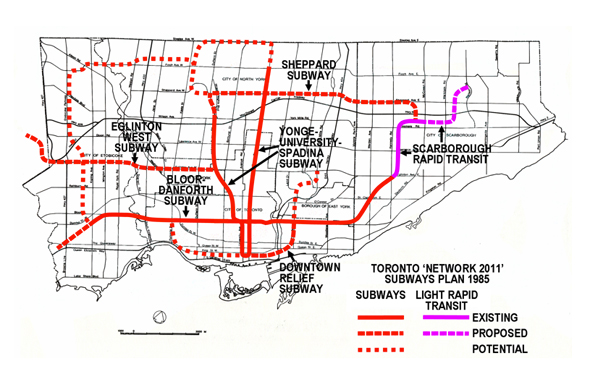
Many of the very cases made for building a subway extension on Sheppard would better justify the construction of a DRL. Sheppard subway supporters are fond of touting just how long plans have been around to build the line further east to Scarborough, but so too have plans for a DRL, which can also be traced back to the now tauntingly named Network 2011 project. Given our current funding scenarios and ridership projections, the case for pursuing the latter project is far stronger.
Don't believe me? Matt Elliott at Ford for Toronto has already laid out the pragmatics lucidly and convincingly. "Unlike Eglinton & Sheppard, the TTC's ridership projections for this route have actually increased since they were first made in 1986," he explains. "With 13,000 riders per hour in the peak direction, the DRL would open with ridership very close to subway minimums and, more importantly, would serve as a relief valve for the overburdened Yonge line, solving one of the most pressing issues facing Toronto's transit system. The line would provide new service to dense neighbourhoods while simultaneously having a positive network impact."
One of the best recent cases for a DRL comes courtesy of Bert Archer at the Toronto Standard. Although he actually floats the idea that Ford might be right about a Sheppard subway extension, Archer's arguments (via Mark Osbaldeston's Unbuilt Toronto books) about Toronto's inability to pull the trigger on grand projects work marvellously in favour of DRL.
"Cities are not businesses," he writes. "They do not need to show a profit, or even break even. They are, unlike businesses, meant to be around for centuries, and are meant to serve their population. This is often expensive, with today's governments needing to make commitments on future generations' behalf." By this rationale — and with particular emphasis on the idea of infrastructure that serves the population — it's high time we started talking more seriously about a Downtown Relief Line, a project that would be both practical and grand at the same time.


Discussion
61 Comments
Sort By Oldest First / Newest First
Subscribe
IMO the best parts of the city are the most difficult to access via transit. Getting to Queen West West, the Exhibition grounds/Fort York or Leslieville/Beaches are the most inconvenient and arguably the most culturally and/or historically rewarding.
Screw Scarbiria! Let's allow Torontonians to move more easily within densely populated areas.
In any case a subway downtown is simply the one that makes the most sense. Its inarguable. The only reason the question hasnt been brought up is because the mayor has already done a good job of creating a bigger sense of distance (literally, figuratively) between the suburbs and downtown.
But the fact of the matter is that a drl would serve all passwngers as the rider capacity of every single line, including both subway and streetcar, would reduce, instead of having completely full trains at rush hour.
Imagine for a moment, if you will, if Ford had come into office and done the following instead:
- done his search for Gravy of Mass Destruction as before, just to set the tone
- fired Webster on Day 1, saying TTC culture needed to change
- left Transit City and new streetcars alone as a done deal
- put Presto through on accelerated schedule
- stated that following the extension of Transit City to improve suburban service, and the delivery of the new LRVs to improve downtown streetcar service, the next step would be to strengthen the subway network by building the DRL and Sheppard West (to Downsview), using the vehicle tax and other levies to fund slow, continuous construction
If he had done all of that, he could have sill been Rob F**king Ford and yet no one would have said a peep. The same stuff would still be getting built, but the tone going forward on the unfunded projects would have been positive and unified. Ford could probably have whipped up a mob to torch Queens Park and all of Ottawa if new subway cash for future capital work did not appear.
But of course none of that happened. What a Child-Mayor. Someone please get an adult into those Mayoral Chains, stat.
"If we're going to consider revenue sources of this nature, we'd best collectively consider directing them toward a transit project that actually makes sense. Given that LRT is the overwhelmingly obvious choice for Sheppard, that means it's time to start talking about a DRL. At the very worst, it would curb all this inane talk about how world-class cities build subways."
BTW, please consider joining our DRL advocacy group on Facebook if you are at all interested in advancing the DRL!
https://www.facebook.com/groups/downtownreliefline/
http://transit.toronto.on.ca/subway/5006.shtml
Too bad that Roncesvalles is now a big ClusterF@#k with slower streetcars than ever.
I encourage everyone to do the same =)
Doing this on a street wide enough to handle entrances and intermittent transformer substations means a street more like King - not Queen. And routing a line along the GO train line - in people's backyards rather than the street ie Roncesvalles to Dundas West Station - makes no sense either for service to commuters or commercial developments. Details, details. Also a reality of subways/buried LRTs.
One major quibble Union as it will look after the renovations won't be able to handle the increased volume, either above or below ground. Any idea of using current rails that go there is not doable.
Queen is a more likely option.
I also think that in order for this to work it has to go up to Sheppard or further. Otherwise, it won't divert enough flow that currently goes to Finch.
We also don't waste all the planning and funding that's been made for Transit City.
I have had enough of the silliness about Lower Queen Station.
People, hello! You walk through it every day.
When you walk underneath the tracks, you notice how one set of stairs is to the north and the other to the south, and yet the 2 hallways don't meet?
One is the eastabound platform, the other is the westbound platform....
The area in-between is reserved for tracks....
Just saying......
Secondly, if you built a downtown relief line it would compete a few GO trains and if you haven't noticed the TTC doesn't actually compete with GO trains on a serious level at the present time. I don't think that that's a coincidence.
Finally, there is one place you could easily run a line which is in the Don Valley but there would be immense backlash from environmentalist groups. However, if you could get away with it, as a resident of Scarborough, I would be glad to scrap LRTs for that. Very few people in Scarborough want LRTs, they do positive harm to the street.
http://transit.toronto.on.ca/subway/5006.shtml
People along Finch want subways too, even though there's no way to justify it given the densities there. Should we build subways to Fenelon Falls or Barrie too? Everyone who wants a subway raise your hand and we'll just pull one out of this hat.
I have only ever heard my father use it.
The biggest obstacle to a DRL - or whatever you want to call it - is the commuter-transit-oriented policies of Metrolinx, at least as far as I can tell. Until that changes, nothing will happen.
http://www.blogto.com/city/2011/11/metrolinx_still_toys_with_the_idea_of_downtown_relief_line/
But, that's not really the point I'm trying to make here. What interests me is the fact that there seems to be at least some willingness on the part of the City and its citizens — or taxpayers, if you will — to embrace alternative revenue tools/sources to fund transit expansion. If that's actually the case, a DRL would be a more useful bit of infrastructure to build. There is, after all, already provincial money in place to fund a more than adequate LRT on Sheppard.
Which is the point of your piece, I know. But the problem at this point is that any attempt to suggest this will get you accused of "diluting the argument" or "confusing the issue" or "talking about pie in the sky projects" - none of which would be true, but since nothing's actually getting built anyway, all the energy is going into rhetoric right now. (The comments sections for any transit piece here are a prime example of this.)
I hate to say it, but Terence Corcoran of the Post had a great suggestion when he said that we should all just shut up, step back, and try to look at the problem again. And yes - this city in 20 years without a DRL of any type is a big problem.
(And FWIW, I'm not crazy about Metrolinx' stub of a DRL/pressure release valve for Union. To be sure, Union will be a nightmare in five years, even with new platforms and expanded facilities, due to increased ridership on GO. But a DRL needs to be more than just a pressure release valve - it needs to expand into the eastern and western suburbs to give an alternative route in and out of the downtown, which is why I like the rail corridor idea. Not that I have any hope that it - or anything, at this point - will get built. So much for my optimism.)
That being said though the sububs DO need either LRTs or Subways.
If there's money for subways it should go towards a DRL, it should be seperate from the LRT discussion and funding and the LRT lines should go in despite what some morons in the mayor's office think.
the Sheppard subway is a moot point; there's no density for it, there's no projected density for it for the next 40 years. There's no money for it, even if you canceleld all the LRTs, the government will take the money back and decide what to fund from there, if anything (R. Moscoe described this nicely). none of the assessments have been done, no private partners have come forward and no constrcution has started, even if the LRTs were scrapped for one shitty subway extension, it would take a ridiculously long time to construct it given all the work that ahs to be done prior to shovels in the ground.
It would be irresponsible and incredibly stupid to scrap a comprehensive and appropriate plan like the LRT, for one shitty little subway extension. We don't even know if one could be put there, ford has no plan. If we scrap LRTs, it would eb for nothing, there's no plan there, no funding, no need, no assessments.
This is a discussion that some others on some other websites have been havign for quite some time, apparently, and not surprisingly, BlogTO has not been having this discussion.
I support a DRL for sure. I get on at Eglinton in the morning(heading north, luckily) and the trains are already jam-packed heading south. I don't understand how they could possibly fit in all the people that must be trying to get on by the time they get to Bloor. A DRL from a Sheppard stop to Union would be great. If most people get off and take the streetcar west at the southern Yonge stops though, wouldn't a DRL just increase the already at-capacity streetcar lines? I feel like we can't just focus on building a single line, and need to look at the impact that line will have on the system as a whole. If a DRL will increase the number of people taking the subway south, then we need to make sure we have the infrastructure in place to handle them all when they get off at their stop.
I can see Metrolinx being a big problem. In Durham one of the worst things they ever did to their transit systems was merge them into on big regional system. In Toronto look what amalgamation did to the city! Whenever you merge things you get big problems because now more people have to come to a decision together on things that may only concern a few of them. I understand wanting to have a regional plan, but that doesn't mean you have to merge systems. The point of the TTC is to handle people who live and travel in Toronto. If Metrolinx is focusing on people who commute in and out of Toronto then that is fine, but it shouldn't come at the cost of the TTC. Metrolinx should just be an entirely separate entity which can plan and implement things in Toronto, but that must work with the TTC.
Also, not having to transfer from Sheppard to the DRL is a huge motivator in getting people to use transit. The Shops at Don Mills would also get many more visitors. Eventually connecting the Sheppard line out West would also help. Another benefit is building an LRT on Sheppard east of Don Mills then makes more sense as the Sheppard subway would actually go somewhere.
“The Drain” in London has two stops – one on each end – and is simply there to move huge quantities of people from Waterloo train and tube stations to Bank tube station (which interconnects with other tube lines).
Similarly the S (“shuttle”) line in NYC takes riders from Grand Central to Times Square with interchanges at either end.
As has been pointed out above, stations cost a lot – both to construct and to expropriate the land at surface (contrary to what was written above, appropriation of land is not stealing, the landowner is paid market value and there is an appeal process). Tunnels cost relatively less.
If the primary goal is “downtown relief” then we should examine possibilities beyond the usual and what is depicted above. We need to understand where the people on the Yonge line originate from and travel to and also where the people who swarm Yonge and Bloor to the point of it being unsafe due to crowding originate from.
It may make the most sense to have 10 km of track with a mere 3 stops. But, for once, we should let the data speak.
a) you left late for what you wanted, and were caught in rush hour traffic
b) you expected said streetcar to get you there despite said rush hour traffic
The problems with the Queen streetcar are mostly due to the amount of automobile traffic on Queen Street; lessen that by eliminating left-hand turns and the like, and the Queen streetcar would be amazing (one way to make things better on Queen and still keep street rail-if possible, and that's a VERY big 'if'-COULD be to make it into a LRT line that would be buried for half of the run [say from around the Humber loop all the way to Woodbine and the Woodbine streetcar yard] and then come up around the Beaches area, but a lot of preliminary work would have to be done, as well as feasibility studies on such an endevour.)
In the meantime, you should try to make sure that you leave early enough to get where you are going on Queen, and also realize that any delays that happen are not the fault of the streetcar itself, but of people driving cars, trucks, etc. and the accidents that occur because of them.
Go to Yonge and Bloor at 8:30 am to see why a DRL is needed.