City
Does the future look like the past for subway expansion?
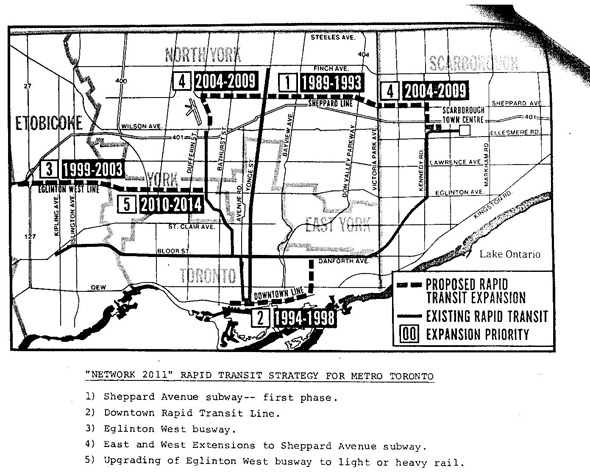
2011 would have been an important year for the TTC and Toronto in general had everything gone according to plan. In 1985 the TTC unveiled a 28-year $2.7 billion blueprint for an expanded transit system called Network 2011 -- scheduled to be completed in what would now be next year. It consisted of five major projects meant to service the growing downtown core and the new urban sub-centres of North York and Scarborough.
Specifically, it called for the construction of a Sheppard Avenue subway line from Downsview station to the Scarborough Town Centre, a downtown relief line running from Pape to Union stations, and a rapid transit line running along Eglinton to Pearson international airport. The TTC hoped that by the time Network 2011 was finished 62 per cent of Metro Toronto's population would be within 1.25 miles of rapid transit service.
The plan was marketed as highly affordable too, with 75 per cent of the financing supplied by the province. Many saw Network 2011 as the absolute minimum Toronto would have to build to accommodate the city's growing workforce and need for transportation.
Clearly the proposal was never put into place. Only a segment of the Sheppard subway line was built, and the rest of the projects never materialized. And as we approach the scheduled completion date of Network 2011, we're in the almost the same position as we were in 1985.
One of the reasons Network 2011 failed is because it was introduced in the midst of a turbulent year in Ontario politics. The Ontario Progressive Conservatives, who had been in power for 42 years and were responsible for much of Toronto's transit growth since Metro's creation, were defeated on a motion of confidence after winning a minority government in the 1985 election.
The move brought in a Liberal government under David Peterson supported by the NDP. Together the two parties stalled on Network 2011 until it fell apart. Transit Toronto speculates that had PC Premier Bill Davis remained in power the project would have been built.
But the failure of Network 2011 is an example of a broader transit problem in Toronto. This wasn't the only opportunity missed. The city has consistently failed to expand its subway system, with small exceptions, since the completion of Kipling and Kennedy subway stations in the early 1980s. So what gives?
I asked a few experts what explains this broader failure.
James Bow, senior content editor at Transit Toronto, told me one reason for the lack of subway growth has to do with Toronto's growth patterns. After the completion of the Yonge/Spadina-University and Bloor-Danforth lines, TTC planners believed that the city's sprawl wasn't dense enough to be served by more subways.
James Mars, a professor at Ryerson's School of Urban and Regional Planning, listed several reasons for the slow growth of Toronto's transit: the failure to create a GTA wide planning agency like Metrolinx sooner, the Ontario Ministry of Transportation's bias in favour of highways, and the lack of consistent national funding for transit.
And David Amborski, also a professor at Ryerson's School of Urban and Regional Planning, says the biggest factor is the lack of federal support for Toronto's transit system.
But with the upcoming mayoral election and subway expansion being proposed by several candidates isn't there reason for optimism? I'm afraid not.
Adjusted to inflation, Network 2011 was a $4.98 billion project. George Smitherman's transit plan is supposed to cost $17.4 billion and Sarah Thomson's is estimated at $14 billion. If we couldn't get a $5 billion project going, what are the chances we'll manage with plans costing three times as much?
Network 2011 was killed by a Liberal government in the late 1980s, and today's Liberal government is somewhat similarly stalling on Transit City. And other than the creation of Metrolinx, we haven't fixed many of the problems facing transit.
It appears no one factor is responsible for this failure, just a series of small failings spread over many years. "It's a perfect storm, I guess," Mars says.
Photo by wvs of the blogTO Flickr pool. Map of Network 2011 from the Toronto Archives.


Discussion
33 Comments
Sort By Oldest First / Newest First
Subscribe
I was born in 1985, and by now, I could have had a pretty substantial transit system. It's interesting that today/our transit issues should not be considered short-term. We need long-term and committed projects.
I agree with Prof. Aborski - we need to lobby for some sort of legislation for Metro Funding across the province.
I think Ontario has learned a lot since 1985 of what needs to be done to grow a cities transportation infrastructure. It is completely obvious we can't keep expanding highways and just putting more cars on the road. We have a big push at the moment for better bike infrastructure, a large variety of public transportation improvements rolling in on a regular basis, and big plans that will hopefully become reality.
Despite the tone of this article, I'll keep optimistic.
Will never get there!
Conservative all the way...they get shit done and everyone (including the so called "marginalized") benefit from it. They run the city like a business...which it is. Toronto can be prosperous in the hands of a great leader with vision and planning.
Sadly, we have no one like that.
2) Mississauga is run like a business, and it's an unlivable car-based wasteland.
But seriously what politics is missing is the attitude of working together to improve our city for the benefit of EVERY individual living or visiting here. All people in lower, middle and upper classes deserve to benefit from a city which is accessible by transit, bikes, walking and yes, driving too. I know wealthy people that can't be bothered to dig their car out of the snow in the winter sure as hell appear on the bus and trains...and they bitch more than every day users about the lack of a complete city wide system.
It has little to do with the political standpoint of the Conservative's or NDP, and more to do with people DEMANDING that their tax dollars go to useful things. Write you MPP and demand you're tax money be put to good use.
It takes an astonishing amount of political will to embark upon an exercise which a) will not see benefits during your term of office and b) costs a lot of money. You're asking politicians to spend money now, piss people off now by digging up their city... and not get benefits for many years to come. This is a very hard thing to ask politicians to do. It's essentially a career-ending move for politicians to undertake something like this.
It's a serious problem in democracies. The easiest way to get past it is to continuously allocate a sum of money for major projects like this, and put the responsibility in some bureaucracy or another. The bureaucracy is insulated from voter wrath, and the continuous spending means no increase in voter taxation, so voters don't notice it. Eventually the subways get built and everyone is happy, even though they would have crushed the career of a politician who dared push a subway-building plan.
North America is supposed to be the "new world" as in "fresh start" with a lot to work on. Even the rest of the world (old world) like Asia and Europe, think that North America is so advanced and innovative by now because we're a new place where people and society never really originated from. That's why Europeans and Asians, especially the Japanese) are shocked whenever they come over here because we are so behind in development such as city planning, transit, etc. But all they're good at here is immigration, building more and more endless sprawl housing areas and condos. Horrible.
Many say that North America, like Toronto, has bad methods and ways of living and lifestyles such as bad planning and over-reliance on cars, and that we are designated to be places for auto and gasoline sales and consumption. This is the reason why there is no transit innovation and progress here. Progress also includes options. The government here is not giving us options and choices in how we commute. As for the bad ways of living, it's true, but it's also the governments in North America not building/planning wisely which forces everyone to have bad habits (ie. car-based society).
It's 2010, Toronto's subway system and its lines should have been mirroring (let's be realistic, not London or Paris) the subway system of Boston or Moscow by now. And we should have lines going out to the 416 suburbs by now (besides the "incomplete" Sheppard line). Payment options and systems on the TTC subway and bus should be advanced as well. The GO should have more lines and service as well, and the bordering 905 cities (Mississauga, Pickering, Markham, Vaughan, Woodbridge, etc.) should grow up and act as individual cities and develop their own transit systems. I think Toronto closed the door on itself and the federal government helped that happen.
Harris would not have done that. Harris _did_ make some progress towards restoring public transit funding in 2001, and I respect him for that, but the funding he was restoring was funding that he cut. In 1995 and 1996, the provincial subsidy for operating and capital was basically eliminated outright, with the exception of one or two projects (primarily the Sheppard subway) that only stuck around thanks to Mel Lastman's tireless campaigning.
The problem of public transit in Toronto is a multi-partisan issue. Metro had finally come together to come up with a plan that Bill Davis likely would have approved if he'd still been premier. Unfortunately, Davis' successors, from Frank Miller, David Petersen to Bob Rae, were all reluctant to contribute the funds needed to bring it all about.
And we mustn't leave Davis blameless, here. As Tomasz notes, there were missed opportunities dating back to the 1970s. Subway construction ebbed because it was getting too expensive, and the areas dense enough to be best served by new subway development were already served. TTC and provincial planners spent the 1970s looked for a technology that could expend a form of rapid transit into the suburbs that was both less expensive, and fast.
For the TTC, the solution was obvious: streetcars on grade-separated right-of-way. The current batch of streetcars have the capability of travelling at 80 kph, because they were supposed to operate on the Scarborough RT. The streetcars would have had the flexibility to operate in subway-like conditions in trunk corridors, but in less expensive installations (like in the middle of the road) in the fringe. But Bill Davis wanted to make Ontario a leader in the industry of high tech public transport vehicle construction. The crown corporation set up by his government, UTDC, started work with maglev technology, but eventually settled on the linear induction model eventually used by the Scarborough RT. They then put pressure on the TTC to change their design to accommodate the new technology. Which turned out to be more expensive and less flexible than LRTs. Which is why Network 2011 was a subway expansion proposal, rather than an LRT plan.
That was the real missed opportunity, here. The Transit City LRT lines we're building now should have been started thirty years ago. Then consider the network we could have operating by now.
1) Sheppard
2) Downtown Rapid Transit
3) Eglinton West Busway
4) East and West extensions to Sheppard
5) Upgrade of Eglinton busway to light or heavy rail
They left the DRT open to what form of rail it would be, while Eglinton was to start as buses and then upgrading to either light or heavy rail. Only 1) Sheppard was built. Today, we are getting an extension to Sheppard in the form of light rail, and we are jumping Eglinton as light rail, skipping the busway setup.
Unfortunately, the second project, the Downtown Rapid Transit, still has no solid plans as yet.
This has nothing to do with either side of the political spectrum. It's just the usual political practice of trying to erase the positive legacy of whoever came before you. And it's f***ing counterproductive.
wow....what horrible logic
that "middle" to "upper" class people don't take transit? and that car ownership is the be-it and end all? that only people who "buy cars and work hard" are going to bring this city up (out of your perceived dumpster)?
wow you are absolutely out to lunch.
Look at cities like Copenhagen, Austria, Zurich, Stockholm.... High high high rates of transit use..and they often coincidentally have high rates of car ownership, but they don't need them to get around their own city because of an excellent public transportation system
i'm not saying ban cars everywhere, but in reality, planning for the next decade, the car has to take a back seat to anything that will improve the public realm for so-called alternative (alt. in a car-centric viewpoint) transportation, like subways, buses, LRT, walking and bikes.
Get over yourself and look how far we've gotten with keeping cars on equal footing with public transit....we haven't gotten anywhere. It's time for the car-lobby to sit back and taste some of its own medicine while the vast majority of infrastructure money is devoted to your so-called alternative transportation.
Suck it up boyo...i guess you're voting for ford as well.
@RobFord: What are you, a human or a neocon zombie zelot?
@Daniel: See above.
@The Rest Of You: Not everything about Toronto & the TTC is bad: quit 'yer bellyaching (as Ann Landers used to say) and realize that the grass is always greener. New York's got a lot of problems with transit too, as these articles from Gothamist can attest:
<a href="http://gothamist.com/2010/08/24/the_wild_cards_over_at.php">MTA: Hey, Let's Make Monthly MetroCards $130!</a>
<a href="http://newyork.cbslocal.com/2010/08/24/report-steep-monthly-metrocard-hike-on-the-way/">Report: Steep Monthly MetroCard Hike On The Way</a>
Trust me, after reading these articles, you'll be glad you ride the TTC, warts and all.