City
How does each Toronto transit plan stack up?
It's showdown time at City Hall today, as council convenes for a special meeting to debate the merits of Rob Ford's vision for underground transit versus the wider-reaching, primarily above-ground plan first put forward by the previous administration. In the lead up to what will surely be a closely monitored session, it's worth asking how exactly we got here. Few would have imagined that David Miller's LRT plan would be back on the agenda when Ford declared Transit City dead on his first official day in office — even if he never had the unilateral authority to do so.
It's been a tumultuous 14 months since then, but it wouldn't be a stretch to say that Ford's grip on council has slowly eroded since that time. The first definitive signs of this came with the unanimous vote against his brother Doug's plan to wrest control of the Port Lands redevelopment from Waterfront Toronto, and the trend kept up when councillors opposed to his slash and burn budget were successfully able to claw back some of the service cuts on the table for the 2012. In the wake of the budget vote, Ford claimed victory, but given his unwillingness to compromise on transit plans, it'll be impossible to do the same unless he gets exactly what he wants today (complete burial of the Eglinton Crosstown) — which is extremely unlikely.
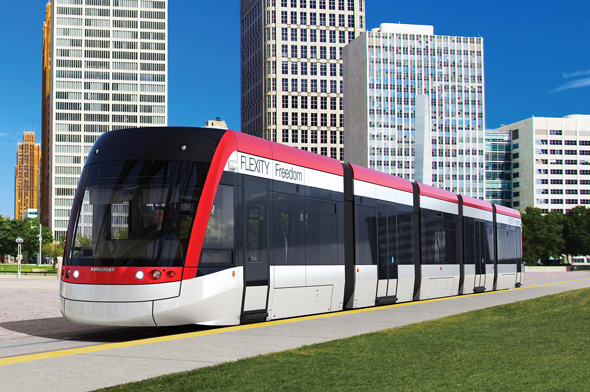
That David Miller radio appearance on Newstalk 1010 the day after the vote on the Port Lands — you know, the one in which he said that Transit City could be "turned on like switch" — seems more and more like an impeccably timed bit of political maneuvering, doesn't it? Today's meeting, however, is about more than just a return previous transit expansion plans.
In a less linear sense, one could argue that the reason Toronto is back to considering an LRT plan many thought finished a year ago is that the various players responsible for transit planning in Toronto just can't seem to get on the same page. In a rather depressing article for the Star today, Royson James tracks the various ways in which in-fighting amongst the mayor, the TTC, and Metrolinx have conspired to put the future of Toronto transit planning in the uncertain position we see today.
Above all, however, the reason that council is gathered today is that there are serious doubts as to whether Ford's plan is the best use of the $8.4 billion the province has supplied Toronto in transit funding. Note well, this isn't a debate about the relative merits of subways or LRTs, but about how to provide service for the most people with a limited amount of money. Everyone wants subways, but Toronto's transit challenges are widespread and where we build infrastructure should reflect that.
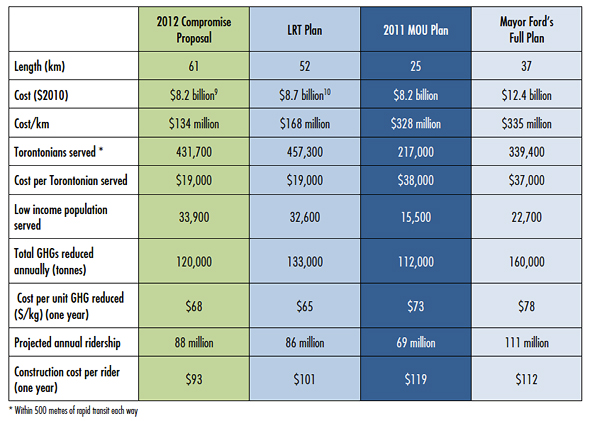
Toward that end, the Pembina Institue's recent tale-of-the-tape comparison of the various transit strategies suggested for Toronto is useful guide to what's on the table today. Amongst the statistics to be found in the chart below, one that should really stick out is the number of residents served by each plan. In a nutshell, the LRT plan formerly known as the first phase of Transit City "would bring transit to 120,000 more Torontonians than Mayor Ford's full plan (including an unfinanced Sheppard subway) at about 70% of the cost."
When one takes out the Sheppard subway extension — and, let's be honest, does anyone think this thing is actually going to be built? — the number spikes to 240,300. While there's an argument to be made about a future increase in density along a subway line, given this city's difficulty in proceeding with transit expansion since the 1970s, it's difficult to argue against the benefits promised by the more wide-ranging plan.
Anyone care to prove me wrong?


Discussion
66 Comments
Sort By Oldest First / Newest First
Subscribe
The Toronto Transit debate begins with the submission of 20,000+ petitions in support of light rail.
ford supporters have turned in only a couple 100 signatures ofr subway.
Replace the 4000 buses that run on Eglinton with a high capacity subway, and redeploy those buses to more needy areas.
Ford's whole plan depends on the Sheppard subway actually getting built, which it never will. If he wants to build subways so badly why not build one where it is needed, downtown relief line!
I support the building of more streetcar lines as per Transit City, but it's generally not denied that heavy rail would help immensely in several high-demand areas like downtown and North York.
Higher ridership = more $$$ for the ttc every year.
Subways have a lower operating cost = less $$$ the ttc spends every year.
Using the same gear we've got = less $$$ the ttc spends on new facilities for repairs, storage, training.
This city needs a long term view, and LRT proposals lose every time. We need subways.
Has it been said that all LRT planned would be on existing roadways or is this just an assumption by people on how LRT works??
And they buried most of the elevated lines in Manhattan years ago.
IMO TransitCity may not be the best thing ever designed (it’s close though) but it has great value, is usable and most importantly can be built starting tomorrow.
BTW, 40% of New York's subway is still above ground.
Also, I've noticed that people here have been treating the terms "LRT" and "streetcar" quite differently. We need to remember that streetcars are a type of light rail vehicle (like how subways are a type of heavy rail, just like passenger and freight trains), and "LRT" transit isn't going to be some revolutionary, end-all solution.
#TOcouncil Cam Weldon to @gordperks admits potential $ shortfall on Sheppard subway plan would affect city's credit rating. #clarity
-----
come on ford try harder in screwing up our city's future, you can do it
Here: http://g.co/maps/ec62j
If you surimpose on the Bloor subway, that's about from High Park to Chester stations.
Say for the next 20 - 50 years ?
The majority of people in Scarborough do not want an LRT. We have an LRT already, it's the crappiest train in the city.
If it doesn't make fiscal sense to have a subway, fine, I accept that. But, by the same token, it doesn't make fiscal sense to have LRTs over buses and as a resident of Scarborough I would happily have buses over LRTs. Just because it is a big project does not necessarily make it a good project. It's quite clear that running an LRT on Eglinton has an element of soft coercion to it, that the master planner bureaucrats want to manufacture a disincentive for driving and drop it on the major thoroughfare in Scarborough and rest their hat on the absurd hope that this will get more people to take the TTC. It will do no such thing, the main reason people don't take the TTC is because it is absurdly slow, by driving to work I save an hour and a half each day. If you do a rough calculation, 365 days in a year minus 52 weekends times 1.5 hours and then divide by 24 hours - you will find that I roughly save 19 days a year - by not taking the TTC. Well, you may respond but what about the people who can't do that? Don't they deserve to save more of their time? The answer is - Absolutely. But it is pretty safe to say that an LRT that stops at traffic lights won't do it. The main reason that public transportation stinks here and in many other places is because it is a monopoly. If we abolished the arbitrary law that gives the TTC exclusive monopoly right to sell "public" transportation in the city we'd have numerous busing companies spring up and organize, we'd have a more efficient use of our roads and of course travel times would reduce drastically. Right now we have a forced dis-equilibrium where you have only the TTC and cab drivers offering their services to the public - that system only benefits two groups TTC employees and cab drivers, the rest of us lose.
http://www.youtube.com/watch?v=UcBXK1LNprc
first of all figure out what you are talking about you have a srt, a outdated technology. right now Scarborough does not have any lrt. so misinformed.
@anon - Comparing the Spadina streetcar to a subway line? That's comparing apple to oranges! Of course apples are cheaper. Use the right tool in the right situation - the spadina line is short, so therefore a subway wouldn't have been good. Streetcar line was the correct solution, hence the profit.
Subways should be used for long runs to move lots of people long distances. The sheppard line needs to be expanded so that it's worth while to actually use it, not this 5 stop nonsense.
Imagine if the bloor line was a LRT instead of a subway with smaller cabins and twice as many stops. Would anyone take it? Hell no.
How do you know what the majority of people in scarborough want? Besides, the main reason for the LRT plan is to spread out the funding to multiple areas that really need it and to serve more people, so it is not just about what Scarborough wants but what the whole city wants.
LRT's will stop at traffic lights, but since they have signal priority they will stop at them far less than buses would. Why does everyone think the subway just runs non-stop between stations? I don't understand where this is coming from. The subway stops or slows down all the time between stations, usually during rush hour(which is when it counts to run on time). I imagine if you time the LRT stopping at a few stop lights and the subway stopping due to congestion at rush hour you won't find as much of a difference between the two as you might think. E.g. Subway from Eglinton to Finch during rush hour takes about 20min because it has to stop in the tunnel so much. Normally that trip should take about 11min.
There a bunch of problems with the idea of allowing anyone to run a bus company in the city:
1) You would have to inspect them for safety and license them, so that's extra money for inspectors.
2) Buses would only run on the most profitable routes, so you would have a ton of transit on very few routes and the vast majority of the city would have nothing.
3) Transit is not a profitable business, so no company would ever even want to start up.
4) I know of one city that has competitive transit: Lima, Peru. Buses literally race each other to the next stop, I don't know how many accidents this has caused, but I imagine significantly more than the number of bus accidents that happen annually in Toronto.
"I didn’t overstep my boundaries, I did what the taxpayers want. They want subways, that’s it. They don’t want streetcars. I was out in Scarborough over the weekend, people came up to me and said, they want subways. That’s it. It’s the taxpayers. The taxpayers want…I was elected on subways, they want subways, I was out on Saturday, people want subways. That’s it. It’s all subways. It’s all about subways. All about subways. So, it’s the taxpayers that elected me to get the subways in and that’s what we’re going to do. It’s like winning an election. So if they voted me in, that means [stutters a bit] I don’t win an election? It doesn’t make sense."
Why doesn't it make fiscal sense to have an LRT over buses? You didn't give any evidence or reasoning for this.
------------------------------------------------------------
A:The Toronto Star gave statistics on this the other day, although they never specifically endorse buses even though it's clear that subways *and* LRTs fail by *their* metric:
http://www.thestar.com/news/transportation/article/1126658--is-a-subway-twice-as-fast-light-rail
------------------------------------------------------------
How do you know what the majority of people in scarborough want? Besides, the main reason for the LRT plan is to spread out the funding to multiple areas that really need it and to serve more people, so it is not just about what Scarborough wants but what the whole city wants.
------------------------------------------------------------
A: Well, the majority of voters in Scarborough voted for Ford and with that against Transit City. Further, the current proposal on the table is to use the current available funds on lines that will exist in Scarborough. The above ground section being proposed by Stintz and the others would exist *in Scarborough*, the money freed up would then be used on extending the Sheppard line *in Scarborough*. So all of the *current* discussion is focused on Scarborough. Moreover, if you've been in those areas during rush hour you will see that those roads are packed putting an above ground line on them will cause more gridlock not less. So when you are saying, "what the whole city wants", it really transforms into "what the rest of the city wants for Scarborough". Hardly democratic on a local level.
LRT's will stop at traffic lights, but since they have signal priority they will stop at them far less than buses would. Why does everyone think the subway just runs non-stop between stations? I don't understand where this is coming from. The subway stops or slows down all the time between stations, usually during rush hour(which is when it counts to run on time). I imagine if you time the LRT stopping at a few stop lights and the subway stopping due to congestion at rush hour you won't find as much of a difference between the two as you might think. E.g. Subway from Eglinton to Finch during rush hour takes about 20min because it has to stop in the tunnel so much. Normally that trip should take about 11min.
-----------------------------------------------------------
As for subway times versus LRT times the Toronto Star article covers that.
Signal priority is highly problematic. It's plain common sense to see that it will increase congestion on roads that cross it increasing gridlock. I would also like to add that because I studied mathematics at university I know that creating a computer program that would give an optimal configuration of traffic lights and signal lights so as to reduce congestion is impossible, even though the problem is trivial to describe the computational complexity is vast.
There a bunch of problems with the idea of allowing anyone to run a bus company in the city:
1) You would have to inspect them for safety and license them, so that's extra money for inspectors.
-----------------------------------------------------------
A: Free Market incentives take care of this, it is in the business interest of the busing companies to provide safe and good rides. Consumers who were unhappy with a particular company could easily switch to another company who they believe is providing safer rides. Licensure is unecessary, however if people feel antsy and want to be able to track down companies in the event of litigation one could go to registration as a half-way house.
-----------------------------------------------------------
2) Buses would only run on the most profitable routes, so you would have a ton of transit on very few routes and the vast majority of the city would have nothing.
-----------------------------------------------------------
A: It's true that buses would run only on profitable routes, and we cannot fault them for that. I don't think however that you can say that the majority of the city will have nothing, supply of busing will rise to meet demand.
-----------------------------------------------------------
3) Transit is not a profitable business, so no company would ever even want to start up.
-----------------------------------------------------------
A: Transit is a profitable business. The reason that most public transit is not profitable is because it is subsidized by the government. The fact that the TTC knows it can rely on a subsidy gives it every incentive not to complete one's work at the margin, and profit is made at the margin.
Besides, if you really believed that Transit was not profitable you would have no problem with abolishing the law that forbids others from competing with the TTC.
--------------------------------------------------
4) I know of one city that has competitive transit: Lima, Peru. Buses literally race each other to the next stop, I don't know how many accidents this has caused, but I imagine significantly more than the number of bus accidents that happen annually in Toronto.
--------------------------------------------------
A: It's in the business interest of busing companies to provide safe travel and obey the rules of the road. Also, this example is one sided - a free market in public transportation(because travel time would be greatly reduced) would cause less people to take their cars and their would probably be less private accidents.
In my estimation the real reason you have so many instances of public transportation being run by bureaucrats is because at some point in the past during a period of inflation, public transportation providers were forced to pass this cost on to consumers. Consumers complained bitterly that providers were being "greedy". The municipal government imposes price controls, which inevitably cause a shortage in the supply. The citizens then bitterly complain about this, and the city government then takes over the whole operation.
So what you have is a situation where bad governmental action(inflation)is addressed by more bad governmental action(price controls) which is then addressed by still more bad governmental action(creation of a monopoly).
Incidentally, also shows that environmentalism comes at a cost, but that's a subject of another debate.
Scarborough needs reliable rapid transit. Scarborough needs a subway, full stop.
If we are going to quibble it's an MRT, not an LRT and, yes, it is still the crappiest train in the city.
Thanks for not clearing up my facts.
1) Ok, buses are cheapest then, thanks for clearing that up. Whether or not they are the most effective is not yet clear.
2) The majority of people in Scarborough probably do want a subway over an LRT, but this isn't about that(since the subway is never getting built). This is between LRT and buses, and I don't think there has been a vote on that in Scarborough so I'm not sure where the majority side on that.
3)This isn't an NP-complete problem though, signal priority is real-time, not programmed. I am sure there is some computation involved (e.g. "don't change light if it just changed 5 seconds ago") but it is not at the level you are implying. This may cause congestion on connecting roads, I'm not sure. I don't know if our traffic grid is smart enough to simply average out the times so that even though the LRT gets signal priority, during relevant time periods (rush hour, day, night, etc) the overall green to red ratio is the same.
4) I think in this instance you and I simply differ idealogically. I believe transit should be run to make a city a better place to live. You believe it should be profitable and efficient. Unfortunately I think these two are contradictory. If you want to serve the most people you will inherently become unprofitable. If you privatize transit and it no longer runs in all neighbourhoods or is priced out of the reach of some people then your city is no longer functional.
DUDE, know when to stop. It's embarrassing watching you get beat down and bitch-slapped by these rational folk. You have made a few points, they just aren't rooted in any kind of clear or sustainable logic. STOP already.
-Why are we spending $8 billion dollars on an LRT network which will bring me almost no benefits over the current local bus routes. The TTC's own studies show that Transit City LRT will be hardly faster than the current bus routes, and that at most riders will save a minute or two over current bus service. A TTC planner told me this to my face at a Transit City open house.
If we are just building local service, then we could just put in bus lanes and serve even more of the city for less cost.
On onto the question of why a full subway plan would carry more people even though it serves less people within walking distance. The answer is simple, it is because the subways will be faster and be able to compete with the car.
People have to remember that rapid transit lines don't rely on just people who live within walking distance. The Bloor-Danforth subway gets most of its riders from feeder bus service. In fact this is why Toronto's subway is so successful on a ridership level. Because we have an inter-modal system that allows buses to extend the catchment area of a subway line.
One well place subway say on Eglinton could potentially serve more people including those coming in on feeder bus, than all the Transit City lines combined.
As an urban planner with a focus on public transit, it is extremely concerning to see the extreme ideological fighting going on between LRT and subway advocates. And even more concerning is the blatant lack of respect and understanding of Toronto's transit history, and the reasons why our transit is such a success (even though we complain about it all the time).
I think people need to sit down and actually start talking about each proposal with an open mind and actually understand how each project would work.
That said, I'd love to see the TTC cover a larger area and lower rates to increase ridership among the city. If it was much more affordable to use public transit then to drive I'd be using much more.