City
That time the subway went from anywhere, to anywhere
Most people know that Toronto has a lost subway station--the infamous Lower Bay--but what's often left out of the story is how it got abandoned by the TTC. After all, why bother to build a station only to mothball it for several decades? The answer lies in a failed TTC experiment to create three subway lines out of two stretches of track: the Yonge-University line (as it was in the 1960s) and the new Bloor-Danforth line.
The scheme, known as interlining, meant riders could catch a train at, say, Greenwood and get downtown via Union without changing. The same system applied to eastbound trains. Riders could get on at Dundas West and get off at Eglinton without switching at St. George, Spadina or Yonge. Lower Bay enabled two separate routes to pass through the Yorkville station without having to share platform space. Despite presenting some advantages, the plan only lasted six months from the opening of the Bloor-Danforth line.
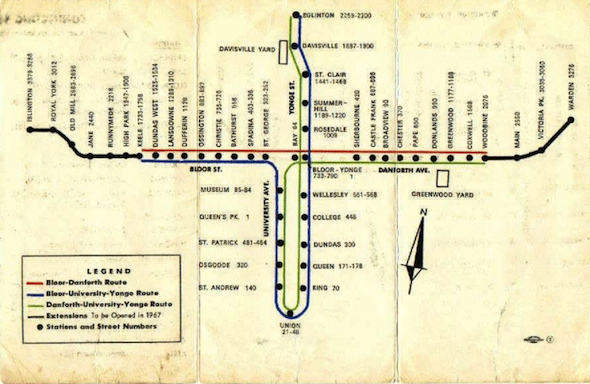
During the brief interlining experiment, the TTC--ever-imaginative with the names of its subway lines--offered riders the Bloor-University-Yonge, Danforth-University-Yonge and the familiar Bloor-Danforth lines on its promotional material. Today's familiar yellow and green designations for the YUS and Bloor-Danforth lines were yet to appear.
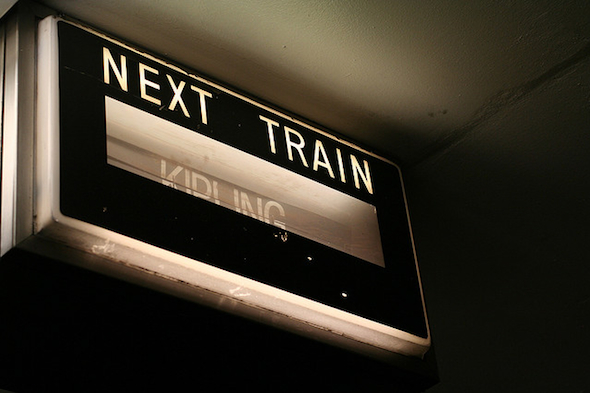
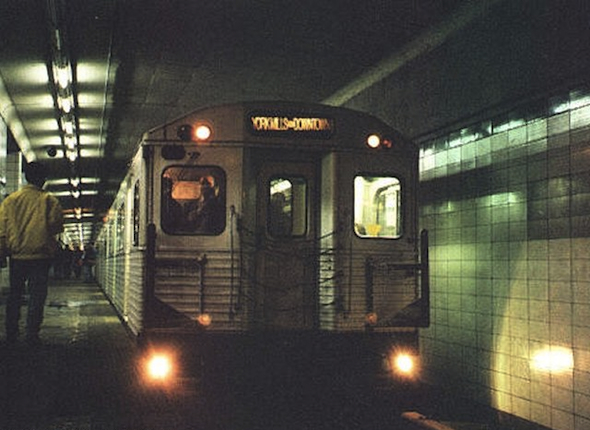
The rollsign on the front of the subway trains and the old "Next Train" displays are the TTC's most visible leftover relics of interlining. Instead of always reading "Kipling," "Kennedy," "Downsview" or "Finch," the signs would change to indicate the endpoint of the next train to save any hapless riders being whisked off against their will.
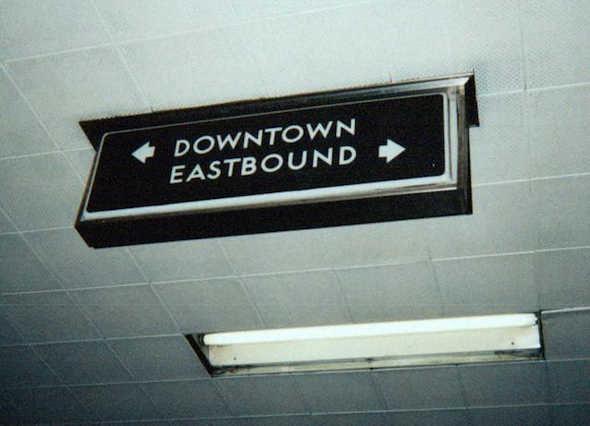
As you might imagine, the system wasn't without its issues. As Transit Toronto points out, a passenger heading east at Bay would have the choice of two different levels and run the risk of missing a train simply by virtue of being at the wrong platform when the train arrived. The same problem applied heading west at St. George.
Interestingly, a customer survey conducted at the time found those in favor and those against interlining were matched for numbers. Most simply didn't care one way or the other.
After just six months, the TTC decided to can interlining and stick with fully separate Yonge-University and Bloor-Danforth lines. The arrival of the Spadina line meant the second platform at St. George remained vital while Lower Bay was bricked up and abandoned when trains stopped passing through.
Today, Lower Bay has an almost legendary reputation amongst those with an interest in lost Toronto landmarks. Though rarely seen by regular subway riders, signs of its existence are still evident to those who pay attention: the mis-matched green tile used to cover over the stairs from the current platform at Bay, and the weird light visible down the tunnel from a westbound train at Yonge are often the first clues.
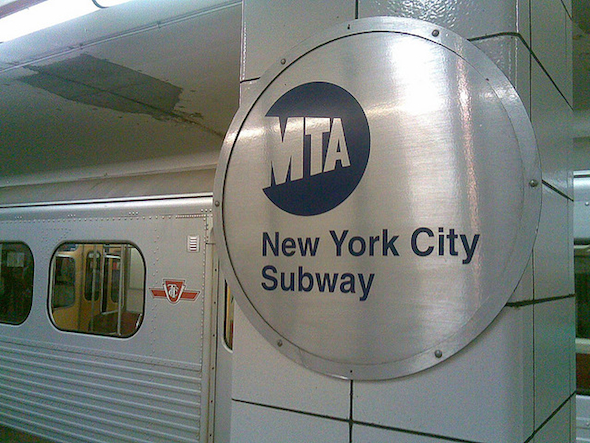
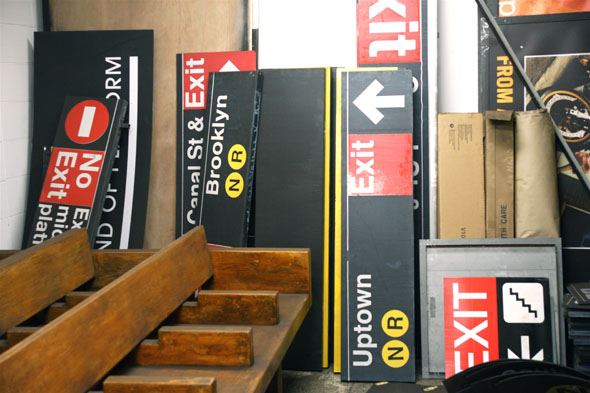
Having an unused subway station hasn't been all bad for the TTC. TV crews and filmmakers often rent the space as a filming location--chances are if you've seen the TTC on film, it's represented by Lower Bay. The TTC even owns an alternative set of signs for the platform to make it look like a stop on the New York subway.
In 2009, Absolut Vodka held a promotional party at Lower Bay. We've even listed the costs involved if you decide to rent the space for yourself--the kicker is you have to keep two trains at $700 an hour in the platform to deal with the risk of people falling on the tracks. Unless you've got friends in high places or plenty of cash to spare, the best way to see Lower Bay is to wait until the TTC next runs a tour or closes Upper Bay--something it does quite infrequently--and get ready with a camera. If you can't wait, check out the images and videos below.
MORE IMAGES AND VIDEO:
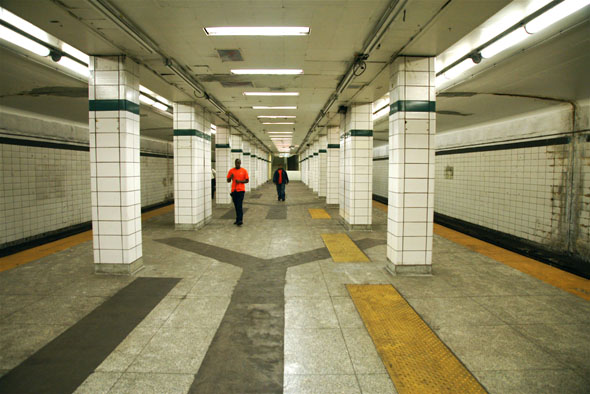
Looking along the Lower Bay platform.
A subway train at Bay showing "via Downtown" on its rollsign.
The TTC's stock of New York subway signs.
Passing through Lower Bay.
A tour of Lower Bay on open day.
Images: "Lower Bay" by Vlad TO, "Next train - Same as the Last Train" by The_cheeseman and "MTA/New York" by laurie.mcgregor in the BlogTO Flickr pool. All other images courtesy of Transit Toronto.


Discussion
31 Comments
Sort By Oldest First / Newest First
Subscribe
http://creativecommons.org/licenses/by-nc-nd/2.0/deed.en
Got a chance to see lower Bay a couple years ago during Nuit Blanche, when an installation was located down there. The installation was meh, but the station was pretty cool...I had no idea it existed until then.
Dave: Jinato is right, my work is licensed under a creative commons licence which allows people to use the image for free, yes, but I am supposed to be credited. If BlogTO found my photo on the TransitToronto site, like they originally had credited, I am unaware of my image being on there and I will be contacting them as well.
Rob: I'm happy with flickr and Creative Commons. It will happen that my images get stolen or used without credit occasionally, but I do find that most people ARE good about crediting my work and this is all work that I wouldn't expect to be paid for anyway, so really, in my eyes, it's not a big deal. I think the benefits of Flickr far outweigh the drawbacks.
Also you should all go down to Lower Bay Station the next time it's open (usually Doors Open or Nuit Blanche) - it's pretty awesome and creepy.
http://www.youtube.com/watch?v=E2syhaH4Qgk
You have to think that maybe 6 months over 50 years was perhaps not enough of a fair trial. Maybe it didn't work then, but given the problems at Bloor it's an interesting idea to consider again. (And seriously, the dual-level thing is not complicated with digital signage indicating next trains.) Forcing so many riders to change trains to get downtown is not a normal way of operating a subway system, but it became normal here because of what happened to Lower Bay...
... and that thinking then ruined the Sheppard line. Think about it -- in any other city, Sheppard would have been a branch line off of Yonge -- every other train goes to Don Mills, say, while the others go to Finch. Many, many cities have branch lines like this. Only a truly stupid, politically-driven person would come up with an idea of forcing a full train of Sheppard riders to all get off and pile onto a full southbound Yonge train to continue their journey.
But that's exactly what they did. Biased against interlining from the 1960s, the idiots at the TTC built the Sheppard line such that a northbound Yonge train can glide over to eastbound Sheppard, but a westbound Sheppard train cannot switch onto southbound Yonge - it would have to pass Yonge station and then reverse. (http://araskin.webs.com/maps/sw_map.html) In other words, the tracks were built in such a way to make branch or interline operation impossible. Morons! This has condemned the Stubway to uselessness. If Sheppard was simply a branch of Yonge, a through train to Don Mills (and only then a transfer to suburban LRT), we could all forget Mel Lastman, Mike Harris or Rob Ford ever existed. It would just be normal instead of a wart on the map. I blame the Bay interlining experience for this retarded excuse for transportation planning.
Freakin' TTC - they can't make a map, they can't figure out fare payment, and they goddamned can't understand interlining. It's like the whole thing is designed to the lowest common denominator so that 12 year olds can run it - trains go only to one place, you don't need to know where, just put that silver thing in your pocket in this box over here. Argh!
That said, there could be a conflict with the YUS when automatic train control kicks in.
Interestingly, the University Subway was design as the first phase of the Bloor-Danforth line, so the interlining was planned. True, it's common elsewhere, but remember that the University line was considered a "white elephant" for its first few years - in fact, it did not operate on Sundays for a time due to low usage. So, many TTC passengers had simply never used the University subway before this experiment
(see route map) http://www.railway-technology.com/projects/sheffield-tram/sheffield-tram7.html However if you've been operating the lines separately in Toronto for over 40 years changing back to interlining might be a recipe for chaos!
Each train carried an IDENTRA loop that would set the route to enter the wye. But, the wye was set to operate in alternating route mode on each exit to keep the trains in order. So, as a train left Museum from Bay Lower, the signal would then be set to accept a train from St. George. If that leg of the system was held up, the next train at Bay Lower would face a red unless the towerman at St. George intervened. As the day progressed, these small delays would add up and the entire system would fall behind schedule. Feeding trains into the system from Greenwood then became a problem because the other mid-day trains weren't in their proper scheduled positions along the line. There was also a time control aspect, but that was dropped one month into the trial
wished to say that I've really enjoyed surfing around your blog posts. After all I'll be subscribing to your rss feed and I hope you
write once more soon!