City
Is the TTC the priciest transit system in North America?
Toronto is a unique city, and so is its public transit system. Few other places in North America offer quite the same mix of subway, streetcar and bus transit, all tied together by a single fare. But there are parallels and similarities out there if you look closely enough. Boston and Philadelphia offer perhaps the closest match of a smallish subway network mixed with legacy streetcar lines, and San Francisco closely mirrors the political tensions of the TTC, Metrolinx and GO with its Muni, BART and Caltrain mash-up.
Montreal and Washington DC have similar rapid transit ridership, while Los Angeles near-identical bus numbers. Yet in the big picture, the greatest commonality between systems relates to fares. All cities have to charge a rider to get from point A to point B, and many grapple with funding sources, labour issues, service levels, local politics and other factors that would sound familiar to even the casual transit observer. After suffering three years of deep recession, even well-regarded American cities have been raising fares and slashing service. Everyone is the same unfortunate situation of having to pay too much for transit... or are they?
It's fairly common knowledge that the TTC gets more funding from the farebox (67%) than any other North American transit system, so one would suspect its fares are relatively high in relation to other cities, but oddly this argument rarely gets mentioned during council debates or most articles covering the topic of fare hikes.
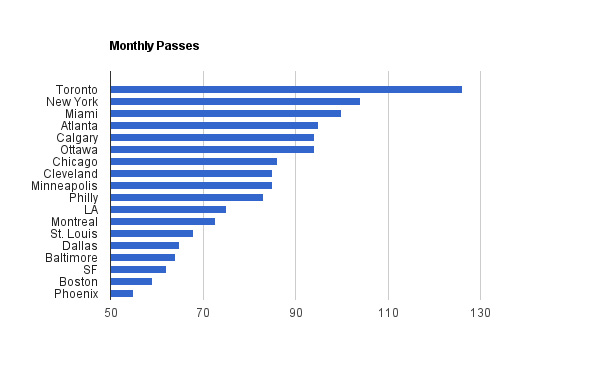
It can be very difficult to peer over the edge of the putative centre of the universe, after all, even in the age of Google. Besides a willingness to acknowledge that other cities actually exist, many assumptions are required to undertake a comparative study of transit fares (see below), and any general comparison will surely skim over some pertinent details. But the question must still be asked — in the afterglow of the latest TTC fare hike, how does Toronto transit stack up when it comes to fares?
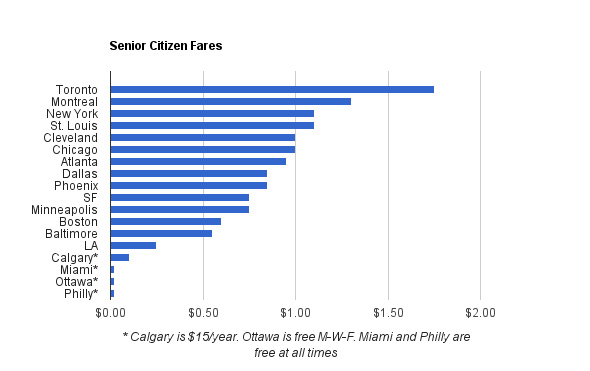
The answer turns out to be an "F," by almost any measure. Although riding the Rocket in Toronto was less expensive than, say, New York as recently as 1990, ever since, the TTC has sat on top of the fare heap. In three of the four most easily compared fare categories for major North American transit systems — the adult base fare, the adult discounted multi-trip fare, the senior reduced fare and adult monthly passes — the TTC comes up as the most costly ride. The sole exception is the adult base fare, where Toronto runs a close second to Ottawa (which says something about public transit funding in Ontario). When measured overall across the categories in question, the TTC is the most expensive single-fare integrated transit system in North America.
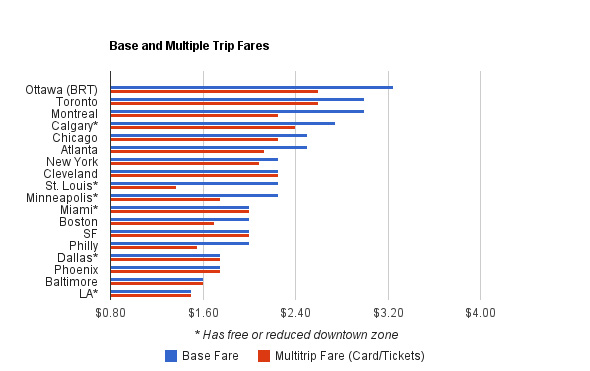
Given that context, is a fare increase for any reason reasonable in Toronto? Or does this show that something else is fundamentally broken on either the cost or revenue side that is driving TTC fares through the roof? There are multiple reasons for the the TTC's monetary woes to be sure — including a lack of provincial funding — but were the comparative position of its fares better represented by the Toronto media and at public meetings, one has to wonder if more pressure could be brought to bear on improving funding and reducing expenses to better protect the farebox. Surely the title of "most expensive transit" is one a striving world-class city would prefer not to keep. Spread the word.
Study Assumptions:
- Most North American transit systems use a single fare within their borders, like the TTC. But there are those which do not, like Washington DC, Pittsburgh, Houston, Denver, Portland, Seattle and Vancouver. It would be apples to oranges to compare these directly with the TTC, since they are both less expensive for close-in residents and more expensive for those in the outer suburbs. Generally speaking, almost all are less costly than the TTC within their city limits, and some even include free fare areas downtown. But for the purpose of this study they have to be excluded.
- Student fares are far too varied in format and age limits to easily compare, but all cities offer some sort of senior fare that is easily compared. Equalizations had to be made for Calgary and Ottawa (see chart).
- Smart farecards are now found systemwide in all cities listed here except Toronto, Cleveland and Philly. But these cities still offer discounted fares in the form of multiple-trip cards or tokens/tickets, which are directly comparable to smartcard discount fares.
- Separate costs for transfers are difficult to equalize. These are now rare in most places and usually waived for smart farecards. They are ignored here for simplicity, though it should be noted they would significantly increase the cost of a single trip in Miami (50 cents) or Philadelphia ($1).
- Where different prices for bus vs subway do still exist, as in Boston or St. Louis, the rail fare was used. For Ottawa the bus price was used as this city's transit is primarily BRT — its small demonstration rail line is actually less expensive to ride but carries only 2% of daily ridership and so is ignored.
- All cities now offer monthly adult passes for bus and subway/LRT. In some cities, such as Philadelphia, these are even good for partial use of the commuter rail lines though this was ignored in the comparison.
- Cities with small transit ridership or nascent rail transit lines were left out of the comparison.
- Exchange rate of par assumed for simplicity. Even at an 85 cent Canadian dollar the results would still hold valid.
Guest contribution from Larry Green.
Photo by Cameron MacMaster in the blogTO Flickr pool


Discussion
99 Comments
Sort By Oldest First / Newest First
Subscribe
we as riders, citizens, taxpayers and voters need to organize and get our funding back - from the province and the feds.
in addition, we need new sources of funding - vrt/congestion anyone?
as well, things such as - zone based fares, timed transfers etc... need to be looked at.
our crap transit system is a dead weight on this city - and it's only getting worse.
where can we begin an organized effort? any groups making any serious moves already? it's time.
2 zones is the equivalent of going from Downtown to Yorkdale.
3 zones is the equivalent of going from Downtown to Vaughan.
http://en.wikipedia.org/wiki/North_America#Countries.2C_territories.2C_and_dependencies
The price for one way trip is three pesos (about $0.25CDN). They also say the real cost is actually nine pesos, about 75 cents.
http://www.metro.df.gob.mx/organismo/costoboleto.html
Ilove Guelph
For those that complain about the TTC prices have obviously never been on the lacklustre public transit systems of its surrounding suburbs... same fare for 30 minute rush hour service and a small number of routes ($3 in Burlington, $2.50 in Waterloo). What needs to happen is Metrolinx needs to take over responsibility of the 400-series highways and all of the transit systems in the GTA and merge them into one. They can control tolling on the 400s and merge routes into ones that make sense for traveling habits.
Also evidently I can't smoke on a subway car, so... you know. I need to start my mornings somehow people.
For another look public transportation, perhaps we should look at what happened in Tokyo.
http://www.theatlanticcities.com/commute/2011/10/why-tokyos-privately-owned-rail-systems-work-so-well/389/
http://toronto.pints.com/display.lasso?choice=2010_ttc
But when you look at the facts and compare the TTC with other transit systems, you can see that is by far the least funded system in the world. Our fares pay for 2/3 the cost of running the TTC, which is insane. For most other cities that figure is less than 1/2, and you actually get a subway system with more than two lines.
Yeah you can drink Ford's cool aid in the Toronto Sun and blame the unions and the gravy. But really, the TTC is probably the most efficient transit system in the continent when you look at how much service they give for the amount of funding it receives.
That statement is a misleading. $100 000 in 2000 is equivalent to almost $122 000 in 2010 dollars. To get a more adequate comparison, you would have to know how many TTC employees made in excess of $82 000 in the year 2000.
The TTC is one big organization and its not even big enough to meet our needs. For years and years it has been scraping by going from government one time cash to more one time cash, no one has addressed the systematic underfunding plaguing the system. Maybe we should spend less money on subway extensions into other god damn cities like the one were building into Vaughn (seriously?) and spend money like that on improving our over crowded existing subway system circa 1954
Where's the comparison of employees wages and benefits?
I have no qualms if a union has been able to keep rages at the levels of inflation throughout the years. If you do the math that TTC Bus drivers wage is near the same as the drivers wages in the 60's. Its our jobs which are in the dumpsters, not the fact that the TTC makes to much. I have no issue with what TTC workers make. Nobody on here can discount the value and importance of the TTC to the lifeblood of the City. The TTC is on the same podium as Police, Fire, garbage, EMS, etc. You take out any of those and the City falls apart instantly.
Why can't people correlate that the majority of the TTCs cash simply just goes into maintenance and keeping things at level of "good", which means that any cutting of anything and you get a third world situation where random things would break and explode.
I went through that list, and there are only 16 collectors on the whole list. Most of those people are engineers, technicians, foremen, and supervisors of departments. Doesn't look all that crazy.
That said, if "operator" means people who drive buses and streetcars, I don't understand why they earn as much as they do.
Some of the people making over $100,000 are senior management or engineers. I certainly don't mind paying someone who designs tracks so I don't die a healthy wage.
Can we not race to the bottom, please?
i don't know about you(well actually i do), but i have no problem with someone who drives a bus and is in charge of and responsible for the safety of thousands of people to be paid well. This remember is someone who has to put up with abusive passengers and assholes daily. They interact with the public much more than any police officer, are assaulted and spat upon, and insulted by complete dickheads like yourself who think they make too much money.
ticket takers? sure, they make too much for what they do, but thats the union pal, they do the best they can for their brotherhood. At least when we finally get automation (in 2045) there will be no more ticket takers and you can take your anger out on someone else.
blaming the union is such a stupid, ignorant, uninformed way to look at the situation. The governments love it though as it deflects any blame away from them (hint: this is who you should be directing your anger towards!)
Much as I am concerned about the poor in this city (and I think that there ought to be a directly targeted TTC subsidy for the poor), the Ontario government has a $16 billion deficit. Increasing TTC subsidies for all riders isn't going to happen in this economy, and service expansion (e.g. finishing the Eglinton subway) is much more of a priority.
You think the TTC is bad now?
Imagine this - $10 fares, subway trains that run every 10 minutes, surface routes that run every half hour at best, dramatically reduced surface network, overcrowding like you've never seen, NO new expansion, NO new vehicles, dingy, dirty stations, deferred maintenance, no night service, no free transfers.
Sound like an absolute wretched shitstorm?
That's privatization for you.
Subsidies:
TTC - 415 million rides at a cost of $0.47/rider
Go Transit - 44 million rides at a cost of $4.71/rider
York Region - 10 million rides at a cost of $2.44/rider
York Region is privately owned, and are on strike for higher wages.
I was wondering how long it would take before the usual suspects start blaming the lack of federal funding or the evil motorists for the TTC's woes.
Why don't we stick to the topic for a change, which is that both the feds and Queen's Park use Toronto as a cash cow. You may bitch and whine that the TTC gets no love, but somebody is paying the $2B or so a year in CAPITAL projects (don't we always seem to forget that pesky capital budget when it comes to grind our favorite axe?)
The TTC rides for free on roads paid for by motorists, by the way. F-U about whether gasoline taxes go to roads or not: the fact is the Province collected $2.6B in gasoline tax last year and only spent $2B on roads in the PROVINCE. Throw in another %50M in net profit for Green P and parking tickets, $70M registered motorists in the city pay for licensing (sure, to the Province, but we still pay it.)
W.K. - this thread was doing fine arguing the points of TTC funding, but you're never going to learn that bashing the evil motorist is only preaching to the choir around here and won't win you any converts.
I'm all for improving the TTC, but one big fact not mentioned in this 'research piece' is that 70% of the folks in the city drive, only 22% take the TTC, yet the TTC already sucks up 60% of the funding. (Look it up - I have too many times to bother again. Don't forget that pesky CAPITAL budget, though!)
I’m just glad I have a car.
Being able to work 30h overtime that often is also a symptom of something wrong.
Toronto doesn't want people to use public transportation, instead get a car and pay more for gas and as always insurance
Yes, costs have to be reasonable but imagine reducing the reliance of the farebox for funding to match the government funding for other metro systems? Would that address all the issues facing the TTC?
This leads to a national transit strategy. Without one, the federal government will only do its share by doing one-off investments. Of course, funding a national transit strategy will require budget re-allocation given there's no way the federal government will borrow to fund transit.
Once you do, however, PLEASE promise me and everybody else that you stay there, and don't ever come back.
that genuinely how to do blogging and site-building.
Normand