Saturday, May 26, 2012Mostly Cloudy 22°C
City

The LEED building boom in Toronto

Posted by Matthew Harris / October 2, 2010

222 Jarvis Street LEED BuildingSustainable building practices are a hot topic in Toronto right now. When Christopher Hume brought together four of the city's most prominent architects for a roundtable discussion about architecture in Toronto, they disagreed on many things, bur the one thing they all agreed on was the increasing importance of the issue of sustainability: "there was unanimous consent that sustainability has become an issue no builder can ignore." And LEED (Leadership in Energy and Environmental Design) has become the accepted measure of sustainability in the building industry.

But what exactly is LEED? And is it the best way to measure sustainability?

Begun in 1998 by the U.S. Green Building Council (USGBC) - a non-profit organization dedicated to promoting sustainability in building practices - LEED aims to codify sustainability in a list of practical considerations. These criteria are captured under five categories: improved energy efficiency, water efficiency, site sustainability, materials selection and indoor environment quality. New criteria are reviewed and voted on by the 20,000 members of the USGBC. A similar, Canadian version of LEED is adapted for the Canadian market by the Canadian Green Building Council.
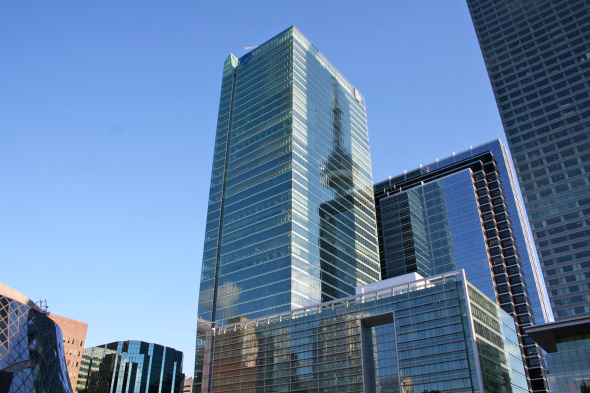
20101002 RBC CentreAfter a building is built or refurbished, it can apply for LEED certification. Upon an independent audit of the building, it can be awarded certification, silver, gold or platinum status due to the number of criteria it has achieved. Since its inception, thousands of projects across North America have achieved some form of LEED certification.
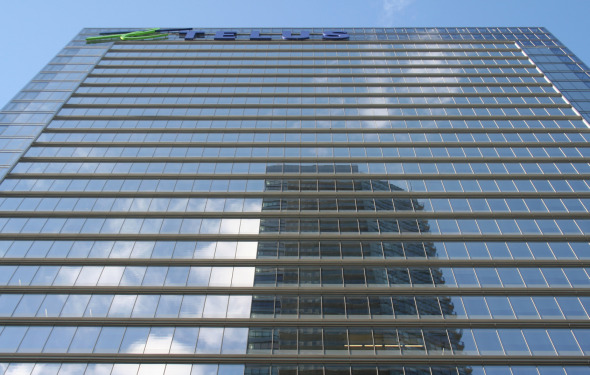
Telus HouseToronto started late to the LEED game, but since then, many LEED-certified buildings have been built, and many more are planned. One of the most recent, Telus House, is aiming for LEED Gold Certification. It has an energy efficient heating and cooling system, recycles the water for its washrooms, and uses auto-dimming to reduce light consumption.

In fact, as the architects in the Hume piece suggested, LEED has become an almost de facto essential for marquee new office construction: along with Telus House, the RBC Centre and the Bay Adelaide Centre received or are working toward LEED Gold certification. First Canadian Place is also working toward LEED certification as part of its cladding replacement. And beyond commericial office construction, the number of buildings in the process of pursuing LEED certification is growing: RCMI Residences, 60 Richmond Street East housing co-op, Minto Midtown, M5V Condominium, 222 Jarvis Street, etc. Nearly 1,000 buildings are registered with the Canadian Green Building Council, and a third of them are located in Ontario.

And therein lies part of the problem with LEED, according to Daniel Brook, a journalist at Slate. In an article he wrote for the site, he pointed out some of LEED's weaknesses, including its use as a marketing tool rather than an ethos of sustainable building practices. He argues that since builders can opt for a limited number of criteria to achieve some LEED certification, they can aim for less costly additions (such as adding bike racks) and ignore more substantial and important additions (such as increasing the building's overall energy efficiency).
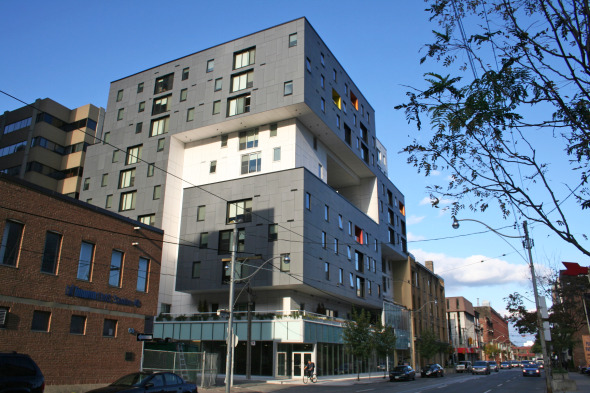
60 Richmond Street EastSome of the loopholes he pointed out in his article have been addressed by more recent updates to LEED's standards, but the inherent problem with checklists remains: a builder can follow the law of the checklist, but ignore the spirit of sustainable building practices - for instance, by including large parking structures in a LEED building. Moreover, by making energy efficiency standards optional, many buildings continue to be built that aren't energy efficient.
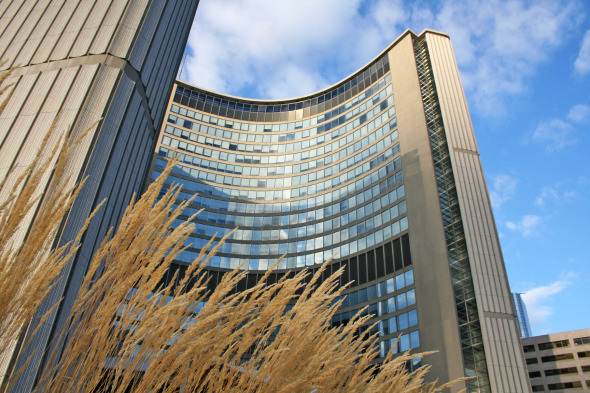
City HallToronto aims to get around this issue with its new Green Standard. As of January 31, 2010, all buildings in Toronto must meet Tier 1 of the Green Standard - this includes the provision that all new multi-unit residential buildings must include green roofs. As a further incentive, any project that meets both Tier 1 and Tier 2 of the Green Standard will have 20% taken off their development charges. Since the Green Standard is different than LEED, it is technically possible for a building to meet one checklist and not the other. However, since many of the practices are shared, a builder working toward sustainability under one system will likely try to meet it under the other.

But the increasing mass of certification and bureaucracy highlights the central problem of encouraging sustainability: with no standard guidelines of what constitutes sustainability, there is no way to enforce it that is loophole-proof. LEED and Toronto's Green Standard represent first steps toward a new way of thinking about building. But because of this, they have much that is controversial, even when the spirit is in the right place.

What do you think of LEED and Toronto's Green Standard? Do you think there are more effective ways to encourage sustainable building practices?

Discussion

18 Comments

Jason Manikel / October 2, 2010 at 09:51 am
user-pic
Despite its faults, the LEED rating system has done more than anything/anyone else at shifting our market towards green buildings. No, it's not perfect. But LEED Canada 2009 *is* better; in particular, it includes a heavier weighting on what most people consider the most important building-related environmental topics - energy and water consumption.

It's true that a building can achieve LEED certification without being particularly energy efficient, so watch for the Gold- and Platinum-rated buildings. It's very difficult to target those levels of certification without going beyond standard energy and water practice. Certified- and Silver-level buildings are quickly becoming understood as not much higher performing than current standard practice.

As for the Toronto Green Standard, its minimum level of energy performance is no higher than LEED's.
snowy / October 2, 2010 at 10:25 am
user-pic
For commercial office buildings LEED is definitely the new baseline, which ain't a bad thing even if they're just trying to match the competition - I'd much rather work at 18 York and be able to open windows and not have offgassy new-building-smell for a year than in my crappy midtown office building. But not all building types are the same, many institutional projects designed by good to decent architects would achieve LEED certified without even trying, and are going after the more important credits and considering maintenance and occupants rather than just "bike racks will get me closer to certified!" And I find that many clients (unless their municipality or a university mandate or something requires them to target certain levels) now want to "track LEED silver/gold/whatever" without actually seeking certification - some clients want to do the right thing rather than get a plaque.

Anyway I'll echo Jason above. The standard is changing: LEED 2009 is trying to address the issue of bike racks being equivalent to an expensive high-performing envelope.
Jo / October 2, 2010 at 11:29 am
user-pic

There are actually lots of simple steps that can be taken to at least GREATLY reduce the urban-heat island' effect in developed areas...Though they might not have the same PR pull as the "LEEDS" label...


http://environauts.wordpress.com/2010/01/27/creeping-green


Jo
Jo / October 2, 2010 at 11:37 am
user-pic

I forgot to mention, that there also seem to be some loopholes for Property Developers to exploit when it comes to the new requirements for building "Greenroofs"...

http://wp.me/pIeK3-8L


Jo
Graeme / October 2, 2010 at 12:05 pm
user-pic
LEED actually requires a 25% reduction in energy consumption when compared to a 'standard' building for even the lowest level of accreditation as a pre-requisite. So by definition all LEED buildings should be at least 25% more efficient. However, the 'standard' building they are compared to is based on the Model National Energy Code for Buildings, which was published by Natural Resources Canada in 1997. I think the real culprit here is the Federal and Provincial governments of Canada for doing nothing to update building energy codes.
Jason V / October 2, 2010 at 12:39 pm
user-pic
Who took the photos? Or are they CGI? Or Google Earth? I can't tell. Shouldn't they have a credit, either way?
Matthew Harris replying to a comment from Jason V / October 2, 2010 at 01:17 pm
user-pic
I took the photos. We generally don't provide a photo credit unless the photos were taken by someone other than the author.
Jason V / October 2, 2010 at 01:21 pm
user-pic
Wow, that explains it. I noticed your photos from previous posts had a similar style, but still wasn't quite certain if these were real. This particular set looks more surreal (or super-real) than HDR, IMHO. Actually, they look pretty cool indeed - good work! Props for taking your own photos, and thanks for the followup!
W. K. Lis / October 2, 2010 at 01:43 pm
user-pic
A "green" building surrounded by a parking lot or garage is not very "green" in my books. But, seeing how LEED was started by a US-based organization, I can see why parking and the building access and surrounding was ignored or not considered.
kenchikuka / October 2, 2010 at 02:36 pm
user-pic
This was a very refreshing article from BlogTO. Well written, non-opinionated and provided external information unlike most articles recently. It also doesn't intensively polarize the discussion in the comment section.

LEED is only a decade old and still developing. Who knows, maybe in a couple of years it will become a standard here in Toronto. 50 or so years ago the building code was not heavily enforced compared today.

I think some people are getting the wrong impression about LEED. It is optional and not required to all construction. I would definitely agree with some of the comments that most constructions are aiming for minimum accreditation but to achieve platinum rating is really intimidating and difficult.

@W.K. Lis: I'm not sure where you are getting your information but in LEED sustainable sites credit category, promotion of alternative transportation is heavily credited. Cars are not going away but LEED does encourage accessible parking for electric or fuel efficient cars or sustainable tranportation. Parking-lot is more of a building code requirement.

W. K. Lis / October 2, 2010 at 04:56 pm
user-pic
@kenchikuka: The key word I should have used was "surrounded". Having a parking lost or garage out of sight, with the building fronting the sidewalk (hopefully) would be better. Having a parking lot surrounding a building creates an obstacle course for pedestrians to reach the building, and does not present itself well. And I don't meant a building sitting in a "park", because the "park" would not be used.
Paul / October 2, 2010 at 05:06 pm
user-pic
@W. K. Lis

LEED for New Construction is meant to rate a building, not the walkability of the comunity.

LEED for Neighbourhood Developments gives credit for locating parking out of sight.
mark. / October 2, 2010 at 06:13 pm
user-pic
Funny, I was just going to point out LEED-ND (Neighbourhood Development), which is being promoted by Andres Duany and his firm. I think LEED is pretty good, but weird that a building can get LEED certification when it's in the middle of nowhere and everyone has to drive to it.
ZAPPA / October 2, 2010 at 08:54 pm
user-pic
Tell me another joke. Like M5V is a Leed certified building but is using floors and countertops from Brazil. The countertop stones called "ubatuba" a native tribe from Sao Paulo are most of the time extracted illegaly from protected areas back there.
So yes, green here but brown somewhere else.!
ZAPPA / October 2, 2010 at 09:02 pm
user-pic
...and here a paper about the extraction of stone in Brazil.

http://www.iaeg.info/iaeg2006/PAPERS/IAEG_146.PDF
3.0 / October 2, 2010 at 10:59 pm
user-pic
Tent cities for the homeless should be rated LEED Infinitum.
Green buildings market / October 4, 2010 at 02:59 am
user-pic
Conscientous measure have to be taken to consider new development for energy saving concepts and devices before the maintenance costs of the buildings causing an ultimate decline in their condo investment value on the real estate market place.

Car Servicing Leeds / March 7, 2012 at 06:16 pm
user-pic
great blog keep it up

Add a Comment

Other Cities: VancouverMontreal