City
A brief history of Toronto's high-speed TurboTrain
Head down to Union Station or Billy Bishop airport today, book a ticket to Montreal, and you're likely looking at an $80 to $250 ticket. A Via Rail train, according to the company's website, takes about six hours to make the trip from Union to Central Station while an airplane can cover the same distance in just over an hour - two if you factor in check-in, boarding, and other necessities.
Right now, train journeys between the two largest cities in the Windsor-Quebec City Corridor take just as long as the road, and provide few savings or incentives for people to ditch their wheels; free wi-fi and a snack service is about as good as it gets.
It could have been so different - in 1968, CN Rail debuted the TurboTrain, a monster of a locomotive capable of making the journey between Toronto and Montreal in just two hours, a third of the time it takes today. Looking like rudolph the red-nosed reindeer on steroids in its CN livery, the TurboTrain was poised to make Canada a global leader in rapid transit.
Unfortunately, as you might suspect, things didn't entirely go to plan.
The TurboTrain - or simply "Turbo" as it was called in early promotional material - was built by Montreal Locomotive Works and operated by Canadian National at a time when countries like Japan and France, now leaders in high-speed rail, were planning or tweaking their fledgling services.
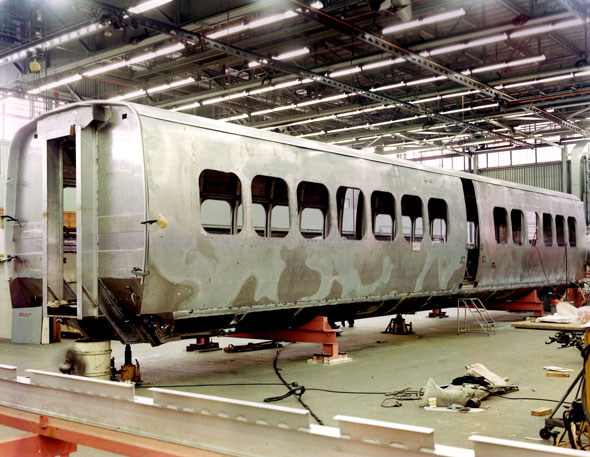
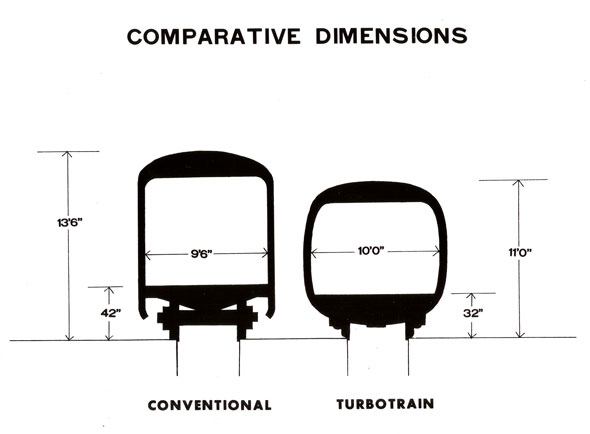
Built like an aircraft, the TurboTrain was the first of its kind in North America to utilize aluminum alloy and proper streamlining. The large, distinctive nose-cones on the front and rear "power domes" were designed to slice through the air while recessed doors and windows created less drag. In total, each seven-car unit weighed just 185 tons, a third less than diesel trains of the time.
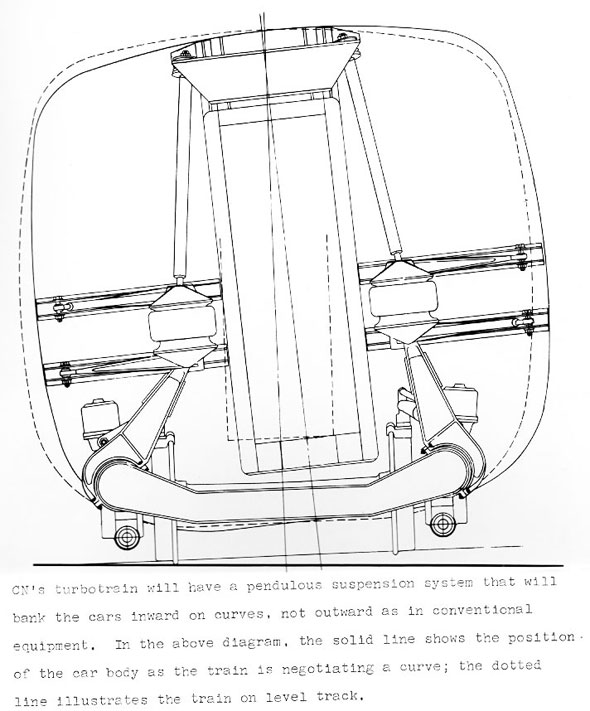
Unlike Via's present fleet, passenger doors were in the middle of each car. The semipermanently-connected carriages shared special wheel sets at the coupling point that allowed the train to lean into bends - counter to centrifugal force - for faster cornering without nauseated passengers.
Each power dome had five 400-horsepower Pratt & Whitney Canada PT6 gas turbine engines. Four were used to power the locomotive, one provided electricity for the interior. On the test track, the TurboTrain was capable of 274 km/h but in service it would often only be allowed to reach half that.
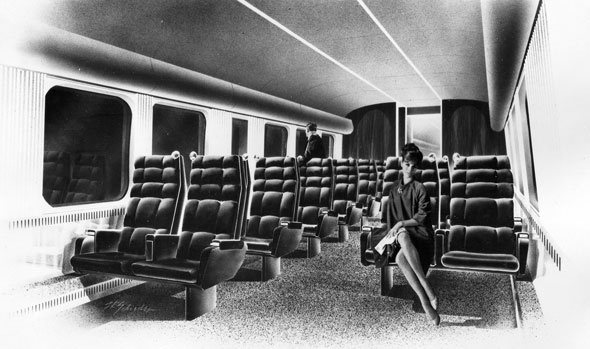
Though speed was the TurboTrain's raison d'être, the new service aimed to provide top-notch customer service, too. The insulated and pressurized carriages shut out external noise and, according to a promotional video, the interior was lined with hand-spun fabrics.
The video makes a point of highlighting the train's "young and exciting" (and apparently all-female) hosts. The girls, all of them in their 20s, wore one of three uniforms during the Toronto to Montreal run. A red knee-length trenchcoat and white beret, a white blazer and matching skirt, or a black pantsuit for evening meal service. The duds were also "easy and elegant," according to the voiceover.
The "TurboClub" cabin in the dome at the front and rear parts of the train was where the real luxury was to be found. Suited businessmen quaffed cocktails and chowed down on filet mignon, veal cordon bleu, roast tenderloin of beef, coq au vin, and Cornish game hen with a panoramic view of the surrounding countryside and passing towns.
The proletarians in the rest of the train had to make do with microwaved snacks from the catering car where, the excited promo boasts, "hot food specialties [are prepared] in a matter of seconds!" The menu was, apparently, "tested in experimental food labs" but looked suspiciously like airplane food.
During the TurboTrain's inaugural run from Toronto to Montreal in 1968, while packed with reporters, the locomotive struck a meat van at a level crossing near Kingston. Although no-one was injured and the train suffered only superficial damage, this was to be the first bump in a series of issues for the new service.
Soon after clocking a Canadian record 226 km/h near Gananoque, Ontario, the original TurboTrains began to suffer from technical problems. The brakes froze in winter and the engine exhaust spat soot over the roof windows. In 1971, the erratic service was halted altogether while CN went back to the test track.
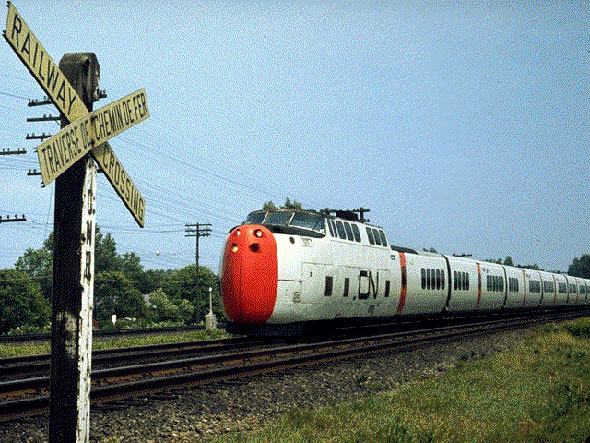
In June 1973, the service returned with longer, nine-car trainsets. Spare power domes and passenger carriages were made into two, four-car trains and sold to the U.S., where Amtrak operated the same model of train. Before either could be delivered, one of the units had to be written off after sideswiping a freight train in testing. As a result the purchase of the remaining unit fell through and the vehicles sat idle until a fire damaged one of the primary fleet in 1975.
In 1978, the trains were transferred to Via Rail, the company created to take over CN's passenger operations. Crucially, control of the track itself remained with CN. Without the necessary authority, the Via-branded TurboTrains had to yield to slow-moving freight trains at every opportunity - a problem that persists to this day.
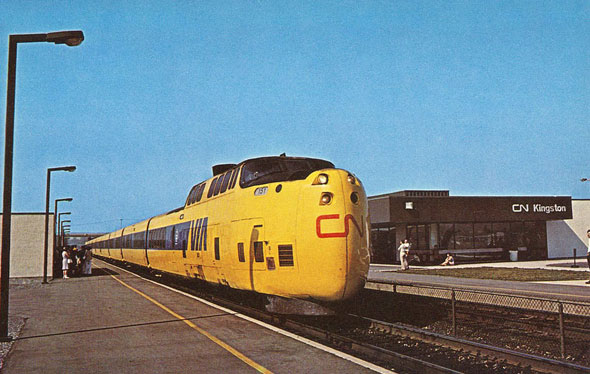
Level crossings, as I outlined earlier, were also a problem for high-speed locomotives on the line. Without a dedicated passenger track for non-stop, full-speed service, trains had to slow down significantly to ensure a safe passage through intersections with the road, adding crucial minutes to the travel time. The trains sometimes had to stop completely to navigate CN freight services.
In fewer than twenty years after its introduction in Canada, the TurboTrain was withdrawn from service entirely, replaced by the hideous diesel LRC locomotives of the 1980s. As if to deliberately erase the rapid-rail experiment, all of the remaining trainsets were scrapped, with none retained for posterity.
Though it eventually outran its technical issues - reaching 97 percent availability over its lifetime - still nothing travels near the speed of the TurboTrain on Canadian rails today.
Images: Igor I. Sikorsky Historical Archives Inc., public domain, and Wikimedia Commons.


Discussion
42 Comments
Sort By Oldest First / Newest First
Subscribe
The only problem with implementing it on the Windsor-Quebec City run would be organizations like the Clean Air Coalition wanting electric trains and ONLY electric trains to be used; but I believe that if just 40 JetTrain set were purchased and made to run the Windsor-Quebec City corridor, we'd have high-speed train service on par with that of Japan, France, and China.
BTW, you can always buy a replica TurboTrain set from Rapido Trains (http://www.rapidotrains.com/turbo.html) and enjoy what it would have been like to travel on one.
a) Via Rail trains can do the Montreal-Toronto route in 4 hours 40 minutes today (they do so every day on the 5PM express trains from either terminus and in just under 5 hours on two other more express-like service during the day). Still not 'high speed' but better than the 6 hours quoted in your article that is used to argue there is no incentive versus private car travel times
b) I highly doubt the figure that the journey between Montreal and Toronto could be done in just two hours, at least in revenue service. 268km/hr service is a maximum speed, which cannot be achieved at startup and the end of the trip, nor near intermediate stations which would be required (ottawa and possibly kingston). Even the latest high-speed rail study (EcoTrain report) estimates that a 300km/hr electric service (a la TGV) would require 2 hours 47 minutes [see page S-7 of the report http://www.mto.gov.on.ca/english/pubs/high-speed-rail/final-report/P020563-1300-001-EN-01.pdf]
but other than that, very interesting to learn more about such a promising program that unfortunately never came into its own. sad.
One other thing about the building of electric HSR lines: how are we going to power them, and with what?
According to the first video, the power domes each have two gas turbines, not five quoted in the article.
According to the first video, the Turbo could make the trip between Montreal and Toronto in 3:59, not 2 hours quoted in the article.
Cool article, but did you even watch the video, Chris Bateman?
If you want to keep your force vectors straight (and the physics sticklers happy) swap in "centripetal" for "centrifugal" in paragraph 6.
Wiki explains it better than I can: http://en.wikipedia.org/wiki/Centrifugal_force
The film is called 3:59 for 3 hours and 59 minutes, not the 2 hours stated in the story.
a dedicated line would have to be built, straight and long radius curves, with all points having right of way access (no level crossings), and any freight that would travel on the line would have to be intermodal, and run on trains being serviced in stations like that of the euro star..
france has snowy seasons like us, so their wheel technology could be adapted, along with de-icing fluid to help at higher speeds.
a good business partnership would be bombardier and virgin trains, who maybe would help subsidize the building and running (with exclusivity of course)..
a 330-375kph train service is what is needed
In practice 3:59 is the fastest they can go without major changes because of level crossings. At present the sensors that close the gates on a level crossing are only 1/4 mile back from the crossing. At 100mph/160kph that means there are only 9 seconds between the lights starting to flash and the train hitting the crossing. They actually run at this speed though rural areas. The Renaissance trainsets are actually capable of going faster but it's not considered safe.
There are somewhere near 600 level crossings between Toronto and Montreal. The first one happens before the tracks leave the Toronto borders at Military trail in Scarborough.
By all means if a private company wants to fund and build a HSR link along the windsor-quebec corridor, all power to them. That doesnt mean we should hand over all public transit to private interests.
Too bad nobody ever thought of having the GO service be just an early version of light rail with long streetcars instead of big diesels; imagine what that would be like?
I am Nathan, and webmaster for CRO (Canadian Railway Observations) We got the link for your article, and we were wondering, if we could turn your article in to a special report. If you could email me back with the okay to do so, as we would like to feature it mid October in-conjunction with our CRO October Issue that comes out the 1st of the month
I have taken the bus, flow, driven and taken the train to Montreal and by far my favourite is the train but the issue is the cost. With sales it can be just a few dollars extra to fly vs. taking the train but the train brings you right downtown vs. having to take a bus from the Montreal airport to downtown (assuming you are flying with porter and don't also have to get out to Pearson).
I would like to see the government subsidize rail development and take people off the roads by creating more "options".
That would be VERY bad news for Toronto, because this is a piece of infrastructure which is about 30 years overdue.
Get it up and running now with diesel, and then convert to electricity. It seems like a reasonable enough compromise to me, and seems vastly preferable to having no airport train at all, which I fear is where this may go if the CTC gets its way.
Anyhow...on to the main subject of this article...)
HSR is a pipe dream for Canada. I believe that this is so for three reasons:
1) As the article makes clear, we don't have dedicated passenger tracks. What we have is infrastructure that was designed mostly in the 19th century, when level crossings weren't a concern at all because cars didn't exist yet. Without dedicated tracks, even early high-speed technology like the Turbo was doomed to failure. Deploying more reliable technology would be pointless because our rail infrastructure doesn't support it.
2) Europe and Asia can build these things because they have the population density to support such services. Canada's geography and demographics could not be more different. Even in the Quebec City-Windsor corridor, we have a few population clusters spread out over a massive distance. That makes any railway expensive to build and operate, and that's before you even talk about climate, level crossings, or other factors.
3) Trains like the TGV and the Shinkansen were built with MASSIVE public expenditure. The debt which the old Japan National Railways built up in order to build the Shinkansen pretty much bankrupted that company and led to its breakup. In France, the TGV has been state-owned and state-operated right from the beginning, and has been built with public money. SNCF and the French infrastucture operator both have heavy debts, and new TGV lines are costing something line 20 million euros per kilometer (!!!!) to build.
I love high-tech, high-speed trains as much as the next guy, but high-speed rail in Canada has all the makings of a great, big, fat, slobbering white elephant.
As for the subject of the article: I support electric HSR transit wholeheartedly, but the building of said networks nationally might not be seen as profitable, so to test the waters first on this endeavor, I think the the federal government should just get VIA to do what CN did back in the late '60's and just use the already available technology we have now-and that tech is (for better or worse) JetTrain.
I did not say that High Speed Rail was absolutely impossible in Canada. What I said was that, for geographic and demographic reasons, it would be extremely technically challenging and extremely expensive. Every report on this subject (including the recent one by EcoTrain) suggests that I'm right. If there is a counter-argument to that point, lets hear it. Personally, I happen to believe that megaprojects that will saddle our grandchildren with debt should not be entered into lightly.
The history of Canadian railways is instructive here. Many of the grand old lines of the industry (like the Canadian Pacific, the Grand Trunk, the National Transcontinental, the Canadian Northern) were built with government money, either directly through subsidies or indirectly through things like government land grants and low-interest/interest-free loans. These things often don't get built by themselves, even when private companies build them. It is usually the taxpayer that funds it one way or another, and, in many cases, ends up bailing them out when the debts become too big, markets shift, and they are no longer economically viable. (See under CN, VIA, Amtrak, and Conrail.)
Yes, some railroads make money today, but only the freight railroads. There was a stampede for the exits of the passenger-rail business in Canada and the United States after World War II, and the private sector has shown no interest in it since. Passenger rail in North America only lives on today as a state-subsidized or state-owned public service.
So what this history says to me is: if you want high-speed rail in Canada, the taxpayers will pay through the ears, throats, and noses for it. No one else will build it. One may think that is a good or a bad thing, but that is realistically what we are looking at.
I don't think it is too much to ask that we be honest about what a project like this would really mean for Canada. Lets soberly ask ourselves whether we really are prepared to shoulder the costs, and whether we think it would be worth it.
Finally, a minor picky point: Canada's first transcontinental railway was not built two hundred years ago. The Canadian Pacific Railway started transcontinental service in 1886, 126 years ago. And by the way, the CPR is no longer a transcontinental railway (as in, it longer serves Canada's east coast). Why not?...Because it wasn't making any money, and so it has refocused on the markets where it does.
You just can't escape the numbers. Dream as big as you like. Just remember that someone eventually has to wake up and pay the bills.
Cheers,
Boingy
As I said in an earlier comment, I don't think that electrification should hold up the opening of the Air Rail Link, but I do think that it should happen on a firm timetable.
Oh, they DID think of it. "GO ALRT." Studied the hell out of it, even had a UTDC train developed for it. Canceled it in the 80s.
There's never any shortage of good ideas in this city. There's just not enough follow-through.
@Ratpick; thanks for the heads-up about GO ALRT; I now wish that would be what GO Transit is now than what we have.
1) That "people of Georgetown" argument doesn't cut much ice with me, I'm afraid. (Actually, it is mainly the people of Weston who are making this argument--Georgetown is well to the west of where the ARL will run, but that's a quibble.) The people complaining the loudest about this project live next to a rail line that has been there and has been operational since the mid-19th century. No one built that rail line through densely-populated residential districts. It was the other way around, I'm afraid.
This is what I find so frustrating about CTC's argument. Are we just supposed to ignore the pressing needs of a rapidly growing city because certain people decided to live next to a very old but very busy rail line?
Sorry, but the fact that one bought a house near a working rail line doesn't give one a veto over the infrastructure needs of a city of 2.6 million people and a metro area of about 6 million. If anything, that is the "Screw You I've Got Mine" factor here. The rest of the city needs that airport train, and it needs it now.
2) However...I don't think that the problem is insoluble. Electrifying is the better way to go, but not in the short term because (as Craig has pointed out) it will mean an unacceptable delay to a project that is RIDICULOUSLY overdue.
If you look back at my comments, you will see that I did not say "don't electrify". I said "open it, then electrify it". In fact, hasn't Metrolinx has committed to doing exactly that? As long as that happens on a firm timetable, I don't see why diesel operations aren't an acceptable temporary solution just so we can get the damn thing up and running with no further delays.
No one is getting 100% of what they want. That's why they call it "compromise".
3) The Jet Train....meh, I don't know. Isn't that pretty much dead technology? Even the Wikipedia link that you provided says that Bombardier has pretty much given up on it. They're not even marketing it any more.
And with respect to that pilot project that you suggest, you seem to be assuming that you could just run a Jet Train on existing rail infrastructure. You couldn't. As the main article and my own comments noted above, the current rail infrastructure simply wasn't designed for trains that can move as fast as the Jet Train can. There are far, far too many level crossings on existing CN, CP, Metrolinx and VIA-owned lines for it to be even remotely safe to operate something like a Jet Train on them.
You have to either build a lot of brand-new dedicated tracks or make a lot of modifications to existing ones, even for a pilot project. Otherwise, you are creating a 500-km-long death trap. How much would it cost to run a Jet Train safely? I don't know, but I'm willing to bet that it would reach into the billions in a hurry, even just to build it between Toronto and Montreal (and billions more to extend it to places like Quebec City and Windsor). All of this with no guarantee whatsoever that it would be a success.
So we're back to my original point. High-speed rail, even as a pilot project, would come with a HUGE price tag and HUGE risks. We've got to be realistic about that. That's all I'm saying.
Respectfully,
Boingy
As for what the CTC wants; it's they that live in this corridor now, and they call the shots, not the idiots that came up with Blue 22 or who run Metrolinx.
I was going to respond to each of your points........but you know what, Spike? It is starting to feel pretty pointless.
I have gone to great lengths to be respectful in both my tone and in my choice of language. And what do you keep coming back with? Childish insults and ridiculous personal attacks about my brain and all sorts of other incomprehensible nonsense. This is getting tiresome.
You may think that you are ripping my argument apart with your searing wit, my friend, but you are just coming across as a tiresome jerk who can't make his point without shouting it.
Too bad, because this was an interesting article and this started out as an interesting discussion thread. But it no longer is, so I'm out. I have unchecked the box that says "email me when someone replies to this comment", and I will not be looking back in.
I have better ways to waste my time.
Boingy
Spike, you were going along okay but then you lost me (and, I suspect, a lot of others). "People like you"? What an idiotic thing to say to someone. Chill the fuck out and grow the fuck up. Thanks.