City
This is what an urban headache looks like
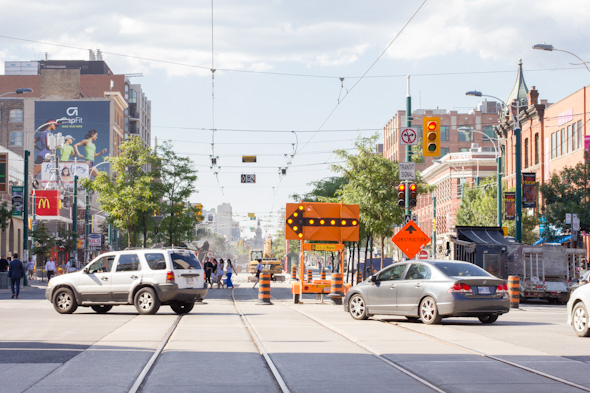
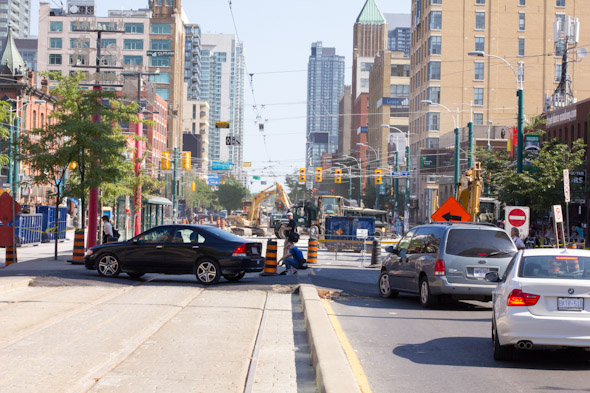
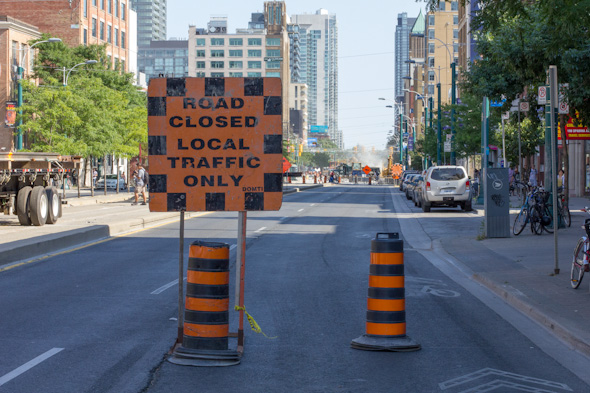
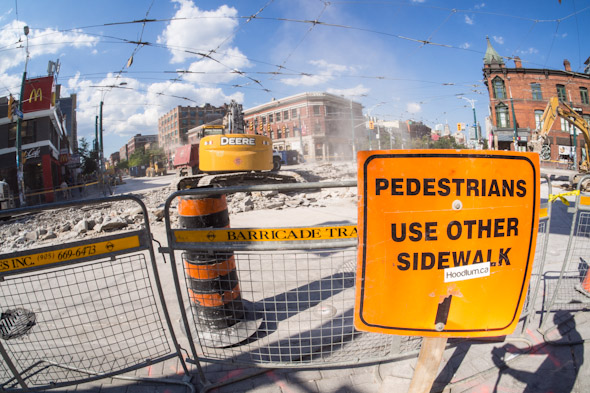
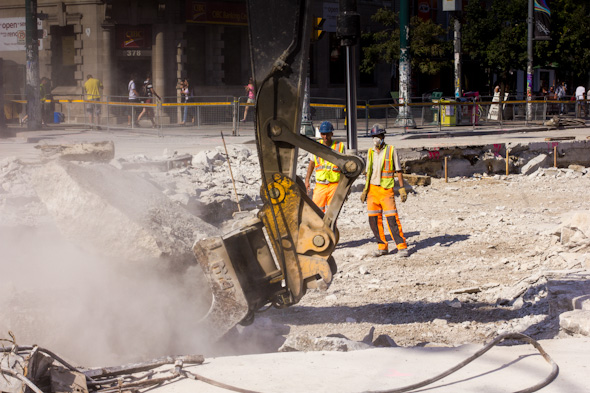
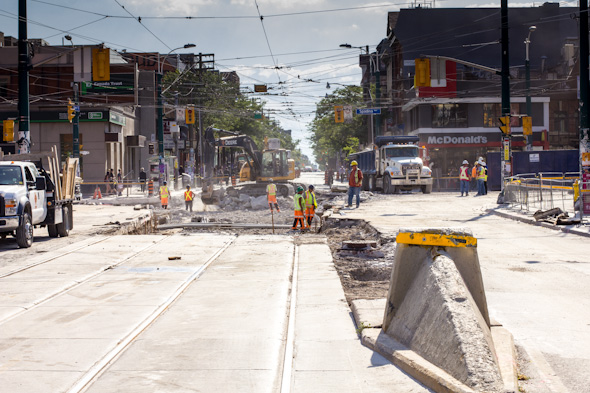
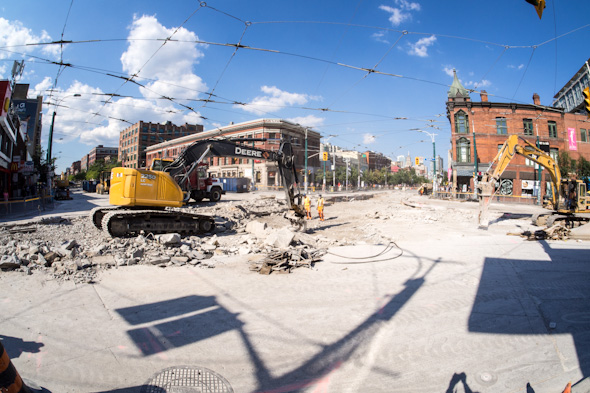
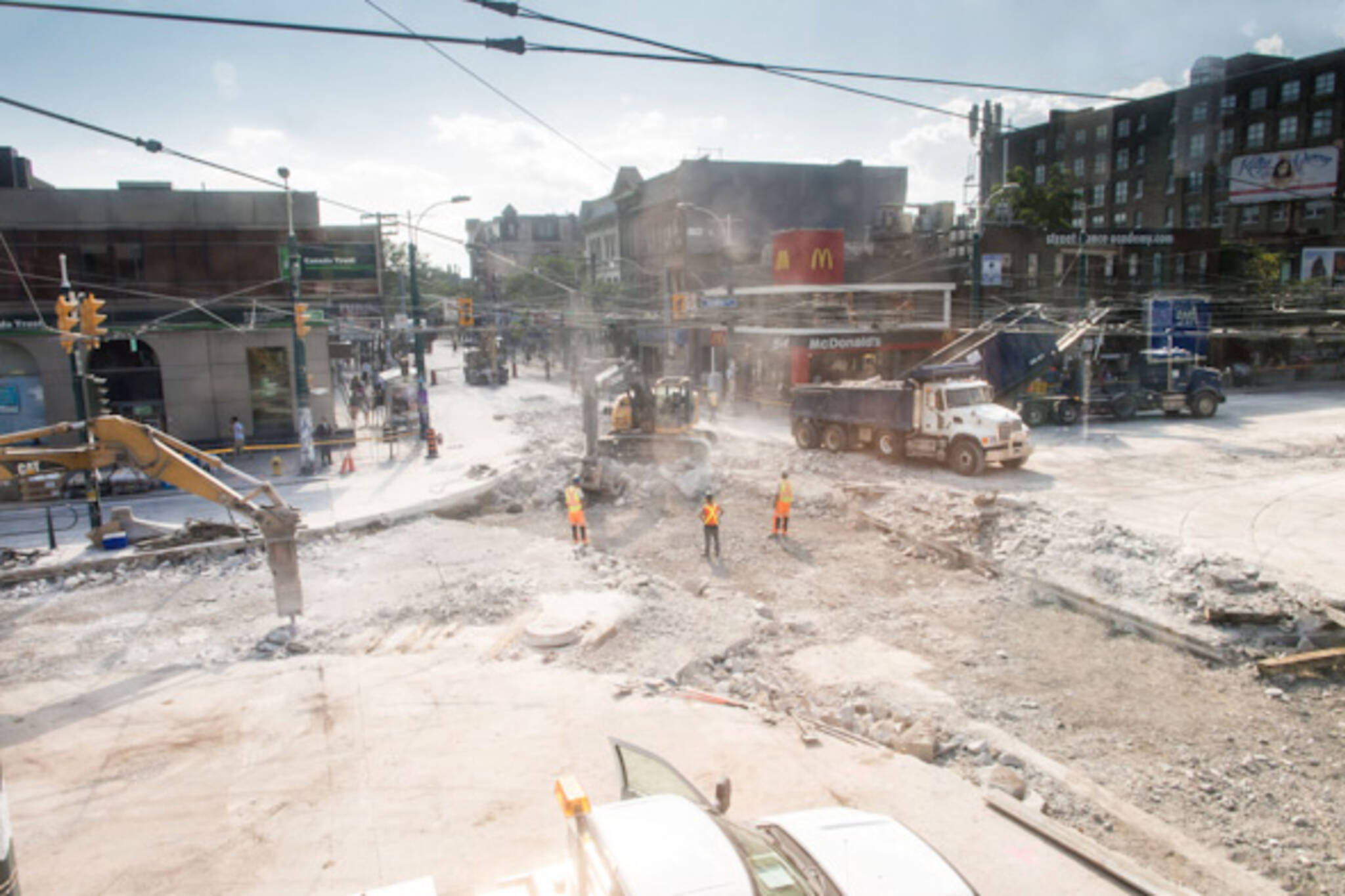
Along with the weather, Toronto folk tend to make a bit too big a deal out of the various construction projects that sweep through the city in the summer months. Nevertheless, once in a while we do get roadwork worth talking about, as is the case with the recent shutdown of Queen and Spadina for TTC track reconstruction and passenger island replacement. A so-called grand union intersection, the shutdown has had at least as much impact on streetcar traffic as it has on other vehicles.
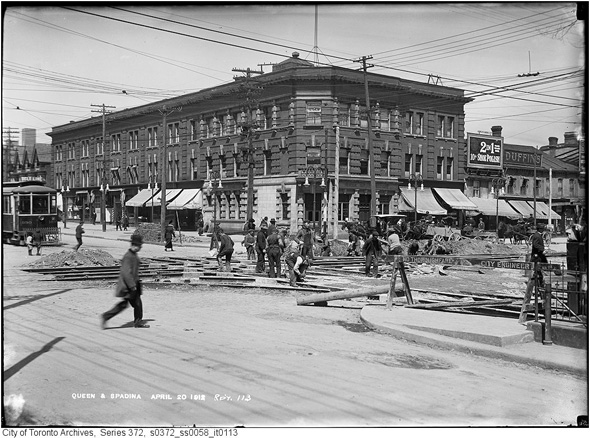
This has been a crucial downtown intersection for over a century with a history of track reconstruction every 25 or 30 year or so. So you'd think it'd be a complete disaster when it gets shutdown for two weeks. I suppose everyone has their own definition of what constitutes a traffic nightmare, but based on a few visits since work started things could be a lot worse. Sure, Bathurst is taking lots of overflow and gets backed up during rush hour, but all things considered, the closure has been well organized and most drivers have got word to avoid the area. There's even a handy TTC video explainer about the construction and diversions.
So while the spectacle of track replacement is certainly photo worthy, the closure is more of an inconvenience than anything else. Not a migraine — just a headache.
More construction porn:
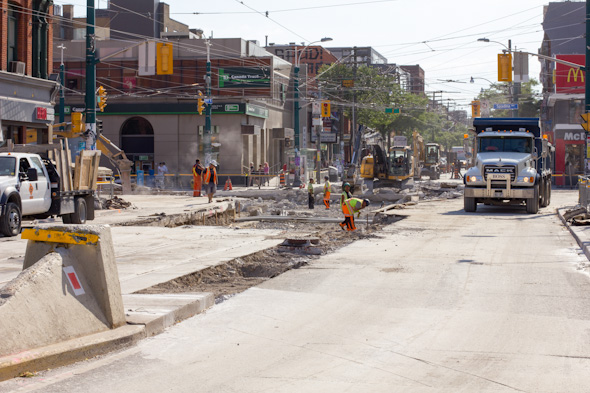


Contemporary photos by Jimmy Lu. Toronto Archives photo from 1912.


Discussion
62 Comments
Sort By Oldest First / Newest First
Subscribe
If people can't stand the disruption of the tracks being fixed, they're welcome either to move to a part of Toronto without streetcars, or they can move out of Toronto, period. The latter would be the best part for me, and I suspect, for everybody else tired of whiny bullshit about the TTC and Toronto.
The return of The Spadia Bus!
http://www.youtube.com/watch?v=lXy7LszpIDc&feature=youtu.be
Construction should be like ripping a bandaid off. The faster it is, the less it hurts overall.
while I don't agree that it should be 24 hours a day, I do agree that the construction needs to quick. After looking at what happened on Roncesvalles, it's clear that a short but intense construction season does much less damage than a long term, slow moving headache.
Let's not complain people, we're progressing as a city. At least you're seeing your tax dollars going to work, instead of it going to those politicians catered food for lunch.
With all those condos popping out downtown, the need for better transit underground is overdue as the population density in the area is expanding quickly.. There aren't enough streetcars just on Queen Street to handle public transit properly anymore. Time for a change - more subways!
As a person who has lived in and around this city since 1971, I can tell you I rarely see a streetcar with 60 people in it. Very rare, indeed. In fact, now that my daily drive avoids Bathurst/King and involves King/Parliament, I get to see an entirely new horror in the city: You simply cannot avoid the streetcar. There is no streetcar service on Church or Parliament, yet the hulking behemoths lurk on those streets, parked and waiting to lurch in front of unsuspecting motorists trying to squeeze around them. I've seen stupid tourists (can tell by their license plates) waiting beside the 80,000 lb train, waiting for it to open its doors.
Streetcars are a menace. More so because the 90% in Ontario who don't live in downtown Toronto don't know how to behave around them. That includes pedestrians, BTW. Try as I might, I just can't shake these beasts: I'd take River, but it's been closed for 6 months. My unscientific counting would put streetcar capacity at maybe 10-12 persons on average. Often they're EMPTY. 80,000/12 is a frack of a lot more than 3,500/1.
And two lanes to make a turn? Three from Spadina onto Adelaide. Dumping hapless passengers into the middle of a friggin' street? Are you kidding me? OOOOH, it's the LAW, vehicles have to stop! Tell that to a passenger who is killed or maimed. Or the cyclists that take tumble over the tracks in the middle of the road.
The list is endless, but still there is a maniacal obsession on the part of a very vocal, very small minority that romanticizes these 1800s dinosaurs.
I had trolleys outside my door in Vancouver as a kid. Nobody knew they were there.
There are plenty of inconvenient truths about streetcars. Let's call a spade a spade: who wants an 80,000 lb TRAIN in the middle of the road?
In an ideal world, they should have changed the "No stopping" along that stretch of king (or even further) to at least 7pm or 8pm during the construction and not allowed any other construction on king that would block the road for that 2 week period.
So no, replacing the streetcars with electric buses in a "dedicated" right lane is not an option.
Except, of course, when you need to try to make a point about how unappealing it is to use public transit, because that's when you roll out that other tired line of yours about how people are stuffed into streetcars/buses and jammed up into each other's armpits.
You see, in namehijacked's world, a public transit vehicle is always only ever stuffed to the gills or virtually empty.
Here's a photo of one in use in Germany.
http://en.wikipedia.org/wiki/File:Doppelgelenkbus_01_KMJ.jpg
If the streetcars were to be replaced by something it would be something that can handle more people and run faster, not something that runs slower, gets held up in traffic, and holds less people.
The bi-articulated electric trolley buses are very long. It would require six of them to carry the same number of passengers as five new ALRV streetcars, not much of an additional labour expense compared to construction and maintenance of streetcar roadbed (not to mention the losses of business owners along the route during construction). Going the bus route would accrue huge savings for the TTC.
And yes, an 80,000+ lb streetcar will ride more smoothly on rails than a much, much lighter trolleybus. But it takes a lot more energy to power a streetcar, etc., etc. I doubt smoothness of ride is really the issue.
Here's that photo again of the pretty German bi-articulated trolleybus. I'll bet it rides very smoothly.
http://en.wikipedia.org/wiki/File:Doppelgelenkbus_01_KMJ.jpg
Stick to the debate. It's not about me altho as a former CN brakeman I will admit that I love riding streetcars. Pity their time has passed. I mourn the passing of steam. I'd love to mourn the passing of streetcars.
Back to your arguments: every type of vehicle gets caught up in traffic but nothing causes more traffic jams than streetcars stopping in the middle of the road for passengers every couple of blocks. And when streetcars malfunction, encounter an accident, or can't proceed because some poorly parked truck stops them, a huge line of streetcars parked in the middle of the road results. Bi-articulated trolleybuses would create none of these situations. BTW, streetcars and buses can both drive at the speed limit so streetcars are not by definition faster.
Rode the 510 bus to Spadina Station today and continued on to Lawrence and Railside West and then back to Spadina Station and onto the 510 bus south. Worked fine. Buses every 30 seconds. Your point?
Only when asked 'what's the problem' do they recall all the *unusual* things that slowed their driving. Pedestrians, people on bicycles, streetcars. Basically every mode of transport that's not part of the "driving tribe".
A stop motion camera on the front of any vehicle would show that waiting in line behind single occupant cars at intersections is where the delays happen. Getting cars off the road is job #1 in the city.
"Getting cars off the road is job #1 in the city."
Given that masses of people will continue to drive cars until it's beyond their means, and that won't likely be for a generation or two, cities have to figure out how to functionally integrate all forms of private and public transportation. Streetcars, buses, trucks, cars, motorcycles, bicycles, pedestrians... they're all to blame for urban congestion yet none are prohibited or can be removed from the current equation. It's just reality. We're stuck with them all. Of all of them, streetcars are the only variable, the only mode of transportation to which there is a viable alternative to help reduce congestion: bi-articulated electric trolleybuses. TTC planners lacked vision and should have used the best tools available to them but didn't and sadly even though streetcars are no longer workable in our congested city core, we're stuck with them... and the endless cycles of horridly expensive and commercially disruptive road construction necessary just to maintain their ridiculous infrastructure.
As I said above, if you can't stand this aspect of Toronto, you should move to Montreal or some other North American city (better hope that they're not developing streetcars or LRT, or are closing of the main streets to traffic, as in New York,and that they're not charging tolls to enter the main part of the city by car, as in London.)
Of course, during 7-9 and 3:30 to 6:30 many, if not most of the streetcars will be full. But what about the other 80% of the time?
See what I want to see? I actually take the time to COUNT the occupants. Just like the bicyles that (don't) ride by my window along Wellesley, as the city gears up to turn more streets into hopelessly clogged trails.
And like I've said, the inconvenient truth is that even on routes that don't have actual streetcars, like Adelaide, Parliament and Church, the hulking behemoths lurk in the middle of the street, simply doing nothing. Daily, I see the tourists (hint: you can tell when the plate say The Garden State or the sticker says 'Wellington') hesitate and stop beside these parked streetcars, until someone leans on the horn to inform them that the train has been short-turned and is simply blocking traffic, as is their inherent right.
Streetcars are a menace. It is clear from the desperate clinging to dogma amongst certain people on sites such as these that they've never gone north of St. Clair, so why would they care that everyone else may actually need to get around and out of the city on a frequent basis.
Everyone must walk at some point, so sidewalks/curbs and a separation between pedestrians and the vehicles was and is a no-brainer. Everyone has to walk, even if from their bicycle, taxi or car to their door and 70% of the citizenry drive, so it seemed like a fair deal.
Nobody knew what to do with bicycles. Initially, nobody cared.
Now bicycles are proving to be enough of a nuisance that the city has to do something about them. Well, a pedestrian walks at 3-5 km/hr, while a dedicated cyclist will want to do 30 km/hr. Clearly, pedestrians and cyclists don't mix. There is nothing whatsoever (other than being constantly vigilant!) that a pedestrian can do to protect himself from a speeding bicycle that flies by on the sidewalk.
So, cities dumped cyclists onto the street to deal with the vehicles. Seemed fair enough: if you're brave enough to ride alongside a 110,000 lb truck, you take your chances. Since a cyclist/vehicle collision will rarely injure the driver of the vehicle, this seemed like a win-win situation: on the streets, cyclists could only be a danger to themselves. As years went by, vehicles became far safer to be in: air bags, safety cages, ABS braking systems, while bicycles became, well, cheaper?
Well, the cyclists eventually caught onto this, so despite paying no more taxes than anyone else (and, in fact, a lot less when gasoline taxes, HST, license fees, parking fees, parking fines, etc. are rolled in), this boutique method of transportation now demands equal time.
So more and more lane space that serves the 70% who drive (and even a chunk of the 22=24% who use the TTC, because the buses don't hover over flower gardens) is given to the 3-5% who cycle - and those are not January's figures, to be sure!
And now e-bikes want equal space. The nerve! Cyclists don't want them in THEIR lanes. Hell, since the spineless city has made it clear that cars are enemy #1, those electric wheelchairs ride right up the middle of Homewood and Bleecker. (Try giving one of those foul mouthed, mean tempered riders the horn!)
I suppose if I had no life and nowhere to go, I would be happy with the TTC, too.
If you're into counting occupants, perhaps you could also take a few hours out of your important 'posting made-up stats on the Internet' time to see how much road space is wasted by one-person cars? The number of cyclists you (don't) see is irrelevant, but here's a hint: there are more of them that you don't see, around the city, on streets where car traffic is low most of the time. The bike lanes on busier streets are there to separate them from cars, because if they weren't there, they'd be in with the car traffic and we'd all be getting in each other's way even more.
Check TTC schedules some time and you'll see why those streetcars are there. Oh, you poor driver, you - the big bad streetcar is waiting to block your way! I bet you like to complain that you're stuck behind one when you're actually too lame to figure out how to drive around one.
Cars became safer because cars are statistically more likely to be involved in collisions with other cars or stationary objects, mostly on faster roads that don't have transit or pedestrians.
The stat you keep flailingly attempt to cite is that 70% of COMMUTERS in the *GTA* travel by car. Not nearly the same as the proportion of TRIPS (hint: not everyone driving at any given moment is commuting) made DOWNTOWN.
The e-bike issue is irrelevant, electric wheelchairs even more so.