City
Are we paying more for less on the TTC?
A report from TTCRiders, a Toronto-based transit advocacy group, says the TTC is flunking in several key areas — including the cost of a fare and the quality of service between various parts of the city — after a year-long evaluation of subway, streetcar, and bus services.
In the report, the group identified five "public transit principles" — the cost of tickets, expansion and improvement, accessibility, frequency of service, and environmental sustainability — and evaluated where the TTC stood in terms of achieving those goals. Generally speaking, it's not good. The group found the TTC lacking in all but one of its key criteria.
Perhaps surprisingly, the TTCRiders says the commission is hitting the mark when it comes to building modern, city-wide rapid transit, praising the recent revival of Transit City and the renewed discussion on the various ways to fund further expansion.
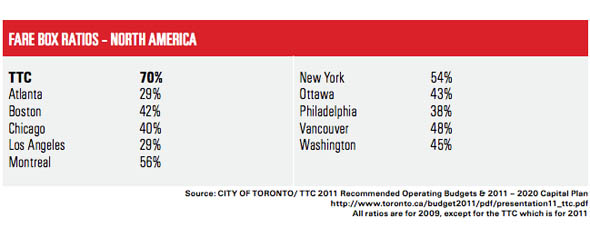
At the fare box, though, it's another matter. TTCRiders calculate that 70 percent of the money collected through tokens and passes is used to fund day-to-day TTC operations. In other cities, that figure is is as low as 45 percent thanks to the use of taxes and other revenue tools to supplement money collected directly from riders. Surely that's a reason why we have the most expensive transit system of any major city in North America.
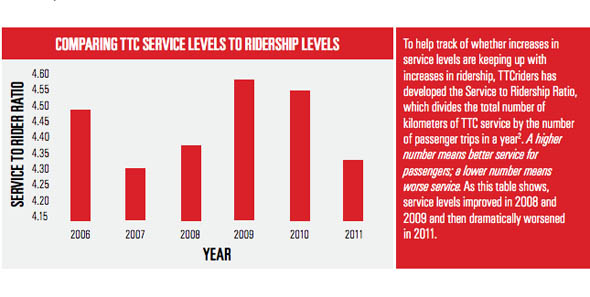
Frequency of service is another beef. According to the report, the number of trains, busses, and streetcars operating in the city does not match climbing ridership numbers. Using a service to ridership ratio, the paperwork shows a 12.5 percent increase in the number of riders since 2006 and a drop in service since 2009. Bottom line: we're paying more money for less service.
What's your opinion on the group's findings — have you noticed similar things while riding the TTC recently? Obviously we would all like lower fares, but are you happy to pay for upgrades and maintenance while you ride? The comment thread awaits.
Photo: "Walk around Forrest Hill" by kaeko in the blogTO Flickr pool. Illustrations: "The State of Public Transit in Toronto" by TTCRiders.


Discussion
26 Comments
Sort By Oldest First / Newest First
Subscribe
I just checked YRT/VIVA and their fare is $3.50 for adults, students (high school) and seniors/children.
If the fares were discounted for every single group that could receive a fare discount then the TTC would not have money.
We should have fare by distance, I live on Morningside Avenue. My sister lives across Kipling Station. Let's forget I have a metropass for a moment. I would pay $3 there and $3 back. The grocery store is 3 ttc stops east of my house. I would still be paying $3 each way to buy my groceries.
If the fares were by distance then I would pay let's say 50 cents each way. Visiting my sister I would pay more.
I use more "TTC resources" visiting my sister than going shopping.
If you get a local job in your community and shop local, the fare by distance wouldn't affect you much.
Also, I mean fare by distance, not fare zones. If you live on the east side of a zone boundary then work/shop across the street, you'd pay two zones, hence why I say fare by distance.
Now to the people who are going to bitch about what about for low income people, poor, etc...get a job locally, it is quite easy.
I had a feeling you were trolling and then I got to that sentence, which confirmed it.
The TTC gets no funding from the province, the feds or even surrounding municipalities, even though people stream across the borders of the city of Toronto each day to get on the TTC at Finch or Yorkdale, for example. Washington's WMATA, on the other hand, gets federal money plus funding from smaller cities surrounding DC, in proportion to ridership. MARTA in Atlanta gets federal funding and a cut of a local sales tax, but no federal funding. The LA Metro has half a dozen different sources of funding.
I'd say the TTC does pretty well considering the limits of its funding, but it definitely needs a way of making its fares fairer (time/distance, ability to buy multiple rides rather than a limited-time pass).
1. The technology to implement it is expensive and complex. Every single exit point from every single station and vehicle will need to be equipped - and all hell will break loose if a machine is broken, not to mention the vehicle delays waiting for everyone to tap out. It's doable, but you'll need to remember that tap out when exiting, or else you'll be paying the max amount. Massive customer service headache.
2. As we all know the TTC is slow, so it's arguable that a 5 minute short trip is equal in VALUE to a 90 minute long trip. If I'm forced to pay 15 dollars for a 90 minute trip across the city because of the distance, I might just say 'screw it' and take the car. Time is money.
3. Many (if not most) normal daily riders use a Metropass anyway, so distance based fares are a moot point for the majority of rides. No point in a huge infrastructure for a smaller subset of users.
Don't get me wrong, I pay two fares daily because of the TTC/YRT regions so I would likely benefit from distance based fares, but it's a complex idea. Time based transfers are probably the easiest compromise.
We don't need stupid token collectors sitting around. We have automatic turnstiles and vending machines. Look at NYC's model, one-two people servicing the entire station.
Listen, I agree that we should have moved to smart cards years ago, and be able to cut some of the staff currently manning token booths in subways, but if you think that alone is going to solve the TTC's funding issues, then you truly have no idea of how extensive they are.
TTC Riders don't realize that when they pay 3$(Adults) it can get them from West to East not to mention that you don't have to pay an extra fair when riding a bus at the station. Also we have the option of taking a transfer, Riders can even go further and take a different bus. All that for 3$ and yet us Torontonians think its expensive. We're spoiled. It cost the TTC more taking us from West to East than 3$s believe me.
Also the Metropass? I mean to me the TTC is giving us cheap rides. I wouldn't blame them being in debt all the time and having crappy service, their losing money.
Only way the TTC can work is if Torontonians are willing to help out the TTC cause again this is OUR public transit and its up to us to help it.
The key in transit fares is to strike a balance between short-distance users so that they will not feel they are subsidizing long-distance users, while trying to promote transit use to those long-distance users.
I don't claim to have the perfect solution to this issue, but I have created a five-point plan as a starting point that can be seen at http://lrt.daxack.ca/FareSystems/index.html
1- There should be more express bus service running through the city and at more times of the day, and they should not be a premium service like the Beach or Avenue rd express or other downtown express services
2- Routes that travel along Bay st and even part of Yonge st in my opinion don't need to run. I have boarded 97 yonge buses during rush hour at king and yonge going north and been the only rider until St Clair. How do we justify a transit service that has one person on a bus during rush hour?
3- Certain bus routes such as the 25, 29, 34, 100 and more, all run frequent service and some of the buses bunch up real close and end up stopping at every stop, what would make the service a little better and more tolerable for people going further is to take 1 out of every 3 or 4 buses and create an express bus similar to the 199 Finch Rocket. I have noticed that since the Finch Rocket has come in the 39 does not bunch up as much and I usually am not crammed in like sardines, plus the express bus gets me to where I need to go a lot faster then a local service. Adding more express portions to routes makes a lot more sense.
4- The one thing that gets to me is all the short turns on streetcars. Especially the 505, I take that service a lot from Broadview station and some evenings I will be waiting and the streetcar doesn't come then I keep waiting, last night there were 7 king streetcars before the 505 finally came. I have been on 505s heading east and seen the streetcar 3 minutes late and it gets short turned at Parliament, or going west the street car is 1 minute late and gets short turned at landsdowne. I know it is hard to keep streetcars on time because of the fact they run on a track and get slowed down by other vehicles but there should be a way to not short turn lots of the streetcars especially when they are not bunched up. I have been on queen several times and seen 3 or 4 streetcars in a row with 1 or 2 being almost empty but there is lack of short turns when it is needed.
I love taking the TTC but sometimes there is a lot to be desired when I see bus routes that need to be changed
If Toronto wants the TTC to be more cost effective we would have to redesign the suburbs, or vastly reduce service to them. Since neither one is an option I guess we are stuck.
That report has a missing word in the caption to the rider-service ratio. I know it's a small thing, but if the people who wrote the report didn't even take the time to read over it to check for spelling/grammar issues, then how much effort did they put into verifying their data?
Keep talking, keep drawing up your fantasy plans and keep arguing the details of stations and lines that will never, ever exist in your lifetime. But most of all, keep making excuses as to why other agencies manage to do what the TTC fails miserably at. After all, mediocrity is what Toronto does best. So long as we're "better than Detroit" we're doing OK, right?
Fucking waste of time..