Wednesday, May 22, 2013Mostly Cloudy 19°C
City

Nostalgia Tripping: Toronto's streetcar suburbs

Posted by Agatha Barc / September 5, 2010

york township, toronto, oakwood avenue, rogers road, 1924Having lived and worked in several former streetcar suburbs of Toronto, I often wondered whether there was a connection between the architectural styles of the commercial blocks on both sides of Lake Shore Boulevard, Bloor Street West or St. Clair Avenue, and whether the growth in the formerly suburban districts had anything to do with the fact streetcar routes operated along their major roads.

It turns out that the arrival of a streetcar also signaled development on the then urban fringe (e.g. Bloor West Village) or it accelerated growth in areas that had already started to develop (e.g. New Toronto or Earlscourt). Proponents argue that streetcar routes helped to establish and sustain centralized, compact communities, with a main commercial street along the route and easy access to transit, which allowed for a convenient commute into the inner city. Others, like Lawrence Solomon, the author of Toronto Sprawls: A History, see these streetcar-centred communities as the first step in the spread of uncontrollable suburban expansion.

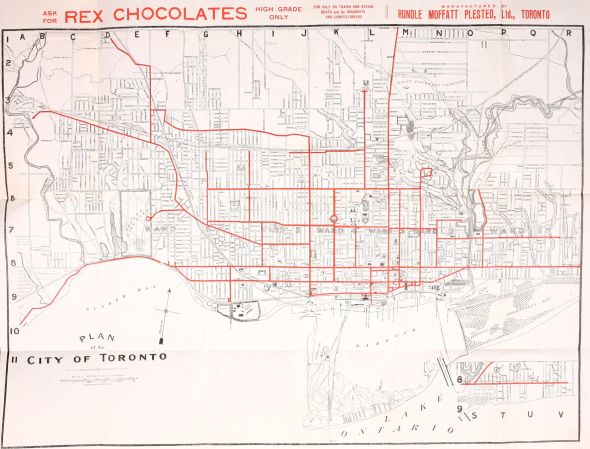
toronto, streetcar routes, map, 1912Until the construction of the subway in 1954, Toronto had a much more extensive network than today. While today the majority of the routes operate downtown and south of Bloor, streetcars also regularly picked up riders on such streets as Dupont and Coxwell, among others.

lakeshore road, dwight avenue, new toronto, etobicoke, streetcar line construction, 1928New Toronto, Mimico and Long Branch in south Etobicoke near the shore of Lake Ontario were one of the many suburban communities, which directly benefited from the introduction of so-called radial railways - named after the fact that they "radiated" out of the city and beyond its limits. The first significant settlements west of the Humber River occurred in 1890s. According to the New Toronto Historical Society, the Toronto and Mimico Electric Railway and Light Company was incorporated on November 14, 1890. Construction on a streetcar line to Mimico started in August 1891 from the intersection of Queen Street West and Roncesvalles and a year later it was completed to the Humber River, and after some financial difficulties and help from William Mackenzie, the route was finally extended to Kipling Avenue and finally to Long Branch.
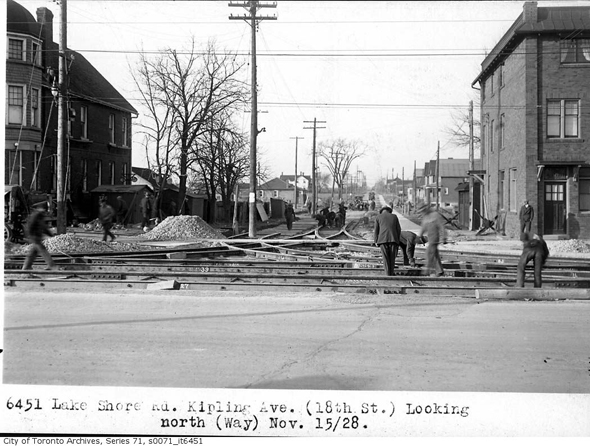
lakeshore road, kipling avenue, new toronto, streetcar line reconstruction, 1928The name of the area eventually known as New Toronto stemmed from the Globe's report on the industrial growth of the area in 1890s, and it predicted that it would be equal or even surpass "old" Toronto as an industrial centre. In 1913, it was incorporated as a village and ten years later as a town, and the population went up from 500 to 5,000 during this decade, and continued to grow steadily, with a growing infrastructure, owing this in part to the availability of transit in the area.
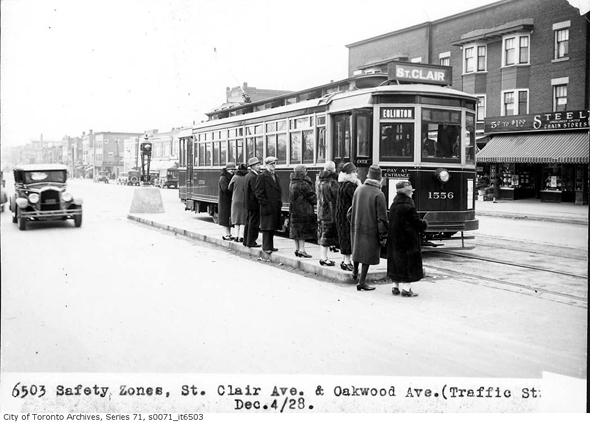
st. clair avenue, oakwood avenue, toronto, streetcar, 1928Even though many former streetcar suburbs no longer have streetcars servicing them, the nature and growth of these communities owes much to these original transit lines.
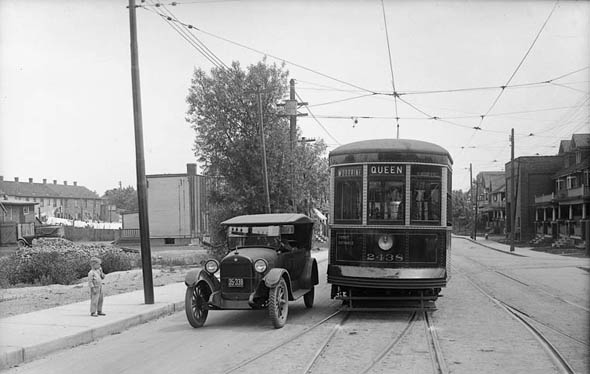
connaught avenue, queen street, toronto, streetcar, 1923

Discussion

22 Comments

gadfly / September 5, 2010 at 09:39 am
user-pic
Well, nostalgia is just that - nostalgia. Where space permits, a dedicated streetcar line makes a lot of sense; otherwise, streetcars are a menace to cyclists, pedestrians and motorists.
I know this is going to start a raging argument amongst the streetcar zealots, but any reasonable person will acknowledge that the cost of maintaining the tracks in our horrid climate (plus the disruptions that maintenance causes - see: Ronscesvales, King St. W, lower Parliament currently), the impediment the streetcars present when all traffic has to stop to let passengers on and off, the noise and hazards these behemoths present at intersections, the fact that they can't stop and the sheer terror the tracks invoke in cyclists trying to cross them - well, it's plain to see they have no business being in an inner core.
What about being all warm and fuzzy about the electric trolleys Toronto used to have? They were clean, quiet, got out of the way to pick up passengers and posed no impediment to traffic or cyclists.
Bubba / September 5, 2010 at 11:01 am
user-pic
wow, "horrid" haven't seen that word in a while, now that's nostalgia tripping.
Agatha replying to a comment from Bubba / September 5, 2010 at 12:38 pm
user-pic
That made me laugh. At first I thought you were referring to my post until I read the comment above!
Agatha replying to a comment from gadfly / September 5, 2010 at 12:41 pm
user-pic
I'm somewhere in between on this. I love Toronto's streetcars for their nostalgic value, but then I dread waiting on the College streetcar every time I have to take it. I also agree with the author I cite here rather than with the proponents of the streetcar suburb as a compact community - who cares if the sprawl centres around the route, it is city outside of the city limits.
Michael / September 5, 2010 at 01:33 pm
user-pic
I agree with the comment above critiquing streetcars, and in favour of electric trolleys (buses). Save for LRT in its own right of way, I think keeping streetcars have been a major error in this city's evolution.
Nick replying to a comment from Michael / September 5, 2010 at 03:18 pm
user-pic
Right, Mr. Fox, because all the cities that ripped them up in the 50s have evolved into much more sophisticated and well planned entities (LA, Detroit, etc. etc.)
Moving target replying to a comment from gadfly / September 5, 2010 at 03:41 pm
user-pic
"the fact that they can't stop and the sheer terror the tracks invoke in cyclists trying to cross them - well, it's plain to see they have no business being in an inner core."

Gadfly.

So true. As a bike courier I completely agree. You have no business biking downtown. Go to a spin class, take the train to work. I have work to do. Don't get in my way.
Maria / September 5, 2010 at 03:46 pm
user-pic
I agree with the first comment. I hate streetcars so much. I would be happy to never see another streetcar again. The only streetcar I don't hate is the Spadina car. I would love for the TTC to just keep Spadina for it's nostalgia, and because it does work, and replace the other lines with buses. They could even make a gallery of streetcar photos at Spadina Station to help commemorate its history in our city. That way we get to keep and cherish a piece of our city's past, while moving forward with more practical transit solutions for the present.
Andrew Jeanes / September 5, 2010 at 03:52 pm
user-pic
Lawrence Solomon is wrong that streetcar suburbs were the first step in uncontrollable suburban expansion. From the 1830s, macadamized roads allowed those who could maintain their own horse-drawn carriages to build large homes outside the built-up urban area. Steam railways also generated pockets of sprawl around new suburban stations in places like Parkdale.

Starting in 1861 in Toronto, street railways (first horse-drawn, later electric-powered) democratized sprawl by making a daily commute affordable to middle-class people who could afford a nicer house, but could not likely afford their own personal (horse-drawn) transportation. Working class people still walked to work and lived close to their work.

Electrification improved the efficiency of the street railways and made it practical to develop the radial railways, the first of which began in 1894. These were more like GO Transit than the TTC, reaching as far as Guelph and Sutton West on Lake Simcoe. Where they contributed to urban sprawl, it was mostly in places where the street railways would have gone anyway.

In the present context, a CLRV streetcar carries 102 people at a normal load, an ALRV carries 155. Crush loads are 132 and 205 respectively. A bus, whether powered by diesel, hybrid, CNG or overhead trolley wire, carries a normal load of about 40-50 people and a crush load of 70-80 (less on low-floor buses). A private automobile in Toronto typically carries one or two people with a crush load of five or six. If you measure traffic in terms of people per hour over a given segment of road, private cars are typically much more to blame for congestion than streetcars are, even when the latter are in mixed traffic.

Asphalt roads are even more costly to maintain in our climate than streetcar tracks. The tracks suffered in the past from poor trackbed design decisions in the 1970s and 1980s but much of the network has now been rebuilt to much more robust standards that will be cheaper to maintain long-term than the asphalt road lanes on either side.

If you replaced the TTC's streetcars with buses you'd need to do so at a 2-1 or 3-1 ratio to maintain capacity, and that would need more operators, more mechanics, more garage space and a lot more money. Steve Munro and others have proved that most of the problems with bunching and consequen long waits for the next streetcar are the fault of poor TTC operational management practices, not because the streetcars are operating in mixed traffic. The bunching problem happens on routes with buses too, so getting rid of streetcars wouldn't fix it.

Cyclists are much more likely to be injured or killed by an automobile than a streetcar. Cycling accidents due to streetcar tracks do happen, but many more happen due to potholes, door prizes, inattentive drivers (and inattentive cyclists). Generally, if you're a cyclist (and I am) and you pay attention (and I do), you know that streetcars and their tracks are not the problem. For pedestrians, I'd have to say, streetcars are not a problem at all. Certainly, not anywhere near the problem that bad drivers and bad cyclists are, in terms of causing pedestrian injuries.
Vince Coughlan / September 5, 2010 at 06:30 pm
user-pic
Very good comment Andrew. I completely agree. Cities are embracing streetcars all over the world. Houston put in and street level light rail system a couple of years ago. Many European cities have light rail transit running trough their streets. And most do not look like what we have in Toronto. Go to Amsterdam and you will find the tracks are not protected like they are here. Cyclist, auto and pedestrian all share the roads with their transit. It might not be perfect but it does work. It's just a head space change that people have to get used to.
gadfly replying to a comment from Andrew Jeanes / September 5, 2010 at 09:36 pm
user-pic
Are you serious? "Asphalt roads are even more costly to maintain in our climate than streetcar tracks. "
Really? They have machines that can rip a few inches of asphalt from the surface, recycle it and lay down a new layer - in minutes. As opposed to the 8 months of sheer horror a street is laid waste to while the streetcar tracks are laid.
This is one urban myth that has to go. Chemistry 101: metal tracks imbedded in concrete, add salt and water - pestro: rust! Add in for good measure the constant wear and tear of the tracks by metal on metal wheels and you have a perfect set up for total mayhem every 10-15 years.
Sorry, but that's a total crock of shi$t. Concrete is expensive and doesn't 'give' much in our freeze/thaw cycles which encompass about 6 months of our year. That's why the concrete laid 401 (and now the 427) are being replaced by asphalt: more pliant, cheaper and faster to lay, cheaper to repair.
Like I said, the entire 'ain't the streetcars quaint' idea needs to go the way of the dinosaurs.
City's are 'embracing' streetcars because it is the urbanist flavour of the week, like global warming. The electicification concept is laudable, but sticking trains in the middle of traffic is insanity. It was in the 1920s and it still will be in the 2020s.
Let's just give it another 10 years and see what the Ry-high grads have to say.... [rolls eyes.]
Eric26 replying to a comment from Nick / September 6, 2010 at 02:59 am
user-pic
I hope you find a logical argument someday.
Nancy Thompson / September 6, 2010 at 09:22 am
user-pic
Regardless of whether streetcars historically helped to create sprawl, today there's little danger. Streetcars will be practical only in fairly dense parts of the city. The costs and benefits need to be weighed carefully, but there are new twists on streetcar technology all the time. Not all run on metal tracks laid in concrete, for example. Streetcars where other public transportation already exists seem to me to be a fashion of the day, but I say let this experiment run its course.
Rich replying to a comment from gadfly / September 6, 2010 at 03:11 pm
user-pic
gadfly if you ever bothered to have a look at the new track bed construction of streetcar tracks you'd realize that metal and concrete never touch in the new beds, all metal parts are encased in some sort of rubber or plastic, I'm not sure which but the only exposed metal is the part that's above ground the streetcars actually ride on. These new track beds will last a lot longer than old ones and require a fraction of the maintanence.
Rich / September 6, 2010 at 03:20 pm
user-pic
As someone who lives in New Toronto I'm very grateful for the streetcar, when you have to travel a long distance its a much more humane mode of transit since you aren't getting bumped and tossed around like on a bus, its a nice smooth comfortable ride. Plus they carry way more people than buses so they save a lot on the number of drivers and mechanics needed, it'd be a lot more expensive to replace streetcars with buses. It seems to me people who regularly ride transit, at least most of them, really prefer streetcars while those who only ever travel in their single occupant cars hate them since they can't pass when they're loading/unloading, considering streetcars benefit more people than they hassle they definitely are worth keeping and expanding, plus congestion would be worse with just buses since ridership would go down in spite of 3 times as many buses being needed on the roads plus all the extra single occupant cars from people who'd rather drive than ride a bus but who are willing to take the streetcar. There are parts of this city I would never go if they didn't have a streetcar line and I'm sure many feel the same way, for example I avoided Spadina like the plague until they installed the streetcar line there, now I'll shop it fairly often because its convenient for me and comfortable.
W. K. Lis / September 6, 2010 at 04:03 pm
user-pic
Streetcars do not cause traffic congestion. Single occupant (or 1.3 on average) automobiles are the cause of traffic congestion.

Why is the traffic on Black Creek Drive crawling during the rush hours? Are there streetcars, buses, bicycles, or pedestrians on Black Creek Drive? No, just motor vehicles, most of them with just 1.3 occupants on average inside them.
realitycheck / September 6, 2010 at 04:26 pm
user-pic
Once you factor in the costs for maintaining the track, streetcars are not cheaper than buses... not by a long shot.
W. K. Lis / September 6, 2010 at 07:22 pm
user-pic
Once the factor in the maintenance costs over the life of the vehicles, plus the capacity of the vehicles and the employees each vehicle requires to operate, plus fuel costs, streetcars are cheaper than buses. As well, ridership goes up when streetcars are used, they go down when buses are used. Just check the cities that got rid of streetcars in the 1950's and 1960's.
Roger DuPuis / September 7, 2010 at 04:40 am
user-pic
Love this post and the subsequent discussion. Inspired me to draft this post for my own streetcar blog: http://tramsstophere.wordpress.com/2010/09/07/streetcars-the-original-culprits-behind-urban-sprawl/
Dave / November 13, 2010 at 10:08 am
user-pic
I've lived both in and around Toronto, and when in Toronto I lived in various parts, both on and off a major streetcar route. I have to say that compared to buses, streetcars are safer, more comfortable, environmentally cleaner, and overall a pleasure to ride. Let's look at that individually.

While there are certainly streetcar/pedestrian accidents, streetcar/cyclist accidents and streetcar/car/other vehicle accidents, it must be admitted that the majority of these (not all, I repeat, not all) are caused by inattentiveness on the part of at least one of the parties involved. I mean, it isn't as if we can't tell where the streetcar is travelling, correct? Buses, on the other hand, have "free will" to travel across the road from side to side, that one simple fact making them a greater hazard for anyone on the road with them. To dodge a streetcar, one must simply step away from the tracks; to dodge a bus, you must get the hell off the road.

Comfort comes specifically at the rail level, just as a train gives a smooth ride due to the method of transport. Potholes and other evidence of a crumbling infrastructure do not affect the smoothness of a streetcar ride. When was the last time you spilt coffee upon yourself as a result of a streetcar launching up and over a groove in the asphalt caused by thousands of cars turning right into and out of a side street over the course of years of neglect? Happens all the time on Lawrence East, between Warden and Pharmacy travelling westbound at Tower. Aptly named side street, because if you have a bus going at a fair clip on that stretch, everyone around you will know how much you spent at Timmy's that morning, based on the roast they are now sopping out of their clothing.

Environmentally, there should be no argument: electric is cleaner. End of line.

So, put that together with the greater carrying capacity, the lower maintenance costs, and the glaring statistics provided by other cities that have discarded streetcars over more 'current' tech for transporting citizens, and the argument to keep and expand Toronto's streetcar system becomes clearly valid. As to the problem caused by congestion in relation to streetcars interfering with other vehicles on the road...well, if half the cars on the road weren't there because instead the people in them were on a streetcar-based transit system, there would be no problem.
Paul Chomik replying to a comment from Rich / April 27, 2011 at 10:45 pm
user-pic
The new replacement streetcar track installations (with the cushioned rails) are meant to have lifespan of at least 30 years. That is considerably longer than the old wooden tie encased in concrete method previously used.
Paul Chomik / April 27, 2011 at 11:01 pm
user-pic
Here are a few more notes to the article.

In 1890, the plan of subdivision for the Town of New Toronto was filed. The town was conceived by a group of industrialists who had visited Rochester, New York.

The radial railway, which became the Long Branch streetcar route, was planned and built to serve New Toronto. It was meant to be a faster, more reliable, and more convenient service for workers traveling from Toronto. By the late 1890s, service was provided on a 20-minute schedule.

New Toronto was incorporated as a village in 1913, with many residents living there only seasonally. By counting residents during the summer months, the community was able to separate itself from the Township of Etobicoke sooner than if it relied on the number of permanent residents.

New Toronto became a "town" in 1920 (1923 is a commonly repeated mistake from some references).

Photo 6337 from the Toronto Archives LOOKS WEST from Dwight Ave. - not east. I pointed this error out to the Archives a few years ago (amongst others). No corrections have been made by the Archives yet.

Add a Comment

Other Cities: Montreal