Saturday, May 26, 2012Mostly Cloudy 22°C
City

Nostalgia Tripping: The Spadina Expressway debacle

Posted by Agatha Barc / July 12, 2010

highway 401When I strolled through Cedarvale Park last week, it was hard for me to imagine that the leafy ravine was once destined to become polluted and congested with high-volume traffic, much like the mess that is the Gardiner Expressway this summer. But, despite how hard it is to picture today, this would have been reality if 1950s urban planners with a short-term vision for the city got their way.

Cedarvale, which I call home, is an early twentieth-century neighbourhood, built by Sir Henry Pellatt of the nearby Casa Loma, would most certainly have a completely different character should the Spadina Expressway have been built. The Annex, along with parts of U of T's campus, would have also shared in this fate, and the Spadina Museum (next door to Casa Loma) would have been demolished.
20100712-archives-allen.jpgNearly 40 years later, the Spadina Expressway controversy is a reminder of the post-war clash between the interests of inner-city dwellers and the values of suburbanites -- one which arguably remains to this day -- and of a redevelopment philosophy that could be summarized as "to hell with the old...bring on the new."

In The Shape of the City: Toronto Struggles with Modern Planning John Sewell, a former mayor of Toronto and one of the key activists in what became a grassroots movement against the highway, writes that the as the former wanted to protect their neighbourhoods, the latter desired an easy access to downtown, where a vast majority of them worked.
Like elsewhere in North America, a good chunk of Toronto's middle class moved away from the inner city to the urban fringe and beyond, relying on cars to ferry them from their remotely located, under-serviced and often unsustainable, suburban communities. These two opposing visions for the city were reflected in the Metro Council and the Toronto City Council. Not surprisingly, the suburban councillors were all much in favour of the highway, while the majority of the Toronto councillors opposed it.
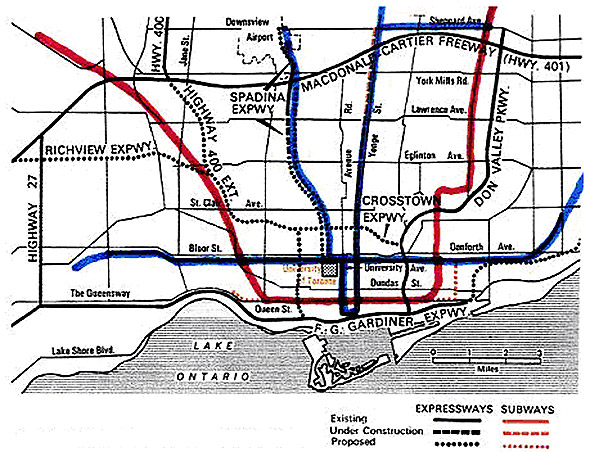
toronto highwaysThe Spadina Expressway was one of a series of planned highway routes for the city, which included a Highway 400 extension, Scarborough, and the Crosstown. All of them were to culminate in the centre of the city. Nearly a thousand houses were to be demolished and in their place new parking lots were to be constructed. To Sewell and others, this plan did not simply mean getting downtown faster; it was really a "remaking [of] the city in a radical fashion."

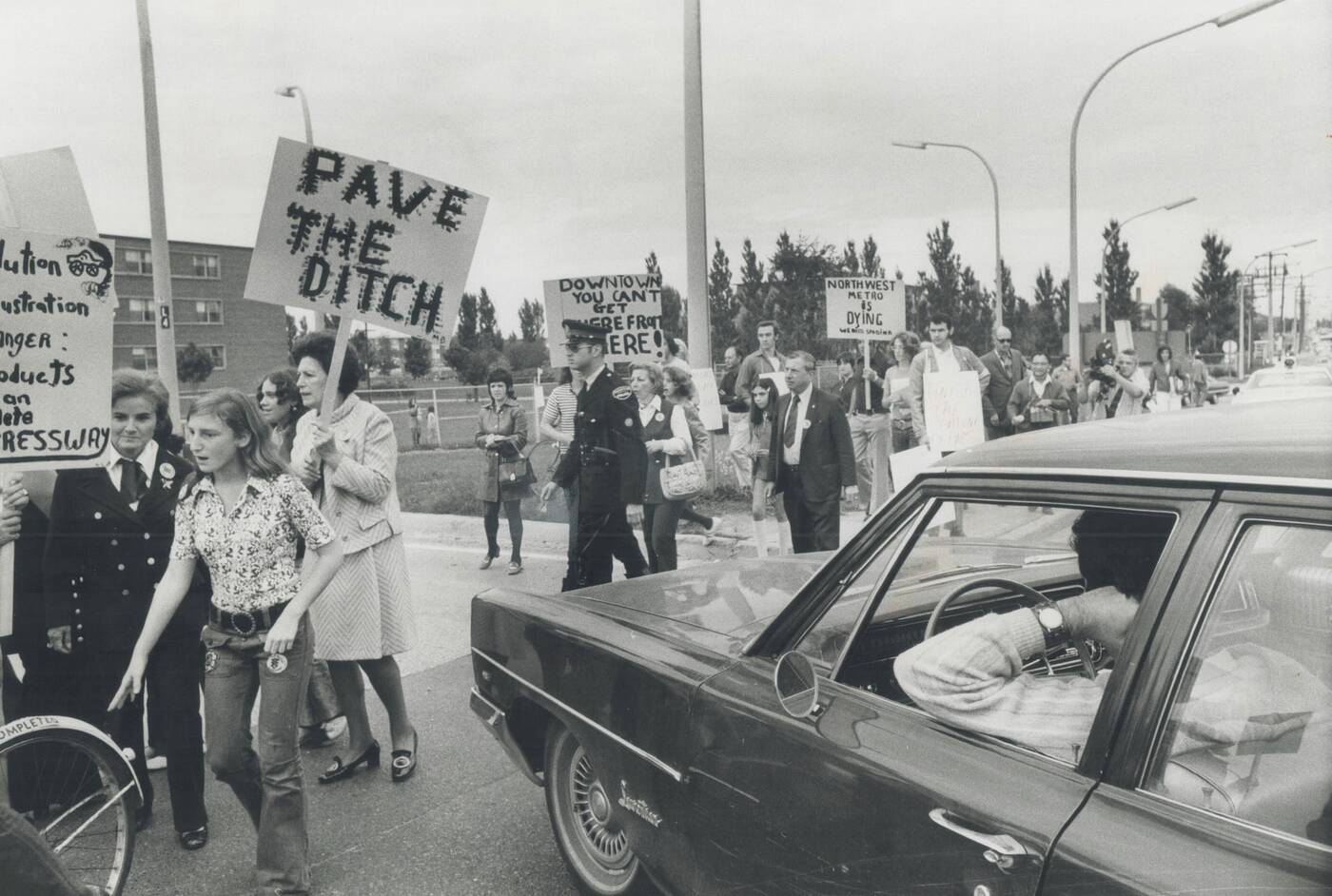
Those opposing the Spadina Expressway banded together in a coalition called Stop Spadina Save Our City Coordinating Committee (SSSOCCC). It was organized in the 1960s by Alan Powell, a U of T professor, and its membership included Jane Jacobs (who resided in the Annex) as well as practically every social group who was affected by the potential appearance of the expressway.

The group lobbied powerfully for several years, organized demonstrations, crowded political meetings, and researched links among various politicians to the highway. The Spadina Expressway became the election issue in 1969, and Sewell, a member of the SSSOCCC, was elected to the Toronto City council. In tune with other councillors who stood against the erection of the expressway, he vowed fiercely to continue to oppose the expressway at the Councils and to take the fight to the provincial government if necessary.
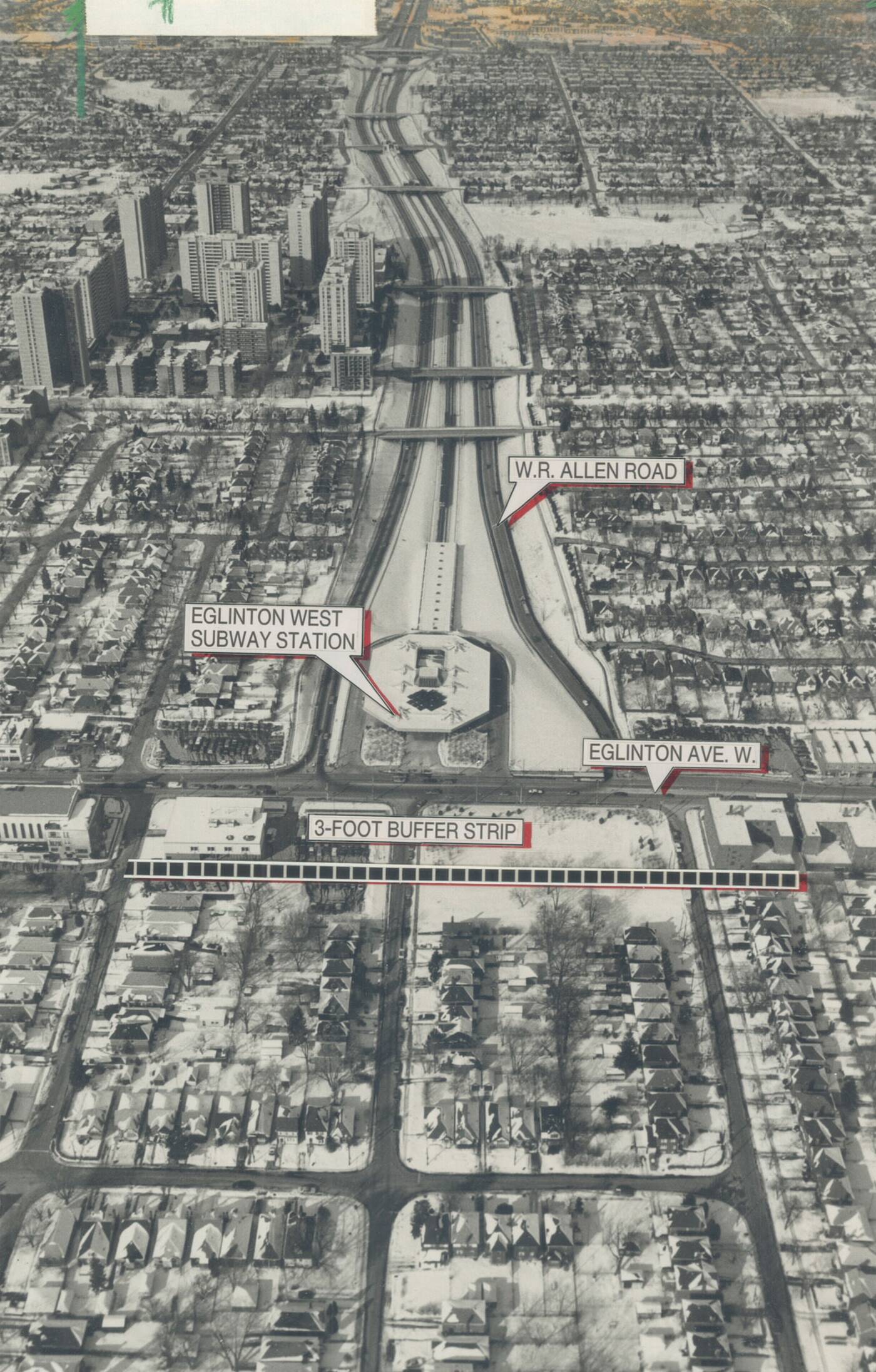
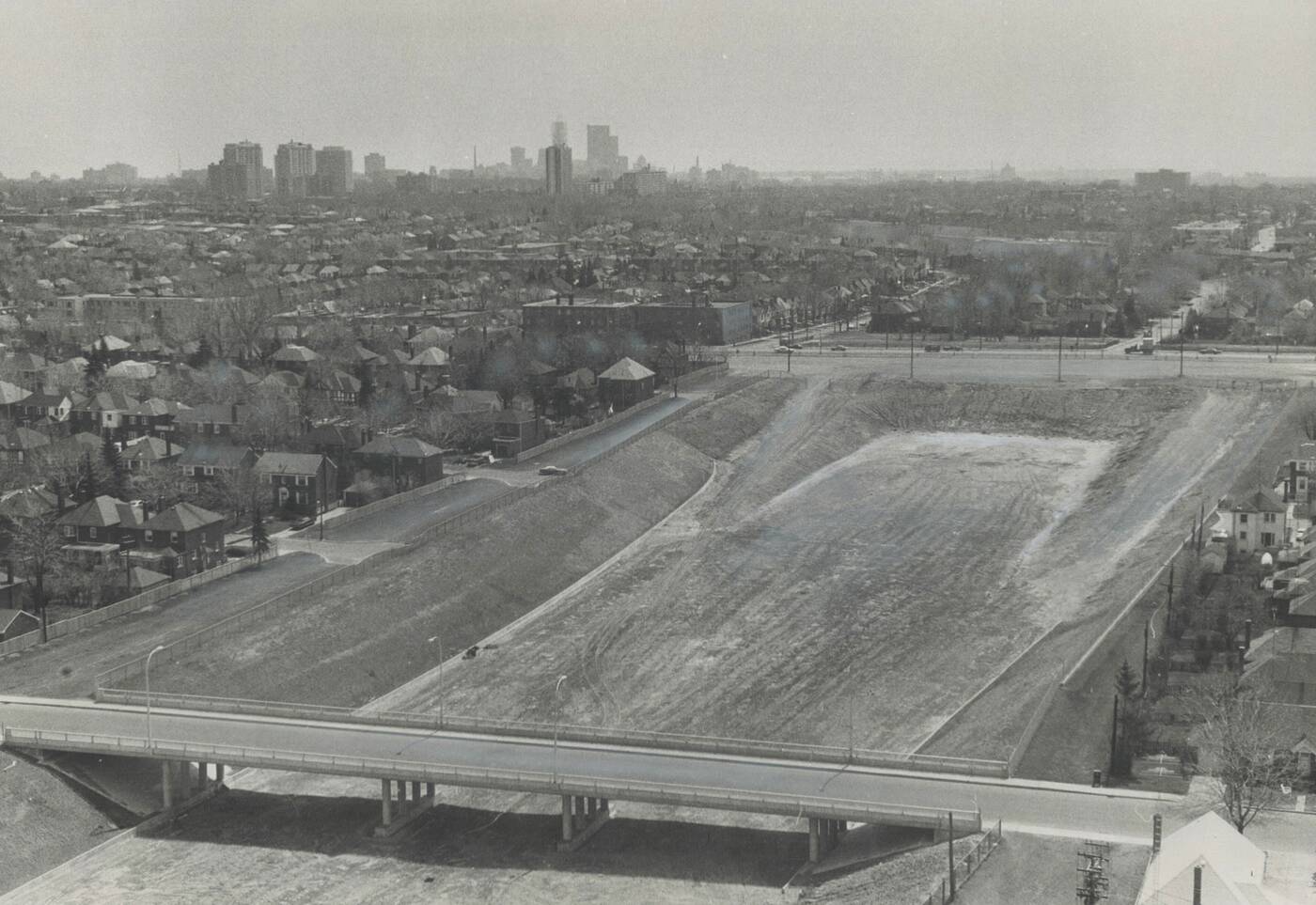
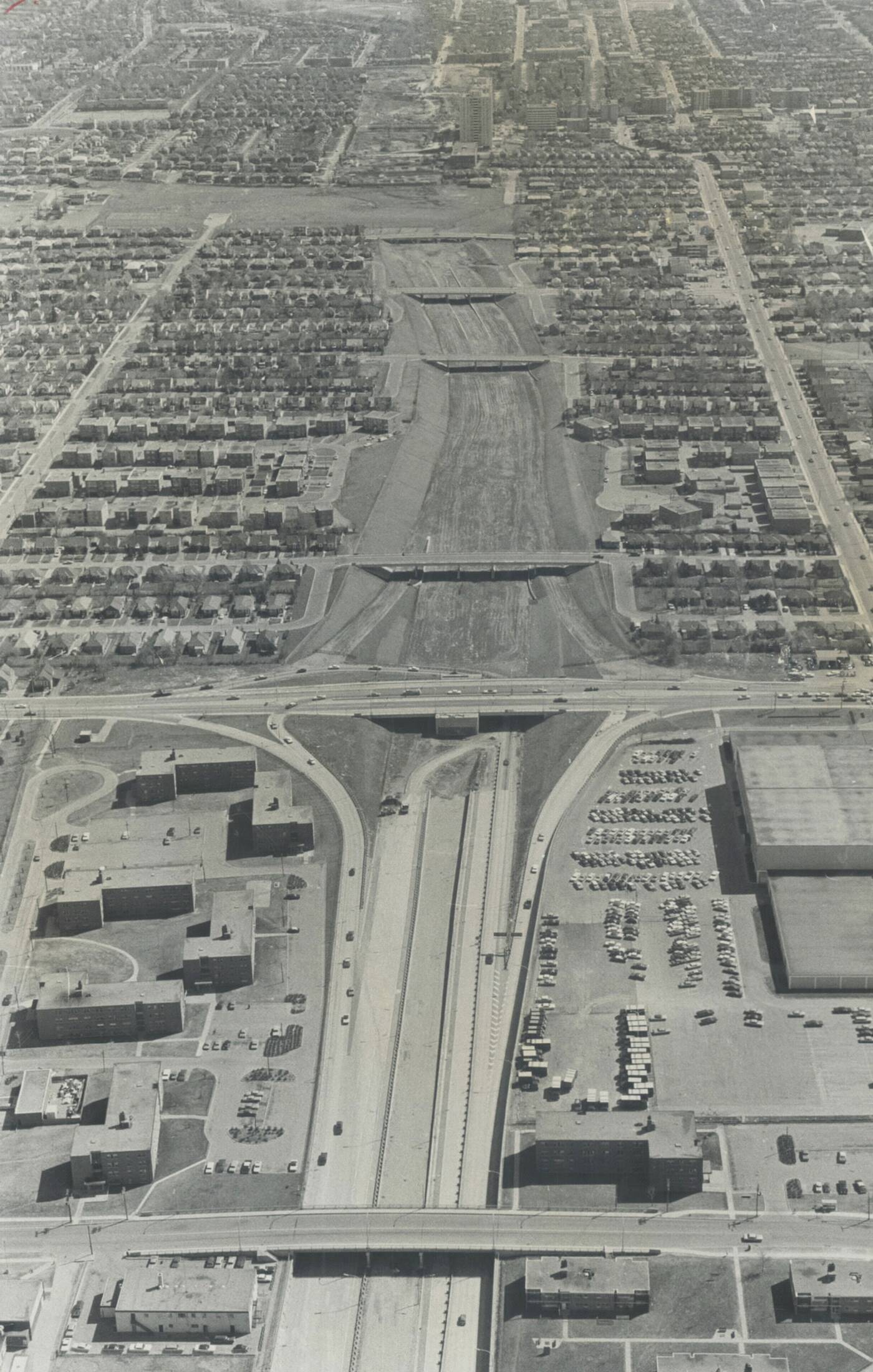
Allen_Road_from_Glencairn-ed.jpgThe Spadina Expressway was fortunately never completed, and the part that did get built was renamed W. R. Allen Road. However, before Bill Davis, the provincial premier, halted the construction in 1971, a giant ditch was dug up in the north end of Cedervale park, which served as a reminder of how closely it came to destroying the essence of the inner city.
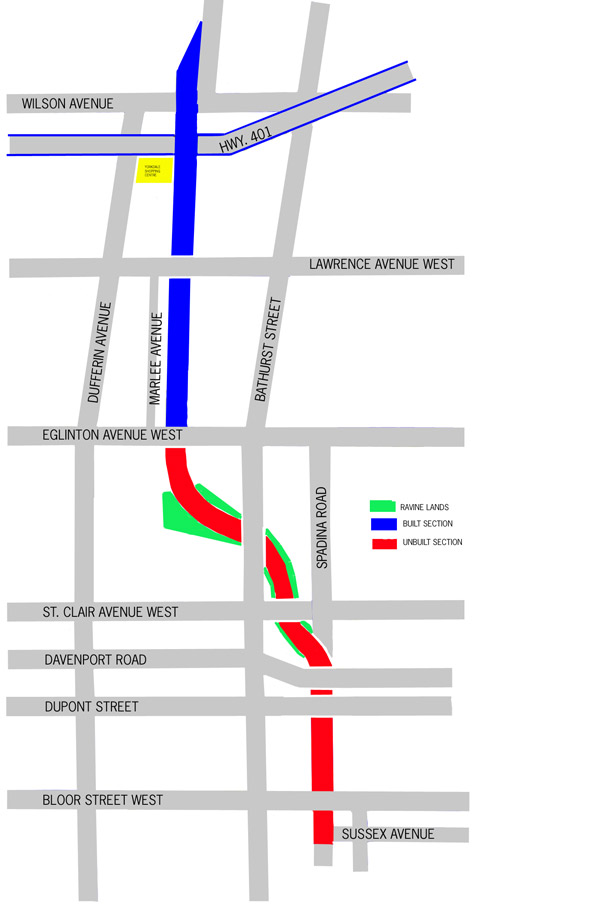
Other bits of evidence of the planned expressway also remain elsewhere in the city. As Mark Osbaldeston notes in Unbuilt Toronto: A History of the City that Might Have Been, the facade of U of T's New College that faces in Spadina is windowless (builders anticipated an ugly view), the lawn at the Toronto Archives sets the building far back from the street to accommodate the expressway that was thought to be coming and the Ben Nobelman Parkette just south of Allen Road's termination at Eglinton was built on land that had been acquired for expressway's path south.

In fact, in 1985 the province leased the city a three feet deep by 750 feet long tract of land in the same area just to ensure that Metro couldn't somehow find a way to continue with the highway. This narrow strip serves as a mostly symbolic blockade, but an important one for those who cherish neighbourhoods like Cedervale and the Annex.

Spadina Expressway planImage Credits: Early stages of construction Toronto Archives (series and fond information at bottom of photo), all others from the Wikimedia Commons.

Discussion

75 Comments

Tomasz / July 12, 2010 at 10:54 am
user-pic
Luckily the Spadina Expressway was stopped and the whole debacle had a happy ending.

But this story reminds me, the saddest thing is that this city didn't have the common sense to stop the industrialization of the waterfront before it was too late.
Rob / July 12, 2010 at 10:55 am
user-pic
To the author, or other knowledgeable folks:

Are there concrete (pun intended) examples of cities which have been ruined by networks of highways like this and other which weren't built in TO? Other impacts aside, speaking selfishly as a driver, I would like to think that a greater network of freeways would really help transportation in TO, but I'm sure you'll tell me otherwise.

So, does the DVP work (to whatever extent that it works) because it is contained within a natural valley versus something like this expressway which would be above ground and of course take away from the communities beneath it?

Just curious! Too bad that all this funding for highways in the 50s/60s wasn't redirected to subway expansion.
Sean replying to a comment from Rob / July 12, 2010 at 11:19 am
user-pic
Rob: Cities? No. Cities as a whole are tough to kill. Vast swaths of neighbourhoods killed in large part due to the bisecting caused by highway planning? Yes... there are countless examples of that.

Adding more freeways does not improve peak travel times because more people will use them... causing the same level of congestion (if not more).
Marc replying to a comment from Tomasz / July 12, 2010 at 11:39 am
user-pic
Correct. I feel the same way. And it's sad that even though the Spadina Expressway issue had a fairly positive outcome (more benefit than loss), the city and planners didn't learn from it at all! Perhaps they learned from the obvious, which is the highway aspect, but not the whole picture. Today, they keep planning WRONG. Too many condos, especially on the waterfront, and lack of innovation and focus concerning transit and our modes of moving around the city, or region. Just look at the traffic, amount of cars, bad layouts and lack of options a commuter has.
Marc replying to a comment from Sean / July 12, 2010 at 11:41 am
user-pic
Absolutely. Making more highways and adding more lanes on them or on roads, does not help. Maybe it helps in what the eyes would see, but overall, it doesn't help the situation because it only means more drivers and cars will use them. This leads to more congestion, more pollution, and of course, more of an ugly setting and ugly look and feel.
Jacob / July 12, 2010 at 11:50 am
user-pic
The thriving culture of Downtown Toronto would be nonexistent if this had gone through. The downtown core would have been a concrete wasteland, like so many American cities that had expressways driven into the heart of them.

People I know, however, are still upset that it didn't happen. (Suburbanites, if you hadn't figured it out.)
Jacob / July 12, 2010 at 11:55 am
user-pic
Lots of bad decisions were made in the '50s, '60s, and '70s, and we're still paying for them. It's why transit is as broken as it is. The glowing view of "the future" back then was that everyone would drive a car everywhere, so communities were designed around that concept. They didn't take into account the negative aspects of that, though. Now most suburbs are unwalkable, and really difficult to integrate transit into. Anything other than buses are impossible, since there's no rights of way for anything else.
Jer / July 12, 2010 at 11:58 am
user-pic
ahh glorious what-could-have-been sentimentality - the refuge of the underworked, over-opinionated, and the deniers of the reality of creating a financial sustainable cosmopolitan. We need only look to the marvellously successful Mississauga to see how a city can co-exist with high-volume traffic, sensibly placed multiple cores, comfortable neighborhoods with fair quantities of transit, culture, and quality-of-life for all. And always budgets met or comfortable surpluses. A wonderful mixture of ethnicities, events, and grassroots organizations. Low crime rate, farmer's markets, and many a club for the youthful and young-at-heart. What? don't like to see the 427, 403, QEW, from that thin strip of 50m or less where you can actually see or hear these transportation ways - well move into the multitude of spacious, nicely-sized backyard-studded safe neighborhoods that abound - all being supported on fair mortgages, at fair market value. Oh yes, i'd rather see the railyards of the Junction; the crime-ridden eyesores of Jane/ Sheppard, and 40% of scarborough. But TO has the cityscape life - oh yes, Queen W, Church, College, etc. - but let's examine those daywalkers - mostly 20s, 30s with an income of less than $20k, hardly enough to pay their share of all the Transit, parks, and festivals they clamour for - unaware that they contribute far less than the average toward city coffers - net leaches, really. But hey, let's have huge tree-lined neighborhoods with difficult utilities' access and large parks that the unemployed can laze on during the summer - because hey we don't need condos or office towers with their city income generating benefit. Why can't we all have 80-year-old brick houses with large backyards a few steps from great clubs, cafes, and shops and a subway stop - and all on $15/hr - 30hrs/ week wage? Well why can't we have the same hedonistic life that those Europeans who live near the Mediterranean enjoy? And those high-maintenance glorious parks that those city workers who make above $60k per year to repair, sweep, and clean - can't we have more of those? Yes, its far more important to have a city that we can walk to have a local coffee or beer than one in which it is easy to get to work, raise a family safely, and pay for. And please, when you throw a loaded word such as sustainability around, support it with numbers or some type of citation. I know this is a casual blog and its more about entertainment then news and opinion than research - but, sometimes we have to live for the future not for the day - and using the word sustainable, whatever that truly means, is not going to suddenly make some enterprise a long-term viable entity. --And this from someone who lived in TO for many a year and has good reason to be proud of this city - but just as many reasons to see it falling into a sort of hedonistic-smoke-clouded decadent shell of a place that actually 'works'. --and as soon as Mississuaga starts creating high-density 'A' class office buildings near the mall cores - so will much of TOs income-generating offices leave to other places in the GTA - but, hey we didn't need those insurance and lawyer offices anyway, they were filled with people that commuted on the Gardiner or DVP. The next 20 years should be interesting. When the province stops handing money to TO, it will certainly be a time of reckoning. But hey, you can always have a safe and productive G20-type 'meeting' in the core - that always gets things done.
Marc replying to a comment from Jacob / July 12, 2010 at 12:04 pm
user-pic
That's why they were pretty stupid. Obviously they would know and have to expect that small-town Toronto was going to grow up and have more people (especially with how they keep pushing immigration), so even if they envisioned that everyone was going to drive a car everywhere in the "future", the obvious would be that there would end up being a huge mess of congestion and traffic. It only shows that they were thinking with their pockets, not their heads or minds. That is why it is important and almost a no-choice situation, that cities should be designed and planned as if cars are NOT used by everyone and not as accessible. Cars will always be there, but it really shouldn't be the only thing out there. Especially when we're talking about the city, which means density and smaller spaces.
Tim / July 12, 2010 at 12:04 pm
user-pic
If you don't think that freeways wreck cities, spend a weekend in Detroit. It's really easy to get around (I know because I lived there).
Jason / July 12, 2010 at 12:11 pm
user-pic
Another interesting tidbit...

The DVP off-ramp for Bloor-Danforth is so wide as it was built as the start of the Crosstown Expressway.
Kevo replying to a comment from Rob / July 12, 2010 at 12:26 pm
user-pic
Detroit is a good example of a hollowed out downtown due to highways entering the core. Basically you can look at any major city in the US (except NYC, more specifically Manhattan) where planners allowed highways to cut into their downtown.

The DVP probably wasn't contested as much as it didn't cut through a neighbourhood and the whole modernism thing wasn't seen as evil yet. Once neighbourhoods were going to be bulldozed and it was noticed that highways caused desolate streets, that's when people woke up. It also helped immensely that Jane Jacobs moved to Toronto right after she led the effort to stop the planning board in NYC from building the Lower Manhattan expressway that would have cut through Greenwich village. An important point to remember is that roads create positive feedback. Look no further than the widest highway in the world right in our backyard - at 18 lanes the 401 is gridlocked every day at rush hour.

I don't want to sound like a fanboy, but read Jane Jacob's book "The Death and Life of Great American Cities". Very well written, easy to read, and it all makes perfect sense once you read it.
Paul / July 12, 2010 at 12:29 pm
user-pic
"The Spadina Expressway was fortunately never completed". Well, then. This is possibly the most biased, short sighted comment I've seen.

Caveat: I live downtown. I have a (crappy) car. Generally, I walk to work. A few times a week, I drive to a) get groceries, b) visit family, c) play sports, at various places around the city.

Although I do enjoy the downtown, anyone who has the temerity to actually drive a car around, or *gasp* commute to work, knows all too well the disaster that is Toronto's transportation system. Driving in Toronto is an absolute nightmare.

It's short sighted to see freeways as only useful for cars. Imagine if you will a Spadina expressway with dedicated transit lanes (on the DVP too), express buses to downtown, etc.

@Tim: Detroit is a bad example. You can't really blame the freeways in Detroit for wrecking the city. The collapse of the NA auto industry: Chrysler, GM, Ford, etc, is definitely has a bigger contribution to that.

gadfly / July 12, 2010 at 12:31 pm
user-pic
Ah, yes - "Don't build it because people will use it!" Isn't there something wrong with that statement? Of course traffic will fill into a void - that's as natural as Newton, but that certainly is NOT a reason to NOT build something.
Sears President: "Let's not build a new store in X city because too many people will buy things there."
BALLS.
And now the Eglinton West neighborhood gets to put up with the congestion... that's better? Can you imagine this city if the DVP,401 and Gardiner had NOT been built? Can you say, "Ghosttown," because it's not the Pollyanna tree huggers on bicycles that generate the tax revenue that build this city.
Wake up, people. The Gardiner and DVP are backed up in BOTH directions these days. It's no longer the nasty, unwashed suburbanites daring to drive downtown into OUR turf; no, it's the (sshhh!) downtowners DRIVING to their jobs in the suburbs or visiting families there or (God forbid!) shopping there.
GoogleEarth ANY major city on this planet of your choice and you will discover that they ALL have a vast network of 6 and 8 lane arterial roads. Thanks to the poor planning of this city at the turn of the last century, Toronto does not. THAT is the ugly truth. The expressways would not have been required if our major routes could handle any volume of traffic. But that ship sailed a long time ago, so city planners in the '40s and '50s tried to play catch up. Then, thanks to Jacobs and her cronies, that all came to a crashing stop and we now have beautiful, leafy neighborhoods that nobody can get to or from.
My office is at Bathurst/Lakeshore. My head office is at Yonge/Major Mackenzie. For all you cycle-nazis, just how do you imagine one could hazard that route? Bathurst? Dufferin? Yonge? (Stop, I'm laughing too hard.)
No, the Gardiner, 427, 400 and hwy 7 is the correct answer: a trip of more than DOUBLE the distance, but due to none of the city's north-south routes being more than one lane wide (with parked cars, stopped taxis, etc.) and the city's outrageously inefficient traffic lights which are guaranteed to cascade red as you need them, it is this ridiculously circuitous route that is faster, easier on the nerves and causes far less wear and tear on the vehicle. How does that make sense?
Have any of you folks tried to drive up the center of the city at ANY time of the day? Which route would you take? This goes far beyond commuters. This city is on life support and many, many of the movers and shakers I deal with are growing alarmed at how piss-poor our road capacity is and none of them would be caught dead on the TTC. You cannot travel anywhere in this city, even on the weekends, due to the bone-headed lack of planning in the late 19th century (when it was impossible for them to envision the city growing beyong a quarter million souls) and NIMBYism has killed any chances of this city handling the next 5 million.
Cars are here to stay. Deal with it. Cities of 10 and 15 million can handle their traffic better than we do BECAUSE they were lucky enough to get their expressways built before the feel-good '70s took all of the joy out of progress.
Yes, it would suck to live in Cedarvale and have an expressway cut through it. Suck it up. The city has to work for everyone, not just for those lucky enough to own the $2million pile of bricks.
I hear parts of Caledon are quite peaceful and devoid of traffic.
gadfly replying to a comment from Kevo / July 12, 2010 at 12:44 pm
user-pic
May Jane Jacobs rot in hell. What a total crock, blaming Detroit's demise on expressways. Detroit is dying because it has no jobs and no tax base! It amazes me how the anti-car zealots pick the most outrageous examples.
Close the Honda and Toyota factories that deliberately avoided the industrialized heartland and went to the poorer south where they could pay half as much and avoid the unions, and then you'll see Detroit's renaissance.
I read the Detroit News almost every day. It has become an ugly, run down city, but that has nothing to do with expressways and everything to do with the racial divide, free trade destroying the American industrial complex, and the mass movement of people and jobs to the American south-west for the nicer weather.

Expressways, indeed!
John / July 12, 2010 at 12:53 pm
user-pic
One issue I see, in particular when making the comparison to NY/Manhatten, is the nearly total lack of true "Avenues" in the old city of Toronto. NY has many wide avenues which can absorb traffic much better than any single (or handful) of superhighways could. In between these avenues are the small, quiet, pedestrian scale streets that everyone desires. Toronto, outside of maybe Lakeshore blvd, Spadina, and University have very few true avenues that allow vehicular traffic to flow, the rest of the city is a bunch of 2 and 4 lane streets and even these are being carved up for bike lanes, widened sidewalks, transit priority. This is what makes commuting by vehicle so difficult in Toronto.

A truly accessible city recognizes the need for all types and coapacities of roadway, from the tiny lanes and streets of the neighbourhood to intermediate roads, avenues and yes even highways. What exists now (and is current planning practice) are the 2 extremes of quiet street and massive superhighway.
Realist (mostly) / July 12, 2010 at 01:07 pm
user-pic
Don't be dense. Expressways were helping kill Detroit's downtown long before the auto industry went into terminal decline.
Kevin / July 12, 2010 at 01:42 pm
user-pic
#1 Ranked City for Quality of Life, in the world, time and again...

Vancouver

# of expressways into Vancouver downtown: 0

'nuff said
Mike W replying to a comment from Kevin / July 12, 2010 at 01:44 pm
user-pic
How many other cities on the list below #40 have no expressways into their respective downtowns as well?

Nuff said.
Touch My Charmin replying to a comment from Kevin / July 12, 2010 at 01:54 pm
user-pic
And thank god. Have you seen the way Vancouverites drive?
Agatha replying to a comment from Jer / July 12, 2010 at 02:10 pm
user-pic
The suburbs (and I'm specifically referring to the inner suburbs, not outer suburbs, like your state-of-the-art in terms of urban planning Mississauga) are unsustainable. This is my opinion as well, having experienced living in Scarborough for a time, without the convenience of a car. This is an informed opinion, supported by the book that I did cite, John Sewell's The Shape of the City: Toronto Struggles with Modern Planning. There are many other titles on the subject, including Lawrence Solomon's Toronto Sprawls: A History.
tdot replying to a comment from Agatha / July 12, 2010 at 03:10 pm
user-pic
"State-of-the-art" urban planning in Mississauga? That's a joke right? Some of the commenters on here really need to get out and see more of the world outside of the borders of the GTA...
Rob replying to a comment from tdot / July 12, 2010 at 03:24 pm
user-pic
Agreed...things are nice and spaced out, but that means there is no way to get from A to B without a car...and we know MT is a joke.
Martin replying to a comment from Rob / July 12, 2010 at 03:29 pm
user-pic
I know that Buffalo's another good example of this. In the 50's or 60's, two major expressways were built in the middle of the city - one cuts right in the middle of Delaware Park, designed by Frederick Law Olmsted (who also designed Central Park in NYC). It's a beautiful park with a lake, hills, and a small wooded area, running tracks, with a major expressway that one has to cross over to get from one side to the other. To say nothing of the noise and aesthetic disturbances.

The other major expressway is the Kensington, which cuts like a shallow canyon down the middle of residential road, dividing the neighbourhood and accelerating its decline. Both of these were built so people could get through the city from work to home, and both had clearly negative effects on quality of life for anyone who still lives there.

The City of Buffalo's population has been cut in half since 1950. It's a city that's easy enough to get around now - if you have a car - but that's because where there are no people, there is no traffic. I don't know of examples of cities that have continued to grow while building expressways in the middle of the city.
gadfly replying to a comment from Kevin / July 12, 2010 at 03:36 pm
user-pic
Vancouver: 7 arterial roads out of the core that are 6 or 8 lanes.
Toronto: 4, if you count Avenue Rd., which I don't since it does a cortionist dance around Queen's Park and UCC.

Greater Vancouver: 2 million

Greater Toronto: 4.5 million

Thanks for making my point.
Agatha replying to a comment from tdot / July 12, 2010 at 03:36 pm
user-pic
Yes, it is a joke. I was being sarcastic when replying to Jer's comment, in which he compares Mississauga to Toronto like a classic suburbanite.
gadfly replying to a comment from Kevin / July 12, 2010 at 03:42 pm
user-pic
Vancouver: 7 arterial roads that are 6 or 8 lanes that fan out from the core.
Toronto: 4 arterial roads, if you count Avenue Rd., which I don't because it does a contortionist it only goes to St. Clair as 6 lanes, then drops to 4 as it does a contortionist dance around UCC.

Greater Vancouver: 2.5 million
Greater Toronto: 4.5 million

Thanks for making my point.

And Buffalo is another bad example: may as well blame it on the closing of the Erie Canal as a major transportation hub. Sheesh! The entire 'rust belt' of the U.S. is dying, due to the flight of jobs to Asia and Americans to the south-west.

Let's blame expressways for AIDS and childbirth out of wedlock while we're at it.
tdot replying to a comment from Agatha / July 12, 2010 at 03:59 pm
user-pic
Thanks! :-)
Congestion / July 12, 2010 at 04:11 pm
user-pic
One highway lane can carry about 1500 vehicles per hour, which ends up being about 2000 human beings.

The Yonge subway carries up to 34,000 people per hour per direction.

So... you see that highways and private vehicles are an extremely inefficient way to carry human beings into or out of the city. You need grotesque numbers of lanes (eight lanes each direction? Sixteen each direction?) when large numbers of people want to enter or leave a city. This many lanes destroys cities.

Light rail - above or belowground - is clearly the only path forward which can move the necessary numbers of humans without consuming far too much space.

Frankly, CARS weren't designed to work in cities with multi-millions of human beings.
Martin replying to a comment from gadfly / July 12, 2010 at 04:15 pm
user-pic
I didn't think I needed to address every economic issue Buffalo and Western New York have faced. I was just talking about highways negatively affecting cities. Yes, thousands of jobs have left, etc, etc. The point is that the population of the city has collapsed while that of the county/metropolitan area has been more or less steady. In other words, most people who left the city did so to move to the suburbs, not just to find jobs in other parts of the USA. This is a direct result of the new expressways crossing the heart of the city, making it easier for people to get from downtown to home in the suburbs, until many of those downtown employers themselves also relocated to the suburbs.

This isn't about The Erie Canal or the closing of Bethlehem steel - which isn't downtown anyway and has nothing to do with the expressways I'm talking about (look at a map) - it's about the changing distribution of where people live and work in Buffalo, Erie County and WNY. So Buffalo (a city whose population used to be greater than Toronto's) is a perfect example of what could have happened to Toronto had the Spadina Expressway been built, with or without the loss of manufacturing jobs. To not see that building highways in the middle of a city leads to suburban flight, accelerating the death of the city, takes a special kind of obstinacy. Sheesh!
Jacob / July 12, 2010 at 04:31 pm
user-pic
"Good for business."

That's quite an idea. You can tear down neighbourhoods and bisect others, building giant expressways so business people can get downtown quickly to their offices. But, when the work day is over, the business people all spill out of their offices and get back home to the suburbs just as quickly, leaving lousy, shattered downtown neighbourhoods behind. So, it's bustling and busy during the business day, but kinda desolate for people who live there the rest of the time.

The questions here is this: Are cities for the business people from out of town who work there, or the people who actually live there? A balance needs to be struck, but tearing down thriving neighbourhoods isn't part of the solution.
Joel M / July 12, 2010 at 04:51 pm
user-pic
Detroit's freeway system may be fast to drive on but you can see how it absolutely tore apart many neighborhoods, beautiful old homes line the sides of major expressways, you can only imagine how many were torn down. Property values near freeways collapsed.

Sure it's good for the rich white suburbans to get downtown but interstate system greatly helped destroy the core of Detroit for good.

Transit is the only solution for dense cities, not more roads.
Bubba / July 12, 2010 at 05:10 pm
user-pic
thank god that it never happened, they should fill in the allen also make it a park. they should take down the gardiner and turn it into a park.
Aaron / July 12, 2010 at 05:14 pm
user-pic
I believe this is the third article on the Spadina Expressway to appear on blogTO since I've been a reader. It was, thankfully, killed, but gawd, get over it. 40 freaking years! You won. Relax.
Bubba replying to a comment from gadfly / July 12, 2010 at 05:14 pm
user-pic
don't forget bad haircuts and the 70's too!

hang on, unwed child birth? man i had no idea! really!?

i think you should blame it for bad english teeth too!
Reality Check / July 12, 2010 at 05:19 pm
user-pic
So much hilariously wrong in the article and the comments.

The best being Tomasz's "too bad they didn't stop the industrialization of the waterfront". Either that's the best troll ever or someone's completely ignorant of history, economics, and economic geography.

A quick recap - Toronto grew as a thriving port, fort, and center of government. Its waterfront was industrialized from the day of its founding. The port and the economic nexus of the city drove the concentration of railheads which dominated downtown up to the 80s and still controls large swathes of the city. That concentration drove the manufacturing centers that include the Fashion District and Liberty Village, whose high ceilings now make for great condos, offices, stores and restaurants.

It is both sad and hilarious that people who can self identify with the left condemn landforms and industries that give opportunities to the lower 90% of the population. Sure you can only conceive of working in a university, downtown building, or suburban office park, but they do not provide jobs for the majority nor can they fulfill the essential needs of an economy. The packing plant on Niagara and the mini cement plant under the Gardiner are needed reminders of what an economy needs but what our economic development has allowed to be located far out of sight and mind of "progressive" elites.

The Spadina Expressway would have torn down some very nice houses, but it, the crosstown, and the 400 extension would have made it possible to get out of the city in less than an hour. As it is now, getting to 400/401 or 401/Markham from Bay and Bloor is an hour long adventure from 8am-midnight.
James / July 12, 2010 at 06:01 pm
user-pic
Comparisons between Detroit and Toronto are ridiculous: Detroit's failure has racial and criminal dimensions that we cannot fathom. However, it is sobering to think that many of Toronto's jobs have moved out to the suburbs reducing the need for further highways downtown.

While it is a point of near-religion to condemn the Spadina expressway out-of-hand, I'm not sure it is fully supported by facts. Toronto's core might have benefited from these highways. Most suburbanites don't bring their wealth and spending dollars downtown.
Stephen Henwicks / July 12, 2010 at 07:14 pm
user-pic
The expressway was an idiotic idea. It would have dumped a lot more cars on narrower downtown streets. It would have meant more destruction of downtown for parking lots. It would have meant more pollution and the decay of urban neighbourhoods. It wasn't even going to be very functional, inducing plenty more inefficient car trips, meaning longer travel times.

It makes me sick that so much of our beautiful and historic city would have been either destroyed or thrust into decay by this misguided infrastructure project.
Stephen Henwicks replying to a comment from James / July 12, 2010 at 07:18 pm
user-pic
It is supported by facts, James. Read "The Bad Trip: The Untold Story of the Spadina Expressway" for instance. The Expressway would have taken a huge toll on the city like those in Detroit. It doesn't matter that there were more problems in Detroit; it cut across very meaningful neighbourhoods and encouraged more people to leave for problematic "garden city" suburbs.

Downtown Toronto is very wealthy today and sees a lot of people from around the region on any given day. The TTC and GO Transit bring people there a lot more efficiently.
Stephen Henwicks / July 12, 2010 at 07:29 pm
user-pic
It's only public transit in our future as our city matures and becomes denser. If you want your city to be pleasant to walk in and get around with quick travel times, it's the only way to go.

We've made progress in Toronto. Mississauga is a municipality that has no rapid transit, with huge roads that are still incredibly congested and hard to get around (try Hurontario on a Saturday). It expects the province and city of Toronto to move its residents around the region. It is for the most part a monotonous grey zone without much diversity in land use. Sidewalk vitality in most parts is a joke. What a failure. They'll probably become serious about city building one day but they've got so much it to do that it'll be a Herculean task.
ABC replying to a comment from Jer / July 12, 2010 at 07:44 pm
user-pic
Jer you seem to think that downtown Toronto is filled with people who earn salaries in the 20 thousand range. I think you may have forgotten about all the condo dwelling lawyers, bankers, doctors and CEOs who pay an insane amount of taxes like myself.

Also, if you think Toronto is being doused in cash please wake up and smell the coffee. It's truly disgusting to hear many 905ers bashing Toronto when they themselves work in the downtown core and pay nothing toward Toronto's budget but expect to use all the services of the city along with its transit system.

You say you have many reasons to be proud of Toronto but at least by the comment you left you just seem bitter. By the way I don't have a problem with Mississauga except that it's probably more exciting to watch paint dry than to live there.
mefloquine / July 12, 2010 at 07:51 pm
user-pic
Why do we need an expressway to "get out of the city in less than an hour"? How is this beneficial to the city?

Why do we need to wreck neighbourhoods and build expressways to whisk someone from one end of the city to another without dropping any business in between. How selfish can you be?

"Cars are here to stay. Deal with it." Sorry, No.

Cities have been around for millennia. They will be around long after the last car has rusted away.

Why would anyone think that you can throw away thousands of years of city building experience, rework the fabric of the city to ignore people and accommodate cars then think there won't eventually be big problem?

Just wait until all these expressway fed suburbs turn 200 years old and see how things turn out. Why would anyone then choose to live in a run down, hard to maintain, inconvenient, old suburb that only ever had the advantage of being cheap. We are just asking for trouble.


Keith / July 12, 2010 at 08:06 pm
user-pic
Train, subways and massive transit are what run places like London and Paris. Old - large cities. Toronto needs massive transit to take itself into the future. Success stories such as the <del>Spadina Expressway</del> are here to remind us that we build around the needs of people and neighbourhoods and not around the whims of greedy developers and contractors who are here one day and leave their mess for the rest of us to live with.
Mississauga is a great city and a success story - as long as you own a car.
Antony / July 12, 2010 at 08:12 pm
user-pic
While it's hard to provide examples of where expressways have been installed and cities have died, Seoul has a great example of where one has been removed (401-sized) and the city has done fine. Spacing covered it here:

http://spacingtoronto.ca/2009/06/10/world-wide-wednesday-lessons-from-seouls-river-expressway/
Drew / July 12, 2010 at 08:21 pm
user-pic
Get rid of some on-street parking?

*crickets chirp*

With regard to North/South avenues, I was having this conversation with a client who lives in the "nosebleeds" (Etobicoke???) and refers to most streets as having only two lanes, … if major avenues are established (you can recognize their names, as they tend to have subway stations on them somewhere)

Kipling - Islington - Jane - Weston - Dufferin - Bathurst - Yonge (further east/west)
Lakeshore - Queen - Bloor/Danforth - St. Clair - Eglinton (further north/south)

You could add a great deal of capacity by eliminating parking on all or portions of those streets for some/part of the time.

Flaming : commence!
Agatha replying to a comment from tdot / July 12, 2010 at 08:25 pm
user-pic
Yes, it is a joke. I was being sarcastic when replying to Jer's comment, in which he compares Mississauga to Toronto like a classic suburbanite.
W. K. Lis / July 12, 2010 at 09:12 pm
user-pic
If the Spadina Expressway was built into the downtown, each vehicle would have needed a parking space. A parking space that is LARGER than an average office cubicle, plus a aisle that is also LARGER than most office aisles. That is a lot of real estate that would become empty in the evenings and weekends.
What is missing is the lack of additional rapid transit to replace the needed commuter demand. We were getting there until the Harris government reversed that trend and put a stop to that. Only now we could be building more of the missing rapid transit, if the budget cuts starting strangling that.
cooper / July 12, 2010 at 11:03 pm
user-pic
I feel like Robert Moses is rising from the dead. His most famous quote, "Cities are for traffic," sounds like it comes right off the bumper stickers of some of the people commenting. I'll look out for you when you're stuck in traffic; I'll be the one passing you and getting downtown faster, smiling from the window of a subway car.

"The 400 extension would have made it possible to get out of the city in less than an hour" - Reality Check

The logic of this statement makes me think of another famous and brilliant quote...

"Nobody goes there anymore, it's too crowded" - Yogi Berra

I love the goal of getting everyone out of the city as quickly as possible -- this is clearly an understanding of the urban condition at its very finest. "Reality Check": I am fascinated by this "reality" you live in!

It is amazing how so many commentors complain about this elusive "elite" that seemingly lives across the entire city (I love the logic of an "elite majority"), and how they seem to think nothing in the downtown is worth preserving from highway development... and yet the very thing they are proposing/supporting is building highways to bring themselves into this "terrible" city. You realize that all these highways will just drive you, oh yes, "in less an hour"..... to what? Something you've destroyed to build a highway! Success!
Keith / July 12, 2010 at 11:40 pm
user-pic
And wasn't it Robert Moses who was involved in the design of the Long Island Expressway so that buses could not make it under the bridges thus keeping the lower class city dwellers from the countryside of the Hamptons - playground of the rich. Expressways serve many purposes... some good - some not. At least we don't have a Spadina expressway.
zeda / July 13, 2010 at 12:07 am
user-pic
re: Jer

the term unsustainable in this sense means that what 'sustains' or what runs the current suburban system, -cars-, will not last forever. cars run on gasoline. gasoline is made from oil, which is a NON RENEWABLE RESOURCE. that means that once its gone, its gone. when you use gas, you burn it, and it turns into carbon, water and energy.

also, every day, more people all over the world want to use it, and every day more is used up than the day previous.

so it is quite reasonable to say that one day, it will run out. Way way before that, it will become a lot more expensive.

another way of seeing car-dependent city building as unsustainable is to look at how they treat people. parking lots and wide and fast roadways are all not very nice to old people, poor people, children or anyone without a car. over time, people move away from these mean places, and the places will die. this will especially happen as the percentage of people unable to drive increases, and they realize how absolutely hideously evil these places really are when you are not tucked safely in a metal egg.

and if you do not agree with that statement, and you are a suburbanite who lives in a suburb built after 1970, why dont you try to do everything you usually do without your car for one day. you can walk, or take your over funded, inadequately designed transit system.
once cars go bust, so will the value of you home, whereas home prices in the city will go through the roof (even tiny condos).

this aspect will be only compounded by the fact that walking in the suburbs is even worse in the canadian winter.

cities need to be built around the the human body, not the lil deuce coup's body. end of story.

as the mayor of toronto in 1973 said at the official execution of the Spadina expressway "if we are building a city for cars, the spadina expressway is a good place to start, if we are building a city for people, its a good place to stop".

thank god they did.


iSkyscraper / July 13, 2010 at 01:18 am
user-pic
Rob, for a "concrete" example read the chapter on the Cross-Bronx expressway in this book: http://amzn.to/a8gAha

For an example of a partially-built highway very similar to the Spadina Expressway that also caused lots of problems, see this case: http://www.nycroads.com/roads/CT-34/


Traffic is elastic and rises and falls according to capacity. The problem with urban highways is that since there is generally an unlimited demand, whatever capacity is built quickly clogs and unless you are driving around at 3 am you don't really see the benefit. Meanwhile, whole neighbourhoods get split up and scarred by the intensive land use. The generally accepted thinking among planning professionals these days is not to build such roads in the first place - this was the lesson of Spadina, but also the many unbuilt expressways in New York, Britain and elsewhere. The real trick is coming up with transit and other alternatives in their place, since stagnation is hardly an answer for growth either.
gadfly / July 13, 2010 at 07:59 am
user-pic
You do realize that right around the same time the Spadina was killed, the same urban planners decided, in their esteemed wisdom, that tall buildings were also bad. We ended up with the 2 decades of squat, faceless 8 storey buildings. Now, the latest regurgitation of Ry-high planners have decided that tall is good and we are seeing 50 storey buildings everywhere. How is that working out for the city?
And we have been hearing about the 'end of oil' and the demise of the automobile since I was in public school. Hmm, still waiting.
Meanwhile, this city is choking on its traffic, new arrivals can't wait to buy a car so they can send pics back home of their pride and joy, and Saturday afternoon you can't move on the Gardiner or DVP in either direction: this is an inconvenient point the anti-car zealots choose to ignore.
Zeda, I wouldn't worry about what cars will run on in the future. We were supposed to run out of coal once, too. It seems that the naysayers get more press than the realists.

Not building the Spadina and the 400 extension will be looked back upon as the beginning of the end of this city. Don't believe me? NIMBYism has already killed planning in this city. Why else do you think that both the Province and Ottawa have washed their hands of us?
mjclogan / July 13, 2010 at 08:25 am
user-pic
If "rust belt" examples of cities suffering from expressways does not satisfy, what about the Cross-Bonx expressway or I-95 in Boston's north end? The cross-bronx is thought to have significantly exacerbated social problems in the Bronx as it bixected very stable neighbourhoods, and the benefits of getting rid of I-95 is completely obvious to anyone who has been to Boston before and after - the north end and waterfront is no longer a challenge to enjoy.
Kevo / July 13, 2010 at 08:35 am
user-pic
@gadfly & @Jer

Uh, so both of you think that the city would be a ghost town if there wasn't any highways going near the core? Let's have a look at the biggest city in North America and one of the biggest in the world that is also the most influencial city in the world: New York City. There is only one very small portion of a highway that cuts through Manhattan. That's through the very northern tip of Harlem and when it was built, the Harlem Renaissance ended and ghettos began until very recently. Now, we look towards Midtown Manhattan, and goodness, what do I see! Gee, no highways, but thousands upon thousands of people on the streets from dawn until well after dark. Why? No highways, decent public transit, and people and work living on top of each other. Of course, other cities that will prove this right are London, Paris, Rome, Milan, & Berlin. I've also never had a friend not come into the city due to lack of access because of highways. The simple solution is the GO Train into the downtown core. The Gardiner was at capacity in 1970 and is only used by 8% of commuters.

Also, if you think that the current Mississauga is a great example of urbanism and use of highways, I know that any planner and any planning professor I've met will laugh at you. Hell, even Mayor McCallion has admitted they made massive mistakes in planning a city that wasn't walkable or good for public transit. Even amongst suburbanites, Mississauga is seen as a joke (sorry Mississaugians) and a traffic snarled city of empty streets, ugly houses, crime, and little to do but go to Square One.

The planning methods that were used the past little while tried to bring order to what seems like chaos, and a city operates on being organized complexity to achieve economic and cultural superiority. These methods went against everything that had been learned and seen for thousands of years of city building, even if this learning was without official planning (and thus was an 'organic' style that best suited businesses and residents). Access by highway to a city core has never determined what cities will become the best or Detroit, Atlanta, and many other major US cities would be more influential than Toronto is on the world stage (Ex: http://www.lboro.ac.uk/gawc/world2008t.html & http://www.zyen.com/PDF/GFC%207.pdf ).

Believe it or not, but Toronto is considered as a good example of good planning practises in North America since they stopped the whole modernism thing very early. There are tons of journal articles on the topic. The proof is out there, you just need to do a better job observing it.
Hamish Grant / July 13, 2010 at 09:11 am
user-pic
Has anyone mentioned Hitler yet? He was a big believer in efficient transportation and in the easy circulation of traffic/armies around cities and rural areas. He would have let the Spadina Expressway be built 'cuz he knew a good thing when he saw it!
Paul replying to a comment from Kevo / July 13, 2010 at 09:59 am
user-pic
I'm not sure what New York you're talking about, but I see at least 6-7 major expressways into New York including: I-495, I-78, I-478, I-278, I-95, Hwy-9 and the I-87.

cooper replying to a comment from Paul / July 13, 2010 at 10:46 am
user-pic
those highways don't actually go through manhattan, which is i think what kevo was talking about. the moses plan for new york city, from what i remember, was actually to have 3 expressways crossing the city from east to west (uptown, midtown, downtown). jane jacobs was also living in new york when she worked to stop those developments as well and then she moved to toronto and worked to stop the spadina monstrosity. and there are really interesting documentaries and books about what the building of even part of those expressways did to tearing up communities in queens, brooklyn, and the bronx.

the highways that you mentioned are basically equivalents to the 401, 427, etc. because they reach or surround the city but they are not "downtown expressways" cutting through the actual metropolis -- which the spadina expressway (and the others proposed for new york) would have been.
Kevo replying to a comment from Paul / July 13, 2010 at 12:22 pm
user-pic
haha, Paul, the only highway that actually cuts into it is the I-95, the 78, 495 and 478 terminate when they hit Manhattan. The Lower and Mid-Manhattan expressways were never built. Note that I was talking about Manhattan, as it is the cultural, economic, and political powerhouse, not its boroughs.

"May Jane Jacobs rot in hell. What a total crock, blaming Detroit's demise on expressways. Detroit is dying because it has no jobs and no tax base! It amazes me how the anti-car zealots pick the most outrageous examples."

Ah yes, it was only part of the problem, however, this thread is about highways, not economies. Detroit started rotting in the 1950s as it turned its economy almost entirely over to car production. Expressways out of the city, along with incentives for buying houses and federal programs to allow for the suburbs, helped with flight from the city which was heavily accelerated after the race riots in the city.

Please note, I am not anti-car. Cars aren't inherently bad, but the way we use them is. Look at it this way (I'm making numbers to make a point): 1 hand pulled cart replaces 4 humans with packs, 1 horse cart replaces 5 handcarts and at a faster speed, and one truck can replace many horse pulled buggies and transport goods faster. A car can carry more people and weight around quicker than anything else in the past, yet 1 car has replaced 8 horse-drawn carriages! That's where the problem comes in, it's our inefficient use of cars/vehicles.

@gadfly - with regards to you comments on high rises. Yes, the whole density thing seems a little silly, with all the flip flopping and whatnot, but I thought about the differences of the two time periods. Back then, when they built highrises, they blockbusted and made superblocks (removing roads and making large blocks), which are very bad for pedestrians. For an example, look at those white apt. buildings across from High Park, Regent Park, or St. James Town for good examples of this technique. Nowadays they may do a bit of block busting, but otherwise they haven't been doing on the scale they used to during the days when modernism was in vogue.
gadfly / July 13, 2010 at 01:35 pm
user-pic
Sigh. Let's forget for the moment that New York has about 4 times the population of Toronto, I can't believe we are having this debate about a crappy city of 3 million! New York, London, Paris and all the other tired analogies that get dragged out in every single one of these 'debates' passed that population mark well over a century and a half ago. We are but a blip on the screen, yet we have epic traffic. We will collapse under our own inertia (and bickering) long before we hit 10 million, let alone 18.
Again, New York is a mass of one way streets and 8 lane avenues. TORONTO IS NOT. People with sad little lives who have nowhere to go north of Bloor or west of High Park are not the ones that will be left paying for our total lack of foresight. I have yet to see the bridges and tunnels of New York devoid of traffic.

And if the sum total of 25,000 years of civilization, of the wars and strife that have been endured is to be jammed into 400 sq ft boxes, 300 feet in the air, and rattled to work every day in a smelly tube with a stranger's armpits in your face, then we seriously need to re-evaluate what the purpose of a city is and why anyone in their right mind would want to live there.
Kevo / July 13, 2010 at 02:48 pm
user-pic
I doubt cities will collapse, unless something catastrophic happens that causes humankind to collapse. Traffic sure as heck won't make a city collapse, we've witnessed that for hundreds of years. Streets have been overcrowded with pedestrians, carts, horses, streetcars, bicycles, or cars in every major city. Subways were a very important piece of technology that allowed us to work further from home, while traveling at very high densities along our own right-of-way. Small apartments are also not that new. People in cities have always lived in cramped quarters, it's just that now we do so in the sky and in a sanitary and safe way (fire sprinklers, toilets, etc.). Although I am unsure how the people of downtown will end up paying for a total lack of oversight? There will always be those who drive because they want to or those that have to (ex: long distance), but it is physically impossible to do so with cars in a city.

There are a couple of examples where catastrophes didn't happen when freeways were torn down: San Francisco (Embarcadero Freeway & Central Freeway), Portland (Harbour Drive), Milwaukee, & NYC (Bronx's Sheridan Expressway - awaiting approval). From what I've found, not only did traffic chaos not ensue, as most of the traffic either rerouted itself or "evapourated" into other methods or times, but there were building booms in which real estate prices went up in the areas that were near the highway. Remember - the city is not a suburb, it operates differently than a place built solely for cars. Also, as a side note, London hasn't reached its economic or population peak yet, as the population has grown and it is one of the two banking capitals of the world along with a massive GDP.

We all know another expressway will not be built into the city, but the fact still remains that the public transit infrastructure hasn't been built to cope with the shift over to public transit. If we look at Toronto's subway system, a vast majority of it was built under Gardiner. He spent a whopping (inflation adjusted) $8.250 billion ($100M/year over 10 years) on subways, schools, 100s of miles of pipe, and roads. What's changed since then? Why can't Toronto leverage its credit without going into the red anymore? On that note, why not end off with a good quote from him that would be appropriate: "Nobody has ever borrowed their way to prosperity".
RG / July 13, 2010 at 07:32 pm
user-pic
It's perfectly obvious that our superhighways are dystopian hellholes, and anyone defending them is a shill for the automobile industry, that dying prop of the Ontario economy.

On the other hand, the they stopped building highways, they should have started building subways; but expansion plans for transit in this city have been cancelled again and again.

The economic devastation wreaked in the inner suburbs due to lack of mobility has been well documented. Another gas price shock and perhaps the violence seen during the G20 will come home where it belongs: in suburbia.
zeda / July 14, 2010 at 01:50 am
user-pic
Gadfly,
seeing as gasoline production only really got started in 1927, and the mainland american oil reserves peaked in 1973, and world oil reserves are theorized to peak between 2007 and 2025,
and you were probably in elementary school at some point in the last forty years,
then it sounds about right, the reality of the situation would not have set in yet.
but it will.
and when it does, things are going to change. we'll have to wait a few years before the pavement on the surface parking-lots cracks enough so that we can peel it off like so many tary scabs (it comes off really easy, you'd be really surprised!).
and of course put our energy into hydro-electric projects, like the radial train system that was put to bed by oil, car and tire companies in the 1930s.
gadfly replying to a comment from RG / July 14, 2010 at 11:19 am
user-pic
Yes, because your Leons furniture can arrive by subway at any time!
This is nothing but socialist bull crap. I love how just because someone has a life and needs to get around the GTA they are someohow a 'shill' for the auto industry.

It's not necessary to get personal, but the fact is only losers would voluntarily subject themselves to the TTC on a daily basis. Yeah, maybe if I worked at Queen's Park and lived at Sheppard/Yonge, I'd take the TTC, but by any other measure it is a joke.
Contrary to the deluded logic of the anti-car zealots, banning all cars tomorrow will not result in a sudden disappearance of the loathed highways and roads. It seems to me that it's the dump trucks, cement mixers and other trucks that are choking the highways. Another inconvenient truth.
Did SF not just build a new 10 lane bridge across the Bay?

Arguing about how people should be 'allowed' to get around is just silly. It's the vocal 3% that are destroying this city. In my line of work, the #1 issue facing residents is the issue of parking and their growing alarm at the growth around us and lack of roads.
All you naysayers can just sit back and watch Liberty Village implode into a hell hole over the next couple years as another 4,500 units come onstream, saddled with single lane Strachan, choked King St., and single lane East Liberty. This is going to be a microcosm of the abysmally poor planning in this city and a dire warning for the future of Toronto.
Jonah B / July 14, 2010 at 05:07 pm
user-pic
Before I begin, let me say that I'm a biker, driver, and transit user.

I think one thing we can all agree on is that building expressways into downtown is not possible in today's world - the city has been built up far too much since the 70's and appropriating property from condos would make the cost of building even one route prohibitively expensive.

I think cancelling the downtown expressway network was good for a number of reasons:

1 - Suburban-Downtown expressway networks only improve traffic for less than 5 years after their construction, after that, congestion usually is back to where it was beforehand. Why? Because as others have mentioned highways are positive feedbacks - the more you build, the more people drive, and the more car-dependent communities get built in the suburbs.

LA is a fine example of this, only recently has their traffic congestion levelled off and fallen slightly. Why? - they're building subways, LRTs and busways now, no more freeways.

By contrast, a city that installs a transit system that meets current demand will not have to expand that network for a decade or more depending on growth levels. And often times all that's needed is to expand capacity on existing routes (ie - new signaling to increase train frequency, longer platforms for more cars-per-train, etc.)

Highways are just incredibly inefficient people-movers, which is why the overwhelming majority of urban planners (you know, people who study traffic for a living) are opposed to freeway networks.

2 - It would have destroyed whole neighbourhoods. Let's just try to imagine Dundas & Spadina if the expressway had gotten built: there would be a sunken highway in a ditch with concrete walls running down the middle of the street, buildings on either side would have been bulldozed to make room for on/off ramps. There would be no retail on what few storefronts that weren't knocked down because there's never any pedestrian traffic directly by expressways, so the street would be completely dead. Add to that many more stores and homes knocked down for parking lots, and the two halves of downtown would be just as cut off from each other as neighbourhoods are on either side of the Allen.

3 - It would loose the city of Toronto money: all of those buildings that need to be felled to accommodate this network would have meant lost property tax revenue. But more importantly, the network would have decimated many retail districts which would have cost the city even more, since taxes are higher on commercial properties. Property values and therefor taxes would also fall in the surrounding areas. I fail to see why it would have been a good idea for the city to invest in something that is expensive to build, maintain and eliminates sources of tax revenue.

4 - The only real reason to build this network would be to promote suburban growth, which as everyone now knows (even Hazel Macallion) isn't environmentally, but more importantly ECONOMICALLY sustainable - the cul-de-sac subdivision & power-centre set-up just uses too much infrastructure (roads, sewers, etc) and generates too little property tax to pay for itself. That's why 905 property taxes are higher than those in Toronto. And even in the suburbs with their wide roads and highways, traffic is often horrible.

That's why Mississauga is trying to go urban with Square One's redevelopment and the Hurontario LRT - it knows it will bankrupt itself if it can't intensify development, and it will never solve it's traffic problems with bigger roads.

I just don't see how anyone can sit there with a straight face and think that it's a fair deal to have expected people living in Toronto to have gutted huge swaths of their city so that they can have "an extra bowl of cornflakes in the morning" (c) Toronto Star on the Gardiner's opening.

Frankly, people who move to the suburbs are making a choice - you can find an affordable house in many parts of Toronto (I have) it just won't be as big as one you'd find in Markham, and it won't have a huge lawn - but frankly unless you have more than 3 kids, you don't need anything that huge. I grew up with two siblings in a typically sized Toronto house, it didn't feel small.

People are essentially making the choice between having a bigger house and having a better quality of life (meaning, spending an extra hour or more a day in traffic, and living in an interesting, vibrant neighbourhood). They moved to suburbia, they knew what that entailed when they made that choice - they knew the pros and cons and accepted them, just as I did when I made the choice to live downtown.

But I don't expect anyone to make sacrifices for purely my benefit, when I support more transit, that has the net effect of reducing traffic congestion and pollution - which benefits everyone. It's a way of constructing a city that benefits everyone.

And that's not socialist, that's just smart urban-planning.
Jake / July 18, 2010 at 01:09 pm
user-pic
All of you realize that your bickering will not do any good, right? You can debate back and forth but nothing well happen. Hush hush!
Sha / July 19, 2010 at 11:25 pm
user-pic
I find it funny how people are arguing passionately that Toronto is too car-reliant and suburban, and how other people are arguing the exact opposite. This should say something about our city. Just an observation.
O.K. / July 20, 2010 at 01:02 am
user-pic
People are way off base here, alot of disinfo. Highways don't sped or help the flows of traffic. If they get built they eventually quickly get filled, this was a trick Robert Moses used to hijack power to build more roads because he knew every major road he built would become congested and require more roads.. its a silly circle.

Throwing around examples of gutted American centers of Detroit and Buffalo is weak, both had major Economic collapses. In Detroit's cases its robust highways just made the flight of its tax base all that more rapid. Better examples are Atlanta and L.A., L.A. in its hayday built the most comprehensive and sophisticated networks of highways and freeways in the world.. now they are chocked off to death at almost all times of day. (still Toronto has worse congestion believe it or not). Atlanta's example there city proper is a complete ghostown with a measly 500k people, with 4 million people relying on its freeways exclusively to get around the city from its never ending sprawl, transit there is present and ok by US city standards, but badly underused for a city it's size.

People that cry for highways endup shooting themselves in the foot, commute times always will endup rising as demand increases and people rush to the new "faster" road.

Toronto's problem is it indeed made the wise chose in not going there highway route. but foolish Metro thinned out there GTA housing and employment with out providing the adequate transportation necessary for it. they were scared to choke off the CBD so they decentralized but provided no realistic ways to get around. Toronto is too big and spread out, and is not too costly to adequately service by the necessary public transit. If Metro wasn't so delusional in it's day, and kept development centralized it would of been easier to manage traffic in and out.. or implement tolls or pricing mechanisms to ease traffic.

The main base is that... once you start to plan a city for cars and not people you run into the issues we face now. Planners in the 50's and 60's planned cities for cars and delusional fantasies of skyhigh concrete towers.. white protestants zipping into the city from there acreages on there speedy concrete rivers with teleporters on the ground to beam them up to there offices.. with robots making them lunch and serving them seltzer with minorities strangely not in the equation at all. these peoples were nuts and couldn't grasp the reality of the diverse nature and interactions of PEOPLE in cities. they planned for the interactions of of things that were alive..' execute. moving cars to office.. to home..repeat,', failing to put people into the big picture.

The only thing Toronto should of done was had some balls in its early years to forge with mass infrastructure projects when it was still cheap. Its going to be expensive but necessary to connect the dots with transportation, with more emphasis needs to be put on mass transit vs. personal auto use. that is really just the reality of our times. You can build a 50 lane highway.. it will become clogged.. no amount of road space will ever satisfy the desire of the auto.
shankardayal / July 31, 2010 at 03:15 pm
user-pic
Toronto, my dream, oh! How it possible !
I congratulate those persons of Toronto to construct HEAVEN on EARTH.
I am 68 years and doing welfare for poor and needy persons through my Society Namlt THE PATH-FINDERS WELFARE SOCIETY in INDIA. I am runing this Society with self contribution and recieve well wishes from banifishries, but now I prey to GOD that give my rest of life's day to those who help to make HEAVEN on EARTH. I salute Toronto.
JB / October 25, 2011 at 02:48 pm
user-pic
Everyone who opposed highways have always been politicians. Their foresight is limited to their term of office.
Android YYZ / December 16, 2011 at 04:22 pm
user-pic
Many of you on here are forgetting the fact that on Toronto EXPY's you have Cars + Trucks + Buses... The same can be said in NYC but only on Interstates and US Highways, the other part of that u guys are forgetting is that apart from the EXPY's you have Parkways, Parkways that only handle Cars only, If we had these here in Toronto is could make it more sustainable, take a look at Northern state parkway, Southern State Parkway, Palisades Interstate Parkways ect... the areas and neighborhoods that surrounds these parkways are not crumbling and falling apart infact its quiet the opposite.

But to have them here in Ontario the Laws would have to be changed! Possibly renaming DVP to DVE.
footsniesha / December 23, 2011 at 05:04 pm
user-pic
must check , just clicks away for more detail
drypezena / January 5, 2012 at 05:35 pm
user-pic
you must read chanel handbags 2010 collection and check coupon code available with confident
zencyjack / January 20, 2012 at 08:17 am
user-pic
you definitely love dvd audio ripper with confident and check coupon code available
Skariuff / January 29, 2012 at 09:12 pm
user-pic
order an aaa louis vuitton , for special offer
Michael replying to a comment from Tomasz / April 4, 2012 at 10:41 pm
user-pic
It is essential for a large city, such as Toronto, to have good transportation means for it's residents. In my view, you must give your people either or both of these two options: good public transportation (i.e. Subways, Street Cars etc.) or good road networks to accommodate cars. Choose one or the other.

Mississauga choose good road networks. We choose to do a half assed job on both which now conflict with one another.

Add a Comment

Other Cities: VancouverMontreal