Saturday, May 26, 2012Mostly Cloudy 22°C
City

Toronto in Infrared

Posted by Jonathan Castellino / April 13, 2010

infrared TorontoA purposive representation of a scene or subject in any form of photography relies on at least two functions during the creation of an image. The first is comprised of the photographer's own framing and subjective angle on the particular phenomena, and the second is in regards to the equipment being used.

Toronto is widely held as a 'photographer's city', and so as Toronto urbanites, we seem to be inundated with images. Because of this, scenery once new and wild often becomes blase due to repetition. For this photo-series, I chose to utilize a very unique and beautiful in-camera mode of capturing images -- that of infrared.
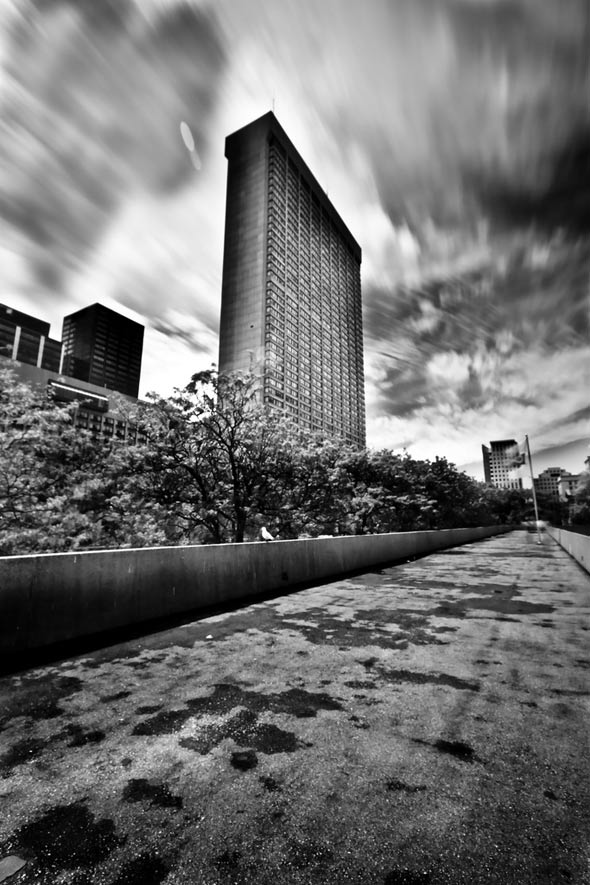
infrared TorontoI have toyed with infrared 35mm film film for years -- that is to say, film sensitive to infrared light. As anyone who has experimented with it is well aware, it can be quite difficult, and film is often wasted. With the advent of IR filters for digital cameras (usually DSLR cameras), the process has become far less complicated -- as long as the photographer is patient.

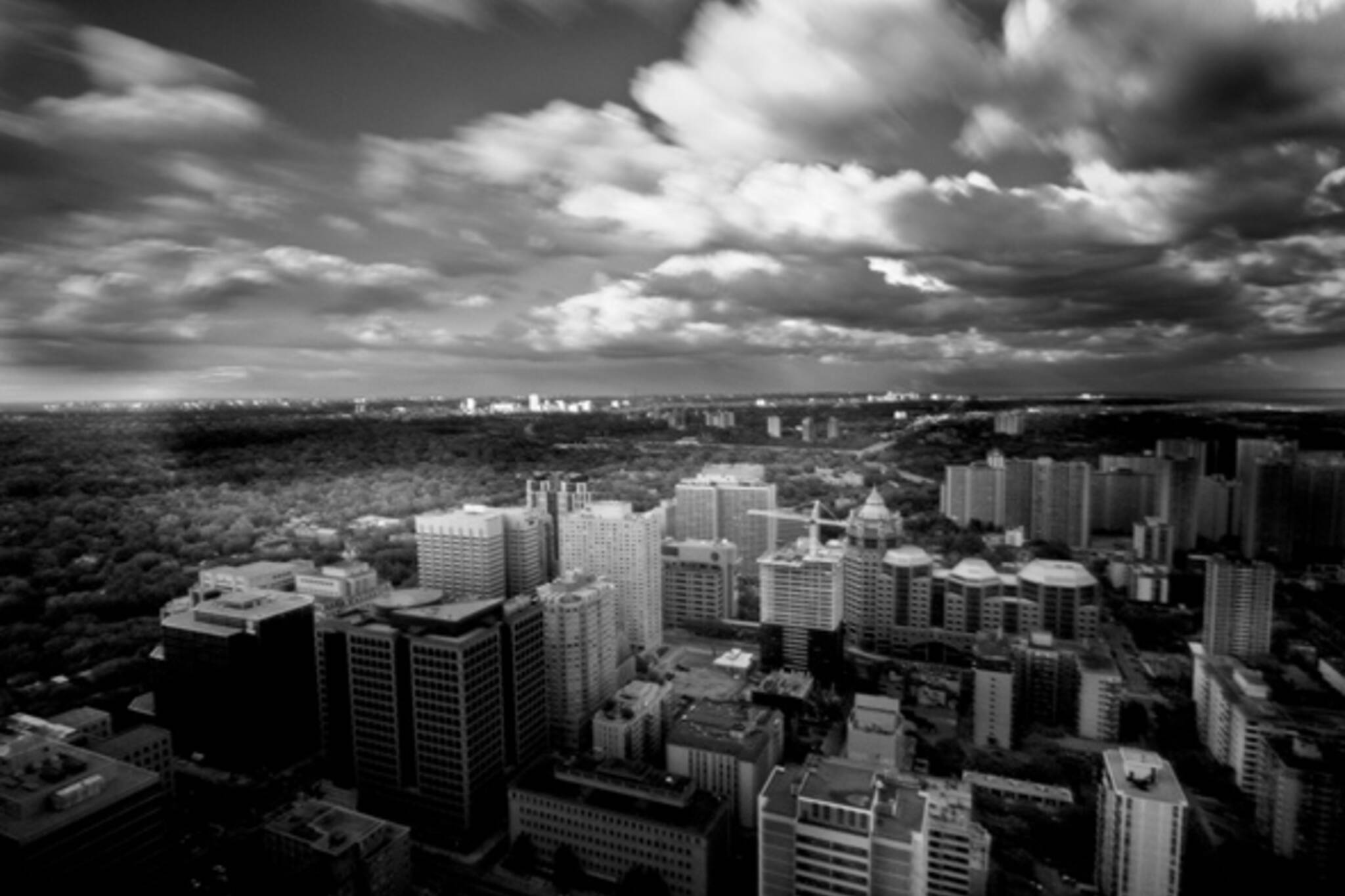
Given my mild obsession with the photographic capturing of clouds who softly contrast our beautiful city, this patience was easily obtained.

The infrared spectrum of visible light is ironically one that is actively blocked on most digital cameras, as it tends to interfere and confuse modern sensors. Removal of the filter -- or conversely the addition of IR filters to the barrel of the lens allows its use, yet requires (in the case of this series anyhow) shutter-times of 1-3 minutes.
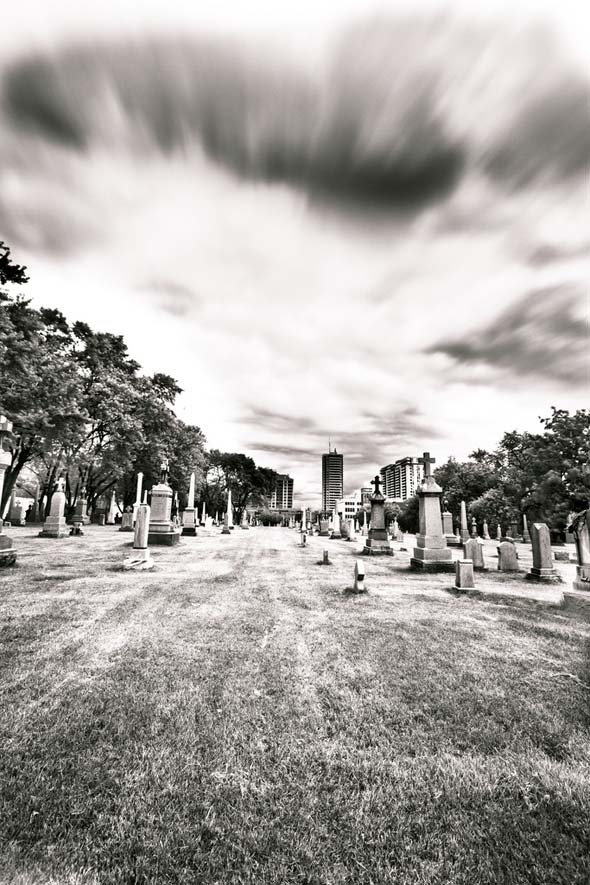
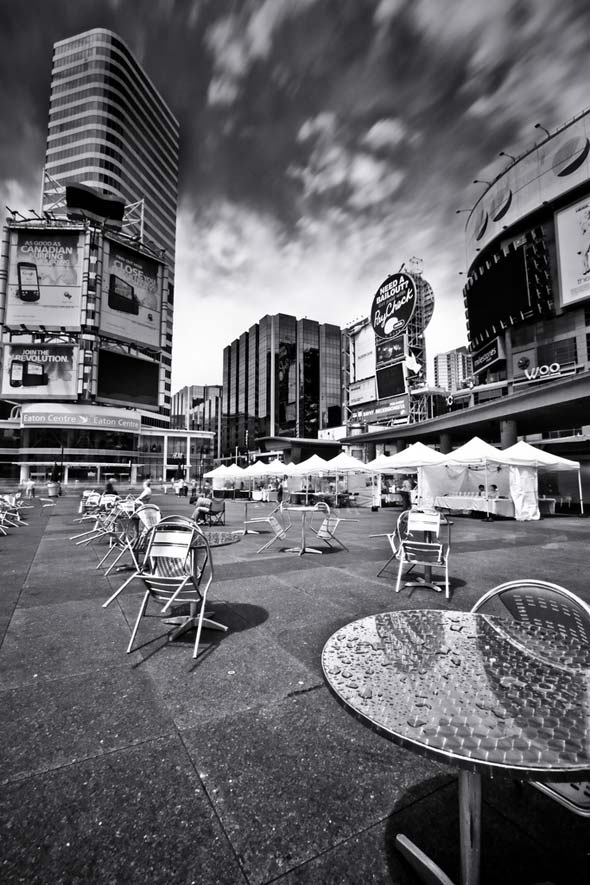
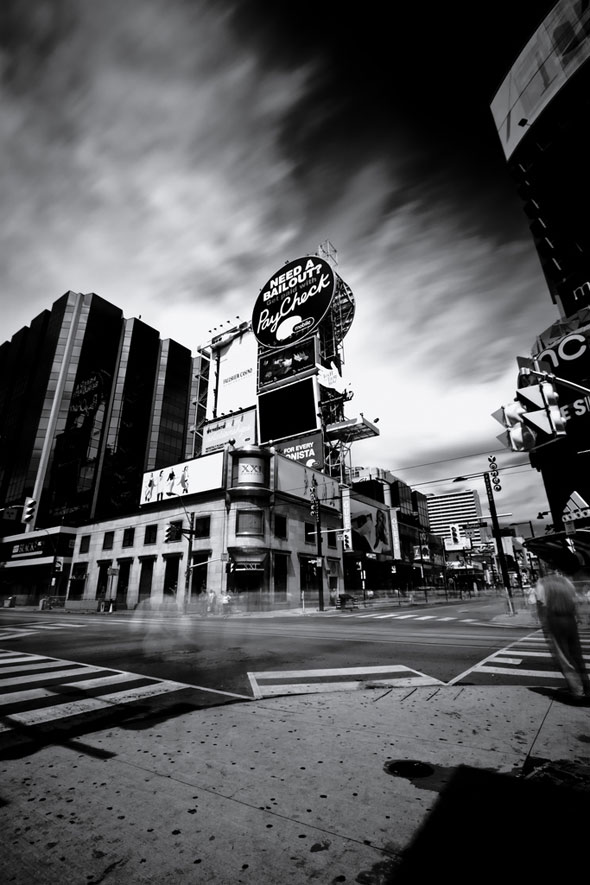
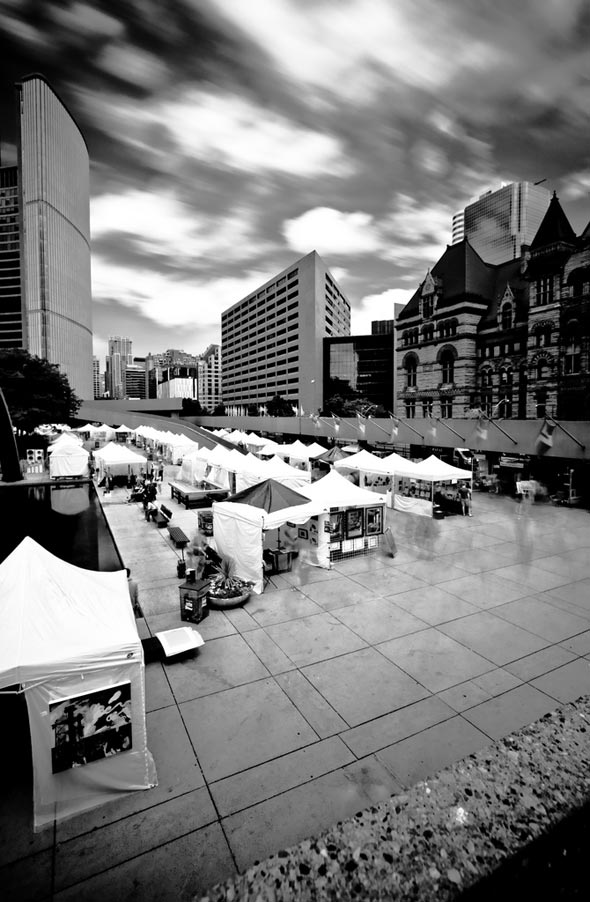
infrared TorontoDue to the longer shutter-speeds, as well as allowing one to avoid over-exposure, one can often capture scenes where urban activity is plentiful, and yet the motion of persons or objects becomes almost invisible...
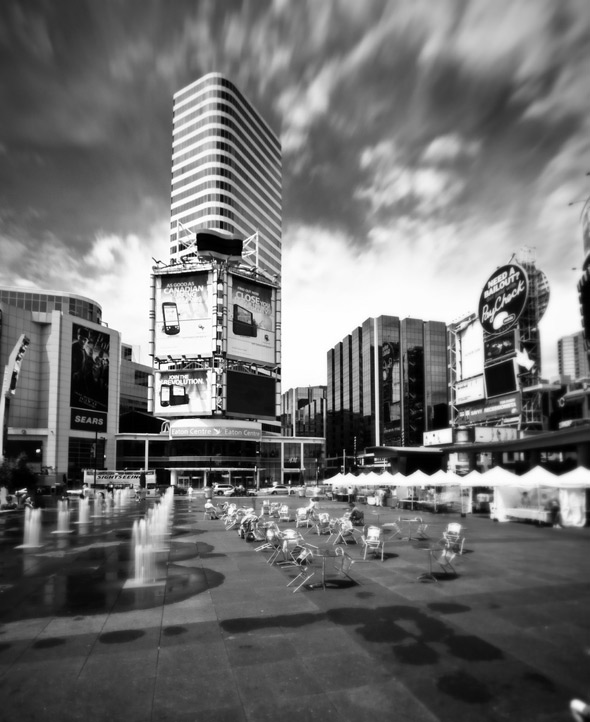
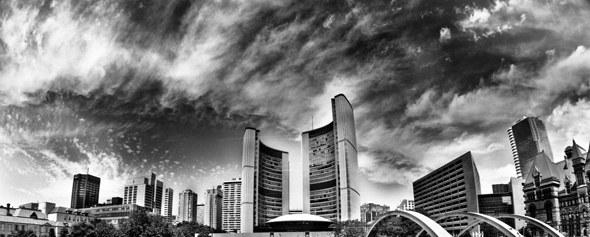
infrared Torontoinfrared Toronto
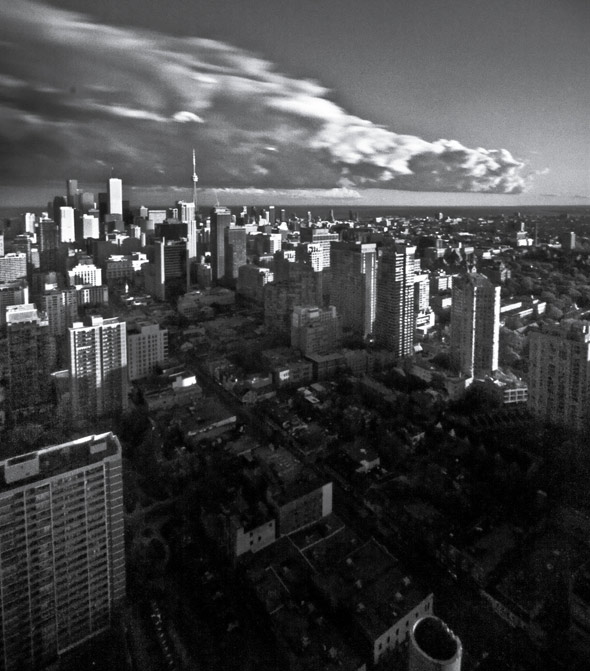
I even employed infrared on several of my 'rooftpping' adventures which I have written about on this site. Let me tell you, keeping a tripod steady on the roof of an unfinished condo at high wind is a very tricky ordeal...infrared Toronto
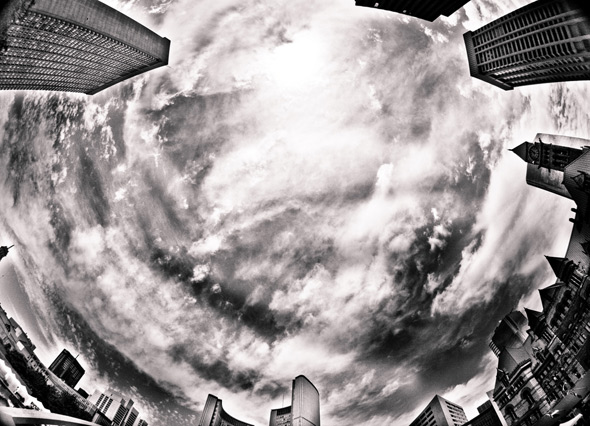
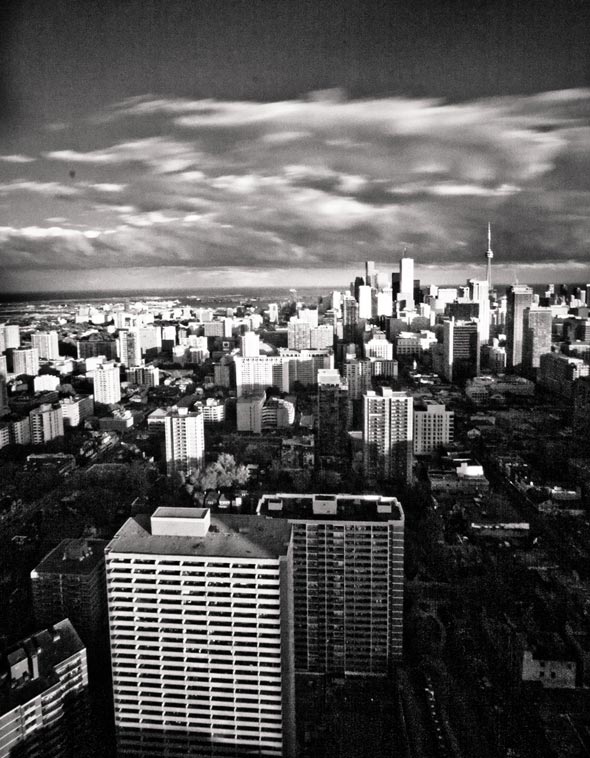
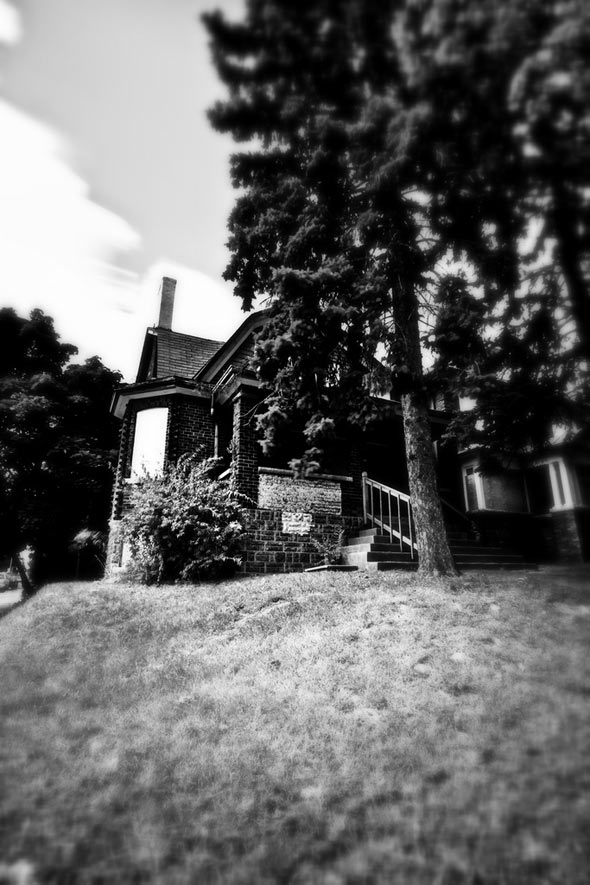
As is capturing an ultra-wide angle scene through a filter which renders a vewfinder almost moot...infrared Torontoinfrared TorontoBuildings devoid of life to begin with take on an almost serene tone (pictured below is one of 13 abandoned mansions just north of Toronto's High Park)...infrared TorontoThe familiar tends to become distinct once again in infrared, owing most likely to the extreme contrast of movement and stillness it is able to capture...infrared Torontoinfrared Torontoinfrared TorontoIt would seem that our impressions regarding visible and invisible light say more about our mind and body's ability to filter than to accept.

Regarding our ability to see the world, contemporary American author Annie Dillard muses "[p]eeping through my keyhole I see within the range of only about thirty percent of the light that comes from the sun; the rest is infrared and some little ultraviolet, perfectly apparent to many animals, but invisible to me. A nightmare network of ganglia, charged and firing without my knowledge, cuts and splices what I do see, editing it for my brain. Donald E. Carr points out that the sense impressions of one-celled animals are not edited for the brain: "This is philosophically interesting in a rather mournful way, since it means that only the simplest animals perceive the universe as it is."" (Annie Dillard, Pilgrim at Tinker Creek, 37).

(To see the rest of this photographic series, as well as high-res. versions of those snaps pictured above, you can visit my flickr slide-show below.)

Discussion

15 Comments

John Doe / April 13, 2010 at 09:57 am
user-pic
With all due respect...

My god these are boring.

When you say 'blase due to repetition', you are hitting it squarely on the mark.

The 'democratization of photography' will be the death of photography.

The 'difficulty' of film, be it cost or expertise kept images out of the market that ultimately had no right to be there in the first place. Sadly, this is not the case with digital.
Loïc / April 13, 2010 at 09:57 am
user-pic
great pics - thanks
ian / April 13, 2010 at 11:01 am
user-pic
Mr. Doe,

You show no respect, intellect or talent. Your post is disrespectful in the extreme, you make incorrect assumptions, and finally you fail to direct us to your own, far superior work. But hey, thanks for coming out.
ian
Gloria / April 13, 2010 at 11:08 am
user-pic
Has anyone offered Jonathan a book deal yet?
I would love to have a collection of his work on my coffee table!
Jo / April 13, 2010 at 11:33 am
user-pic

Wow...Forget you 'Doe'

I LOVE the time lapse skies, and majesty of still(city)life.

Great IR work !

Reminded me how cool 'urban' InfraRed is...Check out the gorgeously detailed textures that are derived from more natural sources as well...

Frank Lemire (BeyondSight.ca)has been into IR photography for years: http://bit.ly/daLZtm

Enjoy

BTW:
click "ABOUT" for his concise and cogent 'statement on IR'
Don / April 13, 2010 at 11:39 am
user-pic
I have to agree with Mr Doe...these photos are insanely poor and gimmicky, and in no way merit a whole article. Probably another of Blogtos friends whom they allow to post whatever they want even though it's not remotely interesting.
Chino / April 13, 2010 at 12:15 pm
user-pic
These are great. Alot of stillness in focus with the sense of movement and time in the background.

Forget Doe and Don. The "death of photography"??? Geez...take yourself a little less serious.
alias / April 13, 2010 at 12:39 pm
user-pic
I don't know what Jon Doe is talking about, there was always bad photography, not just now with the advent of cheaper digital cameras. These aren't my cup of tea, I much like film color IR much better, but cost never kept anyone bad away from photography. Look at all the bad images you see on flickr from rich amateurs using 1ds and 5d mkII's and all that hdr garbage...how do you explain that? Art?
Syncros / April 13, 2010 at 01:37 pm
user-pic
Always nice to see another Infrared photographer working in the city. Jonathan's use of an un-modified camera leads to the extreme long exposures which make his photos look unique. Note how he's turned scenes busy with people into barely visible ghosts instead. The trees don't have the same wintery white look that you often see with Infrared but they're unmistakably Jonathan's work.
Lauren / April 13, 2010 at 03:23 pm
user-pic
Great work! Some of your best are in the Flickr slideshow. Thanks for sharing it.
saltspring / April 13, 2010 at 08:07 pm
user-pic
Very very cool work, Jonathan. Love the cloud and people "ghosts". And, as usual, your composition is very nice.

It would be interesting to compare identical scenes/subjects in IR and "normal" exposure. Can we do that by cross-reffing to other pics on your Flickr site?

BTW, John Doe and Don have obviously been recently discharged from the lobotomy ward after the "2 for 1" special was announced in Neurosurgical Times.
Darcy McGee / April 13, 2010 at 11:37 pm
user-pic
I'll not comment on the photos but I will say this:

A photo shot with an Infrared mode in a digital camera is NOT an Infrared shot.
papa / April 13, 2010 at 11:42 pm
user-pic
lovely pics and great work. very thoughtful. 'mood' is always subjective. but personally, I feel these images have plenty of it.
Jonathan Puddle / April 14, 2010 at 07:59 am
user-pic
Absolutely fantastic work. I'd love prints of some of these.
J / April 14, 2010 at 08:59 am
user-pic
I am not a fan of infrared pictures. Having said that some of these pictures are aesthetically pleasing and do convey a message to me.

However, there are a number of annoying technical issues that I dislike. Many of the photos suffer from bad keystoning, which can often distract the viewers eye. In photography, it is normally avoided unless it can be used successfully to convey a sense of perspective. Here it was not used successfully in that manner. Further, like most infrared photography, detail is sacrificed in favour of the artistic high key look. Given the lack of any real contrast, it is impossible to tell whether exposure was unsuccessful here (many places look blown out) or whether that is a product of the infrared process.

I respect the photographer's vision but don't believe that "art" and "vision" should be a reason to ignore technical deficiencies. It would be unfair to many photographers that spend time refining their craft and paying attention to these things to say that a trendy look trumps perfectly captured images. With all due respect these are fairly average examples of infrared photography.

Great try, I would work more on refining the technical aspects of photography and then move on to image manipulation.

Add a Comment

Other Cities: VancouverMontreal