City
Do You Have to Be Crazy to Ride Your Bike in the Winter?
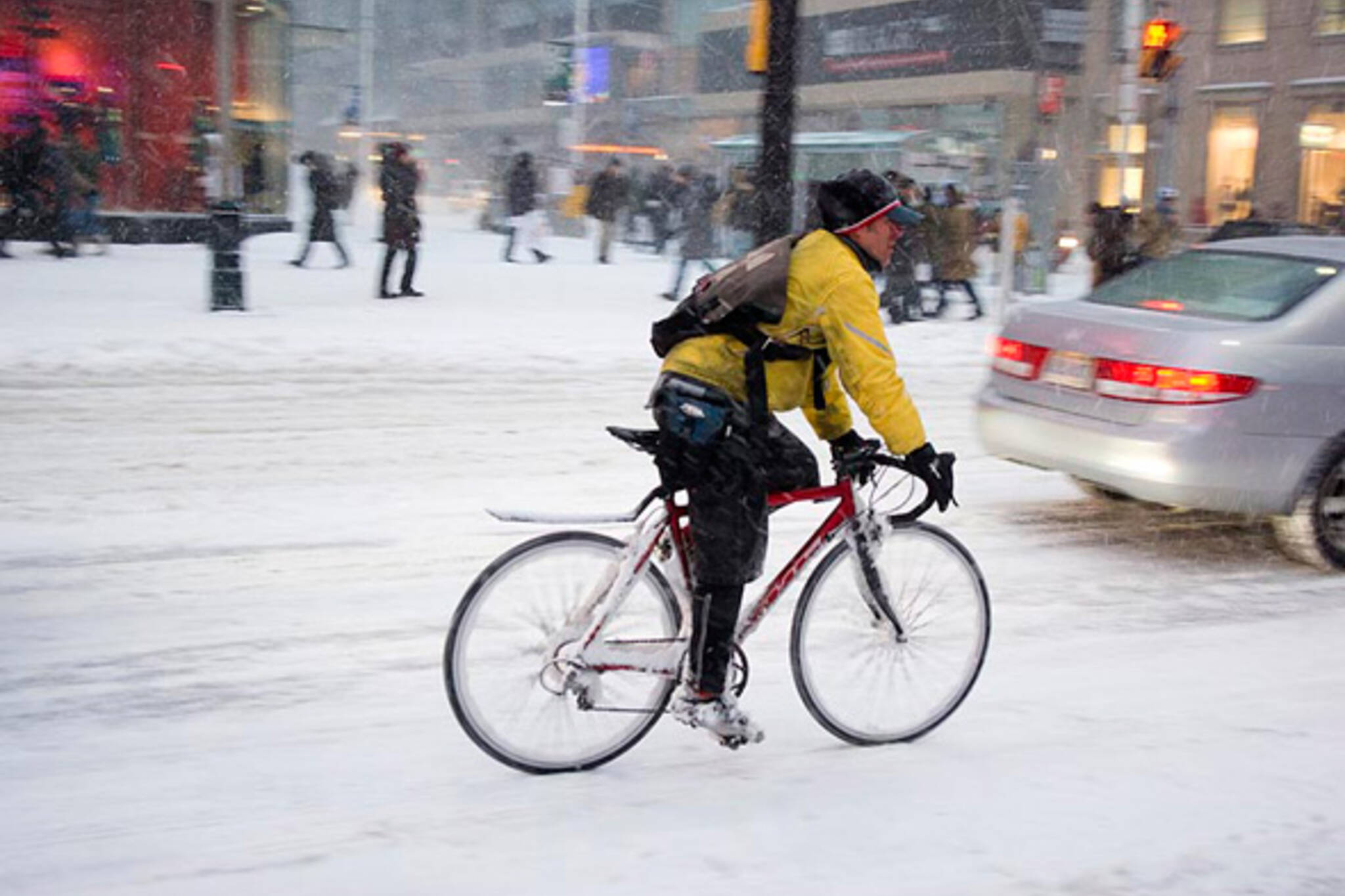
Winter cyclists are a crazy breed. That being said, this is the first year I've ever considered pedaling in the minus degree weather. But I wasn't quite convinced.
I ended-up at one of Bikechain's Winter Riding seminars this week to learn more about winter biking. I left just as skeptical.
Bikechain is the University of Toronto's bicycle resource and repair centre. The space, as expected, is riddled with bikes leaning against walls, tires hanging from walls and bike grease everywhere, including on walls.
There were about four other people who also wanted some tips on winter riding. One of them was Jarlene, a grad student. Like me, this is the first year Jarlene has thought of riding her bike in the winter. Unlike me, she's already doing it.
"I never considered it before because it just wasn't something you did. You know, you put your bike away before the winter and you bring it back out in the spring," she said.
Why did she decide to finally brave winter on two-wheels? "Because everyone around me was doing it." I got an equally unconvincing answer from Elton, who also attended the workshop. Elton was a bike rider in his native India and continued the practice here. "I just love it" was his answer as to why he rides in the cold.
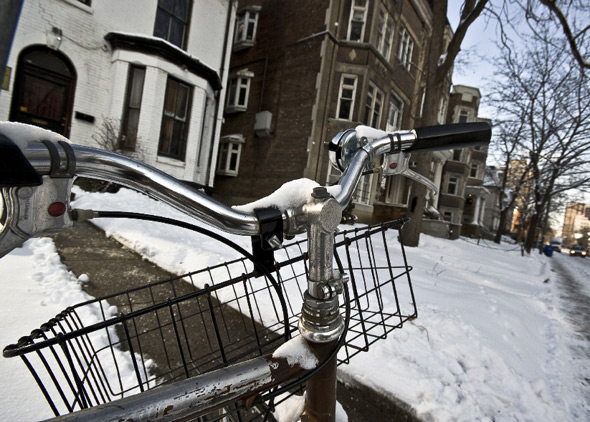
Mathew was Bikechain's seminar leader. He's been a bike mechanic for 18 years and an avid rider for over 20. His first tip for winter riding? Not surprisingly, "dress warm." Then the group shared stories about searing lungs, tear-filled eyes and the joys of sweating in ninja masks and snow pants.
Oh, and the second tip was to expect to fall.
To be fair, Mathew offered a bunch of other guidelines, like how to brake on ice, the necessity of fenders, and the importance of cleaning your bike of snow and salt. But he lost me after his first two two tips. I kept envisioning the cold air damaging my lungs and the prospect of falling into oncoming traffic thanks to a bad skid.
One tip that did stick defied conventional wisdom. Apparently, street tires are better for city winter riding. Mountain bike tires, or as Mathew likes to call them, "knobbies," give you less traction.
Though I'm chickening out this year, it seems like winter cycling is getting more attention in the city. In addition to Bikechain's seminars and their online tips, NOW Magazine Online recently posted their own winter riding advice, I Bike T.O. e-mailed additional guidelines to their list-serve members, and the City of Toronto has a winter riding site that includes a "Reasons to Ride Your Bike in the Winter" sheet. One of the reasons --"It always starts, regardless of how cold it is."
For all you brave and slightly crazed souls who ride all season, maybe I'll see you on my two-wheeler next winter.
Lead photo by sjgardiner, second by Lyndsay Jobe, both of Flickr.


Discussion
45 Comments
Sort By Oldest First / Newest First
Subscribe
I just figure it this way...
It takes me anywhere from 25 to 55 minutes to use the TTC to get to work. That's $3 and sometimes up to a 20 minute wait outside for a bus to come by.
So, I may as well still be cold and get to work in under 30 minutes.
In a reliable fashion. You know, so I don't get stuck on an unnamed vehicle underground unable to call my employer...
One thing that people don't talk about a lot is studded bicycle tires. There are thin ones designed specifically for city commuting - they're fine on bare pavement, skinny enough to cut through snow and slush down to the pavement and when you do hit a patch of ice the studs give you grip. My days of falling on my ass ended when I put a set on my commuter.
But it is getting more popular.
The ttc station is packed with locked bikes b/c the parking is too expensive and walking the distance kind've sucks. So kudos to those who do it.
I used to ride through the winter in Toronto a lot. I'd come home from work and go for an hour long workout ride around the zoo. It was great. The Martin Goodman Trail with snow blowing around you at night is absolutely beautiful.
Lights are important: I had a huge BLT headlight that could have easily been mistaken for a car. Clothing is about layers, yes.
Gloves are the hardest part. When I rode grip shift twist shifters I wore mittens, and it was easy. With Shimano STI shifters you basically need gloves and keeping your fingers warm while preserving your dexterity is hard.
Make sure you have fenders: I didn't, but do now (in Vancouver they're almost necessary) and they keep you drier, cleaner, and your bike in better shape. Change your chain at the end of the winter. It will be too rusted. Use a heavy, thick oil: I used to use Phil Woods (in Vancouver I use Pedro's which is much thinner, but we're only really dealing with rain here. The thick oil helps against the salt and sticky snow.))
I rode a Cannondale mountain bike then. Today I'd probably use a Cyclocross bike. I know some people use skinny road bike tires but I think those knobs on tires work. I'll defer to others who say road tires are fine.
Be especially careful of other traffic, and ASSERT yourself even more than you would in the summer. Get out into that lane so they see you.
Here's a very recent video from Copenhagen that debunks the myth that only crazy people ride in the winter:
http://www.copenhagenize.com/2010/01/copenhagen-january-bicycles.html
Also, thin road tires are terrible because they get punctured easily and I wouldn't want to hit a patch of ice with them. Wider tires are better (and no, they don't' need to be knobby mountain bike tires). Plus road bikes need a lot more maintenance in the winter because they don't always have the same protection on the gears and chain.
What usually brings me down is when I come across poorly cleared refrozen bumpy ice. The studs work the best on these; slicks are suicide.
1) It is faster that the TTC (but then, cycling is almost always faster than the TTC).
2) It is warmer than the TTC. (No standing on the sidewalk waiting 20 minutes for a crowded streetcar. Cycling generates body heat to keep you warm.)
3) It is drier than the TTC. (No trudging through slush puddles or over snow mounds by foot. The bike keeps your feet above any slush or water. Meanwhile, the city keeps main arteries very clear of snow and ice. Even after very large show storms, main roads are often cleared and salted very quickly. The roads might be a little wet, but they are rarely icy.)
4) A couple of times each winter, there will be either an ice storm or a sleet storm. These are the only conditions I encountered in which I'd advise against riding. (Though I still did it.)
5) Drivers (especially TTC streetcar drivers) adopt the same over-entitled and under-thinking attitudes in the winter that they do in the summer.
6) A thin balaclava is your friend, though the easiest way to regulate warmth is to cover your mouth with a scarf.
In all those years, I fell just once, because I'd forgotten about a disused streetcar track on Ossington, which was covered in snow at the time.
Winter riding is not for everyone, but it is a great way to stay fit and save some money. It can be a lot of fun, but you have to get past the people who routinely question your sanity without having experienced it themselves.
p.s. Regarding road tires vs knobbies, one of the fallacies of cycling is that fat tires provide more traction. Traction is achieved by the amount of pressure between two surfaces. A smaller contact point does not mean less traction. Under the same amount of downward pressure, a pin point on a desktop has far more traction than the palm of your hand on the same desktop. Similarly, road tires, if inflated properly, exert more pressure in a smaller contact area on the road than do wide knobbies, thus road tires provide more traction. If you are on ice, all bets are off.
secondly, you have to wear all that gear... i can't really show up at a client meeting all sweaty, my hair flat, needing a shower. i guess if you're bald, unemployed (or employed in a job where it doesn't matter how you look when you show up at 9am) then it's worth a shot, even in winter. but you're crazy anyways.
http://www.theurbancountry.com/2009/11/bixi-is-ready-for-toronto-is-toronto.html
(Unlike Montreal's Bixi program that only runs from May to November)
Also, you don't have to wear "all that gear". I wear the same clothes I would wear if I was walking outside (although I will wear waterproof pants on top of my work clothes if it's snowy or wet outside).
And no, I don't get to the office sweaty because I don't race to work. I take it slow, ride safely and arrive dry.
And I'm not bald, and I show up very presentable at 9AM for meetings. The only thing I put on my head is ear muffs, so I look perfectly normal when I arrive.
Tips for winter:
take up the space you need, don't hug the curb/snowdrift or you'll get hit.
keep your hands and feet warm no matter what
consider a single speed bike - fewer parts to get eaten by salt and covered in filth
road bikes are best, the slim tires really do work better in the snow
Also, you need a job that provides somewhere to change & shower if your ride is longer than 15-20 minutes.
If you are thinking about, try it! It's not as crazy as it looks.
However, the problem isn't the weather, it's the infrastructure. If Toronto had proper bike lanes most of the safety issues around biking generally and specifically in the winter would be taken care of.
cycling downtown is as safe as the cyclist themselves, and any cyclist worth their salt adopts a safe and defensive tack at all times.
as for showing up for work sweaty, clearly you've never cycled before. bikes often come with a thing known as "gears" which --through the miracle of mechanical advantage, allow a person to move near-effortlessly through mosts grades and/or road conditions.
and as for your bald and unemployed comments, I'm not even going to bother...both are squirrely things to say.
Catherine Porter <a href="http://www.thestar.com/news/gta/transportation/article/748469--porter-hard-core-cyclists-do-not-fear-winter">covers the same thing this weekend</a> but is a little more positive. (Wear a helmet, Yvonne - we need you!)
The most difficult part of winter riding is the helmet situation. It's the slipperiest time of year, so you need a helmet more than ever. However, it's the coldest time of year, so you need a thick, warm hat more than ever...
Now cycling in Edmonton, that's a challenge! -30 with uncleared roads, still better than taking the bus!
The best solution for winter riding I found was to ride thin, slick road tires on a fixed gear bike. The majority of falls I took while riding in the winter came from hitting the brakes on a slick surface and having the front, or back wheel lock up causing a dangerous skid.
A fixed gear allows one to slow down a bike without exclusively using brakes, which significantly lowers the risk of a wheel locking up. The slick tires cut through snow well, and help to keep the bike cleaner by throwing up less dirty slush.
Despite what choice of bike one makes for winter riding, the best tips are really to dress warmly, remember to slow down and watch more carefully for hazards.
I also have to ask, how many cycling deaths were in some way the result of winter conditions? I think in the past 5 years we've only had 1 and it was out in Quebec.
Helmets? A thin toque under your regular helmet, and a helmet-cover over it works. This year I am wearing a ski helmet. Works great.
I'm not sure why the author thinks that the reason of "Because everyone around me was doing it." is unconvincing one.
Quite the contrary... it's a great reason because it means that winter cycling is becoming more mainstream.
The TTC is always dead last, so that argument is a non-starter. I used to drive my bicycle in the winter: when I was 15. It was fun, for about 20 minutes.
But then I guess if your employer (assuming you have a job) doesn't care what you look like when you show up, or that you show up 'on time', then have to spend 10 minutes getting dressed over again, fixing your hair and pulling yourself together, I suppose that is okay, too.
As to driver's who feel 'entitled:' we are entitled. We are paying the bulk of the taxes that are carrying this city (my $135 sticker renewal comes up for year 2 in a few weeks) AND we still represent 70% of the transportation public - a clear majority by any estimation.
Cycling is a boutique method of transportation. It's just yet another way for certain types of people to pat themselves on the back and consider themselves better than the rest when, in fact, they just look dorky on their bikes, bundled up in layers upon layers, navigating slush piles, potholes and - 10 degree weather. Good luck with that idea catching on!
I won't make all the political anti-car arguments you can expect... because some people can't hear the obvious. As for cyclists patting themselves on the back? Well... exercise makes you thinner, healthier, more psychologically healthy, and eschewing a car saves an average Canadian about $8K/yr. Then there's all the political arguments...
You want to throw away money to be in worse shape and unhappy, don't be surprised if I am not impressed enough to put up with your awful driving and what you have done to quality of life in my city.
And I'll stack my 2 mile runs against you anyday, bub! Sorry, but most of the cyclists I see wheezing by are hardly the peak off fitness. But as usual, this turns into an 'us versus them' argument. I'll take my heated/air-conditioned, iPod fueled 12 minute drives to work any day, thanks! (I'll bet the cyclist I saw go up and over the hood of a car on Richmond this morning wished he had driven or taken the TTC - too bad he was cycling the wrong way on Richmond and the motorist turning right didn't expect traffic to be heading east!)
We could, of course, just rewind the clock 150 years and give up electricity, the telephone, antibiotics and everything else that makes modern life worth living.
But it's the same usual suspects I see on their bikes this time of year. And most of them are not the healthiest people I know!
The argument about drivers paying for the roads is getting tiresome. Drivers and cyclists both pay for the roads, and both have equal rights to the road (except for the 401, 404, Gardiner Expressway, Allen Rd, 410, 409, where bicycles aren't allowed).
The fact is that cyclists pay more than their fair share for the roads, and are subsidizing the roads for drivers (see this 2004 study by the Victoria institute - http://www.vtpi.org/whoserd.pdf). This doesn't even consider the many utility cyclists in Toronto (like me) who pay the same fees for our cars as you do but choose to leave them at home 95% of the time.
Cycling has a net positive benefit to society (in health benefits and gained productivity at work), whereas driving has a net loss to society (pollution, carbon emissions, gridlock, health, and lost productivity).
One of these winters I might purchase a unit. +1 on checking them out
But this has been debated to death. Cycling is a boutique method of transportation. The stats bare that out. Six percent in the city. Far less in the winter.
I don't see how cycling in the winter is a 'net positive' benefit. Have you seen these guys/gals when they arrive at work? It takes them 10 minutes to pull themselves together - oh, but they pulled onto the property 'on time.' LOL I arrive warm, refreshed, coffee mostly drank and prepared for my day. I can run errands far and wide on my lunch break (even scooted up to Home Depot on my lunch yesterday.)
Sorry, you may be preaching to the choir on blotTO, but the VAST majority thinks winter cyclists are wingnuts. (Not to many bicycle tracks on the Martin Goodman Trail these days either, BTW)
Apparently fads are now things that have existed since the late 1800's and are used by people all over the world (and part of the infrastructure in places like the Netherlands. Oh, but you don't care about the rest of the world now, do you. You can be the happiest man in the world, sittin' in your heated car. Good for you!), you know, just like platform shoes filled with goldfish.
Gadfly, how about one day you and I stand out on the sidewalk and you show me all these wheezing I love how it's always 'wheezing') cyclists? Then I will be more inclined to take your rants seriously.
Have you nothing better to do before and after work than to write silly things on BlogTO posts that relate to cycling?
Did a bicycle kill your pa?
It is not at all crazy to ride in the winter. Some have already posted on this, but that is why the Ktrak has been invented, for people that want to ride, even in the snow.
The 09/10 Ktrak models have enhancements to which include but are not limted to: a 35% weight reduction, a lock out mechanism to ensure greater weight distribution, flotation and traction, larger and addtionaal drive teeth for better track engagement and climbing performance. The original design was for hardcore mtb downhill riders. With the weight reduction the ktrak is easier then what it already was for cross country and pretty much everyday use. For the guy in the picture who is possibly riding to work.
We have the Ktraks in stock in both Canada, Italy, Russia, and Poland. Let us know if you want to take on the Ktrakking experience.
www.ktrakcycle.com
info@ktrakcycle.com