
Exploring New Beginnings at Rankine Hydroelectric Station
The Canadian Niagara Power Company recently decommissioned the William Birch Rankine hydroelectric station. I was invited along with a school of restoration artists earlier this month to pay a visit.
Our Niagara Parks Commission leader jokingly referred to the impressive edifice as 'the building no one ever sees,' as it rests just behind the roadway overlooking the curve of the Niagara Falls themselves - the natural destination of all passing eyes.
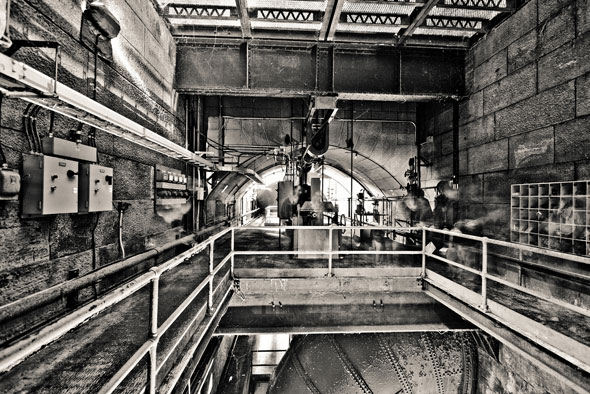
The sheer size and grandeur of the place, coupled with the raw sense of industry (and even this, charmingly detailed) creates a profound impression of space.
As I walked through the turbine hall however, a new sense began to come over me - one of profound sadness. Having recently re-visited a much younger power plant here in Toronto, whose life I had witnessed first hand dwindle from mothballed to utter ruin, I felt that I was witnessing once again the beginnings of a slow and inevitable death.
An ode to the triumph of alternating current over direct current (AC vs. DC) in power, the Canadian Niagara Power Co. began construction of three major turbine stations astride the mighty Falls in the first few years of the 20th century.
The AC power that we are familiar with was the brainchild of Nikola Tesla and George Westinghouse, to the chagrin of genius inventor and marketeer Thomas Edison (of DC fame). One of the other three stations constructed, Toronto Power, gains its namesake precisely because the AC power produced was transferred the distance to Toronto itself.
Because of his crowning achievement, Tesla gained the Niagara Falls Commission contract to produce hydroelectric power from the Falls. These buildings, Rankine in particular, represent the glory of a bygone age.
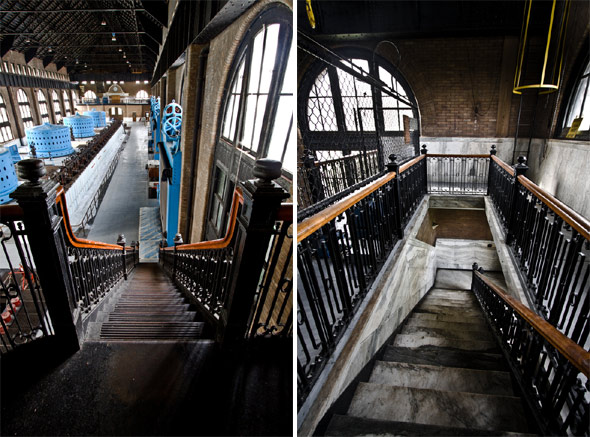
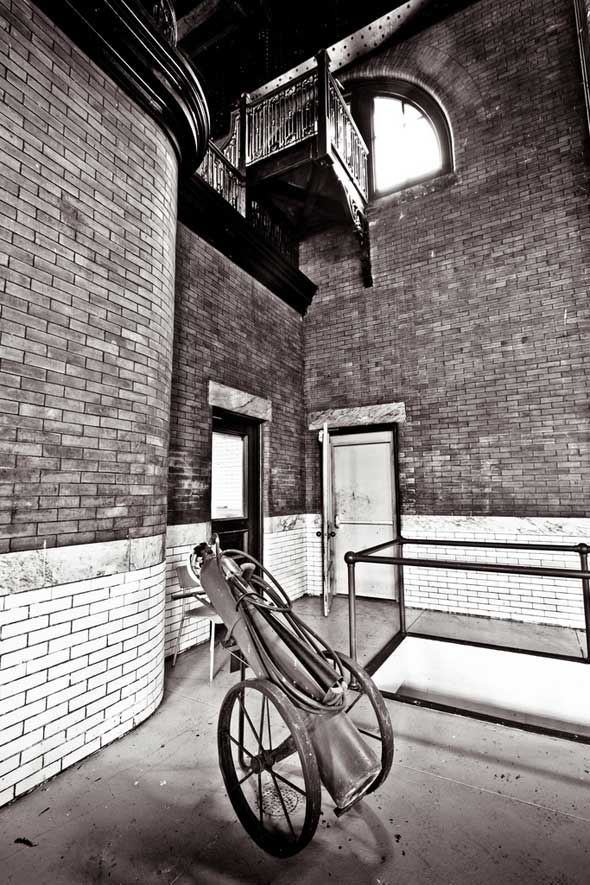
The detail throughout Rankine is exquisite, from the colouring of the machines, to the beautiful stairwells...
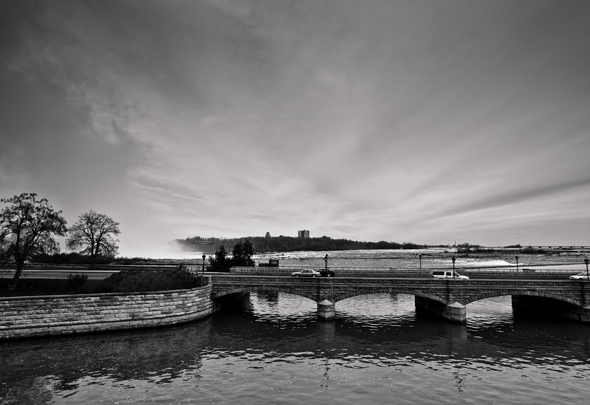
Looking out to the Niagara River and the start of the falls, it is no doubt that the plant goes largely unnoticed by passers-by...
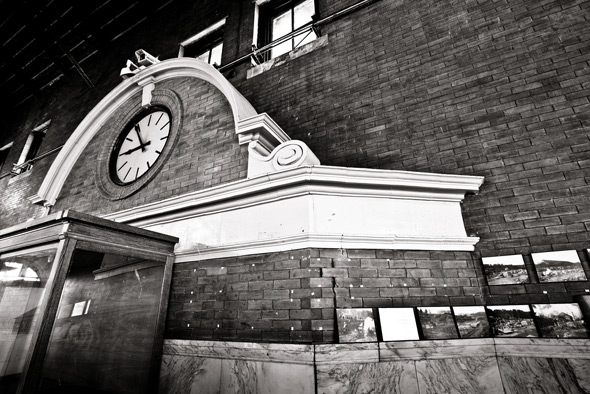
At the head of the turbine hall sits a massive clock overlooking the length of the building; sadly, none of the watches in the place read the same time anymore...
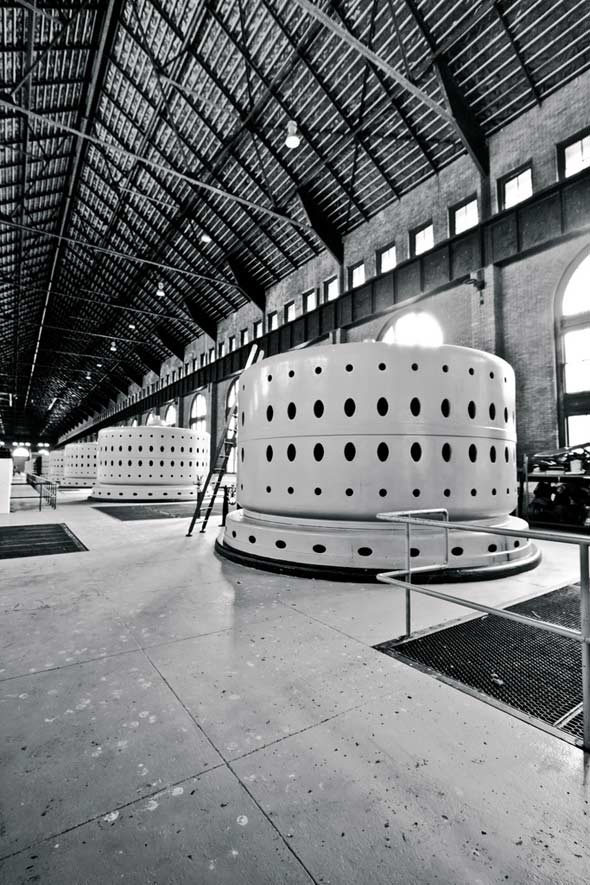
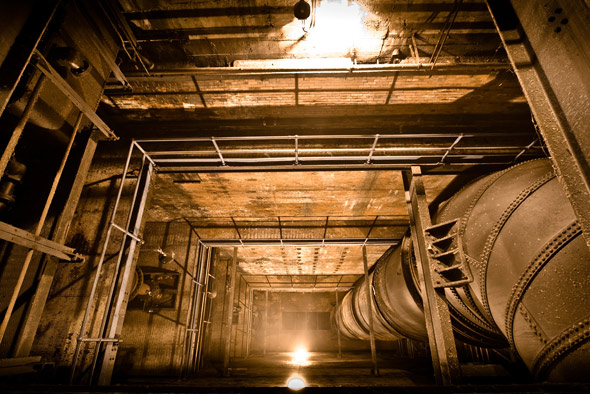
Beneath the shimmering turbine room itself is the cavernous turbine wheel rooms, stretching as far as the building is long, and into vertigo-inducing depths...
The turbine rooms of Rankine are trumped in opulence only by its offices. As our guide explained, the company produces far more than mere energy itself - through their relations with
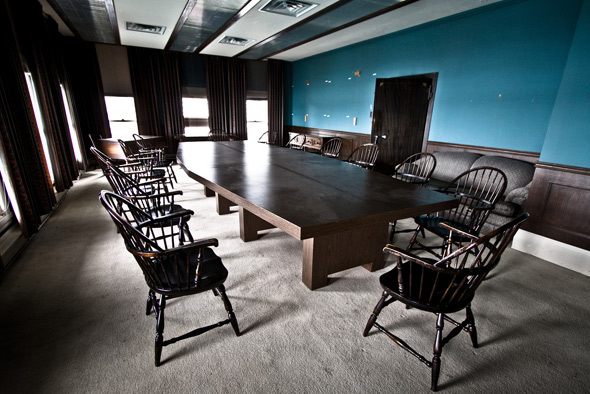
General Electric, they were selling an image that represented items right down to household appliances, so they had to look the part! Selling confidence was a very integral part of selling power itself...
So many details of the lives lived in this place still remains - and viewing the finer details, again I recalled the early days of my relationship with
Hearn, back in Toronto...
Compare, for instance, the image of the control room below with the
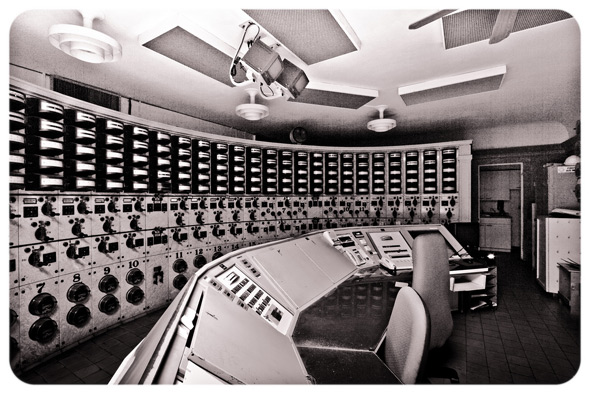
ones I posted a few weeks ago of our own station. The dĂŠjĂ vu I experienced was uncanny; here was I, eigth years earlier...
Or the pristine blue turbine heads side-by-side, next to the
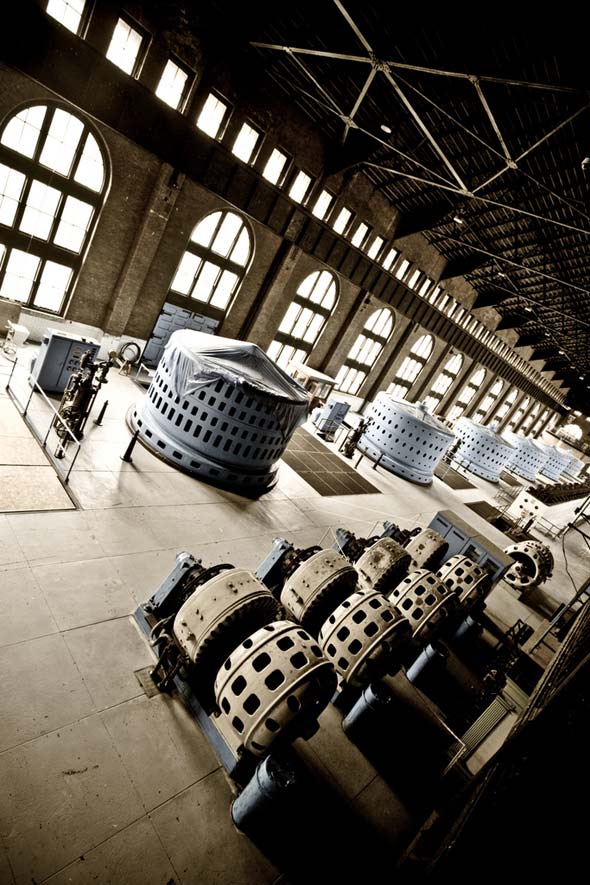
empty concrete husks of turbine shelves at our abandoned thermal station...
At the risk of coming across as an overly-pessimistic building-hugger, I will admit that there is a great deal of hope for Rankine. Only freshly in the arms of the Niagara Parks Commission (hence my visit), there are already gears turbines in motion to protect the site.
I have been reading about, and viewing pictures of this plant for years; my perennial question has always been, why don't they just keep it the way it is, ready-to-hand in case it is one day needed? This question was swiftly dealt with when our host informed us that the company had very recently lost its water rights agreement, and that the cost of transferring to the new cycle was unfeasible. The solution it seems, lies in a completely new life for the plant.
Unfortunately, this potential transition would entail a great deal of compromise: the bottom line, as always, is money. However, if we want to see this beautiful building thrive for another 100 years, major adjustments will have to be made. Ideas of a museum of hydroelectricity have been mentioned, and recently, a very talented young group of students from Toronto's Ryerson University wowed the Commission with idea plans for integrating mixed commercial and entertainment areas into the now silent space.
Saving such an integral and important part of the Ontarian landscape will, alas, come at a price. In order to be economically viable, much of the ethereal sense which the plant currently exudes will be lost.
I tend to view buildings such as these as having an inexplicable essence or soul which draws me to them - especially after the workers have left. One has to realize, however, that they do not merely possess this sense, but are it; the ideas and abilities which built this place are what the social imagination encounters upon entering it. In this manner, these spaces are worth recovering not in spite of, but because they have been all but lost.
Tesla's dream, and all that the production of electricity entails is so fundamental to our way of life, that it goes unnoticed. It is so large that we tend not to see it. In this sense, this mighty beast of industry, so intricately laid, fully embodies that essence, yet consists practically of the materials which we see. A sensitive redevelopment, then, would tend to mold itself after the idea, rather than the form - lest the building itself become no more than another empty vessel.
(To see the rest of the snaps, as well as high res. versions of those above, you can check out my flickr slide-show below.)


