City
Mark This as a Fail For DineSafe as Toronto's Restaurant Inspection Program Yet to Offer Non-English Guidelines
News this week spread of Ruby's final closure thanks to bankruptcy. The popular Chinese restaurant also made headlines earlier this month for shutting its doors after failing two consecutive health inspections.
But would Ruby's have been closed in the first place if Toronto's DineSafe program offered its guidelines in other languages?
Ok, maybe it would have. I'm obviously making a lot of assumptions about Ruby's staff and their English proficiency with that question.
But, on the other hand, the garbage disposal calendar the city distributes has sections in various languages. Or, to use another, more specific example, the city of Toronto's official newsletter comes in 11 languages.
Why, then, is something as important as Toronto's DineSafe guidelines only available in English?
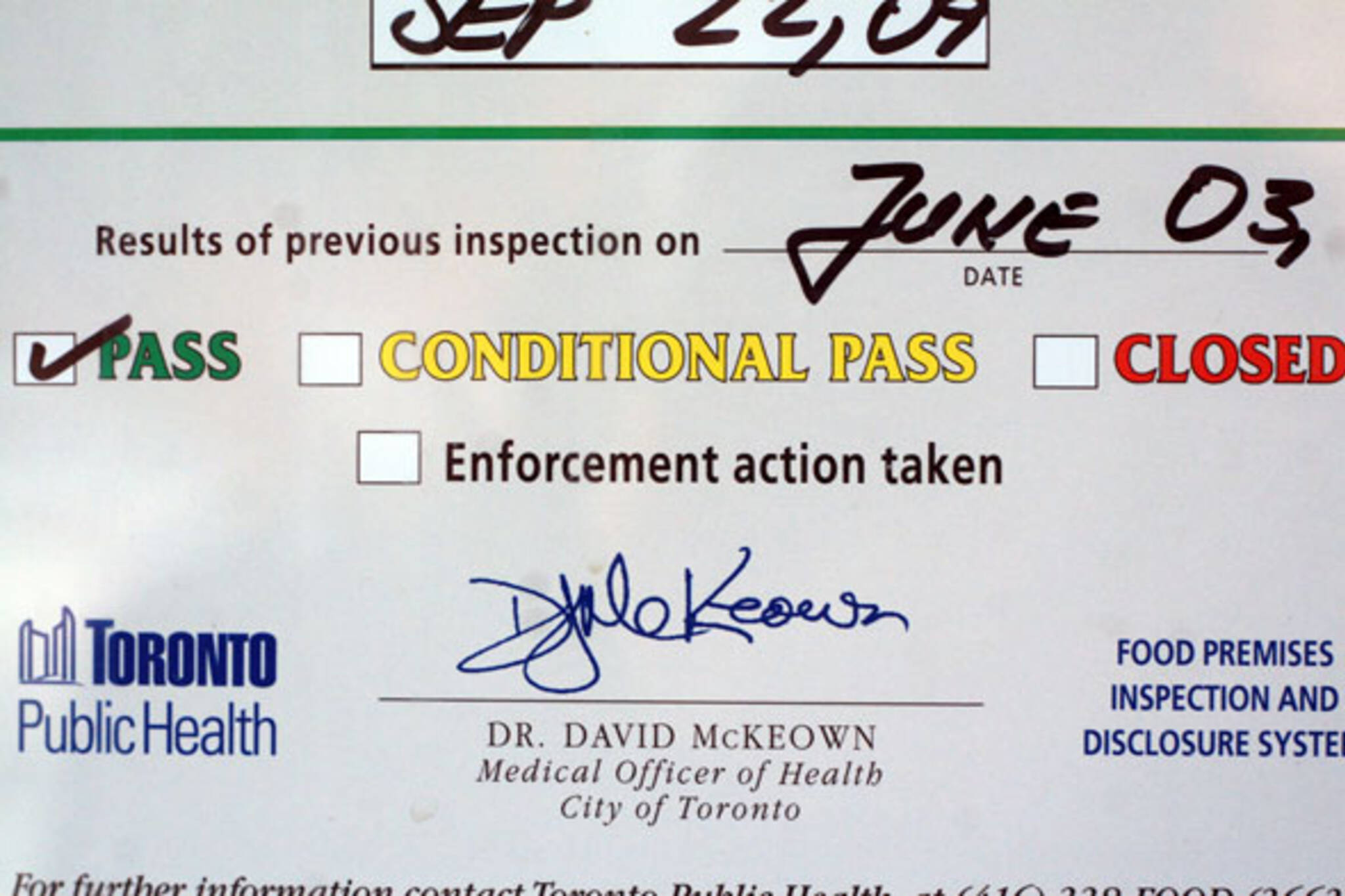
DineSafe launched in 2001 in Toronto, and requires that all restaurants disclose their inspection results to customers. The green, of course, signifies a pass, while yellow denotes a conditional pass and red a failure to meet inspection standards. The city of Toronto's website offers tips on how to pass your DineSafe inspection. But again, it's only in English.
I headed to Bloorcourt to get some opinions. The area is a mecca for yummy ethnic restaurants ranging from Portuguese to Japanese, Mexican, Eritrean, Korean, Indian, Greek and Ethiopian. Everyone I spoke to thought the guidelines should be translated.
"Toronto speaks so many different languages," said Senait. She joined the area seven months ago with her new Ethiopian restaurant Zagol. According to Tourism Toronto's website, Toronto houses more than "5,000 restaurants reflect[ing] tastes, cultures and ingredients from around the world." I assume people in the food industry whose first language isn't necessarily English also accompany these many tastes, cultures and ingredients.
One restaurateur told me he's interpreted food preparation instructions for his staff before. "If you want that traditional food, it's usually the older people who don't necessarily speak English that cook it." He manages his kitchen and is certified in food handling. The city requires that someone with a food handling certificate supervise the kitchen at all times while it's operating.
This issue doesn't just affect "ethnic" restaurants. Look in the kitchens of your typical burger joints. You'll find people from all walks of life, with various levels of English proficiency.
Mebrak, who's been with Cleopatra restaurant for nine years, put it best. "It's important people really understand how to handle food. It's about safety for everyone."
The city can do its share by adding more languages to the DineSafe menu.


Discussion
47 Comments
Sort By Oldest First / Newest First
Subscribe
I dont care what language you speak.
Our laws (http://laws.justice.gc.ca/) are only in both official languages yet that doesn't mean that someone who doesn't speak English or French doesn't have to obey them.
The onus is on the business owner to setup their business within the letter of the law, regardless of who their clientele is.
But "cockroach" and "stanky" are universal.
If I open a burger joint in Shanghai, should I moan and complain that all the signs are in Chinese?
Liars the lot of you's !
Now lets get 99.9% of Spadina restaurants to go "bankrupt" next.
Well said EatMyShorts!
If I open a burger joint in Shanghai, should I moan and complain that all the signs are in Chinese?"
+1000000000000
Sure, let's waste resources printing foreign language materials, training inspectors, etc.
How about fuck the person who's too filthy to bother keeping their establishment up to snuff.
What every happened to "I'm going to run a clean business." Stop assuming we need to pander to businesses that may while that they didn't know you couldn't piss on the customer and stay in business.
The writer suggesting this needs to find a better cause celebre.
If management isn't wise enough to control it's employees or level of cleanliness guidelines, then maybe they shouldn't be opened.
If you want to run a business here, follow the rules, pay someone to translate, ignorance of the law is not an excuse.
I think the rules should stay in the official languages. English is my 3rd language, i accepted that i will have to learn it when i decided I'll live here.
Until restauranteurs are fighting for DineSafe in other languages, this whole conversation is pointless.
Clean is clean. On Mars too.
FAILURE TO PROTECT FOOD FROM CONTAMINATION
IMPROPER MAINTENANCE / SANITATION OF FOOD CONTACT SURFACES / UTENSILS /EQUIPMENT
IMPROPER MAINTENANCE / SANITATION OF NON-FOOD CONTACT SURFACES / EQUIPMENT
IMPROPER MAINTENANCE / SANITATION OF WASHROOMS
INADEQUATE PEST CONTROL
CONDITION(S) FOR CLOSURE: Operator fail to prevent an insect infestation
If you think these problems came from a mere lack of translation, I'm not sure what to tell you.
I understand what you are saying regarding older chefs not speaking English, but surely somebody can translate the guidelines for them if they are truly interested in food safety.
Fail - learn an official language or hire translators.
Respect is mutual.
I too, agree that when we're in Rome we have to do as the Romans do. No excuses. No matter how diverse we are, we have to follow local ground-rules and its language.
Plus, there's absolutely no way a business gets completely shut down for health code violations out of ignorance of the code. The kind of severe violations -- like infestations, non-working refrigeration, etc -- that get a business shut down are common sense, didn't need a document to tell you that stuff.
So, sure, translate the DineSafe guidelines, that'd be a nice service to offer. But anyone who thinks that a lack of translation justifies running a unsafe restaurant has taken cultural sensitivity just a little too far.
They just don't give a shit.
I think it's a huge travesty that my traditional Klingon restaurant failed because the city refused to translate their dining regulations into Klingon!
Not to mention the very act of serving gagH violates several of those laws...
It is ridiculous and rather presumptuous to assume that the language spoken by a restaurant's owner/employees is to blame. To grossly assume that an ethnic eating establishment would have lower sanitary standards than a restaurant run by English speaking staff is actually quite demeaning. Many places in Chinatown are dumps, but that doesn't mean standards in Asian countries are necessarily lower. This kind of viewpoint is not only egotistical but also a blatant display of plain ignorance.
I am bothered by business' that have signs that have no English on them at all. If you come to this country and want us to welcome you, you have to welcome us as well. What if I opened a business and only offered my service to White, English speaking people, refusing to serve anyone non white. That is what business's with no English on them are doing, refusing to serve the country that welcomed them.
How do they follow our tax laws if they can't read English or French? I imagine they are quite creative at tax time. However when it comes to health and safety they speak no English.