City
Clear Sailing Ahead for Distillery District?
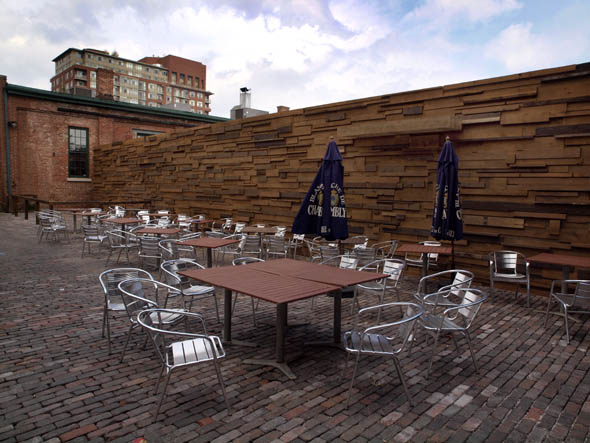
On a humid weekday when Indian Summer sprawls into the fall, thing aren't looking too bad in the Distillery District, the much-hyped reboot of one of the city's oldest and most picturesque industrial landmarks. Patios are still half-filled after lunch, and there's plenty of foot traffic in and out of the warren of stores, galleries and eateries that have mostly filled the old liquor warehouses and vat rooms.
Tenants seem optimistic. Nancea Whitham of Tenacious, a textile goods shop, says that business "is better than last year. I haven't really been affected by the recession." And Nina Jones, who sells stationary out of her shop, Jonesy, says that her year so far has been great, and that despite lingering talk of a recession, "I can see how things are turning around."
It didn't sound so cheerful down here even a year ago, when the first of an apparent string of cold, wet summers dampened foot traffic, and American tourists began evaporating in the first tremors of last fall's economic wipe out. When highly-regarded eatery Perigee closed its doors this spring after almost six years in business, some people expected more bad news. For an area seemingly inspired by the maxim "If you build it, they will come" - or, 'restore it,' in the case of the Distillery complex - it was finally worth reckoning when the "destination" would finally become a neighbourhood.
There's certainly no shortage of horror stories from former tenants, like Craig Urquhart, who ran Artifex Furniture for four years, when much of the site was still under construction. "Given the state of the site, many customers said that it looked like an internment camp without lights," Urquhart recalls. "I understand it was a difficult site to run, but I'm tired of saying that," he says, adding that he and his partner were forced to close down nine months after leaving, having tapped out their resources moving and fighting their former landlords.
Akemi Nishidera runs Kozo, a printmaking shop, on Broadview now, but she spent four years in the Case Goods Building with other artists, artisans and performing arts groups. She remembers security issues, especially on dark winter nights, and fights over signage to draw traffic to the isolated building. She's heard that it "is getting better, but unfortunately for some of us... we don't have the funds to wait for all those things to come in, so there's been some turnover, which is too bad."
Allison Skinner of Distill Gallery is an original tenant, and agrees that things were rough, but that as condo development on and off the site has grown, she's finally getting local regulars, and says she's had her best year ever. "We were in the middle of nowhere and it was a complete construction site. I was the fifth retailer on site and it was horrible."
"But it's been steady growth year after year, as I anticipated," Skinner adds. "In spite of people saying the sky was gonna fall, it never did."


Discussion
35 Comments
Sort By Oldest First / Newest First
Subscribe
You're saying one of the OLDEST parts of the city is inconveniently located?? Wouldn't it'd be more appropriate to call the rest of the city that grew up around it(and to some extent because of it) inconvenient?
Toronto seems to love ignoring its past- just look at Fort York.
We can only hope F.Y. becomes even HALF as useful as the distillery.
I say applaud the good that comes from the development of sites like these, and if you must criticize, provide some useful comments as to how they might be remedied.
This is a discussion board, after all.
Far too many so-called "citizens" in Toronto are more concerned with finding the PROBLEMS in our city instead of seeking the solutions.
That said, the area needs some key things before it becomes anything more than a tourist attraction. That includes a bunch of cheap and fast restaurants (current ones are expensive and slow), an LCBO or Wine Store thats open late, more bars, maybe a hardware store, a book store, late night coffee place.
Currently you have to leave the area and go a fair distance to get any of these things, making the Distillery a place you tour for a couple hours on Saturday afternoon, rather than a place you go to with your friends for a good time.
I WAS, however, saying that comments like yours are all but useless.
Take some pointers from our friend Eric Hacke here, who has a few suggests as to how the area might improve its flow of regular occupants.
Or alternately, listen to Anonymous here, and "stay out of [his] neighbourhood", you "grumpy DB".
and the distillery is a little out of the way. but i think that's part of its charm. to go there you have to make a point of going there--you're probably not gonna just pass by it on the way to someplace else.
It's too bad the city couldn't have done the same thing with parts (or all) of the Massey Ferguson properties and adjacent warehousing in the west end, which has become Liberty Village.
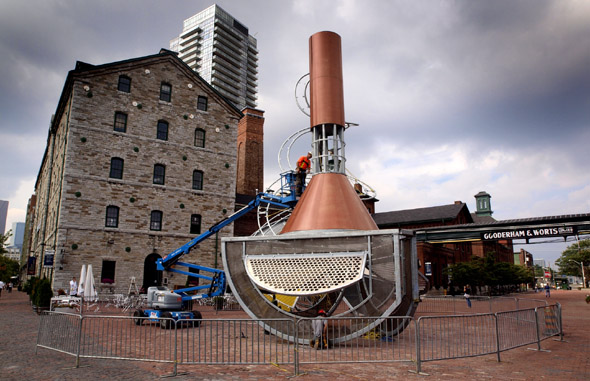
For example the "object" for lack of a better term, pictured above, or the "Titanic scene" recreators the pathway.
But I agree they need a few more restaurants that aren't high end, sometimes I dont want to spend $150 for dinner
It's great in the area, it's full of people as it is, it gets backed up on the brief red light.
So yes it's good.
There is one gate that keeps vehicles out. There are large, ungated entrances on both sides of the gate. None of the other entrances are gated. There isn't even a ticket gate at the parking lot.
jonathan@blogTO
Some people are never happy with where they are.......
Yes it's a bit of a yuppie mecca, and overrun by tourists in summer, but Toronto is a large and diverse city. I think we have room for a West Queen West, a Kensington Market *and* a Distillery. Something for everyone. Rather than deride it, why not celebrate that this area has turned from a vacant industrial wasteland into a dense, lively pedestrian-filled oasis in a matter of only a few years? I think it's fantastic that money has been spent to restore and repurpose these beautiful old buildings that could easily have face demolition instead.
By the way, those criticizing the district for being "gated" are ignoring that you can entry from many sides. The one main gate is primarily cosmetic, and it remains from the historic use of the district as an employment complex. Additionally, those describing it as "empty" or a "ghost town" clearly don't visit often. This was accurate during the winter months a few years ago but certainly isn't anymore: grabbing a quiet pint at the Mill St. pub is not as easy as it used to be!