City
Out of the Car and onto the Bike: Bike Commuting on the Rise
The never-ending bike debate in Toronto and the GTA took another twist this week, with the statistics from Stats Canada's 2001-2006 census report saying commuter bike riding increased by 32% during the five-year period. Adding fuel to the bike-riding fire, Metrolinx said in the coming years it wants to drastically increase the number of commuters who ride bikes to GO stations.
As might be expected, people living downtown were far more likely to take a bike to work than their suburban counterparts. The city provides a map breaking down each area of the city and the percentage of residents who prefer biking to work. For bragging rights--west-enders reign king as bike commuters.
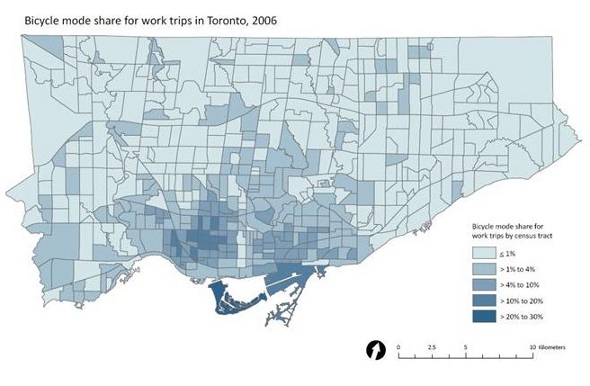
More interesting though is the decline in the number of people driving to work. According to the government's statistics, there was a 5.2% DECREASE in people dragging their car to work. Carpooling must be getting more popular, as the stats point to an 18% increase in the number of car, truck, van, motorcycle, and taxicab riders as passengers.
The most disappointing figure was the slight increase in the number of people taking public transportation to work - up only 1.9% over the five year period. As Toronto continues to grow and traffic congestion worsens, I think that city officials should be looking for new ways to push more commuters to take public transportation to work. A downtown relief subway line or dedicated streetcar lanes would be a nice start.
City officials should take note of the evolving habits of commuters in Toronto. The city's failure to properly install the promised number of bike lanes has been widely reported. I believe the City of Toronto should now be held accountable for this broken promise and implement new policies and strategies that make bike lanes and bike infrastructure (particularly in areas of the city south of Bloor) a reality, rather than a bureaucratic nightmare. And if city officials can't get commuters on bikes (let's be realistic, a lot people can't, or won't, ride a bike to work) it should look for ways to increase ridership on public transportation without being forced to pursue massive infrastructure projects - even though they're much needed.
I am curious what the numbers will show for the 2006-2011 census. Did the massive run-up in commodity (particularly oil) prices force more people into car-pooling arrangements or on to public transportation? We can only wait and see. But in the meantime, city officials should, if nothing else, consider that the traditional method of getting to work (a car) may be slowly on its way out.


Discussion
36 Comments
Sort By Oldest First / Newest First
Subscribe
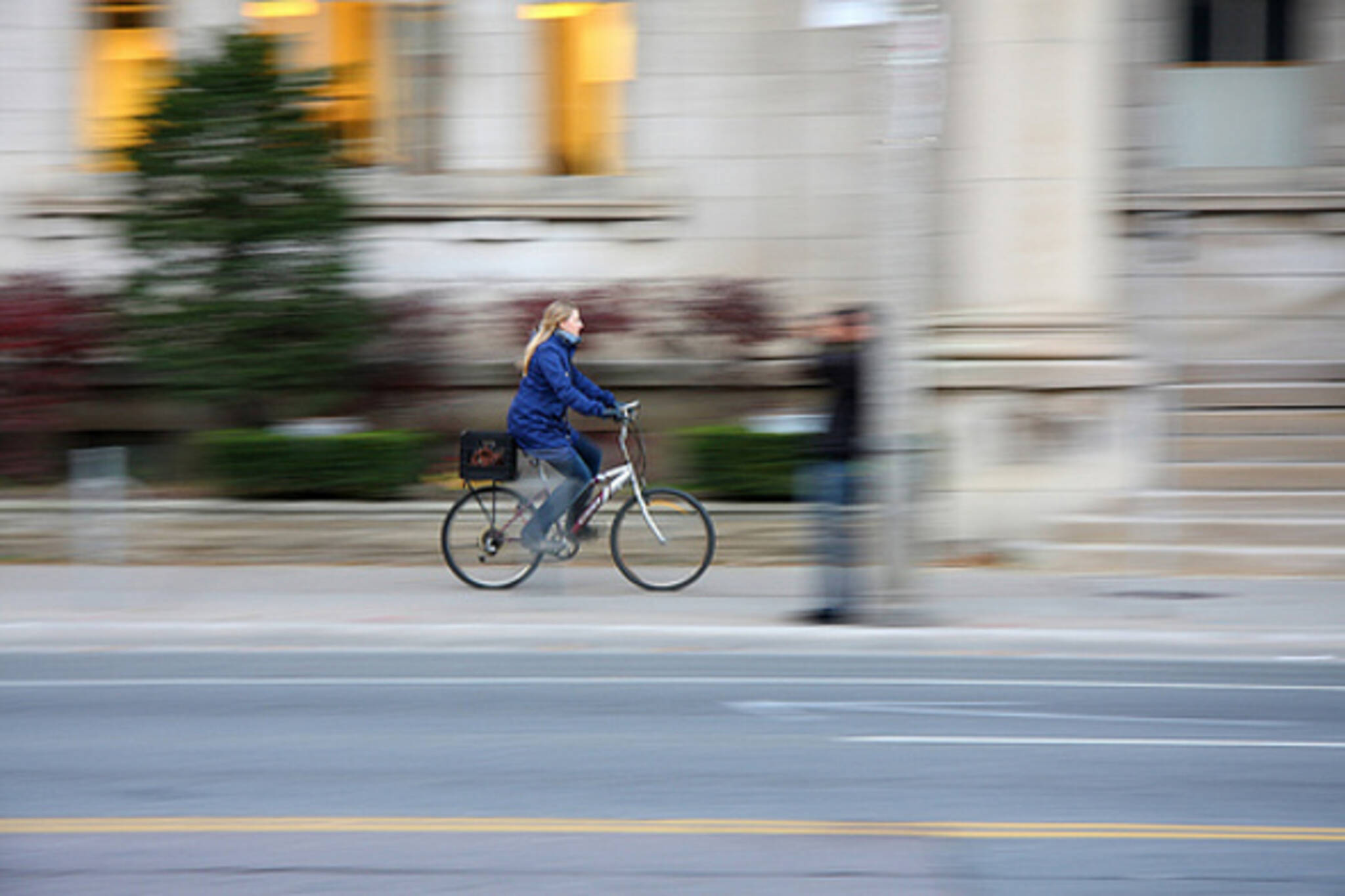
However, am the only one who sees the irony of the above picture? Not only is the woman riding her bike against the flow of traffic on the sidewalk (not cool), but she does so with a bike lane clearly marked on the road beside her.
Cyclists like this do not help the cause.
West enders don't have that limitation.
Ride on!
And another thing...
The only serious congestion that I encounter in my daily routine is the crowd trying to get onto the streetcars on College, Dundas or Queen at 8:15 in the morning. In most cases it's just as fast for me to walk downtown from Little Italy as it would be to take the TTC. On the odd occasion that I've driven to work it's been clear sailing the whole way. There's something seriously wrong with a city's soul when lone drivers can gleefully travel through the downtown core and walking is faster than transit.
The reason you do see them is you use "blinders" while driving. Defensive driving requires you to scan left and right. If you do, you will see them.
Yes, they are smaller and take less space than a car, but they are there. It is their small size in comparison with the car that also shows how beneficial they are. How many bicycles would fit into the parking space of a car? More than you carry when you go to work.
The roads are full of distractions. Get used to it! What you can do is turn off that radio and cell phone. That'll help you focus!
"Cyclists are a tremendous hazard in the winter to drivers". This really made me laugh. Cyclists in winter are the ones taking the risk; their safety is at stake, not drivers'. A cyclist is out there in the snow and cold and you, in your metal box with heated seats, are worried about a "distraction" and having to drive in the left lane? Sheesh, get over it and share the road.
In my former life, I cycle-commuted in both Vancouver and Toronto, and never rode on the sidewalk EXCEPT in bridge underpasses where the traffic below had limited space to begin.
Now I drive as part of my work responsibilities and here's my perspective on cyclists who ride on the sidewalk.
I consider one of my obligations as a driver is to always make sure my intentions are clear, whether or not I see a car/cyclist/pedestrian around: always signal for turns, signal and shoulder check for lane changes, turn cautiously at intersections and drive slowly when crossing sidewalks that intersect driveways.
When I look R, L, then R again before proceeding at an intersection or across a sidewalk, my calculations are based on anticipated speed that a pedestrian (including joggers) would be travelling. If you are going at a higher rate of speed (cyclists on the sidewalk!), then I might not have seen you in my cautious checks.
This terrifies me. If I hit you, your injuries will likely be more grave than the severity of the damage to my car. And it's not that I'm worried about car damage. It makes me sick just thinking about hitting a pedestrian or cyclist.
So as a cyclist, why increase the risk to your own safety!
Any cyclist riding on the roads is taking a risk, winter or not. That's the choice we make. Are you concerned for our safety? That's sweet, but unnecessary, we don't need you to nanny us.
If you're concerned about hitting someone, just be careful and attentive while driving. If that's too much for you, leave the car at home. But don't try to tell me that drivers own the road in the winter and no one else should be allowed on the street. That's undemocratic.
Also, I think its undemocratic and unethical to force anyone to adopt any type of behavior that doesn't immediately and obviously result in a significant risk to others (and don't dumb-down the conversation by making a blanket statement like: all driving is a risk to cyclists and all sidewalk cycling is a risk to pedestrians) and doesn't have widespread (provable) support from the community and city at large. Creating a strategy like reducing driving lanes or chopping back sidewalks to allow for road widening or closing pathways to cyclists when there has not been significant public consultation just creates a polarized and dysfunctional community feeling. Trust the public to make a reasonable choice and trust designers to come up with options that you wouldn't have otherwise thought of. Don't try to protect us from ourselves, just from each other.
I would like to see a comprehensive and open questionnaire of what people really want and how they would act in different city transportation layouts. I am talking about questions such as:
What type of conditions would encourage you to cycle as part of a daily routine (mark ALL that apply): 1a) full bike lane the whole route -or- 1b) bike lane most of the way with small/light traffic streets accessible -or- 1c) don't need bike lanes; 2a) dry roads and temps above 10C -or- 2b) mixed condition roads and temps above 10C -or- 2c) almost all temperatures and road conditions; 3a) a total one-way route length less than 1km -or- 3b) a total one-way route length less than 5km -or- 3c) a total one-way route of no specific length, just based on my time availability; 4a) Good lock-up, change, and shower facilities -or- 4b) Good lock up facilities only is sufficient.... etc... just to get a feeling of what the 'real' population of toronto think and empower them by letting their opinions be counted.
Also add value questions like:
- do you feel that more should be done to increase car capacity, even if bike and transit routes are also increased?
- do you feel that increased density (high-rises over 6 floors) should be allowed at most major intersections to facilitate transport hubs (think of the major intersection in your area to determine if you'd like it)
- if car capacity was halved for other uses, thus increasing your travel time by double or more, would you likely leave the city-region?
- if don't have a car, but could afford one and store it, even if you did not drive it everyday, would you buy one?
.... etc.
It seems that we are only getting feedback from the loudest citizens, not everyone and certainly not a viable quorum. And that's just not democratic.. then we should 'accept' the judgment of the population - not try to change them to a small group's value system of the way the city should be.
That all being said: i would like to posit the idea that the vast majority of people would continue to not cycle in any but the most ridiculous scenarios (warm, sunny days less than 1 km without any cars around anywhere, not to work) and many would choose to not transit if the cost of car ownership was within their range. What should be done in this case? Do we go against the overwhelming majority just because they're idiots and don't know how a city transportation system can function sustainably and how to stay healthy??? Hard call. It would be further interesting to find out how much the city transportation system costs on a per-person basis versus just roads for cars. I don't have any preferences either way, but feel that not enough hard data is out there to be making the kind of decisions that are likely to be made in the coming years. Ideally, we could simply increase capacity and safety for all forms of transportation that showed need for improvement so that no group felt spited. I guess the bottom line is: what would it cost and would people be willing to pay for it? My vote is for more citizen involvement spurred on by easy and widespread polling - now that's good use of taxpayer money.
Then you:
widen (if needed) the roads to 2-lanes each way for cars with proper left turn lanes, add bicycle lanes and those weird little bike-only boxes at intersections, widen sidewalks, create fantabulous and local but not pricey storefronts, allow the old owners to get first run at the housing above, and i bet you the city could make a profit on selling all others at market value, create a few supportive-housing units, and help with jobs in the process. The city just has to become a developer for a few decades. Voila, everyone wins except those few people who can't bear to be without their grade-level homes on a major street and tiny backyards - but sometimes you just have to consider the big picture and the wants of the majority... my 2 cents -> make more space for everyone!!
Its funny and a bit sad but: Mississauga may end up being the role model city with all its space - you just need to increase density and you could have it all - transit, bikes, pedestrians. Just increase the density at major areas with storefront presence.
No shit.
"most don't give a damn about cyclists"
Again, this isn't news to me.
Trust me, I ain't no Lance Armstrong (I don't even know who he is -- some kind of racing dude?) I'm just a commuter, like so many others. I don't appreciate it when people tell me I shouldn't be on the road, no matter what the weather is like. As long as the law allows cyclist to use the roads in winter -- you'll see us out there. Deal with it.
Most cyclists aren't out there on blizzard days but the ones who are (myself included) are willing to take the risk and are probably experienced enough to handle the un-plowed roads.
A few mornings on my ride in through snow-storms I felt I had more control over my bike than the drivers of they're cars.
So as long as cars and bikes slow down to accomadate the different road conditions there really should be no problem.
The cost of dealing with the hazard is shifted from those responsible, that is motorists and cars, to those it imperils (cyclists and pedestrians and whomever happens to be in the way). The fact is (winter or otherwise) motorists are a tremendous hazard to cyclists, pedestrians, and, as the newspaper headlines attest daily, to themselves most of all. Drivers seem to have a much greater difficulty controlling their vehicles than cyclists do theirs; and when they can’t, the resultant harm, injury and cost is of an order of magnitude greater than is possible from that so-called tremendous hazard plaguing the roadways, the cyclist.
A more precise statement of your perspective is this: I, as a motorist, constitute a tremendous hazard to some road users and so they should cede their entitlements because it’s…ah…you know… it’s their fault I can’t refrain from injuring them.
So instead of eliminating or ameiliorating the hazard through infrastructure or regulation, i.e., curtailing automobility’s perogatives, the risks inherent in the technology is externalized, passed on to other road users in the form of less amenity, freedom and safety.
Ironic that the most catastrophic incidents, and by implication, the most daunting hazards, to motorists occur where there are no bicycles or pedestrians at all: the 400 series highways. Irresponsible of all those motorists to expose themselves to such risks, isn't it?
"Ironic that the most catastrophic incidents, and by implication, the most daunting hazards, to motorists occur where there are no bicycles or pedestrians at all: the 400 series highways. Irresponsible of all those motorists to expose themselves to such risks, isn't it?''.now imagine if there were cyclists in the midst of these horrific crashes on the highway, just because they feel have the right to be there, and that the risk is their own to manage.
Reply
Motorists are subject to hold insurance and registration. What of it? These prerequisites do absolutely nothing to ensure greater safety; they're merely part of the apparatus necessary to accommodate the peripheral effects, i.e., widespread material damage and bodily injury or death, of the technology. That cyclists, pedestrians, et al are not subject to these conditions merits not censure but praise: it's an affirmation of their benign nature (relative to autos). Must transportation be injurious, expensive and cumbersome to be considered serious?
It's pertinent to point out that adult cyclists are, by law, NOT required to wear helmets in Ontario. That helmets significantly reduce cyclists' likelihood of serious injury is a contentious issues: both sides claim statistics bolster their arguments. Among the safest cyclists in the world, those in Amsterdam, NL, use of helmets is practically nil -- they just don't wear them. Closer to home, of the two Toronto cyclists killed last year, both, middle aged family men (i.e., not hotdoggers) and experienced commuters riding responsibly (they weren't at fault), wore helmets. Both were riding on sunny days in dry summer conditions on city streets (not highways). Yet both are dead.
I mention this so that you may reconsider what constitutes protection and danger for, and responsibility and irresponsibility in, cyclists. More pedestrians and drivers are killed by motorists every year in Toronto -- a few more died yesterday -- should we mandate that all drivers and walkers wear brain buckets? The surest way to gain security is to eliminate or curtail the threat not accommodate it (with helmets etc.).
I agree with you for the need of greater education -- all round. We can all benefit by this. Period.
My referencing the hazards of the 400 series highways was not an implication that cyclists wish to access them: we don't. It was to underscore that the degree of danger (to all) extant is correlates to the density and license accorded to motorists. Where you find the greatest number of autos operating under the least constraint is where you'll likely find the greatest carnage. Look no further than our highways for proof.
Accordingly your analogy of swimming alongside the ferries in Toronto harbor doesn't hold because that's neither what cyclists figuratively want to do or are doing. But your example, with some revision, serves to make my point. If Toronto ferries were given free reign to berth at the local beach or ply the local waterways what you do think would happen? Recreational boaters, swimmers, anglers -- everybody in short -- would have to give way.
Such unfettered liberty for such a vehicle endangers and limits the freedom of all. Automobility, as its constituted in North America, is largely, an untamed technology: the right to unimpeded driving anywhere, anytime, is akin to a Gawd given right here. The costs of this prerogative in the form of greater risk, less freedom, a degraded urban landscape and ecology, and infrastructure cost is externalized, passed on to others.
DDT your words: "i am not shifting blame...about winter cycling would be that it's not a great idea since the environment, snow wind ice, while leaving cars in a compromised position leave cyclists, without a ton of steel around them, in an even more compromised condition therefore, why risk it and blame drivers for any adverse circumstance."
As a cyclist I do not seek out danger. Decades of all season cycling have informed me as to what constitutes hazard and how to best avoid it. I don't cycling if conditions warrant but too frequently the sole reason is the danger imposed by motorists. And when it does I do as we all should do: direct the blame at those responsible.