City
TTC Unveils its Plan for the Future - LRTs
The Toronto Transit Commission (TTC) is pitching a new plan and redefining their acronym to dramatically change the way our city transit system operates. They're calling it TTC - Toronto Transit City.
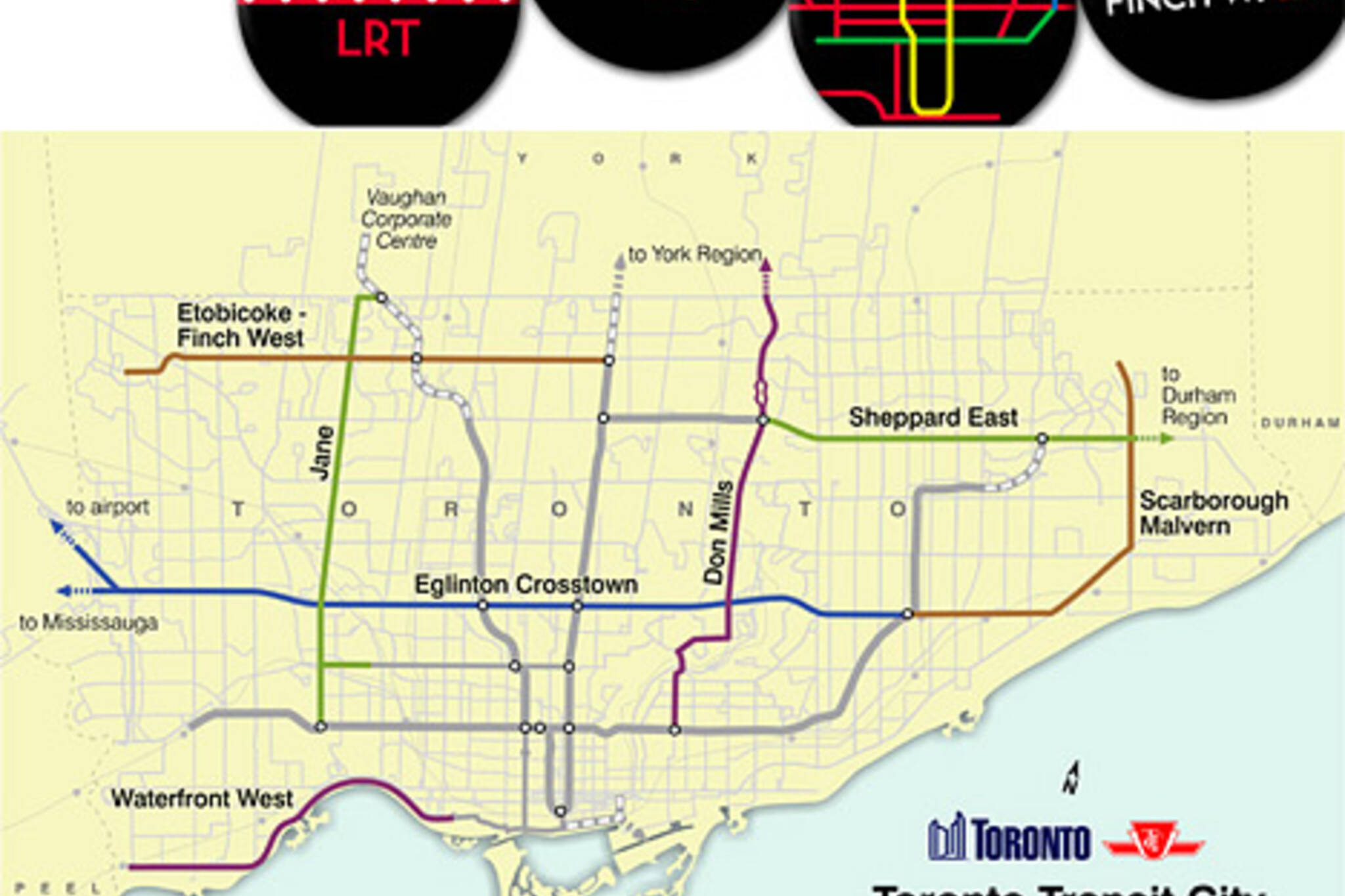
What's the plan? The elaborate, expensive, and complete plan calls for a vast web-like network of above-ground Light Rail Transit vehicles (LRTs), mostly operating within right-or-way (ROW) lanes, to connect the far corners of the city to existing subway routes.
Citing the obvious problems of pollution and climate change, the isolation of communities (and the airport) surrounding the downtown core, and worsening traffic problems on our roads, the plan appears to be well thought out, and the results (in theory) effective.
But how much will it cost? When would it be completed? How will we pay for it?
The seven corridors suggested for the Toronto Transit City Plan - Light Rail are:
* Don Mills - Steeles Avenue to Bloor-Danforth Subway
* Eglinton Crosstown - Kennedy Station to Pearson Airport
* Etobicoke-Finch West - Yonge Street to Highway 27
* Jane - Jane Station to Steeles West Station
* Scarborough Malvern - Kennedy Station to Malvern/Morningside
* Sheppard East - Don Mills Station to Morningside Avenue
* Waterfront West - Union Station/Exhibition to Long Branch
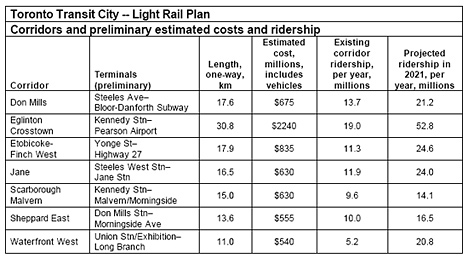
Proposed LRT lines, estimated costs, and ridership projections.
The entire project adds up to:
* 120km of track to be laid at $30million/kilometre (about 1/10th the cost of underground subway)
* 240 light rail vehicles
* $6 billion in capital required for construction and the vehicles
* 15 years of work
The plan relies heavily (an understatement) on funding from all levels of government.
The full report can be accessed here (pdf), and more info and extensive discussions found on the Spacing Wire.
(images and chart: transitcity.ca)


Discussion
39 Comments
Sort By Oldest First / Newest First
Subscribe
Elevated tracks (like monorails) cost a lot more, and might be required in some sections of the city, I presume.
The LRTs might be skinny vehicles, and only take up one lane on existing roads? I guess the use of the LRTs (and hence reduced car traffic) is supposed to offset the space taken up by the ROW lanes?
This will alleviate some of the distress on the subways system. People will not take the subway now if they can take an LRT across part of the city. Especially those folks in Etobicoke and Scarborough.
It will also allow the subway ridership to grow (becuz it will take riders off the subway).
The whole idea is to make it easier to get around. The more riders means more money which means more cars. Especially if the TTC moves to automated trains we can move the subways quicker.
some of us will not like the changes, but the city needs to be upgraded.
I don't think any of these plans will go anywhere. Under Miller's rein TO will continue to be insolvent, running up the deficit .5 billion per year in office (currrently at 1.5 billion) and hope that no other level of government is prepared to bail TO's incompetent city council out.
My final comment is on jobs, and the lack of jobs in the city core. TTC riders have to have a destination, and unfortunately jobs have and continue to migrate out of the city. Public transit funding should be devoted to the areas at the city's edges. There is absolutely no point in building any infrastructure within the core, the existing infrastructure is sufficient.
Furthermore, subway construction costs over 10x as much as LRT implementation. It's looks nearly _impossible_ to get $6billion to fund the ambitious LRT plan... imagine trying to to fun a $60billion upgrade!
Although subway construction is expensive, in the long run it is far less costly to operate. When was the last time they had to tear up the subway to re-build it, but this is an ongoing issue with streetcar tracks, every 10 years. Subways are also far more efficient method of transit, and this will pull people out of their cars, if they can shave significant amounts of time off their trips. Surface vehicles simply can't compete with subways. If the TTC had concentrated on expanding the subway system, instead of wasting money on streetcars, adding a couple of subway stops a year, the cost would not have been/be prohibitive, and we would have a much better system in the long run.
Newer, smaller, lighter, and much faster right rail vehicles are now out there. Putting them in dedicated lanes and making stops 500m or more apart makes for light rapid transit.
Spadina Ave is the model the city is talking about, and it's a pretty poor model. There are dedicated lanes, synchronized traffic lights every 100-200 metres, and it still only moves people at a rate that is about twice as fast as walking. You can put whatever vehicle you want on the track and call it whatever you want, but it will still be a streetcar.
We haven't even talked about cost of these new cars and track. The estimated cost of a new streetcar is 1.5 million, compared to a new subway car at 1 million, and a diesel bus is around 1/4 million. Add to this the track upkeep costs of 100K per year per km (estimate based on 1km = $1.5 million to construct, and it will last 15 years - very optomistic). So if the city adds 120km of track, then they will have to budget an additional 120 million a year for track maintenance alone. There are already 300kms of track, so the total annual upkeep for all the track will be close to 1/2 billion dollars a year. And you thought your taxes are high now!
All projections are based on ridership increases as well. What happens if this does not occur? With streetcars I can guarantee ridership will not increase, so the existing customer base will have to pick up the tab. How does $10 a fare sound?
The Spadina ROW line runs along one of the busiest, densest streets in the downtown core, and joins the Annex to Queen West. It's slow because of the volume of passengers, the high number of stops separated by short distances, and the high number of traffic lights.
These new LRT lines are similar in that they will operate on the surface and within their own dedicated lanes. BUT they'll differ greatly in efficiency because they'll be running along streets that are not at all like Spadina in the core.
In regards to the ROW on Spadina, do you think St. Clair is going to work out any better? What about Eglington, is Eglington not congested today? Are there not traffic lights every 300 to 400 meters today? The city will have to slice that length in half, to allow vehicles to cross the ROW. Businesses will still be furious.
If the plan is to run the Finch line off -road then, this line will work! It should be the line the city starts first. Most of the jobs in TO are now situated around the corridor of the 400 series of highways, and Finch would be a good point to build a real "LRT" off-road.
Although the plan may look good with respect to financing and attractive to many, it still will not solve the problem of congested mornings on most of Toronto's streets. I completely agree with the 3rd post just above me.
Digging tunnels is expensive, building underground stations is expensive, and the whole shebang costs more to operate and keep up than on-street LRT. If you're going to go to the trouble of doing it, you'd better be doing it with heavy rail, the capacity of which isn't required on the routes under discussion.
Your other argument is that streetcar tracks need to be repaired too often. But, if each km of track is 1/10th the cost of a subway, and the track lasts for 10 years, then you should be able to repair the track many times before even coming close to the cost of the subway.
Your other arguments are flawed too but I won't get into it.
The winter factor also affect how many people use the TTC. Waiting outside at -30C versus in a subway station.
I support streetcar use. But I believe for the longer run, we should make our financial commitment to subway development on an ongoing basis. For the short run we can consider prvoding ROW bus services along Eglinton or Don Mills. But we should aim to extend and link such long route to our subway system.
Cities like Montreal, NYC, London and Paris have a good subway system. We would, one day, be able to have ours as well.
Bravo to the new York U line!
Jerrold: LRT vehicles may be a lot of things, but they are certainly not smaller than "cumbersome" streetcars. They are bigger, they are faster, they have more capacity, they usually run in trains of more than one car, their internal seating layouts are usually closer to trains than buses, and are better suited for longer runs.
That's good! Faster means more people will fund LRT trains useful, more people will take LRTs and leave their cars at home. Bigger means the trains will carry the capacity to move all those new riders. Longer runs mean a bigger pool of potential riders. All good things.
Will everybody abandon their cars? No way. But any decline or even lack of an increase in cars on the road will help those that remain in their dinosaur burners. And it's been proven that trains get higher ridership than buses.
What you really want are totally separated rights or way, but failing those being available, reserved lanes in the center of the street are the next best compromise, and they allow riders to patronize stores on the street and connect with their own neighborhoods the way that subways DON'T. There: one advantage of streetcars over subways.
Ottawa had a thriving and profitable streetcar service up until the ascendancy of the automobile put it out of business in the mid 20th century. Ottawa has nastier winters than Toronto does -- they coped with track sweepers.
Winnipeg, for heaven's sake, used to run streetcars, and that's a city that might actually get down to minus 30.
Until there's a direct rail link from Union to Pearson, everything else should come secondary.
On an unrelated transit note, what is with leaving a gap between the ground and glass walls in bus shelters? It's murder when you're wearing a skirt. Thanks for freezing my knees and ankles, TTC.
Shirley said: "They have to dispatch servicepeople to manually dig snow up to keep it running. For shorter line, it is doable. It would not be as practical for long lines like Eglinton, crosstown."
The Eglinton LRT, as currently proposed, would run below grade between Laird and Keele, essentially making most of the line an Eglinton Subway Lite.
People should really read the report before they start sniping.
wait... Dave throws lousy parties. All he ever wants to talk about is building cities and leveraging development.
New money will only generate new ridership if it goes where the new riders are. the perimeter of the city.
Maybe we cant build in Mississauga or Vaughan but we can build up to it and let their buses connect with ours at decent stations instead of desolate corners where the arbitrary borders happen to be. There is so much territory dispute between transit systems it is ridiculous.
I don't mind paying the extra money as long as I'm not forced to take 4 buses and be dropped in barren wastelands for 30 minute waiting times.
Toronto is freezing for 5 months of the year!!! Who wants to wait in sub zero temperatures for streetcars?
The thought of it just makes me want to get into my warm car.
What we need is more subways in the downtown core!
Why can't our politicians see how important this is. We need to start a protest or demonstration or letter writing campaign to raise public awareness on this topic. We need to stop accepting such insane, ridiculous ideas. This is our city. We live and work here. We deserve a proper subway system, not this ridiculous idea!!
This plan is desperately needed to connect communities to the rest of the city that currently sit in isolation.
The cost is reasonable - it also includes the purchase of vehicles.
The maintenance cost will be much lower - the tracks can be built for streetcars-only and won't have to include support for cars and big-rig trucks, which tear up the concrete and over time disturb the track foundations. (for evidence check out the condition of Spadina's tracks - it's been over ten years and they're still in mint condition)
Also, the cars they'll be using are much, much lighter than the current fleet and will wear the tracks much less.
As for the cold factor - the routes are scheduled to come often enough in most places that people shouldn't be waiting in the cold for more than 5 minutes. And hey, maybe it's time for someone to come up with a new kind of transit shelter that protects from the cold. Maybe a heated one? Using the momentum of an approaching streetcar to power an electric heater?