Tech
Does anyone in Toronto use QR codes?
When I was at the South by Southwest Interactive festival in March 2010 I noticed something different about the namebadges. They still had a person's name, photo, and Twitter name, but this time they also had a funny-looking bar code that kind of resembled a tech geek's Rorschach test. The code is called a QR code (which stands for Quick Response code), and in this case it allowed attendees to scan the code to immediately receive that person's contact information in their smartphone - no annoying business card exchange required.
QR code technology has been around since it was developed by a Toyota subsidiary in 1994. Since the explosion in popularity of mobile technology and social media the codes seem to be popping up everywhere, allowing companies to link to multimedia content on the web, or to content on mobile devices. Other mobile technologies including location-based app Foursquare have seen tech-savvy early adopters jump on board but have failed to hit mass adoption. But companies large and small, many of them in Toronto, are betting that QR codes are the next great marketing tactic.
QR codes are popping up everywhere - from a Kylie Minogue music video (the code linked to the word "love"); to Christmas wrapping paper that links to holiday videos; and even wall paper made by Canadian company Rollout (just in case you think the codes need to be plastered all over your living room).
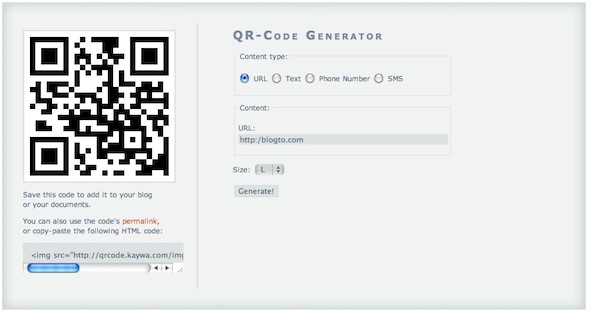
They're becoming so ubiquitous because you can generate them easily, put them anywhere, and link to anything you want. You can create a code yourself in about 30 seconds by going to one of many QR code generator sites and linking a code to a URL, text, or other multimedia content. You can then save the code and add it to your blog, your company's documents, or anywhere else you want. Maybe you include it on your company's brochure so people can link to your website, or take a cue from SXSW and make your next event a little bit more interactive.
For someone to read the code they have to have a QR code scanner application installed on their mobile phone, though there's no standard app across all platforms as of yet. Users simply open the application and snap a photo of the code, and the content is then delivered to your phone. And when I say simply I mean you have to hold your phone extremely still to capture the code correctly - something that wasn't exactly easy at a crowded SXSW party.
Some Toronto companies are leveraging the technology and introducing it to traditionally offline industries. ClikBrix is a QR code and mobile web solution for realtors and brokerages, and allows prospective buyers to scan codes on For Sale signs to get more information about the listing. For a monthly fee agents and brokers create property listing mobile webpages, which are then associated with a QR code.
"We built Clikbrix to help real estate agents easily take advantage of the explosion of mobile users, as well as both energize and reduce volume of printed materials by making them interactive," says Ted Geatros, a partner at the company. "Clikbrix enables real estate professionals to meaningfully stand out in this extremely cluttered marketing space."
And it's not just small companies who are using them. RBC recently introduced the technology as part of its sponsorship of the Tim Burton exhibition at the TIFF Bell Lightbox. The company sponsored the audio guide, which is available by scanning one of the QR codes located in the exhibition.
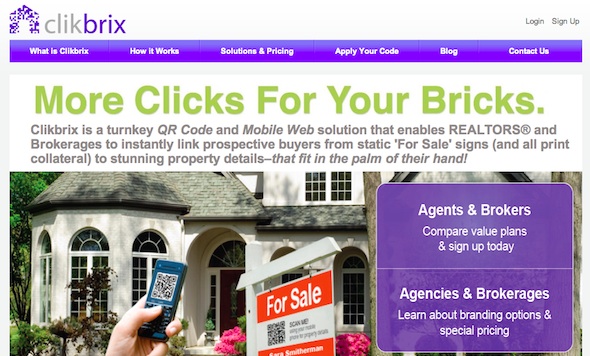
But I'm going to venture a guess and say that the average person strolling past a For Sale sign doesn't have a QR code reader enabled on their phone, and neither does the average die-hard Tim Burton fan, which limits their effectiveness. Companies might be using them to up their cool factor - using QR codes now is kind of like having a Twitter account in 2007, it means you're ahead of the curve - but I'd love to know if they're seeing any success.
Local digital agency Delvinia recently surveyed Canadians on their knowledge about QR codes. The company has been using them in their client projects since 2008, but laments the fact that the North American market isn't anywhere close to the adoption rates in Japan and Europe.
In the survey they found that many people didn't know what the heck they were - some even guessed they were a crossword puzzle or a "complicated maze." Once the concept was explained though many said they were interested in using them.
This is my problem with the codes as a consumer. Scanning one at SXSW was really the first time I really took the time to scan a code and actually use the data it linked to. In that case it saved me the hassle of transcribing someone's card into my contacts, which was worth downloading the app to scan it and actually taking the time to capture it. But why would I ever stop in front of an advertisement, scan the code, and link to another advertisement?
Unless there's a value proposition for the consumer, like a discount, I think advertisers might be wasting their time. At the end of the day it's all about the average Joe using the technology in their day-to-day routine - and I just don't think it's there yet (ask your parents if they've heard of them. I bet the answer is a resounding no). Have you scanned a QR code before? Will you now?


Discussion
36 Comments
Sort By Oldest First / Newest First
Subscribe
They're ubiquitous in Japan. I always wondered why it was taking so long to catch-on here.
Not sure if its the right idea for real estate since the people who are buying homes right now are in the older age demographic and therefore don't keep up with this sort of technology. What do I know though...
"(ask your parents if they've heard of them. I bet the answer is a resounding no)"
lol like asking your parents give and inclination about how popular a technology is.
What QR codes ARE useful for is gaining a better understanding of the physical/digital overlap and blending, and how computer vision technologies work to recognize those shapes. Likewise, looking in to more complex tools, such as the ARToolKit for augmented reality applications, or the TUIO system for touch and physical interfaces, would be a good next step.
With luck, what QR codes will do is break down some adoption barriers for the more appropriate technologies coming as they role out to smart phones and camera-equipped devices, but otherwise, yeah. Skip them and don't muddy up your graphic design with ugly glyphs which only hold meaning to a computer.
Unfortunately, I don't know. because
a) I don't have a smartphone.
b) I read the metro on the subway when even if I wanted to use them,I couldn't due to the lack of service underground.
c) in the absence of the other two, the suspicious side of me wonders if such linking isn't simply going to end up being another ad.
This seems to be a repeat of the "AOL keyword" thing about a decade ago. Those fell off the radar pretty quietly.
Just plastering a QR code on an ad is pointless. Putting a QR code on an ad and telling people that scanning it will get them extra content, a coupon, a video, etc...is much more useful.
It's still very true that this is a niche experience, but so are iPhone apps if you think about it. An iPhone app is only any good to someone who has an iPhone. QR codes can be useful to anyone with a Smartphone and the right software of course. But there are plenty of good QR code scanners in your favourite app store.
I'm inclined to agree with Andrew Lovett-Barronthat QR codes are a stop-gap until image recognition tagging becomes more widespread. But for the time being, they are a great way to turn something static into an interactive experience and to bridge easily between two destinations. A QR code on a website is an easy way to port content to your mobile, for example. A QR code on a TV screen can do the same. The trick is in the education and the execution.
Who knows what might be downloaded into my iphone via QR, that when I sync with my computer it will infect it with God knows what?
At least my computer has protection. I don't think my iphone does.
Their rarity ensures anyone with a smartphone and a scanner feel compelled to scan any code when coming across one in public.
You might be limited by the number of people with smart phones, but I bet you the percentage of smart phone owners scanning is quite high.
As to the general thread. I've used these with Google Goggles on my iPhone at Flash Forward to learn about the different art exhibits. Kinda cool for getting info like that. I'd like to see the AGO jump on board.
I did see one concert sponsored by blackberry and the QR code on their poster was a BBM (black berry messenger) address that you could use to get a reduced ticket price. That's one of the few good examples I've seen of it.
fucking advertising.
Seriously, the most active age group on my websites blogs and videos. as provided by youtube are 45 to 54 at 25%, and 55 to 64 at 40%, Highest age growth rate on social media is 50 - 59.
QR codes will be on my for Sale sign Shortly They can be redirected to a specific landing page, Imagine drive by the sign, click the QR codes and instantly see the interior pictures on your smart phone.
Realtors need to display teh value and services they provide.
David Pylyp
Living in Toronto
The trend leaders are seeing valid reasons to use QR codes. The bit that people do not realize is that if you have a long url that is converted to a QR code there is to much data and the code becomes a black mess that is difficult for a smart phone to read. Google has embraced QR codes and if you use their free url shortening service you will be given a QR code such as http://goo.gl/0K88f.qr along with the actual QR code. You get lots of analytics with this service as well.
You will notice that the code has qr at the end of the link this does imply that if you use the QR code online in your advertising then Google will recognise this and index the link accordingly.
As an aside if you are using a free advertising medium that allow photographs, which a QR code is, you can place your QR code link for free.
With 6 billion smart phones globally there is good reason to get your QR codes and be ahead of the curve for your marketing and advertising. Use them for vouchers targeted to smart phone users in the vicinity and they will come to your business.
The other readers key point of no signal is key. No point in using them on the subway when none of our phones work on 70% of the TTC lines
Codescanning will be big soon in Toronto.
Here's some more information on the subject and barcode scanning in general: http://www.mcloughlin.ca/insights