Sports & Play
Lifting off at an aerial yoga class
I'm by no means a yogi, though I have taken a number of enjoyable classes over the years. Still, because I love alternative and creative workouts, when I heard about bspoke athletics's Zero-Gravity Aerial Yoga class, it sounded right up my alley.
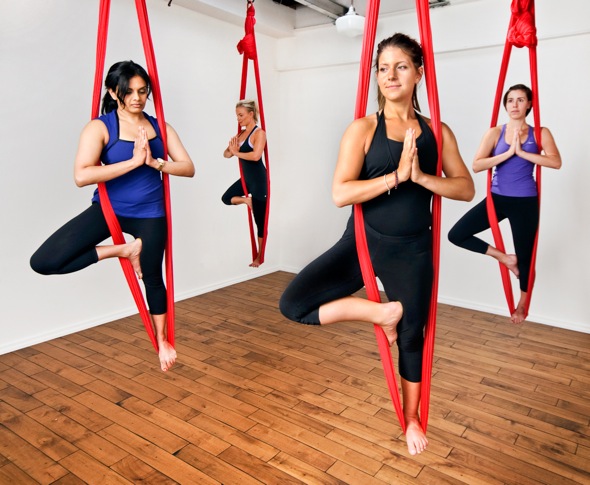
Aerial Yoga is pretty much just what it sounds like — practicing yoga in the air — thanks to a fabric trapeze (also known as a silk). The silk, which is suspended from the ceiling, aids in the performance of traditional yoga postures on the ground or allows the more brave among us to get off the floor and even inverted.
bspoke athletics started offering the program about nine months ago, after owner Jonathan Farber discovered it — by accident, no less — during a trip to New York City. "For me, fun has never been a word I'd use for Yoga," he laughed, acknowledging that while many people do enjoy yoga, it's just not his cup of tea. "But when I saw this postcard I stopped and thought, wow, this looks really fun."
Inspired, Farber began to work to bring the practice to Toronto.
Last weekend I got a chance to stop by and check a class out, and I was pleasantly surprised by how challenging the class really was (though not-so-pleasantly surprised by how sore I was the day after!).
The session began with some stretching, using the silks in a very basic way for stability and balance. Within minutes, however (at least it felt that way!), we were gearing up to try our first inverted pose. Sitting on the edge of the silk, instructor and self-proclaimed yogi Jennifer Adinolfi instructed us to lean back, wrap our legs around the front of the silk and lock our ankles in; effectively leaving all eight of us giggling and hanging upside down, hands firmly planted on the floor.
"Now lift your hands off the ground, and hang," she said. Eyes wide, I look around and see everyone else tentatively moving one hand, than the other. It took me a few tries to work up the nerve to remove my hands, but once I did it felt great to hang suspended in the air like that, feeling almost as if I was floating.
Later on in the class, we did a shoulder stand — our entire bodies were wrapped in the silk as we hung straight legged, upside down, with nothing but our shoulders dug into the silk for support.
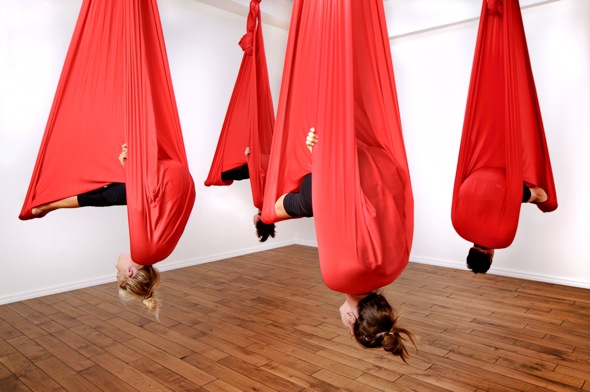
Even the normal yoga postures involved the silk in some way, and I found it much easier to flex, bend, and hold some of the more traditional poses with the aid of the silk.
I was a bit disappointed we didn't do more inversions during the class, but with a group of mostly beginners — some even to yoga — and an older women who was giving it a whirl, I can understand why Jennifer stuck to more grounded, traditional poses, and it just made me want to go back and work to become more advanced so I can get to the really fun stuff.
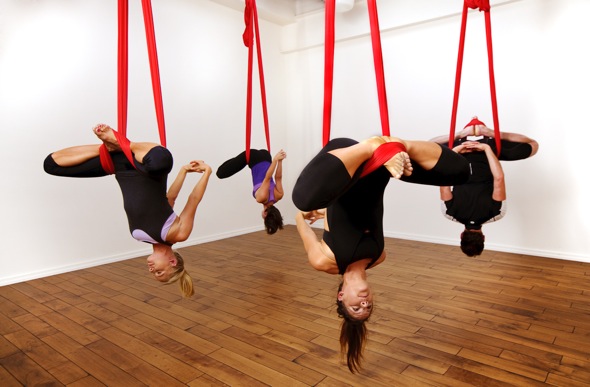
Right now, bspoke athletics offers beginner classes a few times a week. If the diversity of my group both in age and experience is any testament, anyone and everyone is capable of giving aerial yoga a try.
Photos by Stephani Buchman, courtesy of bspoke athletics.


Discussion
23 Comments
Sort By Oldest First / Newest First
Subscribe
There is no weight restriction, as our aerial grid was engineered, designed and installed by the same team that work on the Cirque du Soleil set ups. The fabric can handle multiple bodies, though we only allow 1 person in a hammock at a time.
As far as Hah!'s comment, the aerial hammock (silk) is a tool/prop, not a gimmick. TRX, BOSU,Kettlebells etc. are also tools that we use. Perhaps Hah! believes them to be 'gimmicky' as well, but most leading fitness professionals would disagree.
The advantage to this practice is that it offers support to beginners who may find traditional floor based yoga discouraging as they may lack the core strength/flexibility to keep up. They may also experience pain from pressure and too much load on their joints (like wrists in downward dog).
Zero-Gravity Aerial Yoga allows those who are new to enjoy the benefits of yoga from the first class, without compression of joints and vertebrae (or nerve impingement as reported in a recent New York Times article, leading to stroke etc.).
Advanced yogis can enjoy a new challenge and benefit from increased core and limb strength, wich will benefit their regular floor based practice as well.
i reccomend resistance training as well as cardio-respiratory (aerobic) exercise as well for a balanced training plan. We offer the best cycling program in the City, so come on in and I am happy to discuss.
As the volume increased with the fall offer, 200 new clients were starting from scratch. Now that the offer is about to expire, we are introducing a Level 2 class, that is an intermediate challenge.
we recommend atleast 6 classes before moving up to Level 2. we are also offering a Strength focused aerial clinic and restorative classes this winter.
I welcome your feedback, and given the fact that aerial yoga is so new to the city, we will continue to pioneer the practice with input from practitioners.
As for your athleticism, why not try our cycling program or strength training for a new challenge?
Hope to see you soon.
And... as a competitive triathlete the aerial yoga classes encourage a more supportive and deeper stretch that I find otherwise difficult to attain in a regular yoga class... and yes I like taking pictures of myself hanging up-side-down... it makes for a supercool Facebook profile picture :-)
PS... Jonathan is also one sexy beast!
Try new things, balance, you need lots of different activities to maintain a healthy body.
Yoga alone and aerials alone are both disciplines in which one must be *very* aware of things like precise alignment and controlled movement in order to avoid injury. Lots of amateurs sustain injuries while dabbling in aerials. Lots of folks also sustain injuries from improper yoga technique. Combining the two adds unnecessary risks.
To claim that you can suspend in the air to avoid pressure on joints and vertebra is a bit of a stretch (pun fully intended) -- the pressure is merely displaced to different areas and sometimes in ways which could place un-trained aerial newbies at increased risk of other injuries and strains.
Dangling in the air is not the key to minimizing potential negative impacts of yoga. The key to that is better yoga instructors.
Far better to study each discipline on its own & reach a reasonable level of mastery of the basics before ever trying to get up on aerial silks to do your asanas.
Our Instructors are Yoga teachers first, who have trained and studied Aerial Yoga before completing their Zero-Gravity. They attend regular clinics to update their skills and knowledge with one of the folks who helped shape the original content for the program (who is a very seasoned aerial arts performer, Dancer and Pilates Instructor as well).
Education is key here at bspoke athletics, and that is why I support your assertion that better Instructors are the key.
I encourage you to take a class here and maybe you will rethink your opinion of the safety of our program. We have offered more classes than anyone else in the city, since openning in March, and have not had any injuries.
We have had a lot of folks work through injuries during their rehab with success.
I hope to see you one of these days.
j
It's not yoga though. It's more of a dance focus. This studio is a ballet fitness studio.
If you want to look into it: http://extensionmethod.com/?page_id=86