Saturday, May 26, 2012Cloudy 25°C
Eat & Drink

The Fate of Raw Milk in Toronto

Posted by Lauren / February 13, 2009

20090212---Michael-Schmidt.jpgFor those following dairy farmer Michael Schmidt's court proceedings (dubbed the Raw Milk Trial), the fate of raw milk in Toronto has not yet been decided. After 6 days in a Newmarket court last month, the final arguments have been postponed until May (for Schmidt) and June (for the prosecution).

Since authorities first began their investigations of Schmidt's Glencolton Farm over a decade ago, there has been a whole lot of fuss over a food we don't even really need to be consuming in the first place.

Don't get me wrong, I love milk. And cheese - please - I can't live without the stuff. But the reality of being mammals is that we don't really need our mother's milk once we've gained the ability to eat solid foods, let alone the milk of another animal.

In fact "lactase persistence" (the continued presence of lactase, the enzyme that helps break down the lactose in milk, into adulthood) is a genetic mutation that occurred centuries ago and has since helped milk become engrained in our diets and nutritional doctrine, particularly in the Western world.

But engrained it is, and now the debate turns to whether or not we Ontarians should be able to procure raw, unpasteurized milk. So what's the big deal? We can procure raw meats and shellfish. I mean, no one's being hauled off to court for selling carpaccio or oysters on the half shell are they? Consumers know the risks of consuming these foods.

As far as raw milk goes, I am not debating the merits of pasteurization for food safety - they are quite clear and very important. And pasteurization is especially needed in an industrial dairy system such as ours, where milk from thousands of cows (coming from varying states of health and hygienic conditions) is pooled together and shipped hundreds of miles before it can be heat treated to remove the various pathogens it might have picked up along the way.

From what I have read, Ontario supporters of the raw milk movement aren't suggesting that it start being distributed to the mass market on the same scale that pasteurized milk is.

Generally speaking, raw milk is produced at smaller farms to be consumed by local communities. Farms where a relatively small herd can feed off pasture and are therefore not susceptible to illnesses such as ruminal acidosis and laminitis, among many others. Because they are not in cramped living conditions, the animals are generally cleaner.

Schmidt's farm, for example, has ranged from 4 cows at its smallest to about 30 at its largest. The cows live outside and graze on pasture from May to November. In the winter they live in the barn, and eat fodder exclusively from the farm itself. Many raw milk drinkers have personal relationships with the farmers, and have seen the conditions in which the milk they drink and feed their families is produced.

In several US states, raw milk producers are subject to daily inspection and testing to monitor bacteria levels. So if raw milk CAN be produced free from pathogens and fit for consumption, then why not develop regulations to monitor its production here in Canada, much like we already do for pasteurized milk?

My guess is the lack of cost efficiencies and economies of scale. Because there are only a few players in the pasteurized milk game, it's easier to make sure the final product is safe. But as I mentioned above, raw milk tends to come from small farms servicing their local communities, meaning regular inspections would be much more costly.

So is raw milk ABSOLUTELY UNCONDITIONALLY unsafe to drink? No, but pasteurized milk isn't absolutely unconditionally SAFE to drink either. Both raw and pasteurized milk have the chance of becoming contaminated after its left the cow (or sheep, or goat, or yak, or water buffalo etc) or been pasteurized. But the reality is that the chances for raw milk contamination are higher. As long as people are aware of that, why shouldn't they be able to choose?

One of the biggest arguments against the right to choose is the cost society bears if the raw milk drinkers get sick, or if the bacteria they carry makes others sick. Suggestions that people opt-out of OHIP if they choose to drink raw milk is crazy. Do we make smokers or excessive drinkers opt-out of OHIP? What about people who eat too much, or don't get enough exercise? Where do you draw the line?

There is a lot riding on the outcome of the Raw Milk Trial and public debate around the topic is fierce. Until June, you can probably find Michael Schmidt on his farm milking the cows.

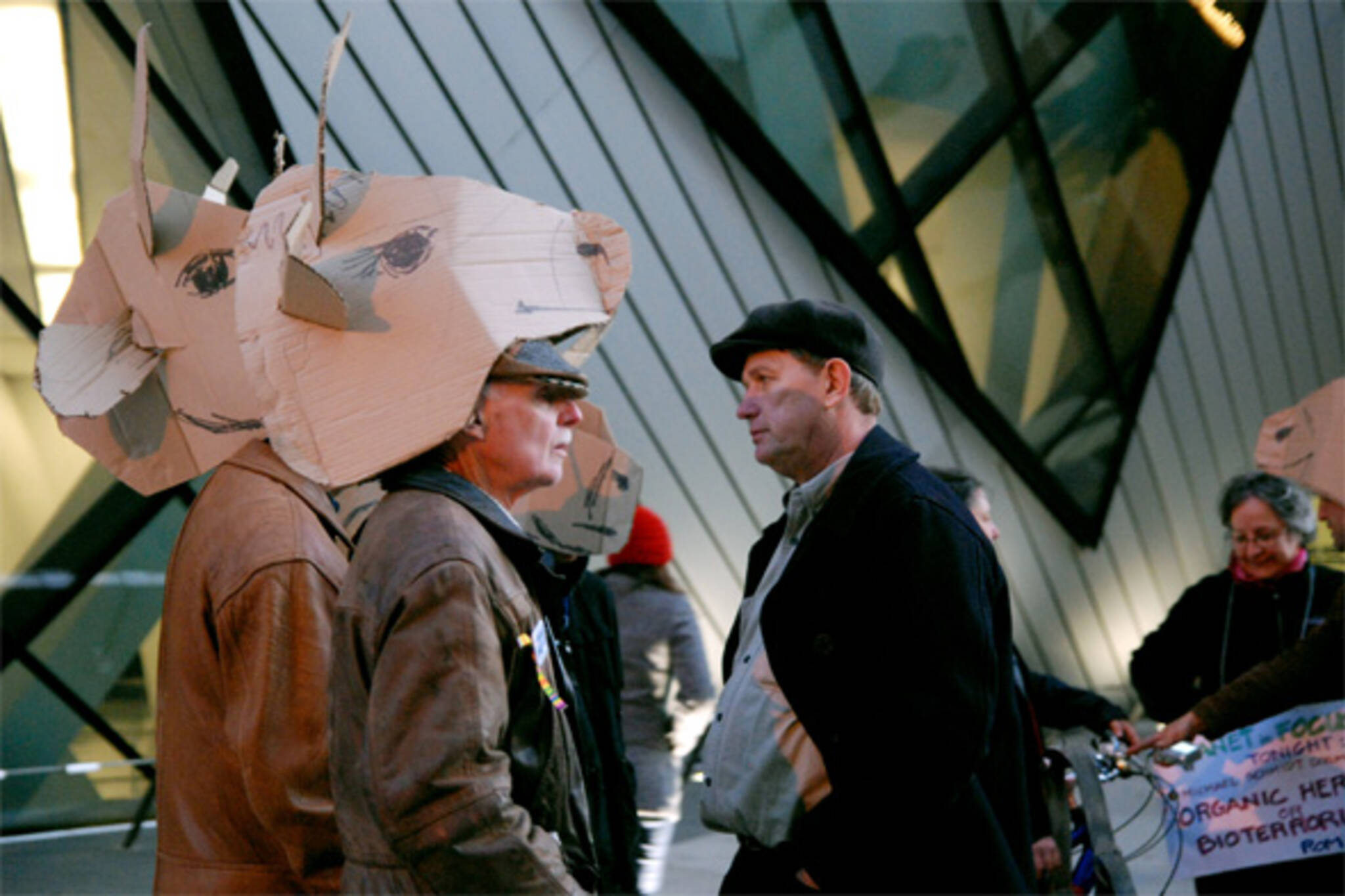
Photo by Sean Bennell from the blogTO Flickr pool

Discussion

14 Comments

Dave (The Other One) / February 13, 2009 at 10:24 am
user-pic
Society already forces people to be safe. House must have smoke detectors, carbon monoxide detectors, and various other design elements for safety. Helmets and seat belts are mandatory too. I don't intend to get into a motorcycle accident or a car accident either, so why should I be forced to wear a helmet or seat belt?Isn't it my personal choice to feel the wind blowing through (what's left) of my hair? Why should anyone else care if I'm only endangering myself?

I'm sorry, but I really don't care what raw milk activists say. They are very naive. Maybe it does taste a little better than pasturized milk, but they are also exposing themselves and their own children to an unnecessary risk.

As for raw fish, it has already been proven that flash freezing fish destroys the harmful agents in it. I'm pretty sure that flash frozen fish is all that is allowed to be sold as sushi grade. (Ontario also is not close enough to an ocean to get access to fresh from the water oysters anyways, anyone selling that would be pretty sketchy, and the oysters pretty funky)
DS / February 13, 2009 at 11:15 am
user-pic
I think it's worth noting that the places where listeria has been an issue in food production has been in large scale facilities. There, I think pasturization is necessary due to the amount of product being made as well as handled. A small scale cheesemaker has greater control over their production and handling and therefore is less prone to food safety issues than a factory.

At any rate, here's an interesting article for both sides of the fence to ponder.

http://domesticfather.com/2008/10/schooled-by-a-cheesemonger/

aDub / February 13, 2009 at 11:36 am
user-pic
It's all in the scale. Thousands of litres of unpasteurized milk in a tank intended for provincial distribution is a real danger. But to assume that means one litre of milk crossing hands from farmer to consumer incurs the same risk is idiotic.
Honestly Dave, how can you call raw-milk drinkers naive? The practise of drinking and using raw milk is thousands of years old, yet the dangers we're afraid of have only surfaced in the past 150 years (if that) through modern milk production and distribution.
Pasteurization reduces the dangers present in factory-dairies. Why should non-factory dairies have to follow identical protocols? It's a completely different method of production and delivery, and there should be a completely different set of laws to gonvern it.
If cost is an issue the gonvernment could withdraw from all of the extensive monitoring they do of the factory-dairies. Then they could implement a single pre-consumer test for pathogens, chemicals, and contaminants to be performed when each batch of milk is being bottled. If the batch is clean, who cares how that was achieved?
tophe / February 13, 2009 at 11:59 am
user-pic
A great summary of the issue! I grew up on a dairy farm and drank raw milk all the time. If done correctly, it's absolutely safe. Pasteurization was a way to keep profit-driven industrial operations from killing the population of cities, as was the practice before such regulations.

Unfortunately the regulations meant to be applied to these big milk operations are now being peevishly followed by politicians who do not understand where these laws CAME from and what purpose they served. Now these laws are eliminating all non-industrial methods of production. At this rate, it won't be possible to survive except by suckling at the tit of a global food chain that will consume all arable land within my lifetime. If you try, milk police (or meat police, or garden police) will come and bust up your grow-op and put you in jail.
Dave (The Other One) replying to a comment from aDub / February 13, 2009 at 01:26 pm
user-pic
Poor argument aDub.

First of all, modern science has been around for only a relatively short period of time. People got sick and believed that evil spirits plagued them, not the food they ate. So don't say that the dangers we worry about have only sprung up in the past 150 years. -> Probably a good definition of "naive".

Secondly, cheese is not an issue. Studies have shown that unpasturized milk can be used in hard, aged, cheeses. If Schmidt was using his milk for that purpose then let him be. The cheese itself will prevent listeria from growing on it. But he's using it as regular milk. That's not cool.

Thirdly, studies have shown that people who have been in regular, close contact with dairy cows have already been exposed to many of the diseases in small enough quantities to have built up a natural immunity. So, raw milk producers tend to not get sick from mildly contaminated product whereas others will.
tophe / February 13, 2009 at 02:49 pm
user-pic
Dave,

Your third point mentions studies that correlate close contact with cows and "natural" immunity to "mildly contaminated product." These studies have a very good point, but I think you are missing it completely.

I hate to break this to you... but everything is "mildly contaminated." Your chicken is mildly contaminated with salmonella. Your bread had fungus the day you bought it. Your hands have all sorts of nasty things on them. Vegetables have all sorts of nasty parasites and bugs. Cereal products average 10 bugs per pack. You yourself are more bacteria than human by every measure.

This is the reason many people people feel raw milk has advantages over pasteurized milk. It causes a natural resistance to the vast and unfathomable microbial world that we find ourselves in. Pulling out and keeping super-clean is why we have super-drug-resistant bacteria and the rise of immune problems like allergies.

I believe your studies (or your interpretation) are confusing correlation and causation. People who spend time around cows also tend to drink plain milk. I believe it is the act of drinking that confers any immunity your studies mention.
aDub replying to a comment from Dave (The Other One) / February 13, 2009 at 03:30 pm
user-pic
Dave,
What about pathogen free raw milk? When making aged raw-milk cheeses in the US, the milk at the start of the process must be clean. If you were to drink it at that point, what is there to make you sick?
Also, diet was a huge selective pressure on populations throughout history. If a population was devoted to eating something that made them sick, that population died off. Things have only changed with the advent of modern medicine. Populations can now be sustained despite a poor diet.
Pre-industrialized peoples may not have had an understanding of microbiology but I think they could understand causation. If every time they drank milk they became sick they would know to avoid milk.
Dee / February 13, 2009 at 04:20 pm
user-pic
This is a great and well balanced examination. I am, personally, a proponent of the right to choose; but it's a difficult and slippery slope.
I really enjoyed this article. I didn't know BlogTO posted articles with such substance.
caroline / February 13, 2009 at 05:17 pm
user-pic
Wow... I am so glad I live in California where we can freely buy raw milk from grass fed cows.
I have trouble comprehending how the gov't doesn't have a problem with aspartame and does with raw milk.

www.raw-milk-facts.com
Rob replying to a comment from Dave (The Other One) / February 13, 2009 at 07:30 pm
user-pic
Response to: Dave (The Other One) on February 13, 2009 10:24 AM "Ontario also is not close enough to an ocean to get access to fresh from the water oysters anyways, anyone selling that would be pretty sketchy, and the oysters pretty funky"

ALL oysters served Raw are "Alive" NEVER frozen if they are not alive then they are not fit to eat raw and if they have been frozen then they are not alive.

I think you are thinking of larger sushi type fish cought out in the ocean and flash frozen.. This was in the news last year and guess what.. it was decided that there was not a great enough risk to the public to mandate the freezing of fish used in sushi. So it is NOT required in Ontario.

Also there have been studies done that show that lactose intolerant people can drink unpasterized milk because the "good" bacteria that is in it helps with digestion... Some Bacteria is very good for you.. just look at the hype around probiotc yogurt etc..

Also in Quebec (and other eastern provences) you can make & buy nonpastursed soft young cheese (not old hard cheeses) yet in Ontario this is against the law. And so far I do not hear of a rash of deaths due to cheese in our closest neighbour..
jack / February 15, 2009 at 10:08 pm
user-pic
they tried to do the same thing to chinese bbq food before.. nobody ever died after eating chinese bbq .. same with chinese herbal medicine.. using your own standards applying on things you don't know
Druck / February 16, 2009 at 05:12 pm
user-pic
This was a very well-balanced, informative post.
I was expecting the usual "raw milk is great, big business is bad, everyone that doesn't agree is wrong" article and I was pleasantly surprised to read this.
Nice job.
Alex / July 30, 2009 at 09:27 pm
user-pic
The problem, which a lot of people don't know is that pasteurized milk is not of the same quality as raw milk. The pasteurization, or ULTRA-pasteurization processes make these milks essentially a refined food. Just like I won't eat "vegetable oil" and will only eat unrefined oils.

Studies done on lab rats, showed the rats to get very sick eating the pasteurized milk, but lied quite robustly on raw milk. Some say this is because the chemical composition of the milk is altered in an unfavorable way by the pasteurization process.

Add a Comment

Other Cities: VancouverMontreal