City
Do people actually like Astral's street furniture program?
Dissenting voices on Astral Media's street furniture agreement with the city are a "vocal minority," says Ron Hutchinson, Astral's senior vice president in charge of the program.
The controversial bus shelters, garbage cans, newspaper boxes, and ad pillars have drawn the ire of Torontonians in the past for perceived ad creep and intrusion on public space. Last summer several of the company's ad holders were hacked by a group of activists amongst other interventions we've reported on in the past.
"I guess you could characterize that group as a vocal minority, and an effectively organized minority," Hutchinson says. "Just remember the program is 26,000 pieces of furniture on the streets of Toronto over a 20 year period, not less than 100 info pillars, that were, by the way, part of the RFP [Request For Proposal by the city] - not something we invented."
"I would contend maybe don't understand the program - it's a fantastic deal for the city because they generate $900 million ... there's 46% less advertising on the streets of Toronto now."
The Coordinated Street Furniture Program turns five years old this month. In a survey commissioned by Astral Out-of-Home, the division responsible for the design, installation, and maintenance of the products, Leger Marketing found 96% of Torontonians believe the items contribute to the functionality of the streets.
"I think what it says is the majority of people see benefit in the program, and like it," Hutchinson says.
Is that undoubtedly the case? The belief that the items "contribute to the functionality of the streets" doesn't necessarily infer that one sees the program as beneficial. And therein lies the (potential) problem with the promotion of this survey. What's missing is a list of the questions that gave the results. We can't really know whether or not those surveyed like Astral's furniture, just that they see the benefits of having a place to stand while waiting for transit and a place beside the sidewalk to put trash. Hardly a glowing endorsement.
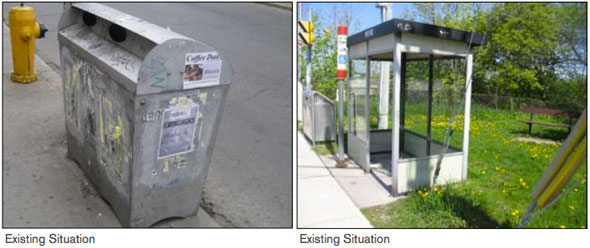
The survey also purports to show strong support for the new design of garbage cans, benches, and bus and streetcar shelters among the 539 people asked. The previous models - which were particularly battered and joyless - are shown above. It's probably not hard, then, to convince people the new, shiny designs are better.
The number of info pillars planned for the city is also being scaled back from 120 to 85 over negative feedback and new, tighter installation guidelines. Fixes for defective garbage cans with broken foot pedals and jammed opening mechanisms are also appearing in high-traffic areas of the city, Hutchinson says. The cost of that retrofit, footed entirely by Astral, is $350,000.
Astral also recently decided to strictly limit the number of new open-sided waiting areas due to complaints over lack of protection from the weather.

Delays keeping up with the installation schedule agreed between Astral and the city, another source of friction for observers of the program, are reportedly tied to design tweaks and staff shortages at city hall. A few months ago the company reported it was 87% on track with its revised roll-out plans.
"[Deployment] was interrupted by the garbage strike and disputes over a couple of things," Hutchinson admits. "Everything we do needs to be surveyed, needs a permit, needs a process so the redeployment of managers slowed down that process. I think the city is satisfied the reasons for the slight delay are design related. I don't think they're upset about it."
How do you feel about the quality of street furniture in Toronto? Are you surprised at the reported high level of support among those surveyed?
Chris Bateman is a staff writer at blogTO. Follow him on Twitter at @chrisbateman.
Image: "The Androids are Among Us" by AshtonPal and "Return of the Garbage Can" by Neil Ta and City of Toronto/blogTO Flickr pool.


Discussion
39 Comments
Sort By Oldest First / Newest First
Subscribe
I worked in the survey business and you can bet that the questions were very very carefully selected (as well as the available answers) to allow for the result Astral wanted. Lord, I remember one survey where a golf course wanted carts and the results came back 52% against. Oops, amazing how 6% (consisting of all "no carts" responses) managed to disappear into the shredder and suddenly 52-48 against became 52-48 before.
Survey people know whose paying the bills and they always get the answer that brings back repeat business.
There was an early iteration of the info pillars. As I recall there was a grand total of one or two of them. The maps didn't show where you are. They didn't dispense the promised brochures, etc. The new ones serve two purposes: they tell you where you are if you don't know, and the provide space for ads. If you don't need to know where you are, you are sure to be irritated by the advertising. On the other hand, if you need to know where you are, they do the job. And they would certainly not exist without the advertising.
Trashcans in very busy areas like Chinatown are often broken and overflowing. But this was the case before. And elsewhere they do the job just fine whatever you think of the design. I agree they could be more functional and attractive. But they could be, and in most cases were, a hell of a lot worse.
http://www.torontolife.com/daily/informer/cityscape/2011/04/21/astral-media-finally-admits-that-its-sidewalk-rubbish-bins-are-garbage/
Added info on the deal:
http://www.toronto.ca/legdocs/mmis/2012/pw/bgrd/backgroundfile-45963.pdf
I think the real issue here is that the city should've involved itself a lot more in the design process. Astral are not designers of street furniture. They are simply trying to act in good faith to provide this benefit. HOWEVER, the city should understand the subtleties of how design of a garbage can relates to high vs. low traffic. Why was that knowledge never input into the whole process.
Its easy to blame Astral here, but really is it their fault that they got no guidance from the city, who after all are the ones who should've been able to predict that this would happen if they didnt step in??
The holes in the garbage cans are way too small, though.
I agree, they could have done a better job at designing the shelters but they *could* be a lot worse. (I also happen to be one of the people who think the info pillars are useless, btw, and more about advertising than information.)
At any rate, I have several issues with their street furniture.
1. Garbage bins: Anyone who has an issue with their legs will have trouble with this set-up. Having to step on a bar to open the receptacle isn't accessible. The older garbage bins were more durable. It's a garbage can for crying out loud. Let's not put lipstick on a pig here.
2. Ad Pillars: I'm a pedestrian, transit rider, and driver in Toronto. These signs are such a danger in terms of visibility. It's hard to see people standing behind them and around corners when you're trying to make a turn. I've had streetcars and buses pass me because they can't see me behind the signs.
From an aesthetic perspective, I'm so sick of being advertised at on the street by the same shitty ads that seem to be in all the Astal locations. Give me a community events board or some discount ad space for charities with small budgets. Give me some social good if you're going to dominate my visual space.
3. Bus/Streetcar shelters: Can we really call these "shelters"? To be a shelter would offer some kind of relief from the elements. The new shelters effectively prevent these small infrastructure items from being used by people who find themselves without a regular bed to sleep in. Bench bars prevent anyone from laying down, and gaps between the glass/sides and the ground means that the interiors are wet, windy, and cold. Why not offer spaces that show a bit of humanity?
The ad spaces on these shelters are such a pain. The ads block your view of oncoming traffic (vehicular, bike, and pedestrian). When you drive down Toronto's streets, the Astral booths are more predominant than the store fronts and add very little architectural value.
I see I'm not alone here.
But they do suck and aren't durable enough. Plus, the 'separate' openings for garbage and recycling are a lie. Watch a worker empty one and witness it all just being tossed into one big pile in a truck.
In my opinion, the garbage bins look MUCH better than most of their predecessors and they appear to have just about solved the broken foot pedals issue.
The information pillars are DREADFUL - take up far too much space and have VERY little "information".
The newspaper boxes seem like a better solution but we need more of them so they can be better evaluated.
The poster boards seem like a waste of time.
Good to hear, but will they replace the "shelter" I use every morning with one that has walls?
I have little problem with the proper shelters, but these one-walled things are less than useless; they're insulting.
Complete garbage. Utterly lacking in almost any redeeming quality.
Frankly, the city is to blame too for allowing this crap to be put on our streets.
And those so-called "info pillars" ruin sidewalks, especially when the ad design is poor. Recent offending examples include the pillar blocking the middle of the sidewalk on Yorkville Ave and the pillar blocking the sidewalk on the Danforth near Carrot Common.
THIS genius is the guy who invented the furniture. He introduced the filth flaps that you have to touch so that you woudn't have to touch it, because of SARS. because you know, a simple can that you put garbage in was too small town for us.
I am seriously also wondering whether his glasses are prescription or not, he's obviously into unnecessary ad-ons :)
Greetings! Very helpful advice within this article!
It is the little changes that produce the greatest
changes. Many thanks for sharing!