Saturday, May 26, 2012Mostly Cloudy 22°C
City

The origins of the Eaton Centre

Posted by Agatha Barc / December 23, 2010

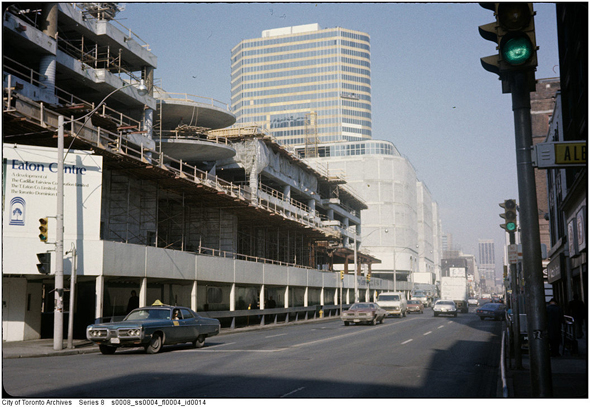
Toronto, Eaton Centre, Eaton's Timothy Eaton. Co. Ltd.As shoppers are stuffed like sardines into the Eaton Centre frantically searching for Christmas gifts today, I thought it might be a good time to recall the origins of Toronto's downtown shopping mall. As with College Park (originally known as Eaton's College Street), the Eaton Centre is one of Toronto's relic landmarks of the former Timothy Eaton Co. Ltd., a famous Toronto-based Canadian institution, which went bankrupt in August of 1999. The large-scale shopping mall, located at 220 Yonge Street, officially opened in part in February of 1977, when the first phase of the construction was completed.
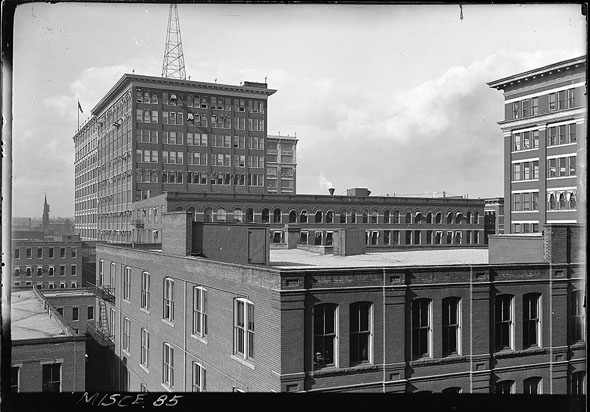
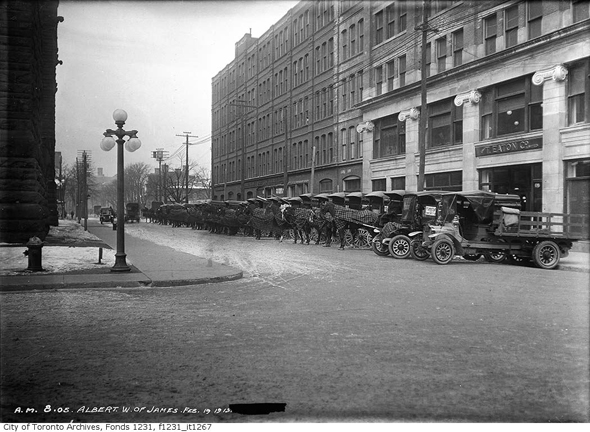
Toronto, Eaton Centre, Eaton's Timothy Eaton. Co. Ltd.The site of the present shopping complex has been a witness to the changing vision and expansion of Eaton's. According to Mike Filey's Toronto Sketches 8: The Way We Were, Timothy Eaton, the founder of the company, opened a dry goods store here on December 8, 1869. At that time the population of Toronto was 47,000, and the location was considered quite a ways from the commercial centre of the city along King Street, east of Yonge.
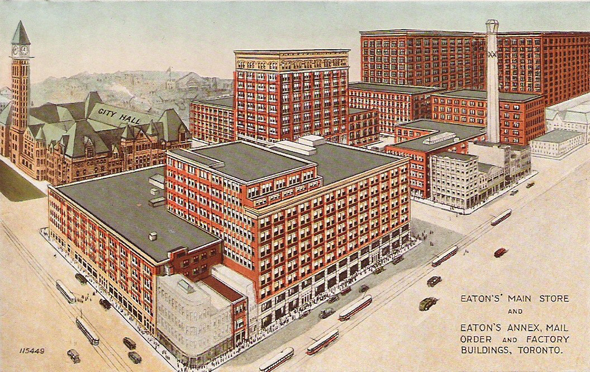
Toronto, Eaton Centre, Eaton's Timothy Eaton. Co. Ltd.T. Eaton led his company for nearly 40 years, until his death in 1907. By that time, his business skills led him to considerably expand his empire, which now included a much larger main store, Eaton's annex, as well as mail order and factory buildings, bounded by Yonge, Queen, Bay and Dundas streets, neighbouring the Old City Hall and the Church of the Holy Trinity. Another notable addition was Eaton's College Street, a few blocks north along Yonge Street, which opened in 1930, one of the city's most distinct Art Deco buildings.
Toronto, Eaton Centre, Eaton's Timothy Eaton. Co. Ltd.On March 1, 1966, Cadillac Fairview, partnered with the Eaton's, announced the new plan for the Eaton Centre development, as depicted in this CBC video. It included a construction of six new buildings, such as a new shopping complex, office and apartment towers. Filey writes that this proposal proved to be highly unpopular with Torontonians, as it called for the demolition of old City Hall and the Church of Holy Trinity, a landmark dating back to 1847. The developers realized that demolishing old City Hall would anger the public, so in order to appease the opposition, they proposed that the clock and memorial Cenotaph be preserved. However, thousands of Torontonians still protested against the scheme, which was eventually abandoned and replaced by a more popular proposal, which was accepted by the city council.
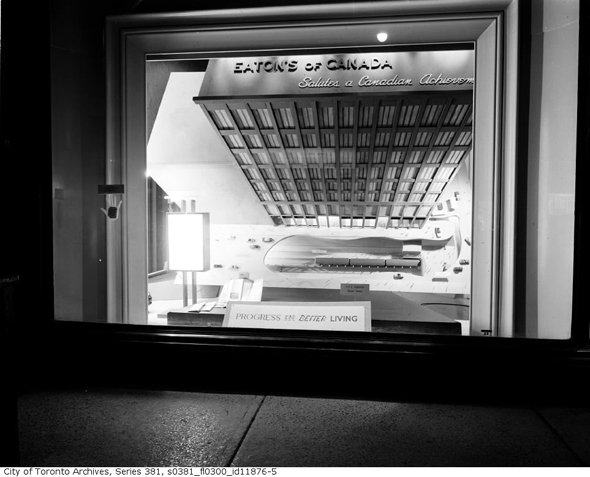
Toronto, Eaton Centre, Eaton's Timothy Eaton. Co. Ltd.The present shopping complex was designed by Bregam & Hamann with Zeidler Partnership, according to Patricia McHugh's Toronto Architecture: A City Guide. Phases, one and two, respectively completed in 1977 and 1979, included the construction of one hundred stores within a five-level shopping and office arcade, Eaton's flagship store, and two office towers. The mall aimed to attract more upscale, "urban and affluent" customers, although their moderately priced items were still available for sale, as explained in another CBC video. During phase three, the Trinity Square and the Bell Trinity Square towers, facing Bay Street, were completed.
Toronto, Eaton Centre, Eaton's Timothy Eaton. Co. Ltd.The Eaton Centre is now showing its age. On June 20, 2010, Cadillac Fairview announced the revitalization of the complex, which is projected to cost $120 million. It commenced on July 2 and will take two years. The makeover includes a revamping of the north food court, a new restaurant (Open Kitchens by Richtree), new floors, renovated and enlarged bathrooms, upgraded finishes on all elevators and escalators, and a new retail lobby for the office tower at 250 Yonge Street. The galleria space will feature a light sculpture designed by the United Visual Artists.

Toronto, Eaton Centre, Eaton's Timothy Eaton. Co. Ltd.Images from the City of Toronto Archives.

Discussion

9 Comments

Torontonian / December 23, 2010 at 02:20 pm
user-pic
The article states that it was to attract an upscale
crowd. The retail plan is that the higher priced stores
are at the topmost level and the most economic stores
at the lowest level. The presence of daylight would
be an asset to merchants selling higher priced goods.

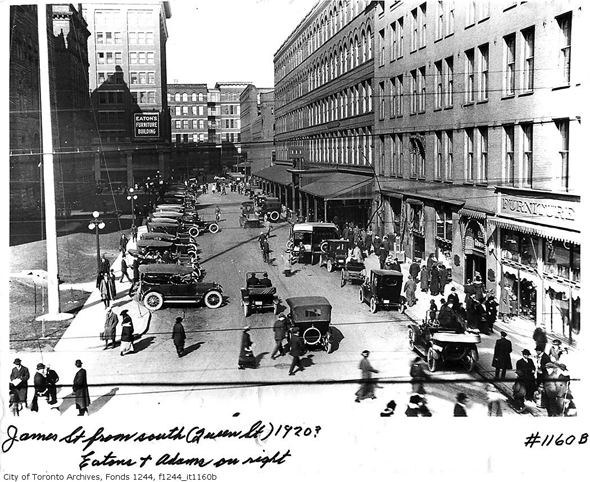
The last photo threw me for a minute. I quite forgot
that there was a traffic light at Albert and Yonge Sts.
When I worked at Eaton's, we used that light to make it
over to the Colonial Tavern. There is also the light
at Shuter St. and that made for a heavily signalised
stretch of Yonge from Queen to Dundas.

Adam Sobolak / December 23, 2010 at 08:21 pm
user-pic
Bregman + Hamann were the architects w/Zeidler. (You're forgiven.)
Mada Kalobos / December 24, 2010 at 04:53 am
user-pic
It's Cadillac Fairview, not Farview. (You're not forgiven)
Steve Munro / December 24, 2010 at 06:57 am
user-pic
Also missed in the architecture credits is the fact that the original design was much more inward looking, a bunker that turned its back on the street much as the Pacific Centre Mall in Vancouver (built before the Eaton Centre) does. Zeidler was brought in to revise the design.

The entire history, including the assumption that major landmarks would be demolished to make way for a huge box shows how corporate arrogance almost destroyed a chunk of downtown and, by implication, the pliable civic politicians who were expected to let this happen.

With the new crew in charge at City Hall, will design matter, will neighbourhoods matter, or will we sell the city to the highest bidder?
Rob Ford / December 24, 2010 at 02:49 pm
user-pic
We'll sell the city to the highest bidder. Thanks for asking.
iSkyscraper / December 24, 2010 at 08:59 pm
user-pic
The Eaton Centre has had quite a ride. It was the model for other cities to copy for many years as they almost all lost their downtown shopping, made it through the death (by Big Box) of the urban mall and now has somehow managed to survive and thrive by adapting for the modern era. There really are few others like it. Well done, EC.

Agatha replying to a comment from Torontonian / December 28, 2010 at 02:34 pm
user-pic
Thanks for this. I wasn't aware that this was the setup for the original layout.
Agatha replying to a comment from Adam Sobolak / December 28, 2010 at 02:36 pm
user-pic
Thanks for pointing that out. It'll be corrected.
Agatha replying to a comment from Steve Munro / December 28, 2010 at 02:44 pm
user-pic
I've been reading your transit web site for quite some time. Thanks for stopping by, and for providing the additional information about the architects - I will add it to the post.

Also, I think it's great that the two landmarks have been able to outlive the company that most likely considered themselves more historically significant.

Add a Comment

Other Cities: VancouverMontreal