Sunday, May 19, 2013Mostly Cloudy 16°C
City

Goad's Fire Atlas of Toronto

Posted by Derek Flack / November 17, 2010

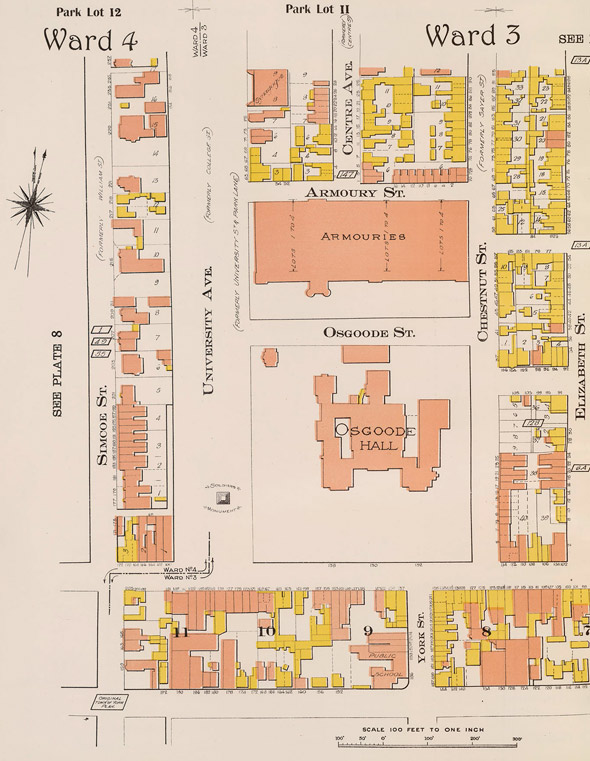
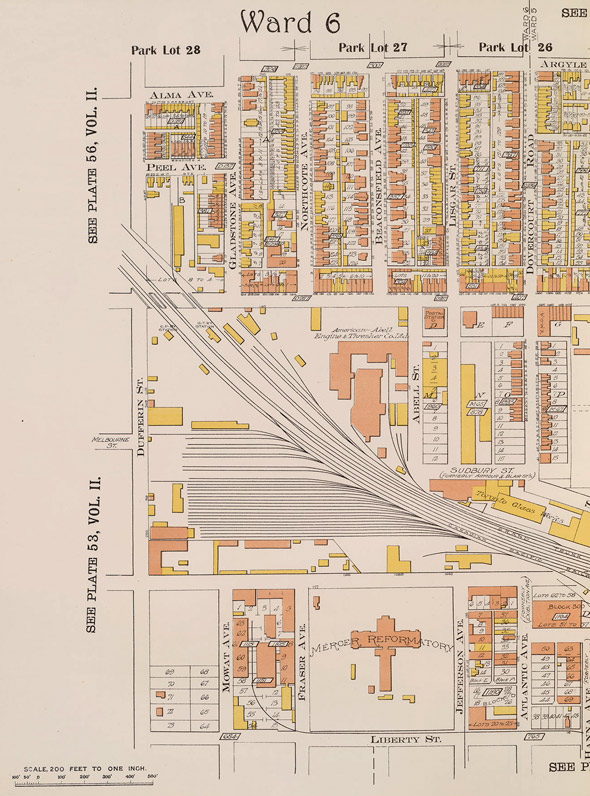
Goad's Fire Atlas TorontoGoad's Fire Atlas of the City of Toronto and Suburbs is quite possibly my favourite in a long list of maps. Although not the artistic feat that P. A. Gross's Bird's-Eye View of Toronto (1876) represents, there's a whole other level of meticulousness and precision on display in Charles Goad's cartography.

As is noted in the introductory information on the Atlas from the Toronto Archives, "Fire insurance plans were originally compiled by mapmakers and leased to insurance companies, who used the information about building sizes and construction materials to determine the fire risk and therefore the cost of insurance premiums." And, from a pragmatic standpoint, these maps now allow researchers "to determine when a building was built or demolished, details of building materials, the position of a building on a lot, lot and address numbers, and lot sizes and shapes."

But for me, there's more to it than this. With its identification of buildings both big and small, Goad's Atlas operates like a proto-Google Satellite map, where the viewer can get a sense for the urban environment on a street by street basis rather than just in a macro capacity. For the contemporary map-reader, this level of detail underscores just how much the city has changed in the last century.

That such change has happened is not particularly remarkable, but to be able to see how an area like Corktown was laid out prior to the construction of the DVP and its off-ramps, or that Dupont Street ended its westerly jaunt at Shaw or that College and Carlton didn't really connect as an intersection, all of these things are the stuff of pure fascination for those interested in the nature and history of Toronto.

There are multiple versions of Goad's Fire Insurance Plans, which date back to 1880. The examples below come from the 1910 iteration, which has been scanned in its entirety at the National Archives. To scroll through larger versions of each page, follow this link.
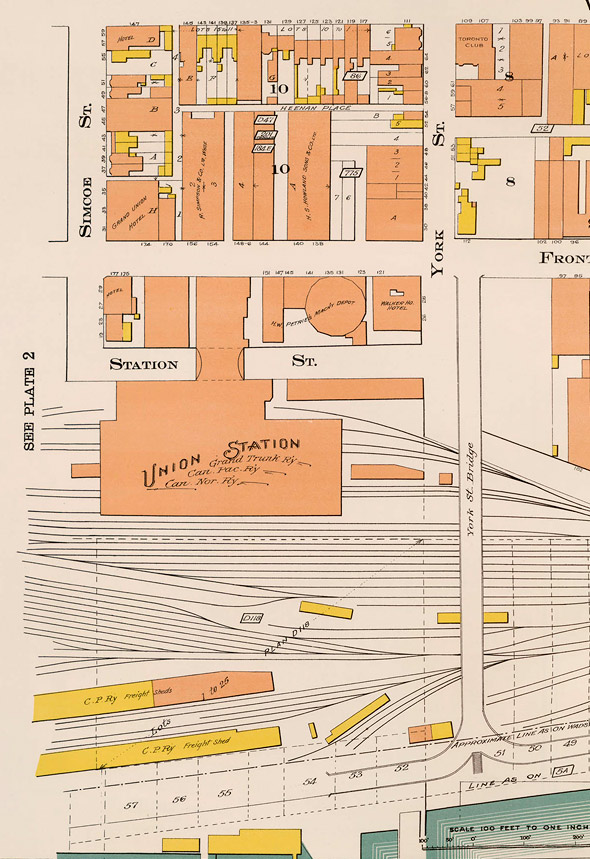
Old Union Station and surrounding area
Old Union Station Toronto

The site of the now-demolished Armouries
Toronto Armouries

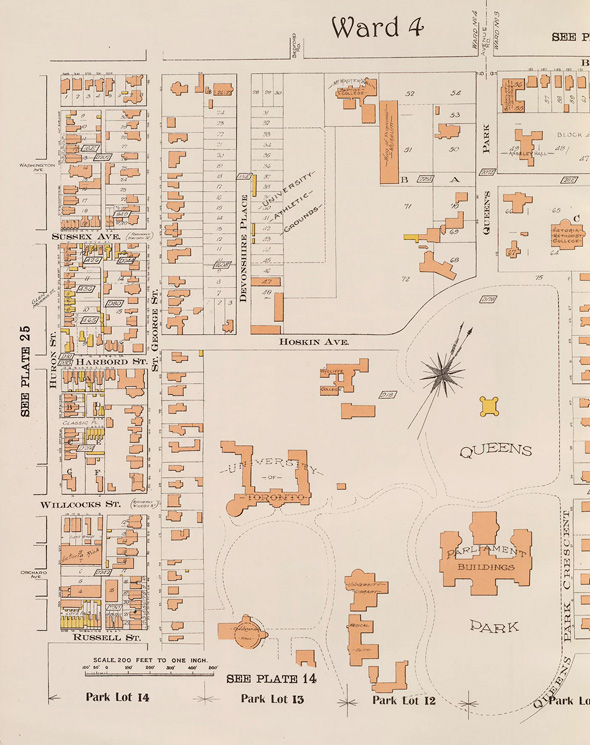
The University of Toronto
Old U of T

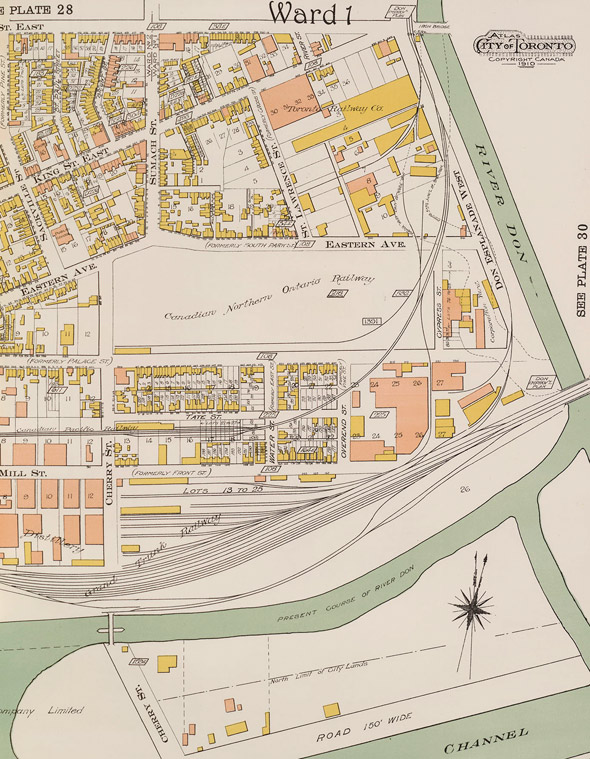
Part of Corktown
Goad's Atlas Toronto

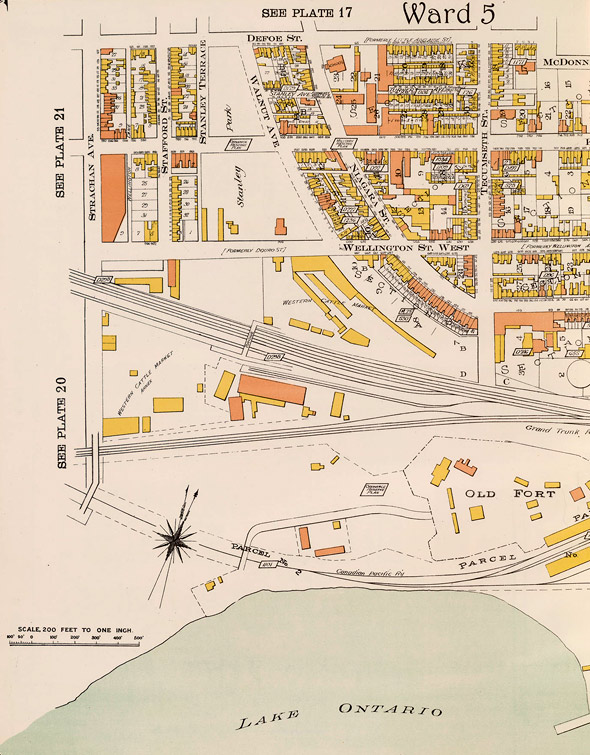
Fort York and surrounding area
Goad's Fire Insurance Plan Toronto

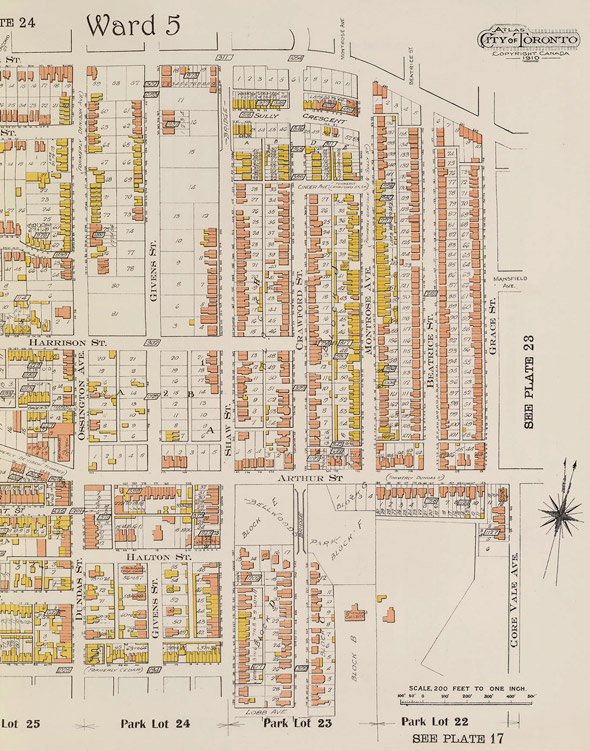
Ossington and area
Goad's Fire Insurance Plan Toronto

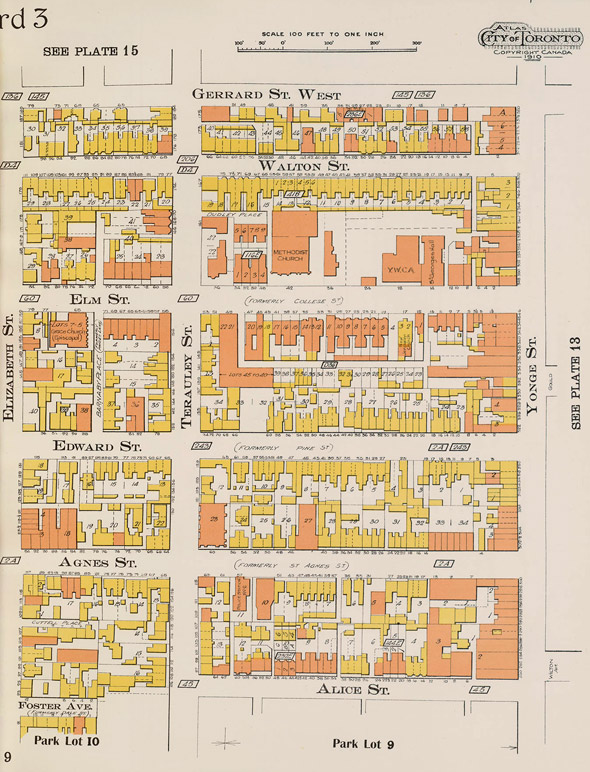
Yonge Street below College
Goad's Atlas Toronto

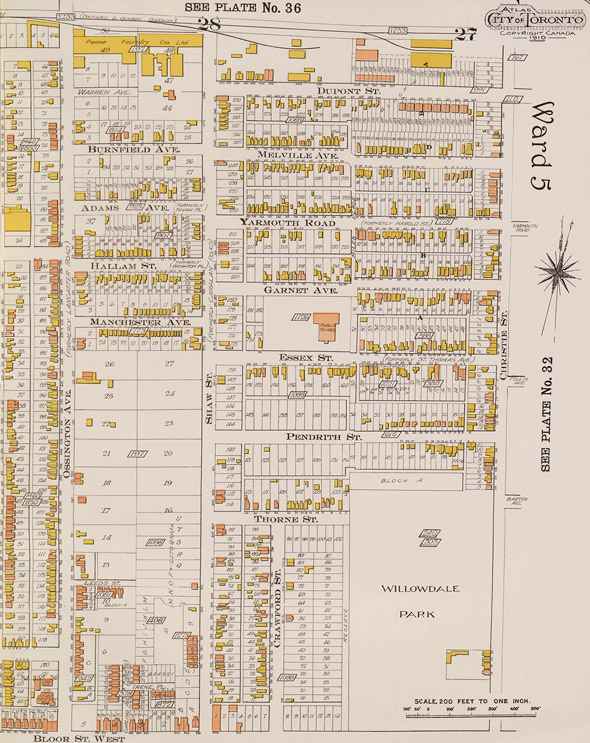
What is now Christie Pits
Goad's Fire Insurance Atlas Toronto

Around the Dufferin jog (which will finally be eliminated tomorrow)
Goad's Fire Insurance Plan Toronto

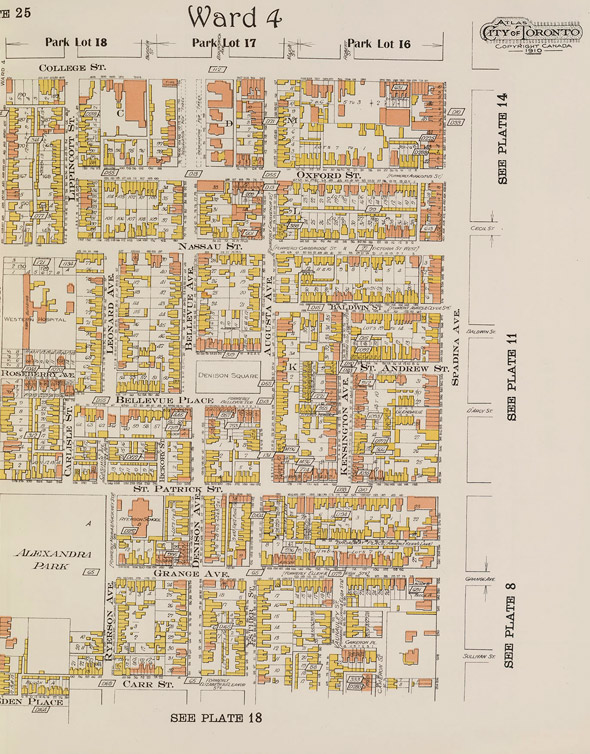
Kensington Market
Goad's Fire Atlas of Toronto

Discussion

15 Comments

Michael / November 17, 2010 at 02:26 pm
user-pic
This is totally a rip-off of Ork posters.
Torontonian / November 17, 2010 at 02:47 pm
user-pic
Hurrah! Now I can look through Goad's at leisure
since there are no copies circulating at the library
system. It is a wonderful book and a possible
companion work to it would be Mapping Victorian Toronto.

I'd love to browse through that latter one since
it's also no longer available in the libraries.
qwerty replying to a comment from Michael / November 17, 2010 at 02:56 pm
user-pic
How so?
Dave / November 17, 2010 at 03:27 pm
user-pic
I find it interesting how Dundas once stopped at Ossington and everything east of that is a patchwork of other streets. You can kinda tell by how the buildings change along the street east of Ossington, even today.
Matt replying to a comment from qwerty / November 17, 2010 at 03:48 pm
user-pic
Sarcasm.

See comments on this: http://www.blogto.com/arts/2010/11/toronto_neighbourhoods_mapped_via_word_clouds/
ccw75 replying to a comment from qwerty / November 17, 2010 at 03:50 pm
user-pic
please tell me you're making some sort of double irony comment here.
Pat Anderson / November 17, 2010 at 04:00 pm
user-pic
Interesting! I've now spent a couple of hours looking at some of the maps, and finding, sadly, that they didn't always keep up to date. So they're nice for a visual, but shouldn't be used to set the age of a house, or to deduce what a neighbourhood looked like in a particular year.
Sonia / November 17, 2010 at 05:02 pm
user-pic
Fascinating... a lot of my neighbourhood is "uncharted", and thus I assume those streets weren't in place at the time, which is incredible since I know my house was built in 1920, as were the rest of the houses within a two-three block radius. It seems like neighbourhoods evolved quickly then too.
gadfly / November 18, 2010 at 07:56 am
user-pic
It is fascinating to see how this city evolved, or actually how it didn't evolve. We were taught in school that Toronto was built on a grid, yet it is plain to see that it was not. The Don and Humber Rivers hemmed the city in, as did the hump at Davenport and everything else was an accident. The railways were allowed to spread like a cancer everywhere. It's funny how the citizens of the 19th century did not view trains, with their noise and pollution, as a bad thing.
Clearly, nobody who was involved in mapping out the city had any imagination that one day the city might be more than a hundred thousand people. I find that shockingly myopic. That lack of vision has saddled this city with billions of dollars in costs to correct their laziness. The Dufferin jog being only one of dozens of examples.
With cities like New York, London and Paris already well over one million people at the time these maps were produced, it shows just how small-minded and 'provincial' city planners were until the the 1940s. By then it was too late.
Matt / November 18, 2010 at 09:49 am
user-pic
Oh god, Gadfly. How negative can one person be? If you hate Toronto so much, move away.
Derek Boles replying to a comment from gadfly / November 18, 2010 at 09:51 am
user-pic
Railway development in Toronto was actually quite constrained compared to many other comparable and larger cities. Most of the rail expansion that occurred downtown from 1855-1930 was done by filling in the harbour, not through the wholesale destruction of existing neighbourhoods, as happened in London, or on a much smaller scale, in Toronto with the building of the Gardiner Expressway.
After 1890, all the railways shared one downtown passenger station, not six as there were in Chicago. The railways certainly did not always get their way. In 1905, the Grand Trunk wanted to build a new line right through the Beaches.
Public attitudes towards the railways in the 19th century were decidedly mixed. Those who appreciated them remembered what it was like to travel, say, between Montreal and Toronto before 1856, a journey that could occupy five days at certain times of the year.
On the other hand, certain railway companies such as the Grand Trunk were loathed by Torontonians, in much the same way that people who spend three hours every day commuting back and forth to work loathe the TTC.
gadfly replying to a comment from Matt / November 18, 2010 at 12:34 pm
user-pic
When you have witnessed the slow, unerring degration of your city over a period of 35 years, perhaps, you too will get an attitude that is not based on the Toronto Star's press clippings....
Kevin Branigan / November 18, 2010 at 04:53 pm
user-pic
so very beautiful, so much work.
icertsherron / February 1, 2012 at 06:19 am
user-pic
click to view chanel online shop for gift
Nathan Ng / April 4, 2012 at 04:44 pm
user-pic
The Goad Atlases are certainly beautiful.

I was excited to see Atlases put up online by the TPL in their digital archives, but soon discovered that navigating their catalogue was painful, as the database titles don't include plate numbers, nor can you sub-sort results by plate. Meanwhile, the version put up by the Archives suffers from being trapped in a wretched file-format that is essentially unsupported on Linux and OSX.

I decided to put together a simple tool to allow myself to easily locate and view the maps. The result is a rudimentary, but (hopefully) useful and complementary mode of accessing Goad’s Atlas (1884, 1890, 1893, 1899). You should be able to use any major browser, any platform, no extra software required.

Rather than keep the tool to myself, I’d like to share the work with you, and other Toronto heritage enthusiasts at large. I hope some of you will find it of use.

Here’s the introductory post -- enjoy exploring Victorian Toronto!

http://skritch.blogspot.com/2012/04/goads-atlas-of-toronto-online.html

Add a Comment

Other Cities: Montreal