City
Globe and Mail redesign to launch October 1
On October 1, the Globe and Mail will reveal a "dramatically redesigned" paper that's predicted to feature the most significant changes in the publication's history.
The overhauled print edition will feature colour on every page, enhanced photo and graphic production, special stock paper and custom print options for advertisers. The October 1 unveiling will also kick off an eight-week, after school special-sounding series titled "Canada: Our Time to Lead."
The weekend edition will be revamped to include an improved GlobeStyle and more in-depth editorial content and analysis. As well, the Globe and Mail's website, globeandmail.com, will introduce improved functionality and navigation and enhanced visual presentation.
It all sounds great on, ahem, paper. But, the launch will likely be most exciting for those wondering whether or not it will reveal a print-model that ensures the Globe's long term prosperity -- or, as less optimistic critics of print might have it, itslong term survival.
The paper's so-called "new era" is very much a product of the 18-year, $1.7 billion contract the publication signed with Transcontinental Inc. who has invested in cutting edge KBA Commander CT presses. But will it really matter how magical the ink-to-paper process ends up being? Will it the changes be primarily about style rather than substance? And perhaps most importantly, is the Globe simply betting on a dead horse?
Globe Editor-in-chief, John Stackhouse caused a stir when he claimed that "we're trying not to be the paper of record, but the record of insight" at a journalism conference earlier this year. Although he later qualified that statement, he also noted at the time that the new paper will be "aimed at the digital reader." What exactly this means - in terms of editorial content - won't become clear until the October 1 launch, but it goes without saying that Globe is betting big on the future of print at a time when other publications are wary of making such a commitment.
Reading the Friday paper should be interesting, if nothing else.
Update (5:45 p.m.):
There's a copy of the redesign floating around the net. Below is a copy.
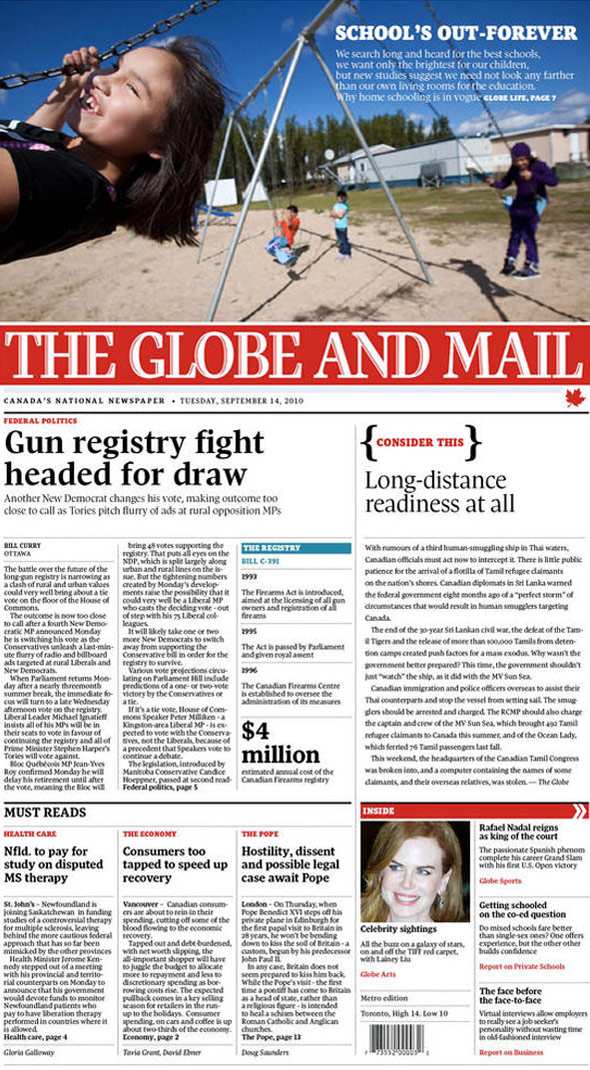
Lead photo by charmgirl13 on Flickr.


Discussion
29 Comments
Sort By Oldest First / Newest First
Subscribe
The reality, whether you like it or not, is that I don't know a single person under 35 who subscribes to a daily newspaper.
2009 2008 2007
Globe and Mail ▼ 1,891,629 ▼ 1,996,582 2,024,320
http://en.wikipedia.org/wiki/List_of_Canadian_newspapers_by_circulation
B. I'm talking readership, not circ. Readership includes web readers (which, it's true, do not provide income the way print readers do.)
C. Those numbers you cited above include a lot of free copies that used to be mailed out or handed out, and papers have dramatically cut back on those during the recession.
Look, I'm not in love with the Globe. But this whole "newspapers are dead thing" is dumb. Young people don't subscribe to newspapers, it's true. I don't. But I read them online, and I'm familiar with their contents and writers and styles. And I buy print editions when they catch my eye. Good newspapers are turning into something different, and they're not going to bother trying to be sources of breaking news. They'll be analytical and smart instead.
The Globe looks like they're going down this route. I have no idea if they'll be successful. I think they're become more boring lately, actually. But newspapers are changing, not dying, at least not until something can replace them. (If you saw Twitter can do that I'll lose it.)
Kudos to the G&M on getting ready early. I personally don't buy newspapers because I don't want the paper, but I would pay a few dollars per month for a digital edition.
I guess it just depends what sort of people you know.
Of course if you include web readers in your definition of 'readership' the numbers will be growing. But we're talking about physical newspapers. When you read an article at globeandmail.com, you're not reading a newspaper. As dumb as you think it is. Newspapers are dying.
You know what else is dying. Books. Just like the newspaper, books are dying because of a digital alternative. Ebooks outsell hardbacks according to amazon.com. I'm sure web readers out number newspaper readers as well. It's time we move forward and evolve. NO MORE PAPER CUTS!!!
http://online.wsj.com/article/SB10001424052748703720504575377472723652734.html
i think if the G&M charged 75c or even 50c for an e-paper, and as a result brought up the level of articles, they would do very well.
then again i'm on their editorial advice board for the new paper's format so maybe i'm biased.
I think that the news organizations that newspapers represent will adapt and survive though. So the Globe may not exist in print in 20 years. There might well still be something called the Globe though, with journalists in its employ.
It comes down to different reading styles. With a physical paper in front of you you read a much broader selection of articles because they're there. Online you open a couple tabs of stories that look like they may interest you; the four or five stories that sit on the front of the website and not much else.
Also, the sheer act of perusing the morning paper over coffee and breakfast is quite a pleasant tradition, I find. Also, spilling coffee on a physical newspaper is way less troublesome than spilling it on your keyboard.
Check out The Guardian newspaper, a publication that ceased to print its newspaper and now only published via Twitter.
http://www.guardian.co.uk/media/2009/apr/01/guardian-twitter-media-technology
http://www.guardian.co.uk/subscription-services
A unmitigated failure in my opinion. It is not even a "nice try big guy" Thank God we still have the Tor. Star and Sun to capture my interests. With newspaper readership fading fast, you now have accelerated this fact.