Sunday, May 19, 2013Mostly Cloudy 19°C
City

Nostalgia Tripping: 1 Spadina Crescent

Posted by Agatha Barc / August 2, 2010

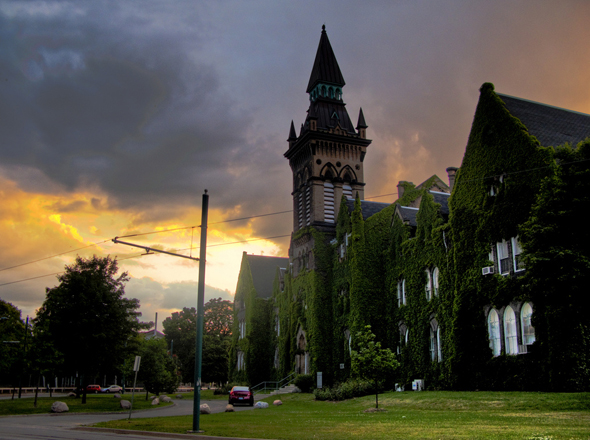
1 spadina crescent, knox college, torontoThe imposing Victorian structure located on a circular lot just north of Spadina Avenue and College Streets quietly sits in the shadows of much taller downtown structures, but in late nineteenth-century Toronto, it was an easily recognizable landmark, even from a distance. This is clearly evident from W. Wesbroom's colour lithograph, published in 1878, and entitled Bird's-Eye View of Toronto.

Even before becoming a U of T student, this building always intrigued me. But when I finally got to explore it, the rundown interior was sadly disappointing in terms of the architecture and state of repair. Because it seems to be isolated from the rest of the campus, it doesn't feel like a part of it, and it was obvious to me that it had seen better days.
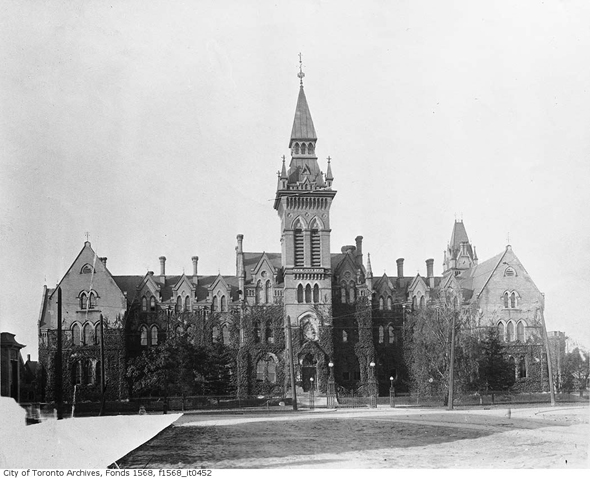
1 spadina crescent, knox college, torontoFor some time, 1 Spadina Crescent has been part of U of T's lore, owing much of its eerie reputation to the Gothic Revival style that it possesses, as well as an unsolved murder and an accident back in 2009, in which a young ghost hunter perished after having fallen from the roof. But behind the "creepiness factor" that has been highlighted over the years lays an interesting history that has often overshadowed.
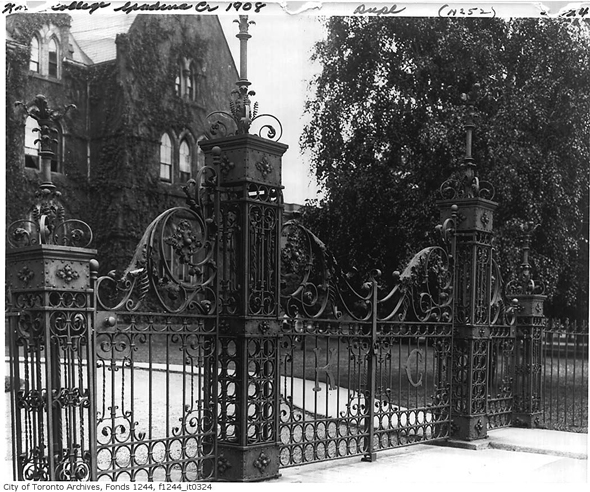
1 spadina crescent, knox college, torontoAccording to Larry Wayne Richards's University of Toronto: An Architectural Tour, the building was designed by the architectural firm of Smith and Gemmell and erected in 1875 in order to house the Presbyterian School of Knox College. Smith and Gemmell were also responsible for designing another landmark, the Church of the Redeemer at Bloor Street and Avenue Road.

When Knox College moved to the present location on St. George Street in 1915, 1 Spadina was converted into the Spadina Military Hospital, treating returning veterans from Europe. It's not hard to imagine that their time there was anything but pleasant, arriving from the horrors of the trenches to an aging, intimidating structure, which seemed to be in the centre of the city, but that kept them isolated while they convalesced. Amelia Earhart, who unsuccessfully attempted an around-the-world flight in 1937, was employed in the diet kitchen of the institution.

During the 1920s, the site attracted the attention of Conn Smythe, the owner of the Maple Leafs, who wanted to build a new arena. Along with a group of businessmen, he proposed to demolish the existing building and erect a 1,600-seat stadium, modelled after the Olympic Arena in Detroit. However, this proposal was never implemented and Smythe instead built Maple Leaf Gardens at Church and Carlton Streets.
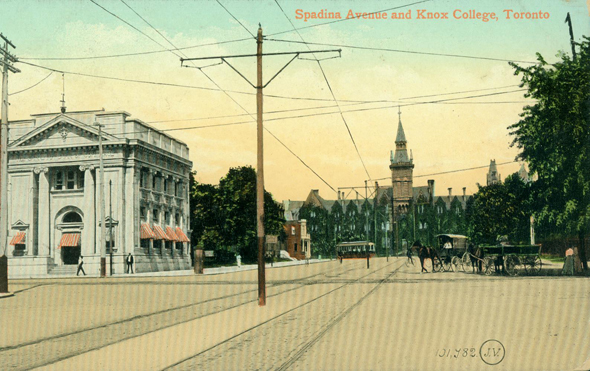
1 spadina crescent, knox college, torontoIn 1943, the structure was sold to Connaught Laboratories, one of the first of large-scale suppliers of insulin. In 1972, the building came into the hands of U of T, and since then has contained the Department of Ophthalmology, the Eye Bank of Canada, the Department of Anthropology, and the Department of Art.

All of these tenants have adapted the structure to their own use, often adding extensions, which is the reason why the back appears completely altered, although the front façade has remained intact.

1 spadina crescent, knox college, torontoIn 2005, W. Bernard Herman, an alumnus who graduated in 1932, donated $1 million in order to restore the entrance and the grand staircase, which will be named the Sharon and Bernard Herman Lobby. In 2007, the firm of Kuwabara Payne McKenna Blumberg architects submitted a master plan for the revitalization and expansion of the building, which will eventually provide space to the Department of Fine Art.

Perhaps post-renovation, the building's creepiness factor will eventually diminish.

Photos from the City of Toronto Archives, Wikimedia Commons, and postcard from the author's collection.

Discussion

11 Comments

Jeremy / August 2, 2010 at 03:18 pm
user-pic
Umm, could you put a little warning that that birds-eye-view picture you're linking to is 77MB large? It's quite a bit larger than the average browser can handle efficiently.
NorthernSoul / August 2, 2010 at 03:47 pm
user-pic
Good article! Thanks for that! I live around the way and had no idea of the buildings history or modern purpose. Presumably, a prestigious placement for a building back in the day with a prominent sounding address. Seemingly an awkward fit now as the decay of the College/Spadina intersection creeps further north.
Keith / August 3, 2010 at 01:55 am
user-pic
It's a spectacular building lost in the new craziness of our city - sad but true. It needs a hell of a lot more than a new staircase inside. Creepy or not - thankfully it's here to stay.
Torontonian / August 3, 2010 at 08:38 am
user-pic
Please correct the church's name to
Church of the Redeemer. There is no "Holy"
in its name.

Its web address is: http://www.theredeemer.ca/
Jason Bondy-Sawyer / August 3, 2010 at 07:30 pm
user-pic
I've ridden the streetcar past this building countless times but never once stepped inside. Even during my years as a U of T student I neglected to explore this one. Maybe it's time to pop-in now, before the reno?
max / August 3, 2010 at 08:14 pm
user-pic
There's a lot more to the Amelia Earhart part of this story.

It was supposedly in Toronto that she discovered the wonder of flight.

A pilot that recovered at this hospital took Amelia up for her first flight when he was well enough. She didn't fall in love with the man but sure was taken by the flying thing.
Agatha replying to a comment from max / August 4, 2010 at 02:03 pm
user-pic
That is interesting, but what is the source?
Agatha replying to a comment from NorthernSoul / August 4, 2010 at 02:04 pm
user-pic
Thank you!
bob / August 4, 2010 at 02:09 pm
user-pic
KMPB is not a good architectural firm.
north / September 16, 2010 at 03:00 am
user-pic
RE: Amelia Earhart
You have your facts wrong.
She first went up in a plane In Long Beach, on December 28, 1920.
Here is the FACTS:
ith a young woman friend, Earhart visited an air fair held in conjunction with the Canadian National Exposition in Toronto. One of the highlights of the day was a flying exhibition put on by a World War I "ace."[29] The pilot overhead spotted Earhart and her friend, who were watching from an isolated clearing and dived at them. "I am sure he said to himself, 'Watch me make them scamper,'" she said. Earhart characteristically stood her ground, swept by a mixture of fear and exhilaration. As the aircraft came close, something inside her awakened. "I did not understand it at the time," she said, "but I believe that little red airplane said something to me as it swished by."[30]

By 1919 Earhart prepared to enter Smith College but changed her mind and enrolled at Columbia University signing up for a course in medical studies among other programs.[31] She quit a year later to be with her parents who had reunited in California.
In Long Beach, on December 28, 1920, Earhart and her father visited an airfield where Frank Hawks (who later gained fame as an air racer) gave her a ride that would forever change Earhart's life. "By the time I had got two or three hundred feet off the ground," she said, "I knew I had to fly."[32] After that 10-minute flight (that cost her father $10), she immediately became determined to learn to fly. Working at a variety of jobs, as a photographer, truck driver and stenographer at the local telephone company, she managed to save $1,000 for flying lessons. Earhart had her first lessons, beginning on January 3, 1921, at Kinner Field near Long Beach but to reach the airfield Earhart took a bus to the end of the line, then walked four miles (6 km). Earhart's mother also provided part of the $1,000 "stake" much against her "better judgement."[33] Her teacher was Anita "Neta" Snook, a pioneer female aviator who used a surplus Curtiss JN-4 "Canuck" for training. Earhart arrived with her father and a singular request, "I want to fly. Will you teach me?"[34]

Earhart's commitment to flying required her to accept the frequently hard work and rudimentary conditions that accompanied early aviation training. She chose a leather jacket but aware that other aviators would be judging her, slept in it for three nights to give the jacket a more "worn" look. To complete her image transformation, she also cropped her hair short in the style of other female flyers.[35] Six months later, Earhart purchased a second-hand bright yellow Kinner Airster biplane which she nicknamed "The Canary." On October 22, 1922, Earhart flew the Airster to an altitude of 14,000 feet (4,300 m), setting a world record for female pilots. On May 15, 1923, Earhart became the 16th woman to be issued a pilot's license
Putoto / April 11, 2013 at 02:41 am
user-pic
I think they should restore the metal pinnacle object(?) on the very top of the roof.
Also they should make the coppered part at the roof whose colour now very green, dark brown or the original yellow brick tone shown in the historic photo. Those simple addition/ touch-up things will make the building look much better!

Add a Comment

Other Cities: Montreal