Saturday, May 26, 2012Mostly Cloudy 22°C
City

Future not so bright for laneway housing in Toronto

Posted by Rick McGinnis / August 11, 2010

A typical downtown lanewayToronto has miles of laneways, a parallel city just off the axis of our street grid, where garage doors replace porches and mailboxes. It's a place where glimpses of people are rare, though you'll occasionally find a house sprouting amidst the tarpaper siding and spalled brickwork, a lone colonist for human life in this city for cars.

Toronto's first laneways were laid out in the age of the horse, and you'll still find the odd coach house behind older streets, complete with second floors for hay storage. They spread with the auto, as the city's narrow residential lots made the street-facing garages commonplace in nearly every suburban subdivision impossible. They're traveled mostly by graffiti- taggers and stray cats, but some urban pioneers regard them as a wasted opportunity to increase urban density and add another layer to city life.

"It's unusual and that's very appealing," says architect Martin Kohn, who designed a laneway house on Croft Street, near College and Bathurst. "It's a different situation than normal and some people want to be different. There's an enforced modesty about your ambitions because the sites are so tight, and privacy issues and how you deal with those things. There is a virtue in restraint, and that appeals to people."
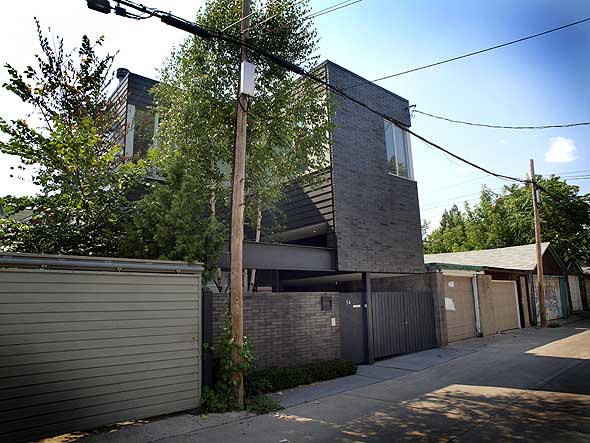
Croft St. laneway houseCroft is a unique exception to the city's laneways - a named street with stretches of housing built intermittently along its length. It's also the sort of place where laneway housing pioneers are more likely to overcome obstacles put in their way by the city's zoning laws and committees of adjustment. Kohn's firm is one of a handful that have made laneway housing a specialty, but he says that he strives to let potential clients know that they'll likely have an uphill battle getting their homes built.

"We get calls every six months, we'll get two or three phone calls people asking about it, and sometimes we'll even go look at properties. But in the end they've got to be really committed, and spend some money to push it along."
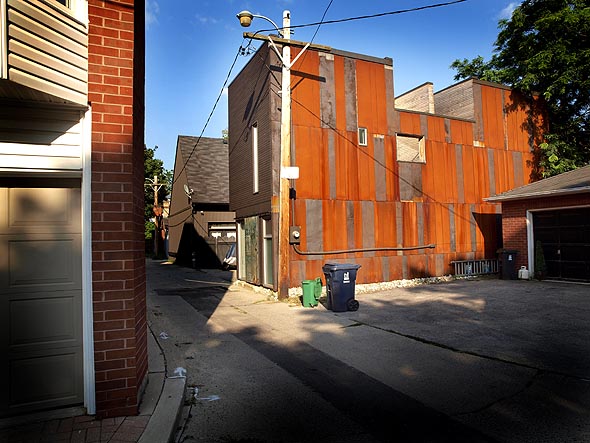
Shaftesbury Ave. laneway houseMeg Graham of Superkul Architects was the architect of a laneway house on Shaftesbury Avenue, near Yonge and Summerhill - another project that made it through city approval thanks to being sited on a named laneway where other homes already existed. Like Kohn's Croft street house, the home on Shaftesbury was built on the bones of a preexisting structure, and the architects were forced to be creative, both in satisfying myriad city requirements and applying for variances, and in maximizing the tight footprints of the sites. Echoing Kohn, she compares designing the house to building a boat, where every square foot has to be used.

But like everyone with a passion for laneway homes, Graham says that the city could be a lot more accommodating to these kinds of projects. "Policy always leads, right? And it's stated in the official plan that this increased level of density is desired. The zoning always takes a long time to catch up and there's always the NIMBY factor, too. Policy is a broad brushstroke instrument, and in the end people are going to be either really interested or completely uninterested in seeing it in their backyard."

The hurdles in building a laneway house are plentiful: besides getting services like water, power and sewage into the site, the city also has to be satisfied that garbage and fire trucks have unimpeded access. In addition, there are privacy issues with nearby neighbours, and requirements for parking spaces and outdoor space that have to be either met or argued to the point of gaining a variance. Both the Shaftesbury and Croft houses feature ingenious solutions to these issues, involving clever structural fixes and innovative features such as roof gardens and internal courtyards, which probably explains why laneway houses evoke such passionate advocacy from architects and the urban design aficionados who commission them.

City Hall is certainly unenthusiastic about the spread of laneway housing, insisting that it isn't necessary to the city's long-term growth plan, which concentrates on the condo-heavy downtown, the "avenues" (major streets) and discrete development zones such as Yonge and Eglinton, Etobicoke, Scarborough and North York.

"Laneway housing is not a key component in the City's plans for growth," says David Oikawa, Manager of Community Planning for Toronto and East York. "Laneway housing has potential adverse impacts such as over-intensification of lots, servicing issues, health and safety issues and overlook into adjacent properties. Laneway housing may be acceptable in a neighbourhood where there is a history of it in the neighbourhood and it forms part of the character of an area, but laneway housing needs to be examined on a case-by-case basis to determine if fits within a neighbourhood."
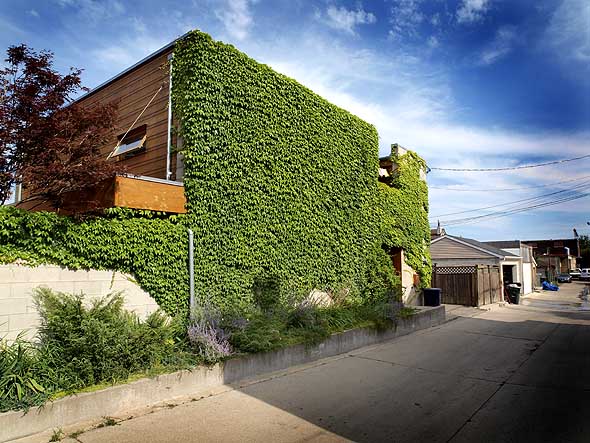
Carleton Village laneway houseProponents of laneway housing argue that, while many of the obstacles listed by the city are reasonable, it's an option that should be more often on the table, if only for reasons that transcend issues such as density. Architects Christine Ho Ping Kong and Peter Tan built their Carleton Village laneway house on an unusually large site near Davenport and Old Weston Road, retaining three cinder-block walls of a contractor's warehouse to create a live/work space with courtyard areas on two floors.

Tan says that it was his experience growing up in Thailand, in addition to a thesis he did of Kensington Market's laneways and the couple's travels in Europe and Asia that opened their eyes to the potential of laneway housing, which they say is usually championed by people who've traveled to places where urban real estate is both scarce and expensive, resulting in cities that have built into every corner and crevice.

"Having these layers and parallels are what makes cities amazing places to be," Tan says, "that you can discover corners that you never thought existed - it gives it layers that a city like Toronto desperately lacks. Cities like Rome that have all these layers and collisions of different things happening, you can really experience that, and if the laneways were developed that's what you'd get in the city - layers of experience."

For Elena Soni, who commissioned the Shaftesbury laneway house that recycled the rusted steel cladding of the workshop that stood on the site, location and uniqueness more than make up for the lack of space. "The city will have to change its mind because in order to keep neighbourhoods healthy you need to have people living in them, with eyes on the street all the time, and we have no more space in Toronto. So the more laneway housing we make the more alive our core will be. To anyone willing to undertake this I say keep it on, and the city will have to change its ways."
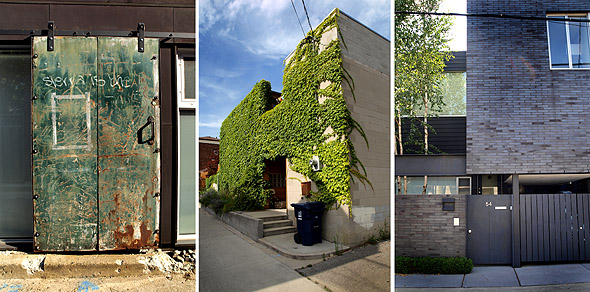
Laneway house triptych

Discussion

26 Comments

bob / August 11, 2010 at 03:15 pm
user-pic
Laneway House is very nice house
Andrae Griffith / August 11, 2010 at 04:07 pm
user-pic
Myself and an elite group of Ryerson University urban planning students (now grads) recently did a study of the uses of laneways in an area stretching from the Entertainment District to Seaton Village. I think there is an apetite for laneway housing in certain areas, but they need to be designed so that they respect the privacy of the existing homes. A traditional-sized house might not be appropriate if it overlooks someone's private back yard.

Also, we found that there are barriers to laneway housing in many areas of city policy. How do you collect garbage from a dead-end laneway when garbage trucks aren't supposed to reverse in the name of safety? How do you fit sewers and gas lines in narrow laneways when the building code requires seperation between the utilities and the houses? All of these things can be overcome, but it's not as simple as saying "just build it."

If anyone wants to see the award-winning report we published I'd be happy to share. @gttavisions or email me through my blog.
Sean / August 11, 2010 at 04:10 pm
user-pic
Generally speaking, if you don't already have a laneway house, odds are very good you won't get one approved by the city. Same goes for coach houses or any other form of "house behind a house". You are virtually guaranteed to have an expensive OMB fight against the City.
W. K. Lis / August 11, 2010 at 08:06 pm
user-pic
There was a time when porches and the main entrance fronted the street with the living room window and the garage was out of sight in back with the laneway. Today, the porch almost disappeared with the front door to the side, the living room behind the garage and the driveway and all important car in front, the laneway has now in front.
mike replying to a comment from Andrae Griffith / August 11, 2010 at 09:12 pm
user-pic
Easy there, Andy. I'm sure you're hot stuff and all but if you keep pumping your tires that hard they're going to pop.
Andrae Griffith replying to a comment from mike / August 11, 2010 at 09:45 pm
user-pic
Who's Andy?

Either way, we did the work for Adam Vaughan's office. It won an award. My tires are only filled with truth.
John / August 11, 2010 at 10:50 pm
user-pic
I'm not sure who Pam Graham is, but MEG Graham is the partner with Superkul Architects and architect of the laneway house: http://superkul.ca/practice/about
Darcy McGee replying to a comment from Andrae Griffith / August 11, 2010 at 11:19 pm
user-pic
The words "elite" and "Ryerson students" should only be used in reference to Subway's search for the next great sandwich artist.
god / August 11, 2010 at 11:51 pm
user-pic
Fire safety? Sprinklers (and let's not even start about how not up-to-code the current housing stock it)

Garbage? Figure something out.

Privacy? Figure something out that retains privacy.

Seriously, there are solutions to all of these but the city is too unimaginative and lazy to care.
tedrogers replying to a comment from Andrae Griffith / August 12, 2010 at 01:50 am
user-pic
friends don't let friends go to ryerson.
Fionn McCool replying to a comment from Andrae Griffith / August 12, 2010 at 02:22 am
user-pic
Apparently, even "elite" Ryerson students can't spell or string grammatical sentences together. What chance have the regular students? Oy vey.
emmy / August 12, 2010 at 09:22 am
user-pic
while city policy, and certainly the by-laws, may be lacking in regards to this issue, it is not, as "god" states as easy as "figuring something out." at the end of the day it is not the responsibility of the city to address privacy or servicing issues. if someone wants to submit an application for a laneway house it is their responsibility to show that they can address those issues in a way that respects the existing context while satisfying the requirements. toronto needs more laneway housing but there needs to be a sense of quality to them which would be difficult to find should the approving bodies start saying yes to everything. the condo jungle by the waterfront is not the solution to increasing density in the city, however, greter guidelines would need to be in place before laneway housing could be considered a viable option.

rye-high? damn, i wish i was lucky enough to go there to become an elite grad. i guess a degree from another university and real life experience only qualify me for plebe status.
Nimby / August 12, 2010 at 10:36 am
user-pic
I'd be pretty pissed off if someone put up a house blocking my backyard's sun and view...
rick mcginnis replying to a comment from Nimby / August 12, 2010 at 11:16 am
user-pic
Well, it would only happen if somebody managed to sever your backyard from your property without you knowing, then overcome the OMB and zoning by-laws that require community input on every one of these case-by-case projects. Every one of these laneway houses were built on lots that had long been severed, and the owners did their level best to get on their neighbours' good side. In any case the whole review process would make an unreasonable laneway house design impossible.
Jessica Bell / August 12, 2010 at 04:14 pm
user-pic
I would buy or rent a laneway house in a heartbeat, and I can't wait for the day when there are more of them.

For me it's about affordability. I don't have the nearly half a million you need to buy a house in the inner suburbs. And I don't think condos are all that great.

There are problems, for sure, but other cities around the world have overcome them and other issues associated with higher density living, and Torontonians can too.


Rachel / August 12, 2010 at 10:17 pm
user-pic
Melbourne has heaps of laneways, but they tend to be more in economic areas and not residential ones. That doesn't stop people from putting in the odd restaurant on a street or a bar upstairs and around the corner.

Maybe Toronto could set up shop.
Daniel / August 13, 2010 at 02:02 am
user-pic
instead of the bums sleeping beside your garage, they can sleep on your front steps.

seriously, do people really want to live off a laneway? grow up and get a real house. how can you raise a family like that?
Marc / August 16, 2010 at 01:59 am
user-pic
Gross, did I just read the name Ryerson? That place is littered with 416 suburbs and 905-next door idiots who lack in culture, basics and education OUTSIDE OF SCHOOL AND BOOKS. Ryerson is also infested with those from the 416 suburbs and 905 next door cities who those who were just put there by their parents as it's just "what's to be done" after high school is done. Oh wait, this is found throughout the other universities as well! But Ryerson is the centre of it all.
Marc / August 16, 2010 at 02:01 am
user-pic
As well as those valley girl-sounding girls most likely brainwashed by AMERICAN media. Why do I say this? Because this is Canada and we never had this here as a natural thing. Never. It'll be sad if those kinds end up working in the financial district or somewhere in that league one day. Ugh.
jamesmallon replying to a comment from Daniel / August 16, 2010 at 08:23 am
user-pic
Oh yeah 'Daniel', I want to grow up to be 'aspirational', just like you.
jamesmallon replying to a comment from Daniel / August 16, 2010 at 08:25 am
user-pic
Here in Tokyo the housing stock corresponds to 'laneway' housing from a N.American point of view, and the city zoning is messy but interesting, whereas Toronto is the opposite.
laneway larry / November 17, 2010 at 05:19 pm
user-pic
Laneway (LWH) houses should be a good idea that solve problems. But new problems arise. I am a tenant renting the existing, main house where a LWH is being constructed. This is not pleasant. While I might like to eventually live in a LWH, the construction impact is significant. Noise, fumes and being surround by construction is not nice. Especially when no compensation by the landlord. These things, as usual, always work out to the benefit of the land owner, the developer and the construction crews (as well as the city that gets revenue from permits). There are no benefits to tenants renting homes where this is happening. There should be. We are part of the city, but (as usual) ignored except of course for our cash.
laneway larry / November 17, 2010 at 05:24 pm
user-pic
Lastly, we probably should ask ourselves as a society: do we want to become a new third world environment, or do we want to consider other options? At what point does a lane cease being a lane and becomes another street? I thought the ecological, environmental direction was to create LESS streets, less footprints for buildings - - and CREATE more footprints of trees, nature and the like. What I see happening is "ecology" and "green" and "sustainable" being hijacked (as usual) by developers, politicians and basically, "money." Those making less than $100,000 a year need not apply. Those making less than $50,000 a year are basically scum to be jammed into boxes. Maybe the answer lies in tackling over-population. There's the real un-sustainable item. People. People are not sustainable, and people are not green.
laneway larry / November 17, 2010 at 05:27 pm
user-pic
Laneway houses do not solve "affordability." Nothing does.
Those are the dreams of fools.
Wowza replying to a comment from laneway larry / June 15, 2011 at 02:51 pm
user-pic
Wow! What exactly are you suggesting laneway larry? "Maybe the answer lies in tackling over-population. There's the real un-sustainable item. People. People are not sustainable, and people are not green."
_n / March 28, 2012 at 01:52 am
user-pic
I'd love to build a 500 square foot laneway house where an unused garage used to be. Better idea than a condo.

Add a Comment

Other Cities: VancouverMontreal