City
TTC Releases Suicide Statistics
The TTC has recently released statistics pertaining to suicides and suicide attempts involving Toronto subways. The information, which has long been kept confidential, was requested under the Municipal Freedom of Information and Protection of Privacy Act.
Although the mainstream media has previously resisted reporting on such incidents, this request was made by what the TTC refers to as "a local media outlet." Initially denied on account of fear that the publication of this information might lead to copy cat acts, the request was won on appeal and the Information and Privacy Commissioner ordered the information be made public.
In compliance with the order, the TTC has specifically released statistics that chart incidents of suicides and attempts between 1998-2007. Formerly the subject of much speculation and urban mythologizing, the numbers are sobering. On average, there has been a suicide attempt every two weeks over this period, with more than half of them successful.
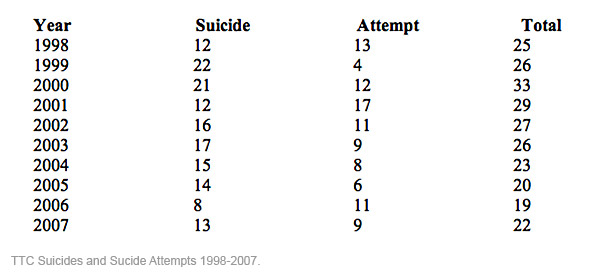
That's certainly more than I would have estimated, and I understand the desire to keep this information under wraps. Forgetting the fact that there is evidence to suggest that reporting of incidents of this nature can pose difficulties for those who are already at high-risk for an attempt on their lives, there's a compelling argument to be made that these statistics may incite fear in the average rider.
With this information now public, the TTC is thus taking steps to highlight the preventive measures that it takes in regard to suicide attempts. Over the past decade or so, the Commission has worked with St. Michael's Hospital and the Trillium Health Centre on a number of initiatives to help prevent suicide attempts on subway property. Most notable is the "Gatekeeper Program," in which employees are trained to identify those who are exhibiting high-risk behaviour and how to best interact with them should they encounter distressed individuals on or near platforms.
What's so unfortunate about situations of this nature, however, is that it's extremely difficult to bring trains to a halt with any haste, and there just aren't enough staff to monitor every passenger's behaviour for signs warning of a possible jump onto the tracks.
For those employees who suffer the misfortune of being involved in such incidents, the TTC also offers a number of counseling programs oriented around acute psychological trauma. With roughly 25 attempts a year, this is no doubt a serious problem for subway drivers.
So, despite this release of information, the TTC will maintain its current policy of not informing the media of suicide attempts when they occur.
The forced release of the statistics has spawned feverish debate, with some people lauding the Toronto Sun for doing the digging, others condemning the media for revealing the numbers, and others playing devil's advocate.
What's your take? Should these numbers have been kept from the public? Is the contagion effect a concern here? What do we now do with these numbers? Are barriers on platforms the next step?
Photo by sjgardiner, member of the blogTO Flickr pool.


Discussion
73 Comments
Sort By Oldest First / Newest First
Subscribe
The urban myth was that a suicide occurred several times a day.
Just some thoughts.
May 19 – Star Wars Episode I: The Phantom Menace is released in theaters. It becomes the highest grossing Star Wars film.
With proper research my educated guess is that we would find that the link between the people is that they were Star Wars fanbois.
If you don't make fun of suicide you are more likely to commit it.
Way to rub it in on us Mr. Double T to the C.
I feel for the ttc subway drivers...
Doesn't sound like such a good idea now does it?
(back of the envelope:) there are around 100 trains in service on the system at any given time. 2 operators per train, 3 shifts. 600-800 subway operators?
With 25 suicides a year, that's roughly a 3% chance of seeing an attempt. Every year. Over the course of a 30 year career (+/- 750, depending on long term trends), that means that more likely than not an operator will witness a suicide attempt. Witnessing 2 or 3 over that span would not be uncommon.
This might be one of, perhaps the primary reason, for "modified duty" that many collectors are on.
But don't know these stats. The TTC does though.
I also wonder about numbers of people pushed onto the tracks. I remember that happening a few times years ago by people with mental illness. I used to stand back from the tracks just in case! I guess those stories DO make the news. Still, wouldn't mind seeing those numbers as well.
http://en.wikipedia.org/wiki/Platform_screen_doors
Remember, each of those numbers is a person...I remember reading about a woman who jumped in front of a train along with her kid(s?) a few years ago...sometimes this city feels very vast.
However, I don't think barriers are the way to prevent suicide. Expanding social services and in particular mental health services would do a great deal more to help than nets/barriers.
Attempts at suicide are only part of the incursions to track level. The Spadina Extension should be built ready for platfrom doors from 2016 when the new signalling is commissioned, with the rest of the system retrofitted over time.
http://video.edmontonsun.com/video/sunshine-girl/sunshine-girl/5790925001/subway-suicide-revisited/49779658001
I had just moved to toronto and obviously he was just trying to shock me
Plus I see that every other news reporting institution, even the sanctimonious, has picked it up.
In London UK they much more blunt, heard an announcement last summer while visiting, "delay on line due to death".
Even though I'm not a subway operator I've witnessed 6 suicides on the subway since 1953.
The shock and trauma is no less when witnessing these events than for the operators involved.
I still have nightmares about one which I believe was accidental.
For many years I could not ride the subway I was so traumatized I needed psychological counseling in order to work through the Post Traumatic Stress.
Unfortunately, there is no easy answer, people who are so troubled and depressed that they have made the choice to end their lives, will find a way, whether it be by jumping in front of a subway train or by another method.
Obvious problems are cost and installation but there are many other factors involved. Just one additional reason is the station & tunnel ventalation is designed around trains moving air between stations and solid barriers would prevent or limit that.
If you have ever been on a platform during a minor garbage fire when trains were stopped, you see how fast the stations fill with smoke and how well they clear once the trains restart.
The TTC has suggested barriers may be considered and installed as new stations are built or re-designed (such as union) as the cost is far less when included in the station design and not retro-fitted.
On the one hand I feel like I'd want to know the real reasons for why the TTC is making me late, because if I knew it was a suicide it might make my reason for being in such a rush seem trivial and introduce a little perspective when it forces me to reflect on what is really imporant. On the other hand, it seems to happen so often (every 2 weeks) that perhaps it might have the opposite effect of desensitizing people and making them cynical; the last thing I'd want is to find myself reacting to a suicide notice with impatience and disdain (i.e. "Of course he had to commit suicide when I'm late for my important job interview...")
I feel that putting up barriers is a mute point. If someone wants to kill themselves, they will find a way to do it. Money is better spent on education and support.
I agree with you that the secrecy of TTC and other subway system suicides is counterproductive. I think the main problem, though, is that it still really is a taboo subject. I've written about the subject myself on my site - in relation to books about teens who have attempted or completed suicide, and found that some readers stopped following me afterward. I think they were offended or upset by the subject, but I for one would rather discuss it and help prevent it.
Air conditioning and heating are much more efficient when you seal off the station from the tunnels. Air contamination would be reduced as well with much less dust from the tunnels being blown into the station.
I cant find mention of it anywhere but I am finding a lot of news about how the ttc is now releasing their suicide statistics and that they are gonna go ahead with suicide barriers at the stations. What gives? Anybody?