Friday, March 19, 2010Mostly Cloudy 11°C
City

PUG Awards go to AGO and One St. Thomas

Posted by Lisa Pasold / June 4, 2009

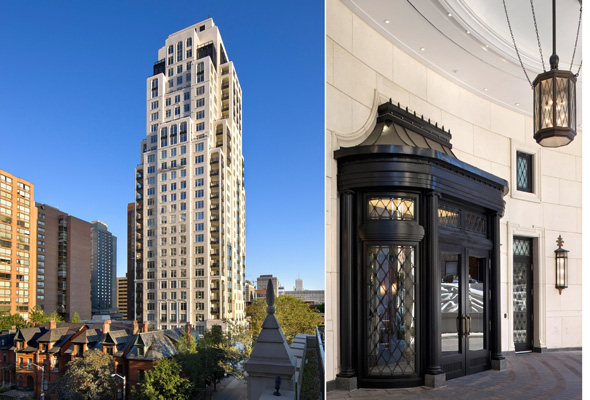
PUG AWARDS AGOLast night's PUG awards didn't bring any surprise winners: Gehry's fantastically-successful AGO won as best commercial/industrial building, and One St. Thomas Residences won as best new residential. But the event brought out the city's who's who of architecture and urban design, at the gorgeous McKinsey & Co. building on Charles (a fortuitous last-minute move from the Gardiner Museum), and included a panel discussion that got some blood boiling.

PUG award statue

I have no quibbles with the PUG winners - enough has been said on the gorgeous AGO, and classy One St. Thomas (see photo below) is a great choice, especially when you compare it with the other contenders. But One St. Thomas is also very safely successful: if you want to win public votes, referencing Art Deco is always a good way to go (see last year's winner, the subdued condo-ization of the former Argyle & Dovercourt bakery, with its early Art Deco stylings). My only complaint is that so many of the residential entries were so unrelentingly boring. See the full list on the PUG site.Winner One St Thomas
And the losers? Well, to spare sensitive architects' feelings, the losers weren't presented with dunce caps at the ceremony. But in the commercial category, the most-disliked building this year was Mount Sinai's Joseph & Wolf Lebovic Centre; the second-most-disliked was the easy-to-hate Toronto Life Square. Both, I think, well deserve PUG's big thumbs-down - maybe we can install a public garbage statue on their curbs.

Founded by Gary Berman and Anna Simone in 2004, the PUG awards began life as a critique of the ugliest buildings in our sometimes unlovely city - but gradually, the "Fugly" award has morphed into the cuddlier, ultimately more interesting, PUG. The award is based on popular votes (you didn't cast your ballot? mark your calendar for next May, so you don't forget.) To qualify for a PUG, buildings had to be completed in 2008, contain an area greater than 50,000 square feet (or be considered noteworthy), and be located within the City of Toronto.

Winners & losers aside, the PUG awards features a panel discussion about the city, and that was the real meat, yesterday evening. This year's panel consisted of George Baird (Dean of U of T's Faculty of Architecture, Landscape & Design), urban strategist Joe Berridge, developer Alan Vihant, and the verbose Councillor for Ward 20, Adam Vaughan.

Former Kontent magnate Michael King as the very shiny MC kicked off the panel discussion by wondering if this new economic atmosphere will parallel the Great Depression, creating a major cultural shift in our built world. Then he asked the panel to consider whether Toronto has a master plan.

Joe Berridge answered simply, "I don't think Toronto is plan-able." To my despair, he then added, "Be careful of big ideas." As conversation progressed, Adam Vaughan became gradually more frustrated with the discussion.

I sympathize. Just before the PUGs yesterday, Danish architect Jan Gehl gave a lecture to a standing-room only crowd at the Design Exchange. He talked about recent urban decisions in Copenhagen, Melbourne, and New York City. Gehl is one of the masterminds behind New York's PlaNYC Initiative, including the new pedestrianization of Times Square. The lecture was inspiring, and Councillor Vaughan was there, in the front row, drinking in Gehl's ideas.

Melbourne had problems much like Toronto's urban sprawl and planning failures--yet it has successful shifted away from car dependence, using Gehl's ideas. If Melbourne can evolve in an exciting architectural direction, surely we can too. But an hour later, there we were at the PUG awards, hearing the same dull platitudes about our city. No wonder Vaughan became a tad apoplectic.

Why aren't we consistently inspired? The panel agreed that Toronto simply doesn't thrive with its master plans. This is largely because a lack of political will has tied urban planners' hands. The audience - and MC Michael King - seemed shocked that Vaughan would actually get upset about this problem, breaking the oh-so-polite Toronto code. But I think his emotion is encouraging: people are ready to care about this city, and get upset at its failures.
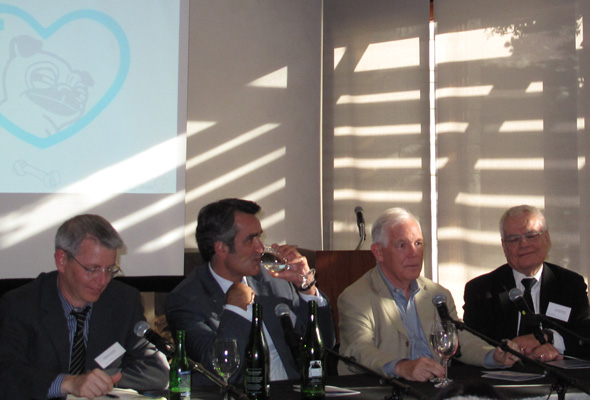
PUG panel Vaughan Vihant Berridge Baird

As PUG co-founder Gary Berman said last night, "We're gathered here today because we love our city, and we want it to sparkle, to dazzle." And maybe, to set off some firecrackers.

PUG includes two inspiring initiatives: PUG ED, a program for senior elementary school students to think critically about architecture in Toronto, and PIMBY, or Pug In My Back Yard, which will focus on the city's planning process. Which hopefully means even more difficult conversations about how to make this city better. I, for one, can't wait.

Photo of AGO interior by Roger Cullman.

Discussion

13 Comments

Harry / June 4, 2009 at 5:01 PM
user-pic

"Why aren't we consistently inspired? The panel agreed that Toronto simply doesn't thrive with its master plans. This is largely because a lack of political will has tied urban planners' hands."

It's much simpler than that; for the past 40 years Jane Jacobs and Jan Gehl have pointed out that 98% of urban planners are engaged in anti-humanistic urban planning. At the same time a 200 page study shows that neither urban planners or politicians have the required skill sets to do humanistic city design. Even worse, there are no universities in North America that can teach the required skill sets; translation the universities don't have professors with the required above mentioned skill sets. (The blind leading the blind.)

The solution is obvious; hire Jan Gehl to oversee the redesign of Toronto. That's why NYC, London UK, Sydney (and the list goes on and on) have all hired Gehl. There is no one else who can do it.

A|Layton / June 4, 2009 at 5:05 PM
user-pic

So that's why this city is heading down the crapper. People like Joe Berridge who 'strategize' the Mayor's next 'groundbreaking move' with small ideas and small will to go with it.

David / June 4, 2009 at 7:26 PM
user-pic

London: Est. 50 A.D.
Paris: Est.250 B.C.
Copenhagen: Est. 1000 A.D.
New York City: Est. 1624
Toronto: Est. 1793

I'm not sure why we don't understand this, Toronto is a different city. Much younger, established at a very different time and more importantly our population bloomed at a much different time than any other major city. Other cities that are perhaps laid out better have for the most part had major reasons for that (Chicago Fire, San Francisco Fire) that allowed for a revamp. Our city is not like that.

I personally feel as if our city tries to force change. I'm not sure whether that is the wisest way to go around building a city. Paris became the way it is now over hundreds of years of change, like the ocean over a rough stone, creating grooves and notches. I think we all get the Jane Jacobs thing, community, etc. It's hard not to agree with it, but it's the way that we build the city that is the problem. I think that the first thing the city has to do is fix our public transportation system, with a subway, no more streetcars. Whatever the cost of building an extensive subway system is now, it is just going to be more and more expensive in the future.

I'm just not a fan of forced planning, or planning that gets in the way of a natural city. An example would be ossington, banning all new restaurants? Why not embrace the change? Maybe it is just me.

Harry / June 5, 2009 at 9:10 AM
user-pic

"I'm not sure why we don't understand this, Toronto is a different city."

They said the same thing about Copenhagen 40 years ago, as Jan Gehl began to redesign the downtown core of Copenhagen. He was told the Danes were different; that they really were not very social, so there was no point in providing public open spaces, where people could come and just hang out.

Well it turns out that the Danes are more Italian than the Italians and come out by the tens of thousands to hang out for hours and hours in the dozens of squares, wide sidewalks, bike lanes, and promenades. So it was completely untrue; the Danes in Copenhagen are NO different from people in Rome or Toronto. Toronto is no different from any other city in the Western World nor are Toronto residents different from citizens anywhere in the Western World!

Please .... stop apologizing for the self appointed elite in Toronto. These multi-millionaires and billionaire land speculators (who love to call themselves developers) have used their millions to buy politicians and others. This has happened in cities, all around North America and Europe, over the last 50 years - everywhere.

Jane Jacobs explains the above in her last book, DARK AGES AHEAD. Jacobs says that urban planners working at City Hall as well as the politicians are supposed to protect the residents of any city (including Toronto) from the "money comes before people" land speculators. But in fact, urban planners and politicians have been supporting whatever the "land developer/speculator" wants.

So David you have it all backwards here, it's the land speculators who are forcing their self interests based on "make money on other people's backs". And the latter started in:

London: 1950 A.D.
Paris: 1950 A.D.
Copenhagen: 1950 A.D.
New York City: 1950 A.D.
Toronto: 1950 A.D.

What you and others need to do is some secondary research and read the history about the inter-relationship between: auto maker CEOs, land speculators, expressways, farm land, suburbia, electric street cars and envelops filled with 1000 dollar bills left on restaurant tables. Then you will understand why the in-human, unlivable, unhealthy city has been FORCED on us all. Jane Jacobs and Jan Gehl has begun to take the land speculators chains off our wrists and ankles.

By the way, if you did some research, you would have known that Toronto's downtown did burn down, "The Great Fire Of 1904":

http://www.toronto.ca/archives/fire1.htm

David In replying to a comment from Harry / June 5, 2009 at 10:08 AM
user-pic

Okay.......

First off, I was aware of the Toronto Fire, Here are some figures:

Cost of Damages / Lives Lost / Area Lost
SF: At least 235 Million / At least 3000 dead / Uncertain, entire city affeccted
Chicago: 222 Million / Around 200-300 dead / 4 sq. Miles
Toronto: 10 Million / Zero dead / >1 sq. KM

As to the "developer talk", its a cop-out, the design of a city lies in its public spaces, where the city has fallen short.


"Please .... stop apologizing for the self appointed elite in Toronto. These multi-millionaires and billionaire land speculators (who love to call themselves developers) have used their millions to buy politicians and others. This has happened in cities, all around North America and Europe, over the last 50 years - everywhere."

I wasn't aware I apologized for anyone, I'm not sure why you wrote that at all.

My "Toronto is a different city" comment, please note how I'm referring to the city, not the cities inhabitants. The city size and population difference between Copenhagen and Toronto is huge.

Don't blame the "big rich" people, it's so easy to pin all the problems on them as opposed to looking at as a total societal shift. And maybe we'll shift back, but shifts are made over time, like change.

Also, our city is not "unlivable", "unhealthy", or in-human. Maybe it needs to be made better, but blaming auto makers, expressways, suburbia is so predictable and formulaic. I think the self-described "elite" are not exclusive to developers but self-righteous anti-developers also. Self-importance and arrogance are not exclusive to anyone.


Harry / June 5, 2009 at 11:11 AM
user-pic

David

You now say that you were "aware of the Toronto fire", then why did you originally say:

"Other cities that are perhaps laid out better have for the most part had major reasons for that (Chicago Fire, San Francisco Fire) that allowed for a revamp. Our city is not like that. "

You are apologizing, when you pretend that Toronto hasn't matured; because Toronto didn't have a major fire disaster. That had Toronto had it's own major fire disaster - that would have enabled Toronto to redevelop properly. But Toronto did have that momentous fire; but didn't mature. Why? Fairy dust?

You agreed with me (pretending not to agree with me) when you say:
" the design of a city lies in its public spaces, where the city has fallen short. ".

Who do you think controls the development of public open spaces; it's those billionaire land speculators. The definition of public open space is:

"all the spaces between the buildings" (not including the privately own buildings and the land surrounding the privately owned building)

So where is 90% of Toronto's public open space found? It's found on the roads! And who has decided and now still decides on the width of the roads and the width of the sidewalks, where roads go and don't go, where car parking lots are development, whether or not bike lanes happen, who can park illegally on the roads with being ticketed etc.- it's the billionaire land speculators and their support entourage (planners, and politicians).

Again you need to do some research about the absolute control that billionaire land speculators have had and still have over the design of Toronto (and other cities). Are you aware of the billionaire land speculators who wanted to run the Spadina Expressway from Yorkdale Shopping Mall right down down Spadina through the City to the Gardiner Expressway. Jane Jacobs organized tens of thousands of residents in Toronto to stop this "planning" that was approved by Council and was going to be implemented. An election ended the billionaire's wet dream. Instead the Spadina Expressway was just constructed as far as Eglinton - it's now known as the Allen Expressway.

You say "our city isn't unlivable, unhealthy or inhuman"; tell that to the bikers who have been killed on Toronto roads for starters. 90% of Toronto's public open space have been turned over to cars. That's inhuman. And it's the developers who made that choice. You call it falling short. I call it inhuman, unhealthy, unlivable.

Lastly "there you go again" ... apologizing for the billionaire land speculators when you say:

"My "Toronto is a different city" comment, please note how I'm referring to the city, not the cities inhabitants. The city size and population difference between Copenhagen and Toronto is huge."

Jan Gehl is now redesigning/redeveloping the roads for more and better sidewalks, more squares, 16,000 miles of safe bike lanes while cutting car parking and reducing car lanes by 50% in both New York City and London England.

Population London UK 7,512,400
Population New York City 8,250,000
Population Toronto 2,500,000

It's the urban planners, politicians and the apologists who provide the smoke screen that enables billionaire land speculators to do their dirty work. So what apology/excuse are you going to dream up next?

Harry / June 5, 2009 at 11:12 AM
user-pic

David

You now say that you were "aware of the Toronto fire", then why did you originally say:

"Other cities that are perhaps laid out better have for the most part had major reasons for that (Chicago Fire, San Francisco Fire) that allowed for a revamp. Our city is not like that. "

You are apologizing, when you pretend that Toronto hasn't matured; because Toronto didn't have a major fire disaster. That had Toronto had it's own major fire disaster - that would have enabled Toronto to redevelop properly. But Toronto did have that momentous fire; but didn't mature. Why? Fairy dust?

You agreed with me (pretending not to agree with me) when you say:
" the design of a city lies in its public spaces, where the city has fallen short. ".

Who do you think controls the development of public open spaces; it's those billionaire land speculators. The definition of public open space is:

"all the spaces between the buildings" (not including the privately own buildings and the land surrounding the privately owned building)

So where is 90% of Toronto's public open space found? It's found on the roads! And who has decided and now still decides on the width of the roads and the width of the sidewalks, where roads go and don't go, where car parking lots are development, whether or not bike lanes happen, who can park illegally on the roads with being ticketed etc.- it's the billionaire land speculators and their support entourage (planners, and politicians).

Again you need to do some research about the absolute control that billionaire land speculators have had and still have over the design of Toronto (and other cities). Are you aware of the billionaire land speculators who wanted to run the Spadina Expressway from Yorkdale Shopping Mall right down down Spadina through the City to the Gardiner Expressway. Jane Jacobs organized tens of thousands of residents in Toronto to stop this "planning" that was approved by Council and was going to be implemented. An election ended the billionaire's wet dream. Instead the Spadina Expressway was just constructed as far as Eglinton - it's now known as the Allen Expressway.

You say "our city isn't unlivable, unhealthy or inhuman"; tell that to the bikers who have been killed on Toronto roads for starters. 90% of Toronto's public open space have been turned over to cars. That's inhuman. And it's the developers who made that choice. You call it falling short. I call it inhuman, unhealthy, unlivable.

Lastly "there you go again" ... apologizing for the billionaire land speculators when you say:

"My "Toronto is a different city" comment, please note how I'm referring to the city, not the cities inhabitants. The city size and population difference between Copenhagen and Toronto is huge."

Jan Gehl is now redesigning/redeveloping the roads for more and better sidewalks, more squares, 16,000 miles of safe bike lanes while cutting car parking and reducing car lanes by 50% in both New York City and London England.

Population London UK 7,512,400
Population New York City 8,250,000
Population Toronto 2,500,000

It's the urban planners, politicians and the apologists who provide the smoke screen that enables billionaire land speculators to do their dirty work. So what apology/excuse are you going to dream up next?

Harry / June 5, 2009 at 11:13 AM
user-pic

David

You now say that you were "aware of the Toronto fire", then why did you originally say:

"Other cities that are perhaps laid out better have for the most part had major reasons for that (Chicago Fire, San Francisco Fire) that allowed for a revamp. Our city is not like that. "

You are apologizing, when you pretend that Toronto hasn't matured; because Toronto didn't have a major fire disaster. That had Toronto had it's own major fire disaster - that would have enabled Toronto to redevelop properly. But Toronto did have that momentous fire; but didn't mature. Why? Fairy dust?

You agreed with me (pretending not to agree with me) when you say:
" the design of a city lies in its public spaces, where the city has fallen short. ".

Who do you think controls the development of public open spaces; it's those billionaire land speculators. The definition of public open space is:

"all the spaces between the buildings" (not including the privately own buildings and the land surrounding the privately owned building)

So where is 90% of Toronto's public open space found? It's found on the roads! And who has decided and now still decides on the width of the roads and the width of the sidewalks, where roads go and don't go, where car parking lots are development, whether or not bike lanes happen, who can park illegally on the roads with being ticketed etc.- it's the billionaire land speculators and their support entourage (planners, and politicians).

Again you need to do some research about the absolute control that billionaire land speculators have had and still have over the design of Toronto (and other cities). Are you aware of the billionaire land speculators who wanted to run the Spadina Expressway from Yorkdale Shopping Mall right down down Spadina through the City to the Gardiner Expressway. Jane Jacobs organized tens of thousands of residents in Toronto to stop this "planning" that was approved by Council and was going to be implemented. An election ended the billionaire's wet dream. Instead the Spadina Expressway was just constructed as far as Eglinton - it's now known as the Allen Expressway.

You say "our city isn't unlivable, unhealthy or inhuman"; tell that to the bikers who have been killed on Toronto roads for starters. 90% of Toronto's public open space have been turned over to cars. That's inhuman. And it's the developers who made that choice. You call it falling short. I call it inhuman, unhealthy, unlivable.

Lastly "there you go again" ... apologizing for the billionaire land speculators when you say:

"My "Toronto is a different city" comment, please note how I'm referring to the city, not the cities inhabitants. The city size and population difference between Copenhagen and Toronto is huge."

Jan Gehl is now redesigning/redeveloping the roads for more and better sidewalks, more squares, 16,000 miles of safe bike lanes while cutting car parking and reducing car lanes by 50% in both New York City and London England.

Population London UK 7,512,400
Population New York City 8,250,000
Population Toronto 2,500,000

It's the urban planners, politicians and the apologists who provide the smoke screen that enables billionaire land speculators to do their dirty work. So what apology/excuse are you going to dream up next?

David / June 5, 2009 at 12:45 PM
user-pic

First off, I apologize, but I don't have the time, will, or desire to keep a fight going over a blog posting.

To reiterate, the fire in Toronto had no lives lost, only affected much less than a square km, and involved office buildings. If you don't see why that is so much different than in SF/Chicago where at least hundreds died, if not thousands, the scale of the fires is so different, it's apples and oranges.

I'm done with this, you're spinning things out of my words that I haven't said or meant. You actually take my words where I call Toronto a "livable" city and then counter that point with the fact that some bicyclists have gotten killed. Well, that's life in a large city with roads, cars, and people.

You're trying to polarize my point of view with yours and draw contrasts. I can't spend all day going through what you've wrote and why it is irrational and ill-conceived. I speak for no one but myself, I represent no one but myself, and I imagine it would be hard enough to have a thoughtful discussion with you in person, no less on a blog post.

Harry / June 5, 2009 at 2:00 PM
user-pic

David

Briefly, bad city planning has happened in Europe and America for the last 50 years in big and small cities, earthquaked or non-earthquaked cities, fire ravaged or not fire ravaged cities. It's happened in ALL cities. ALL!
That includes London, Paris, Toronto, Vancouver, Hamilton, Montreal, Buffalo, Detroit .. ad nauseam.

And what is at the centre of the bad planning? The domination of the city planning by the car! It's the domination of the car in London, Paris, Toronto, Vancouver, Hamilton, Montreal, Buffalo, Detroit .. ad nauseam - that is the issue.

The domination of the car causes a lack of public open space (since roads consume 90% of public open space). At the same time the CO2 and other pollutants produced by cars are a MAJOR health hazard. Moreover, the lack of public open space and the associates facilities - wide sidewalks, bike lanes, public washrooms, baby changing stations, shaded public seats and water fountains is a major mental health issue. At the same time the noise and congestion from cars produces negative stress issues.

So the $64,000 question is: how did the car happen to dominate city planning - dominate public open space in ALL cities?

And if you did some serious reading you would discover that in fact after World War Two, land speculators and car manufacturers got together to perpetrate the largest social engineering project ever. And envelopes full of crisp 1000 dollar bills bought all the expressways the land speculators needed to make suburbia happen. And to make congested city streets. Again read Dark Ages Ahead.

David / June 5, 2009 at 5:22 PM
user-pic

Am I the only one who realizes all of the positives that the car has brought us. It is really easy to hate the car, pollution, gas, etc. But the reality is that when my wife is giving birth, I can be at a hospital in less than 15 minutes. I can take my young son to skating lessons (we are not within walking distance and he can't ride a bike). Etc, etc. There are so many ways that a car is integral to our lives, and we can't act as if they are the problem. They are not, and it is naive to think so, in my opinion. If you live in the city, and you enjoy shopping at the farmer markets, they all come into the city via car, they use the 400/401/403, etc.

I am a heavy car user, and a heavy cyclist, I see a reason and purpose for both, I don't see a reason to put the person on the bike ahead of the person in the car. I just want to find out about the last discussion at city hall to make driving more efficient, so I could spend less time in my evil car getting from point A to Point B.

Another point, our cities economy is reliant on people driving in from the GTA to spend money in the city, providing employment and life in our downtown core. This issue is multi-faceted and grey, not black and white.

G.I. Poo / June 5, 2009 at 7:15 PM
user-pic

Government wants to do something big, splashy, something to get the attention of voters so they can point to themselves and say, "Look! See, we feel the same way about this place as you and we want changes."

So they commission a plan.

Planners make the plan.

The city adopts the plan.

The plan sits on a shelf and gathers dust.

A|Layton In replying to a comment from G.I. Poo / June 5, 2009 at 10:49 PM
user-pic

Actually, it goes a little something more like this:

Councillors need an issue to hing the next election on

Planners make the plan

Councillors realize that the outcome of said plan wont be realized for at least 20 years (much longer than the 4 yr term of a councillor)

Councillors reject plan because of their own greed and need for attention

The plan sits on a shelf and gathers dust

The city suffers

Years later students/reporters/planners/councillors find the plan and wonder why it was never enacted as it would've at least in part solved many issues of the day

Add a Comment

Other Cities: VancouverMontreal