Tuesday, February 14, 2012Cloudy -1°C
Tech

Getting with the 21st Century: Toronto Considers the Wireless Canada Program

Posted by Brady Yauch / February 17, 2009

ComputersAs the web and web-based applications continue to garner greater attention in our lives, the city is looking at ways to make broadband access more universal.

A current proposal making its way through city hall is offering to place one thousand internet-ready, no-cost computers in public venues across the city. Better yet, as part of the plan, the city will actually generate a profit. Take a deep breath.

It's called the Wireless Canada Program. It was first brought to the city council's attention last year, and is being pushed by the Toronto Office of Partnerships. It goes something like this: a private firm in Toronto (the Oxford Group) is offering to set-up and maintain (at no cost to the city) 1,000 internet-ready computers in venues across Toronto. The initiative will be financed by corporate sponsorships, as they'll be able to place their logos on the computers' screen savers.

After the proposal was introduced, both the Toronto Community Housing Corporation (TCHC) and the Parks, Forestry and Recreation Division (PF&R) "deemed the initiative to have merit and expressed interest in having the computers placed in community centres and community housing sites." The city estimates the program would generate more than $500,000 in revenue over the initial 5-year term. The income will go the TCHC and PF&R, with the final allocation depending on the actual placement of the computers.

When I first heard of the proposal, it grabbed my attention. I am a major advocate of bringing the web to as many citizens as possible. According to the OECD, Canada currently ranks 10th in broadband penetration, with about 27 subscribers for every 100 people. At a quick glance, the proposal seemed like a great idea - allowing more people across the city to have access to both the economic and cultural benefits that come along with the web.

But I don't think this plan is right one for the city. The evolution of the web has been, first to laptops and netbooks, and more recently to smartphone devices like Apple's iPhone. This proposal doesn't take these devices into consideration. By only allowing people access to the internet through conventional PC portals, it carries the distinct possibility of becoming obsolete before it's even implemented.

The city should start looking towards more innovative approaches to bringing the web to a greater number of people. Toronto Hydro's move to bring free wireless (for six months at least) to the downtown core was a good start. Maybe the city should start looking at creating an internet-based service similar to other utilities, like water and electricity. Surely, as more people across the city sign on, the subscription fees will continue to drop. Yet, something tells me Rogers and Bell wouldn't back this plan up...

The city could also look to fund non-profit groups like Wireless Toronto that already offer free Wi-Fi spots across the city. Or, in support of those free-market enthusiasts, it could keep the status quo and let the private industry fight it out for our Internet dollars. But introducing a program that places PCs in venues across the city and depends on ad dollars to stay afloat (has the city been following the collapsing media industry) doesn't make much sense to me.


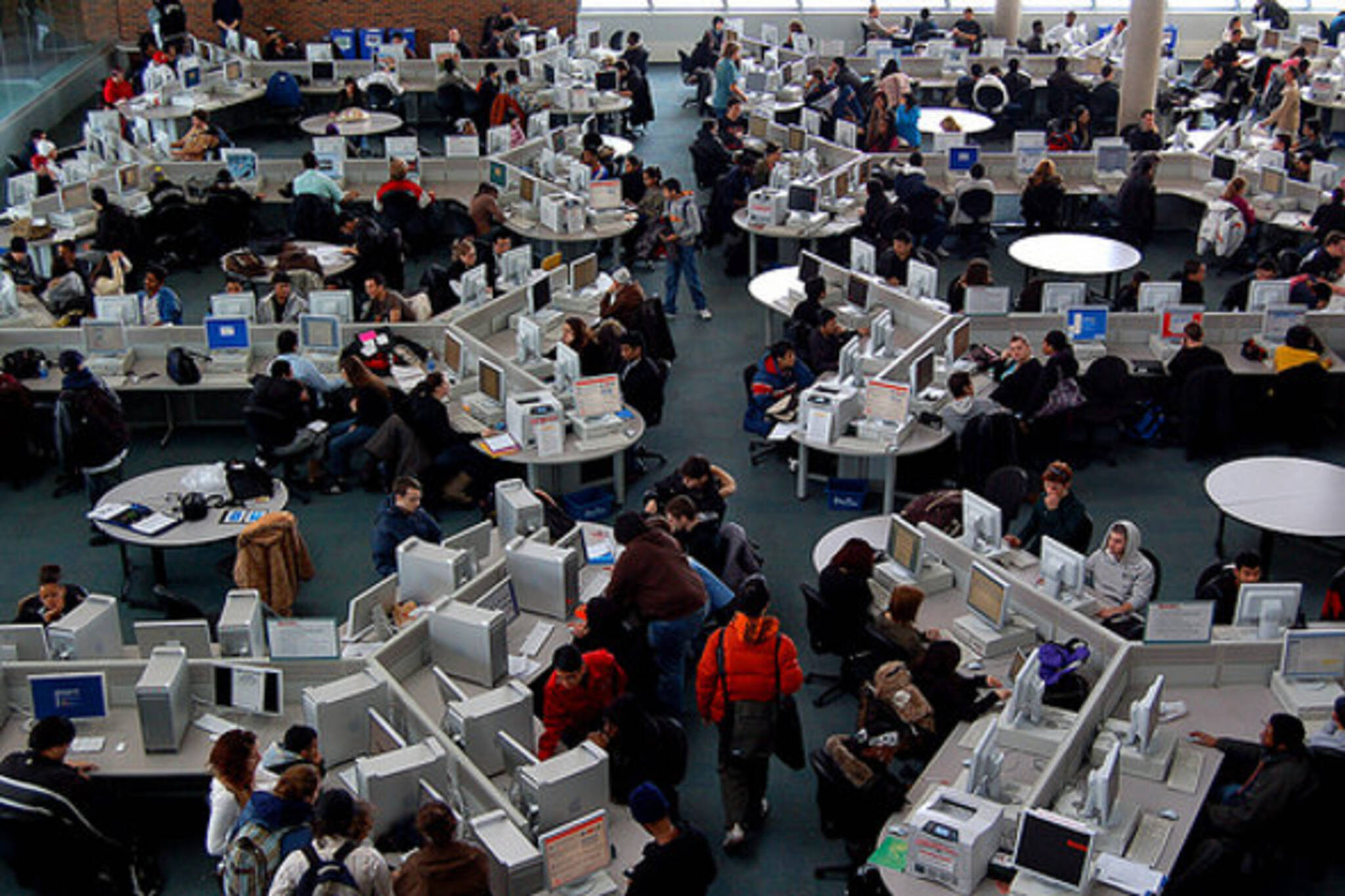
Photo by Derek Flack

Discussion

16 Comments

Jerrold / February 17, 2009 at 11:50 am
user-pic
So wait... it's called the "<b>Wireless</b> Canada Program" and they want to install public terminals in fixed locations? I fail to see the wireless in this.
badbhoy replying to a comment from Jerrold / February 17, 2009 at 12:03 pm
user-pic
The name is misleading. I got all excited for a moment at the prospect of free wi-fi in Toronto. Instead they offering what I've been able to get at the public library for 15 years.
Rajio / February 17, 2009 at 12:08 pm
user-pic
Does not compute.
Mark Dowling / February 17, 2009 at 12:36 pm
user-pic
Doesn't this conflict with the Public Library's internet access? How many of these community centres are distant from a TPL branch?

I can see some bright spark saying "TPL's internet access doesn't generate a profit so we should can it".
mrs / February 17, 2009 at 12:41 pm
user-pic
I think that the point of this is to bring the internet to people who actually can't afford a computer, no? What would be the point of offering free access on blackberries and laptops to people who dont even have a computer at home? If you can afford a blackberry, you can afford to pay for your internet.
Disparishun / February 17, 2009 at 12:50 pm
user-pic
Mind you, computer-based Internet access is a lot more open, flexible and standards-compliant than most access from devices like mobile, etc. Not such a bad thing to make sure it is available.
Parkdalian / February 17, 2009 at 01:02 pm
user-pic
I agree.. this program is ineffective since we can already get wi-fi at libraries. Besides, I think we're all going a little too tech-crazy for my taste.
sniderscion / February 17, 2009 at 01:05 pm
user-pic
The old desktop isn't dead yet; there are a lot of people who haven't embraced the web over tiny devices so far. Personally I'd much rather see a map or a menu (for example) on a larger screen rather than scrolling through on a small screen. This would also be great for people with accessibility issues.
Brady / February 17, 2009 at 01:08 pm
user-pic
Yeah, the idea behind the program is to bring the internet to people who otherwise wouldn't have access to it. That's the reason they're pushing it in public places like community centers and what not. People with blackberry's and iPhones already (conceivably) have the means to tap into the internet.

But the cynic in me says it's about money. This is an easy way for the city to bring in some added revenue. That's not a particularly bad motive, as it allows the city to use the money on other programs. I just wish the proposal would expand its horizons.

By using PCs (and yes the wireless title is a bit misleading) they're really capping the amount of people who can use it--1,000 at any given time. But if they provided some sort of city-wide wireless program and allowed low-income families and community centers access to it for free, they would be able to reach a far larger demographic. Who knows. As far as I know, a number of cities in the U.S. have tried city-wide wireless programs and the economics behind it didn't work out.

Plus, the slowdown in advertising is surely going to change some of the revenue numbers in the proposal.
David / February 17, 2009 at 01:16 pm
user-pic
It goes something like this: a private firm in Toronto (the Oxford Group) is offering to set-up and maintain (at no cost to the city) 1,000 internet-ready computers in venues across Toronto....

More open access for underprivileged people to computers is a good thing. Yes, the library offers a service, often times overloaded by kids playing games or messaging each other. The questions needing answers here are a) what venues across Toronto? I sense there is a catch in this one; and b) what is the revenue model--again, there is something missing in the equation. Companies don't fork out hardware, manpower and cash, even in good times, just to brand a desktop computer. There is more to this than we are reading here.
Bubba / February 17, 2009 at 02:18 pm
user-pic
They need to upgrade the infrastructure first before they should start anything as in fiber optics, we are still using old telephone
land lines that have been around for 100 years and is limiting us at the moment and the idea of giving free internet access is great but if we leave it up to a private firm it's just going to get twist into something else. The city of Toronto should seriously look at this as a utility and upgrade the system and take control of it this way they can give access to community based groups to give free internet access and help them develop programs, they can't do any worse than Bell or Rogers.
chenyip / February 17, 2009 at 03:31 pm
user-pic
$500,000 in revenue (i'm assuming gross) over 5 years? Not exactly swinging for the fences on this idea are we guys?
Laura / February 17, 2009 at 04:13 pm
user-pic
why put computers everywhere, and not like most modern cities, offer free or CHEAP universal wifi everywhere. I'm not surprised, Toronto is the most archaic city (e.g. subway system).
Wifi is only a hot commodity because they COULD offer it free, but they want to charge money. Make it cheap. In Hong Kong you can get wifi in the subway as a hotspot for really cheap ($7 a month or something)
Patrick / February 17, 2009 at 04:50 pm
user-pic
Hydro is probably the best bet for city-wide broadband because they already have the best and widest infrastructure (power lines). Most of the bandwidth on these lines is unused and AC socket LAN adapters are becoming quite common (i.e. not so expensive). Providing wireless anywhere in the city can be done higglety pigglety because the wired end-points (still needed if the network is built up this way) can be anywhere where there's power. Standard LAN and wireless-repeater networks have to grow outward and require new infrastructure (LAN cabling, routers, etc.)

My not so humble opinion.

http://torontocitylife.com
Mark Dowling / February 17, 2009 at 09:44 pm
user-pic
Now that the City have sold TH Telecom to Cogeco, there could be some issues about leveraging internet via Hydro infrastructure.
John D / February 17, 2009 at 10:33 pm
user-pic
My feeling is that city or area-wide wifi endangers people through untested health risks. It looks very much as though the proposed system could very well run wired ethernet based broadband which would not pose these issues. I guess the unanswered question is which public spaces are proposed for the installation of these computers. I mean I'm certainly glad I have access to highspeed internet. I'm sure lots more people would enjoy it as well, and feel more a part of the modern age if they too could share in the experience.

Add a Comment

Other Cities: VancouverMontreal