Environment
Earth Hour 2011 in Toronto the worst yet
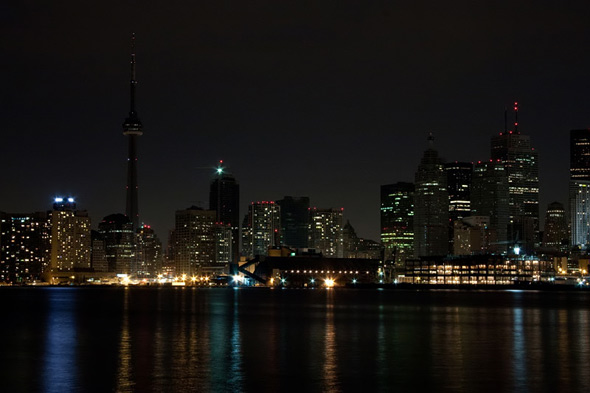
Earth Hour 2011 in Toronto was a bust. Although the lights went out on the CN Tower and the billboards at Yonge and Dundas Square, aside from the former, surveys of the skyline offered little indication of the collective effort made by those who did participate in the annual event, which was founded by the World Wildlife Fund in Australia back in 2007.
According to Toronto Hydro, energy consumption between 8:30 and 9:30 p.m. last night dropped 115 megawatts. That sounds okay — until you compare the savings to past efforts. Last year, which we also deemed a disappointment, witnessed a decrease of 296 megawatts. Thinking in percentages, that's about a 10 per cent savings, while 2011 was a little less than half that. In 2009, on the other hand, the city experienced about a 15 per cent decrease in energy consumption.
Colder temperatures do play a role in all this. Checking back through historical weather records reveals that it was roughly 10C in 2009, just above the freezing mark in 2010, and about -5C last night. Those differentials alone are bound to skew the energy consumption data considerably.
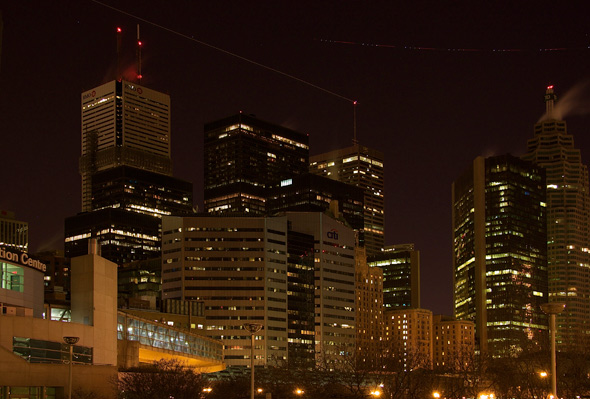
But the primary reason the event was so disappointing this year wasn't even about the numbers. Insofar as Earth Hour is symbolic more than anything else, it's significant to note, for instance, just how few local photographers bothered to capture images of the darkened skyline. In past years, Flickr was quickly stocked with before and after photos when the lights went back up. This year, there are just a handful of uploads tagged and/or titled with "Earth Hour Toronto."
This alone might not be surefire proof that interest is waning, but the relative lack of buzz on other social media sites was obvious as well. That's anecdotal evidence as well, but I'd be thoroughly surprised to hear someone claim that the event hasn't lost some of its luster around these parts.
So despite the fact that more and more countries are participating globally, perhaps it's time to change things up or re-brand the event somehow. As much as it's true that cutting one's power for an hour each year isn't a license to burn energy the rest of the time, if the main goal of Earth Hour is to foster awareness of our energy consumption, it'd be nice to see it regain some steam.
Earth Hour over the years (check links for more images)
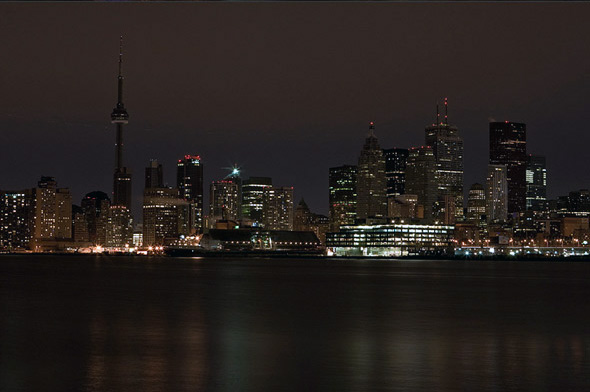
2008
Second image by Patrick Molicard-Chartier.


Discussion
58 Comments
Sort By Oldest First / Newest First
Subscribe
Without substantive action, the tiny temporary gains of "Earth Hour" are functionally negligible. Any given corporation can undo the benefits of Earth Hour a hundred fold within five minutes.
Chemical dispersants, anyone? I haven't had enough nosebleeds today.
Get a life chumps.
Then on top of that I gotta do that on the weekend for earth hour?- on the one day I can afford to have the lights on?
It's supposed to "raise awareness" of environmental issues, but it encourages activities that are just so bad for the environment, it's rather disgusting.
As I said, I hope the numbers are low because people are smartening up... but my experience with people leads me to believe that in actuality, people are bored with the exercise and never really cared about the issue to begin with.
But I take the TTC every day, so I've become rather cynical about people.
But all that is an aside. Back to the real point. Should we really care if Earth Hour is failing? Is it the best way to substantially increase awareness and induce real, lasting change in people's consumption habits?
I consider myself an environmentally-conscious person. I don't have a car; I walk and talk public transit. I compost, recycle and reuse stuff as much as I can. I use CFL's, dimmers and power bars on timers. I use my major appliances in the off-peak hours. I don't keep my lights or electronic devices on necessarily.
Now I participated in Earth Hour as I always do, but I found myself actually unable to do much, besides turn off two lamps in my family room, for the hour itself. That is, I'm already so environmentally-intelligent ALL THE TIME that the token gesture of turning off two measly lamps during Earth Hour seems pretty insignificant to me.
Now I know Earth Hour isn't really about reducing energy consumption just for one hour, but about increasing awareness of being environmentally-conscious/intelligent. And, I realize they are preaching the choir with me, so to speak, since I have already committed to being sensitive to these issues.
But, I can imagine that many people would reach the same conclusion as me: what's the point of turning your lights off for one hour? I KNOW for a fact that people that are skeptical about this thing say ask questions like that. They say "who cares about one hour, when there are hundreds of coal-fired power plants coming online in China every year?"
What really matters is the thousands of OTHER hours in the year. Are people being intelligent about their energy usage all the time? What is Earth Hour doing to substantially change people's habits in a real, productive, permanent way? Can anyone actually answer this? What is the success of Earth Hour, beyond just the Hour itself?
Judging by the non-stop increase in greenhouse gases, and obviously the decreasing participation in Earth Hour, I highly doubt it is inducing actual change.
For that reason, I think we shouldn't shed a tear for the demise of Earth Hour. In my mind, other more substantive efforts are producing real change...like the Smart Meter program, like the move by the Ontario gov't to renewables, like gov't rebates/incentives to buy hybrids...these are REAL impact changes.
If Earth Hour will stick around, it needs to have more teeth. It needs to be more ambitious and more substantive.
How about Earth Commute Day where people leave their cars at home. Or maybe next year we should try Earth Week and we should include more than just turning off your lights for an hour.
I think by improving the event to show more substantive change that is accessible and achieveable by the average person, people will hop back on board.
However, that is just one small part of a bigger picture. The whole point of earth hour is to step back and see just how much energy we waste on needless things. It isn't about measurable energy savings for one hour, it is about conserving energy 24/7; this hour just lets people acknowledge this.
I'd say it's a step in the right direction that we didn't have a rock concert this year.
I'm not buying Toronto Hydro's press release - if you check the Ontario electrical grid on Sygration the usage actually went up during the hour.
I'd love to hear what any Earth Hour participants here have done/are going to do in the next week to curb their energy consumption.
Earth hour is more useless than a SUPPORT THE (INSERT NAME OF TROUBLED GROUP HERE) facebook page.
I turned 100% lights on for 48 hs so my landlord can pay more and more. He already charges me $1400 for a one bedroom it is more than he pays for the mortgage. I leave all on 100%.
-----------
yeah, because landlords shouldn't be allowed to profit from their properties
hey it costs nike 4 dollars to make those shoes how come they cost 200 dollars
ow my tiny brain hurts
the idea of earth hour is good, but will never succeed.
the only sure fire way for people to appreciate power/conservation/ etc would be to force a citywide blackout much like the blackout in 2004.. which although caught everyone off guard, after 2 days, it was a great way to get "off the grid" for a bit... but safety reasons would hamper the effort!
I was going to pick less flowery language, but that pretty much hits the nail on the head.
The symbolism of Earth Hour is completely pointless without people following up on that hour of darkness with further changes in their lifestyle.
To make matters worse, many people switch to candles during earth hour which, news flash, are worse for the environment than the most inefficient incandescent bulb. Even official events were using candles everywhere. Talk about missing the point.
"Light bulbs don’t produce greenhouse gases – burning fossil fuels to generate electricity does."
<b>"for every candle that is burned to replace electric lighting during Earth Hour, greenhouse gas emissions over the course of the one hour are increased by 9.6 g of carbon dioxide."</b>
FYI:Those numbers are based off of Australian power generation which gets 80% of its power from fossil fuels. Ontario only gets about 37% of its electricity from fossil fuels (Coal+oil) So the numbers end up being <b>far</b> more significant.
If you're using fluorescent bulbs, then that number rises to 80 bulbs that need to be turned off to equal the carbon footprint of ONE CANDLE. (It's over 200 bulbs if using LED)
Lets put it this way, I use CFLs in my apartment. I'd have to have every single bulb turned on for 10 hours to equal the amount of carbon released by having one candle lit for an hour.
Don't get me wrong, I appreciate the symbolism, but surely there is something better we can do, or at the very least discourage people from using candles.
http://www.thestar.com/news/article/962523--the-lights-were-on-but-they-weren-t-home
None of it matters anyways, the earth was doomed the minute us humans, who consume and create waste to live, became part of it. Any effort to fix it is a delay of the inevitable and futile at best.
For example, my employer's building got credit for installing public showers, with the rationale being that bicyclists can use them to shower the sweat off, so it encourages people to ride bikes. As if people are going to go to the trouble of showering at work. So they're literally almost never used, except maybe as a private spot to sneak off and make out in. What a great use of resources.
BLAH BLAH i turned my lights off for an hour! Nobody else did, the sky is falling. Yes i'll get back to doing laundry every day and running the AC at 21C all summer.... SO WHAT! At least i did something and raised awareness! Yup.
Should be renamed sex hour. That would encourage more people to turn off the lights...
Where have all the good marketing people gone?!
writing.
but this web site gives feature based content.