Tech
Vintage computers and technology in Toronto
As I've mentioned before, one of the best parts of digging around the Toronto Archives is the stuff you find that you were never looking for. I'd guess that at least a third of the ideas I've had for historical posts about the city have come via some serendipitous discovery or another. Today's installment certainly fits this bill.
When I was putting together a post about what banks used to look like in Toronto, I happened to stumble upon some spectacular, Kubrick-esque shots of an unidentified computer room that got me wondering if there were any more like them in the City's digitized collection. As it turns out, there are — though not as many as I'd like.
Not being much of an expert on old computers, the little collection below is organized by aesthetics more than anything else. The technology used by the TTC, CBC and chartered accountants featured below is obviously quite different, but its size and design (not to mention the way that it's been photographed) places it within a particular historical context that's been all the rage since Mad Men took off a few years ago.
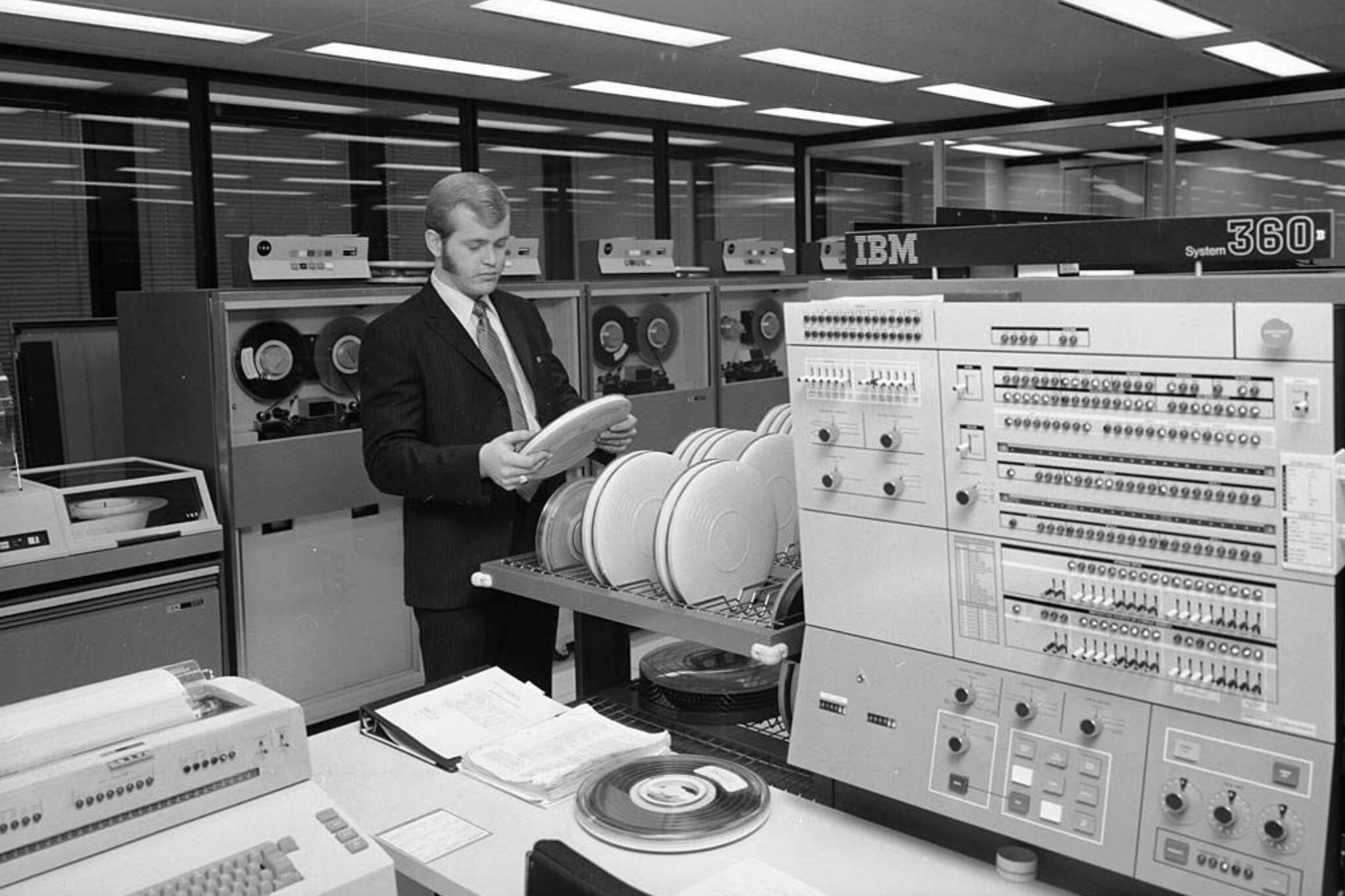
Because it seems compulsory to note just how rudimentary some of these computing systems were, here's some of the specs on the processing power of the IBM System 360 seen below: "The slowest System/360 models announced in 1964 ranged in speed from 0.0018 to 0.034 million instructions per second (MIPS); the fastest System/360 models were approximately 50 times as fast with 8 kB and up to 8 MB of internal main memory, though the latter was unusual, and up to 8 megabytes of slower Large Core Storage (LCS). A large system might have 256 kB of main storage." By contrast, the Intel Core i7 Extreme Edition (990x) does 159,000 MIPS at 3.46 GHz.
Well, at least according to Wikipedia — which is about as far as my will to research this subject goes. I just really like the pictures...
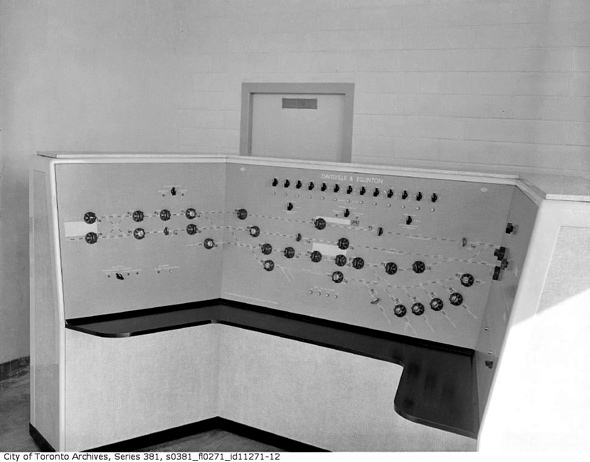
TTC controls for Davisville and Eglinton Station, 1953/54
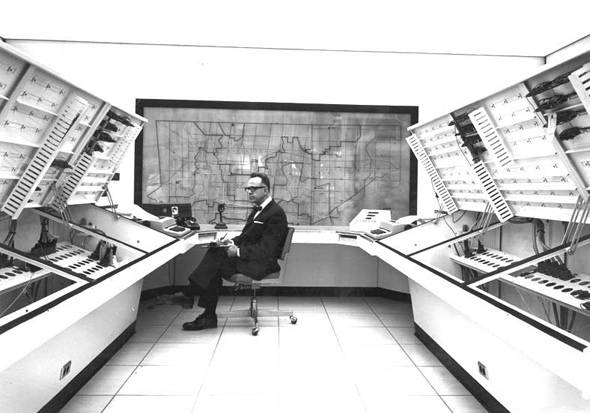
Control Room, Toronto Central Pumping Station, 1960s
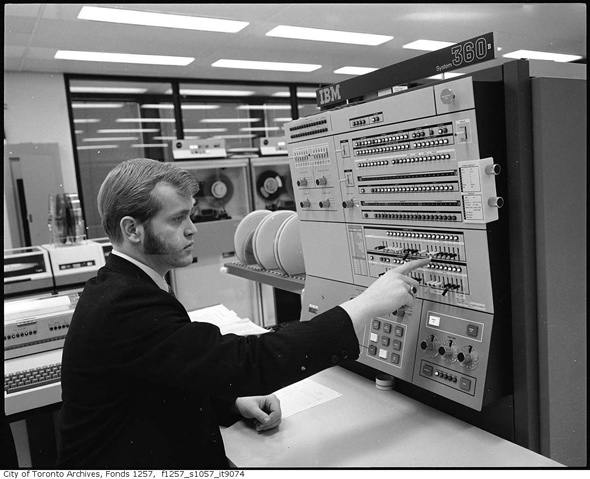
Computer room at unidentified bank, 1960s
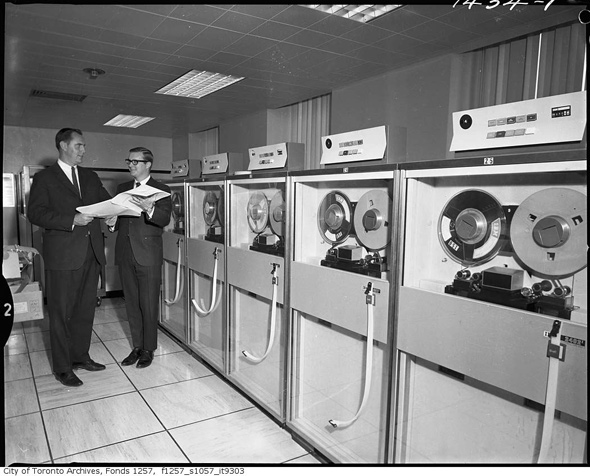
Computer room at Winspear, Higgins and Stevenson chartered accountants , 1960s
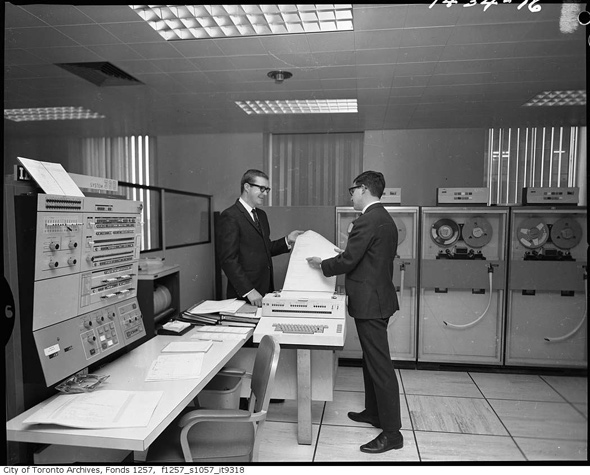
Computer room at Winspear, Higgins and Stevenson chartered accountants, 1960s
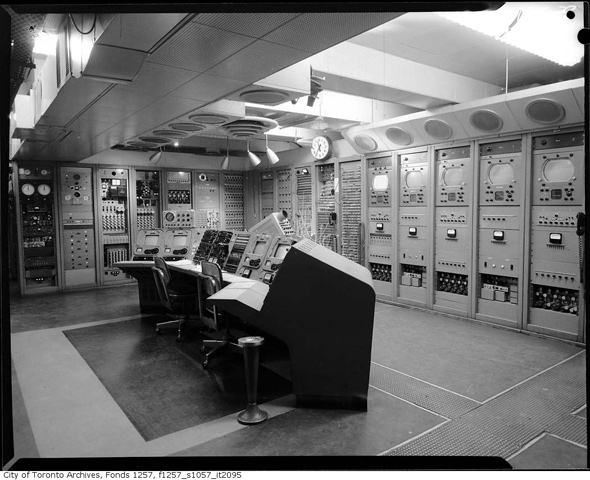
CBC Control Room, 1960s
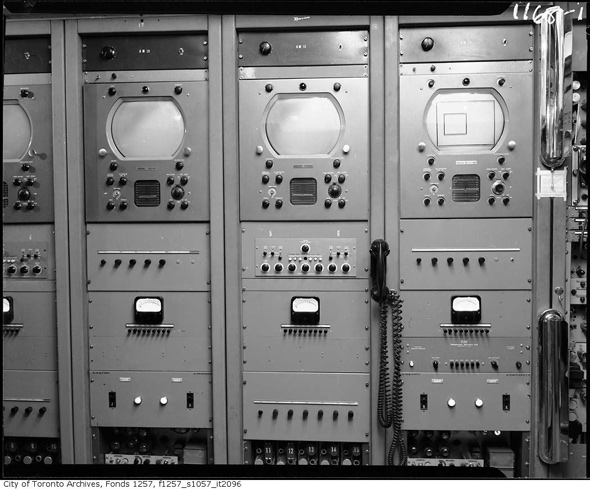
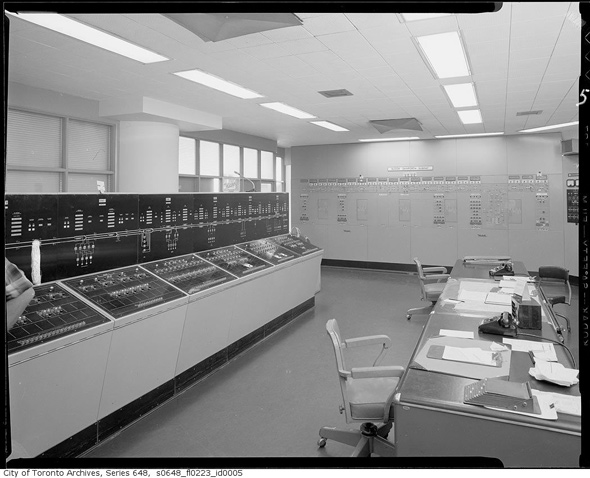
TTC Control Room, 1967
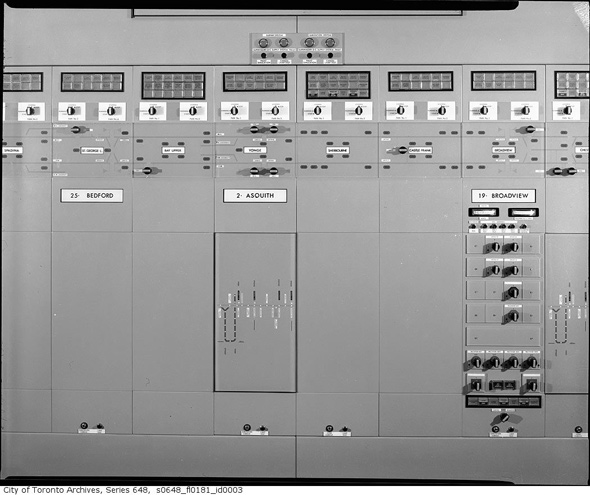
TTC Control Room, 1965
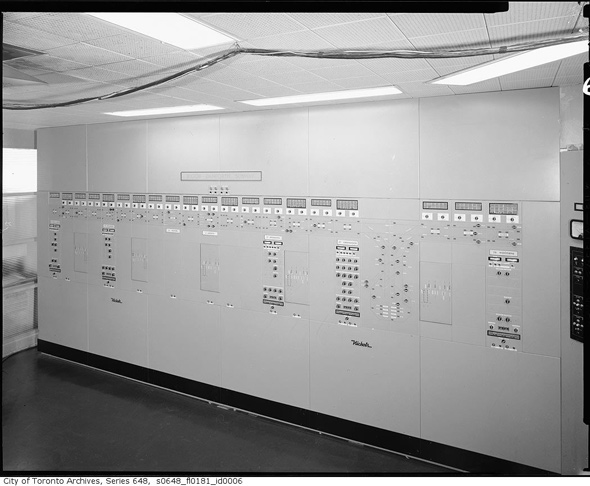
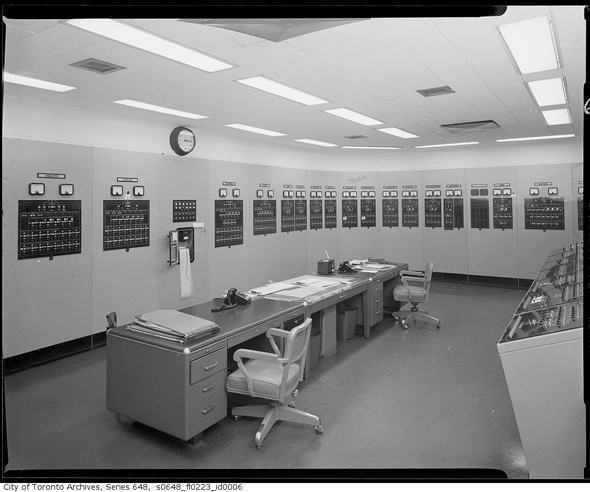
TTC Control Room, 1967
Photos from the Toronto Archives


Discussion
44 Comments
Sort By Oldest First / Newest First
Subscribe
the computer floor (5th floor) was separately
air conditioned and it felt like a cold spring morning.
The noise was terrific with all the ka-chunk,ka-chunk
of the printers and the whirring of the tractor
mechanism for the forms in the printers. Then there
were the card sorters.
The heat was amazing because all the equipment was
tube powered--the transistor hadn't made the inroad
in 1960 that it would do in later years.
The connector cables and power supplies were hidden under
the false floor on which everything rested. The false floor was about 30 cm above the building's structural floor.
Then there were the keypunch operators who had their own area and 30 of those machines going on all day, every day was also a challenge to the ears.
-----
Looking at the first photo, I wonder how small the same amount of data processing power would be nowadays.
I can imagine all these machines running hot trying to keep up with what they were tasked to do while my machine is basically idling.
Look at your phone. That would be twenty of those rooms.
It was replaced by an IBM 360 in the early 70s.
Unimaginable? Transistors sure were a big leap forward.
new automobiles or household appliances.
http://www.youtube.com/iraeus
Spoken explanations are in German, but there are subtitles :-)
I just wish the smell could be bottled, too.
I can almost smell it when I look at the top picture. That combination of machine oil and hot electronics, cleaning products and a background hinr of cold cigarette smoke and cheap perfume.
Only one piece of our IBM 360 and Borroughs 6700 are left - their name plates! The rest were dumped after their leases expired.
I don't recall the sorting speed, but you couldn't see individual checks, just a blur as they passed through.
Quite noisy too. Ours was on the computer floor but in a room with a sliding glass door.
I don't recall the sorting speed, but you couldn't see individual checks, just a blur as they passed through.
Quite noisy too. Ours was on the computer floor but in a room with a sliding glass door.
My first program on it seized control of the OS and typed "I want a cookie" on the 1052 console. It wouldn't do anything until the operator typed "cookie." At $0.60 per second (today's dollars), this was an expensive stunt.
It worries me that I remember all those four-digit serial numbers 45 years later.
What the hell would those people do all day, sitting there like that? There aren't any screens! "At 2pm flip this switch. If this light comes on, call me immediately." Another interesting tidbit to know - which I didn't see mentioned here - would be cost. I'm sure these machines were expensive as all new technology tends to be.
The room was on the first floor of the Sandford Fleming Building (might have been called MacLennan Labs at the time). The building had a fire in the 1977.
The machine was moved to the MacLennan Labs (the name had moved!) and finished out its days analyzing bubble chamber experiments I think.
It probably had 32K words of core memory, each 36 bits wide. I think that was the most that was possible (15 bit addresses).
I was wondering if you know a good laptop repair center in Toronto like http://laptops-repairs.ca/ . they are nice