Sustain Yourself: Grow a Garden
We hear all this talk of saving the environment; recycling, reducing your waste, using energy conserving light bulbs, etc. But what if you wanted to do more... something bigger? A lifestyle change. But where to start?
I really want to "watch what I eat"; try make sure the food I eat doesn't come from half-way across the earth, and that it's as fresh as possible. The best way to do this, I think, is to grow and make everything myself. I know this isn't entirely possible for me (well, it is, but I like to start small), so I decided to try my luck with a vegetable garden. I've also recently acquired a bread maker, so I'm able to bake my own loaves. Toasted veggie sandwiches and BBQ'd veggie skewers all summer long... *drool*.
However, a garden isn't quite as simple as throwing in the ingredients and pressing the bake button. I figured I'd keep a kind of journal, take some photographs along the way, and share them with you. Perhaps you'll decide to sustain yourself vegetabley too, and we can help each other along the way.
The first task in any project like this is research. I checked out some websites, and came across the Better Homes and Gardens guide to planning your first veggie garden. The second page in the guide talks about the layout of the garden, and they suggest a book called Square Foot Gardening by Mel Batholomew. For some reason, that name sounded familiar. I checked my own bookshelf and what do you know? There it is! It was fate. This is the garden I'm supposed to grow.
The square foot method of gardening is a space-saving, time-saving, labour-saving system (perfect!), that divides the garden into small beds (typically 4 x 4 feet), instead of the traditional rows. These blocks are then divided into one-foot squares. Each one-foot square is planted with one, four, nine, or 16 plants, depending on the growing space needed for each plant. Bartholomew's book is supposedly the bible for this method of gardening. Good thing I picked it up for $2.99 a few months ago from the Goodwill on Roncesvalles! It sounds complicated, but after skimming the book, I'm finding that most of it is just common sense (an expert gardener's common sense, that is).
Sunday is the day we're laying out the garden. It's now past the last frost of spring (I hope). The farmer's almanac says May 9th is the start of this year's 149-day growing season, but some plants are meant to go in the ground early (like lettuce). I figure if we start things out on Sunday, it'll give us a couple weeks to get the rest of the plants/seeds ready.
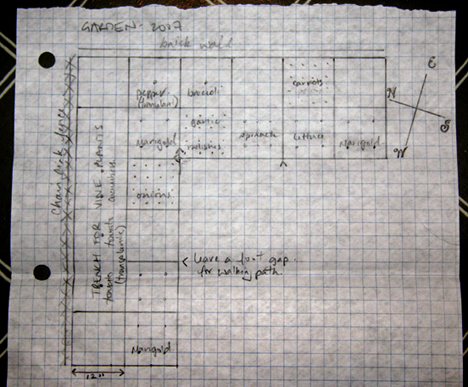
Here's a rough sketch of the garden design:
I need to decide if I'm going to plant in the ground, or make some planting boxes and build up. Either way, I'll have to mix a special soil concoction that I've learned works well (1/3 peat moss, 1/3 coarse vermiculite, 1/3 compost). Unfortunately, we don't have a compost pile at my place yet, so I'll have to buy it, along with the other two ingredients. Anyone know where to buy nice big bag of vermiculite?
Look forward to seeing some photos of the gardening action on Sunday. It's supposed to be really beautiful this weekend (finally)!
Comments (16)
Ring the bell when dinner is ready :)
Looking forward to following the progress of your garden, Kari!
Well, one of the interesting things I learned was that marigolds, as well as nasturiums and plants in the onion family, help deter bugs! I've been told that marigolds and tomatoes should ALWAYS be planted within close proximity of one another.
You'll notice there are some blank squares still... more veggies will be planted in those. I'm thinking more cucumbers, maybe a strawberry bush in the top right corner, and some herbs for sure. I expect the layout to change a bit, anyways...
I think a blogTO staff BBQ is in order for this summer, Jerrold!
I've been experimenting with growing my own vegetables (and strawberries...yum!) the past few summers. Unfortunately all the outdoor space I have to grow is a small deck on the east side of a house.
I've managed to cover the deck in planter boxes though and have had varying success growing herbs, tomatoes, cucumbers, peppers, leaf lettuce and even acorn squash.
Looking forward to following along with your progress.
marigolds keep some of the flying pests away, don't they? but what about squirrels? they're always stealing my tomatoes.
The book I'm reading says to build square foot wire cages for over top of your plants... but since tomatoes are a vining plant, I'm not sure how that would work... I wonder if scarecrows work for squirrels?
The City of Toronto gives away free compost on it's environment days. Check the schedule for one in your area. But bring and bucket and shovel.. and car if you are wanting a lot.
You might wanna go easy on the vermiculite: "An article published in the Salt Lake Tribune on December 3, 2006 reported that vermiculite ... had been found to contain asbestos which had led to cancers such as are found in asbestos related cases."
I am not a gardener, but shredded bark might work well as a
substitute.
Also, regarding the general accuracy of the
Farmer's Alamanc: "In the October 1981 issue of Weatherwise, pages 212-215, John E. Walsh and David Allen performed a check on the accuracy of 60 monthly forecasts of temperature and precipitation from the Old Farmer's Almanac at 32 stations in the U.S. They found that 50.7 percent of the monthly temperature forecasts and 51.9 percent of the precipitation forecasts verified with the correct sign [i.e., as correctly predicting temperatures above normal or below normal]. These may be compared with the 50 percent success rate expected by chance."
The Almanac's "Frost Chart" is "Courtesy of Environment Canada," though, and so is thankfully based on actual science rather than the "secret formula" used for the Almanac's long-range weather forecasts ... and the associated, laughably weasel-worded claim that their predictions are "almost always [!] very close [!] to our traditional claim of 80 percent."
Not to rain on yer parade ... er, garden.... :)
Well, rain is usually a good thing for a garden. Knowledge is beneficial too! I was hoping to learn along the way, and I think that's going to work out well.
The almanac does claim to be right only half the time, but really, who knows? I figured I'd go by what they say anyways, though. I don't think gardening will ever be an exact science.
About the vermiculite... is it required by law for them to say on the packaging if there's any asbestos involved? If that's the case, I'll be careful to read all of the labels.
I may just pass on the vermiculite all together- depending on how the original soil is in my back yard. I'll find out more on Sunday.
I'll have to go to the environment day early this Saturday (when it's planned for Parkdale)... we're planning a bike trip to Hamilton. How heavy is leaf compost?!? Can I schlepp it home on my bike? LOL
I am not sure how heavy it is. Also, don't go too early, they may not let you take it before 10:00, they try to give everyone a fair shot (it is like black gold to people, they go crazy for it.) As for a bike, it may be difficult, though I have seen someone put a trailer on their bike with three full sized garbage cans...just a thought.
Good luck
We've decided to wait until the 28th to get the compost... we'll get a Zip car and load 'er up. The Lower Sherbourne Community Park on The Esplanade is hosting a Community Environment Day...
I'm so glad I found some free compost! Thanks for the tip!
Ah, marigold plants. Apparently, they're very good for keeping nasty bugs off your lovely veg.
(Square-foot gardening rocks, by the way).
Very good quality compact fluorescent. I found best price and in stock at Interlight www.interlight.biz
Huge inventory of light bulbs
Hi, good post. I have been woondering about this issue,so thanks for posting. I’ll definitely be coming back to your site.


RSS