Mr. Movie Goes to the Deadpool in Style
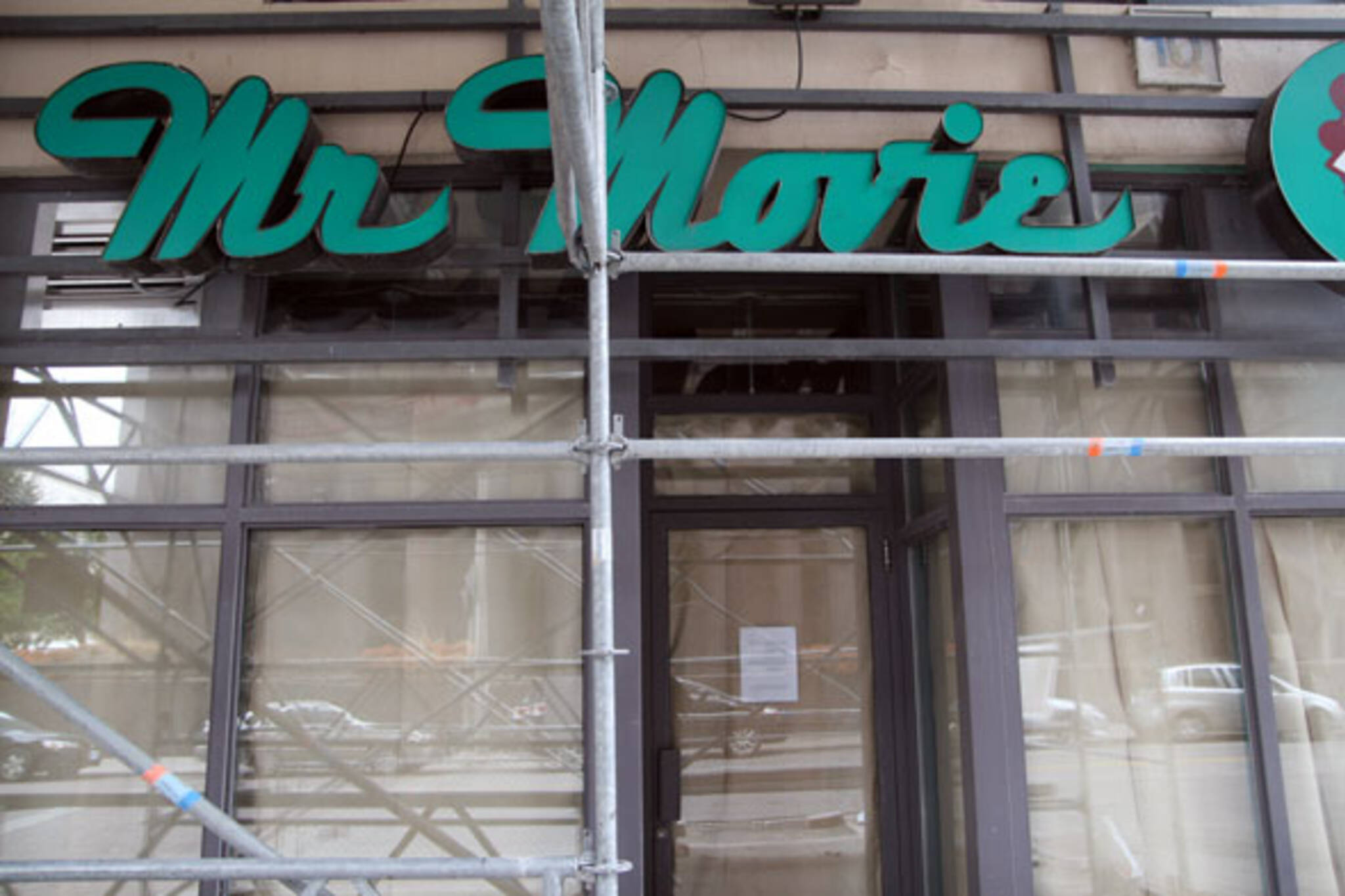
Mr. Movie, an independent video rental store near Ryerson University, closed for business at the end of September. It was a sad loss for loyal students and residents of the Merchandise Lofts in which it was based; but in this era of video on demand, Zip.ca and online streaming (legal or otherwise) the fact Mr. Movie was losing money and customers wasn't altogether surprising.
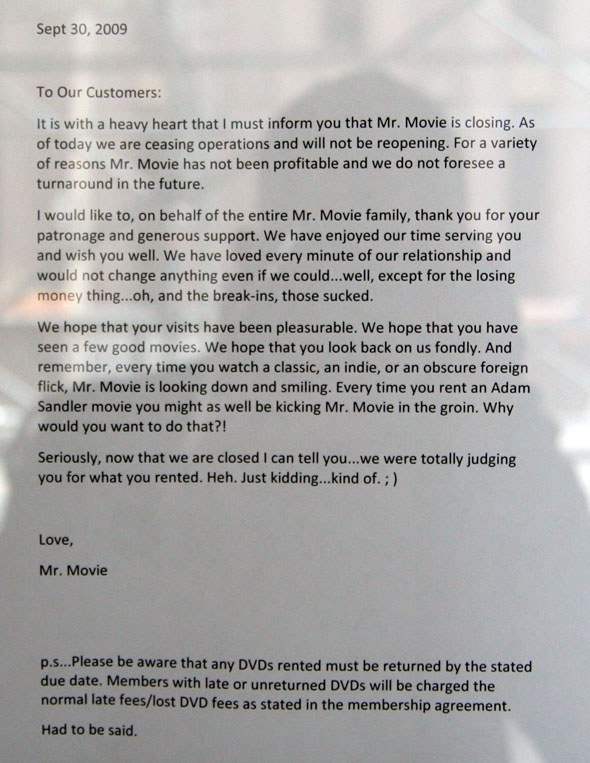
It's nice to see, though, that the owners have a sense of humour about the situation. In a note posted to their front door (see below), they take some time to poke fun at themselves and their customers.
Thanks to David Silverberg for the tip
Comments (16)
It is only a matter of time for all of them including Blockbuster. Broadband is about to take over.
Morga, in large cities you may be correct however Blockbuster does very well in small towns where there is little or no high-speed internet availability.
Blockbuster was in the news a while back concerning bankruptcy rumours (http://www.bloomberg.com/apps/news?pid=20601087&sid=a6uMC.qiRqFo) so who knows what's gonna happen with them.
As for online rentals/downloads, although it's growing, there's still a lot of people who'd rather physically go to the store and rent a disc in hand then wait for a download to finish, especially when the file sizes are gonna be huge for HD movies.
Kenny: Blockbuster received funding but are also closing a substantial number of stores to scale back their costs and will not be filing any time soon.
In Canada though, they remain profitable and are not under the same microscope with their finances.
I do think that their brand is obsolete though. They have been unable to stay ahead of trends and technology and unless they come up with something earth shattering that Zip/Netflicks can't copy, they will not be around for much longer.
It's a sad day to see any of these independents go under; however, video's demise has been predicted since 1987 when a 'video on demand' project was launched in Santa Catarina, California. Blockbuster's parent company spun Blockbuster off a few years because they could see the writing on the wall: 5,000 sq ft stores with high overheads will not be able to make it going forward. Some of the smaller, better stocked independents may survive, sort of like the used LP places that have been kept alive, tucked away in dark little corners. Small towns don't have Blockbusters or Rogers, which is the real enemy to these independents - even though these independents are often better stocked and better staffed than Rogers or Blockbuster.
But, who knows? Video stores would have died a long time ago if the wholesale price of movies (VHS) didn't come down from their $100+ peak in the late '90s to the $12-20 range for a typical DVD today. No way these little places could have survived if one copy had to 'turn' 22-25' times just to break even!
@gadfly
I might be wrong, but it's my understanding that the $100+ versions of rental movies were not the same as their $20 retail equivalent. It's irrelevant for DVDs obviously, but those premium rental versions of VHS tapes were manufactured to a higher standard than the one's you'd buy from HMV, because they had to withstand a much greater viewing count.
No, actually the major studios tried to block the betamax and VHS systems, arguing that the machines would only be used for recording copyrighted material. When they lost that battle, they then tried to prevent rental outlets from being able to charge for renting them. It was a titanic battle in the early '80s when the wholesale cost of movies was in the $20 range.
When the studios lost that battle, too, they realized the only way they could participate in the 'lost' revenue was by inflating the initial cost to the $80 range and then higher as the market would bare. It had no reflection on the actual quality of the cassettes themselves. Later, pay per rental systems (like Rentrak) were tried with varied success, but $100 became the norm in Canada. Ironically, most movies don't make money until released on VHS (or DVD, as the case now is), but initially the studios did not see it that way.
The game companies tried the same thing and met with better success: they did win the legal battle against the photocopying of the instructions, which the Courts viewed differently.
By the late '80s, people began to collect movies and the studios saw merit to a 2-tier price structure: 'rental priced' at $100 and then 'sell-thru' at $12-$22, generally 4-8 months later. Some movies (generally Disney and Warner kids stuff) would come out at the lesser price to make up for in volume. E.T. is prime example of that: when Spielberg finally released it, it sold several million copies, rather than the normal 2-400,000 for a successful 'rental priced' title.
I used to work for Video One, which was the VHS distributor for the major studios, and gadfly is correct.


RSS