City
TTC conducts first public test of new streetcar
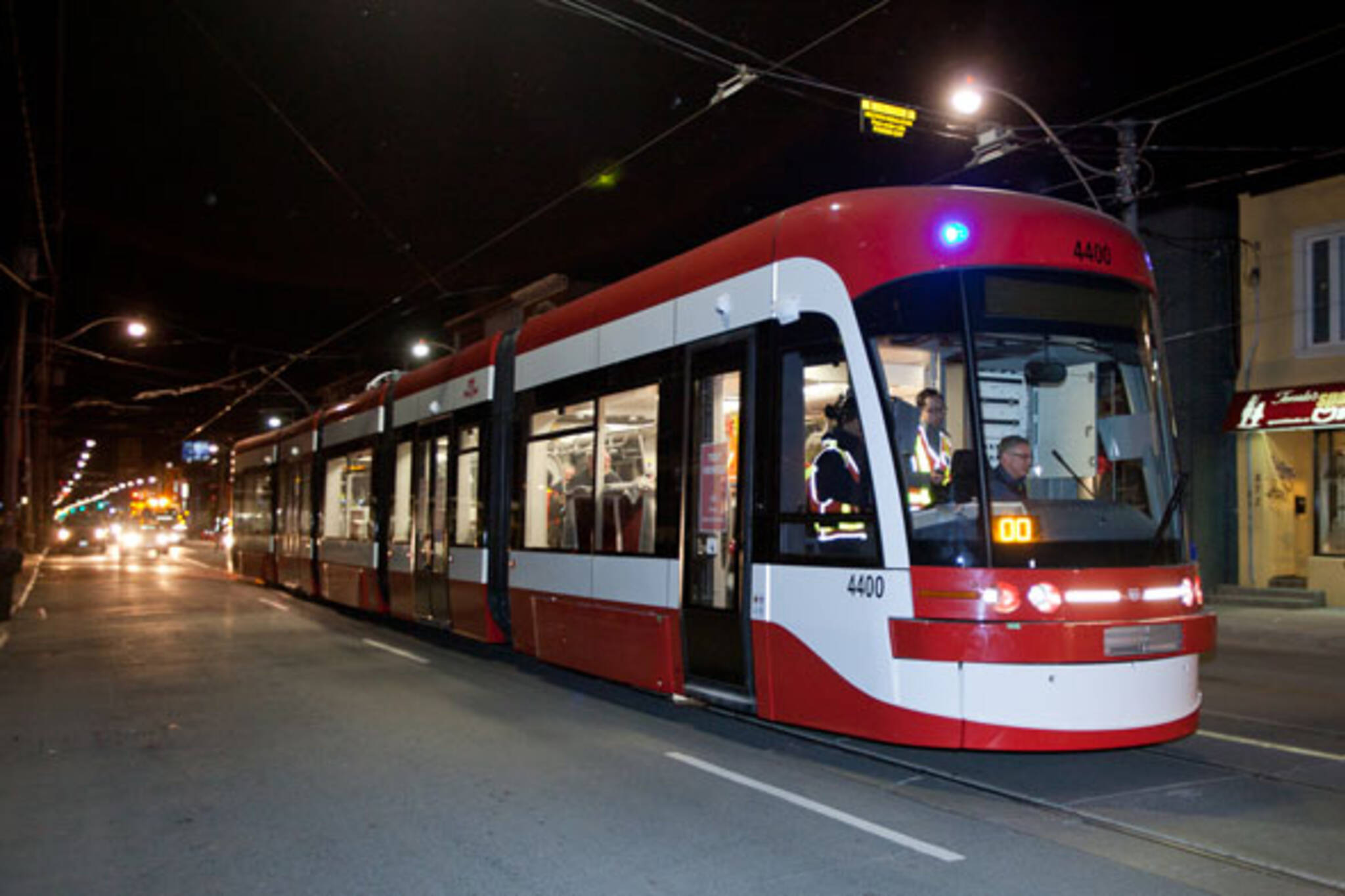
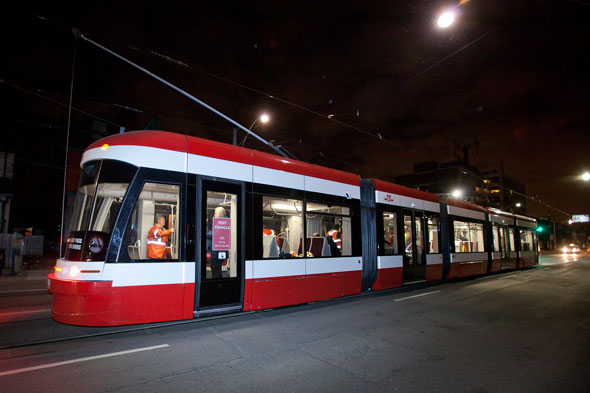
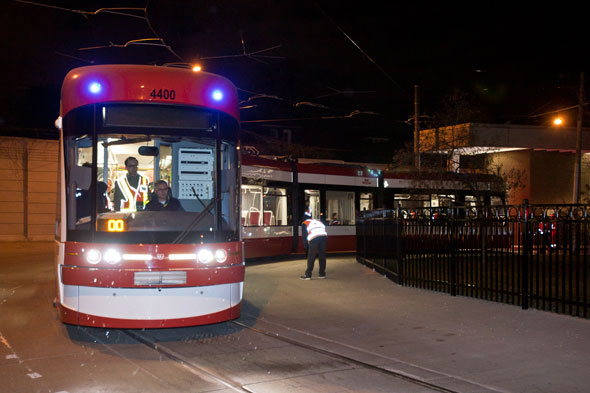
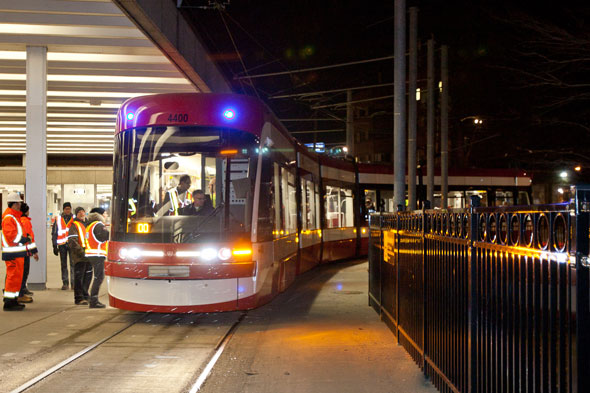
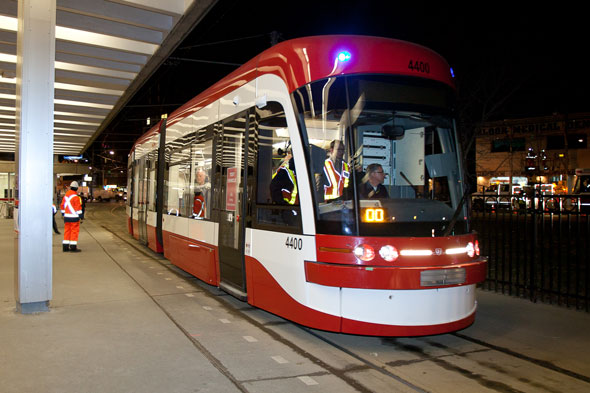
The first of the TTC's new longer, low-floor streetcars recived its inaugural road test under the cover of darkness this morning, giving early-risers the chance to glimpse the vehicle outside of a TTC car barn for the first time.
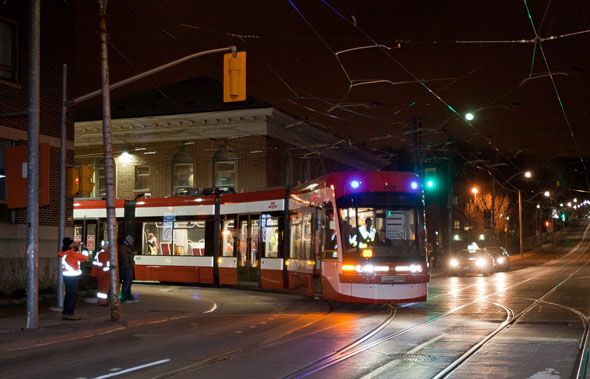
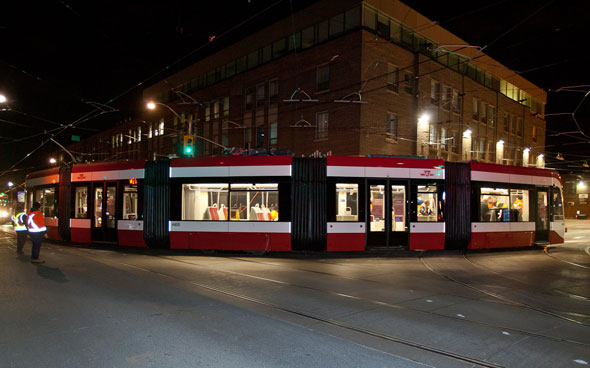
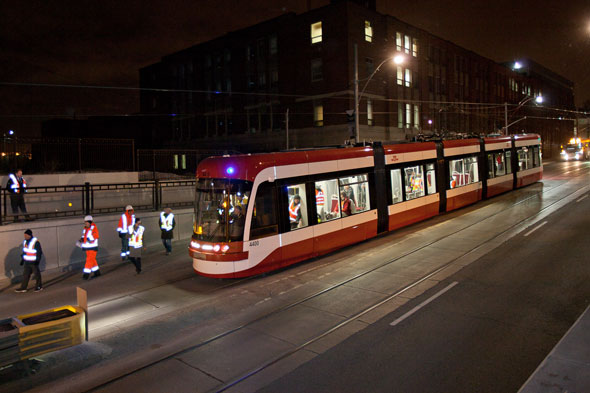
Following a basic route that included a cornering test at Bathurst station, the first in a fleet of 204 new cars costing a total of $1.2 billion was guided by a team of engineers south on Bathurst Street from the Commission's Hillcrest facility to Bloor Street. The group were testing acceleration, braking, security cameras, doors, and clearance between buildings and other static objects.
Back in the lab, the car has undergone static tests of its air conditioning, heating, lights, stop announcements, and ergonomics.
The Bombardier vehicle was unveiled at a press event on November 15 last year. It will feature all-door boarding, full Presto integration, and increased seating capacity. When the new fleet is fully operational the city will actually see a net loss in the number of streetcars; currently there are currently 247 CLRV and ALRV light rail vehicles plying Toronto's streets.
Tweeting this morning, the TTC's Brad Ross called the maiden test run a success. He says the streetcar will continue to receive night tests but will slowly begin appearing during the day over the next few months. The new vehicles are due to enter full service in 2014.
MORE PICTURES:
Chris Bateman is a staff writer at blogTO. Follow him on Twitter at @chrisbateman.
Images: TTC


Discussion
137 Comments
Sort By Oldest First / Newest First
Subscribe
As for them being too long. The MU (multi-unit) PCC streetcar trains that ran on Bloor and later Queen, were two coupled PCC streetcars together. Which is about the length of the new streetcars by themselves. Same with the older Peter Witt streetcar and trailer trains that ran on Yonge Street, Bay Street and other routes.
They will be able to make lights and turns faster than the current streetcars.
Cars SHOULD be overtaking them. 'Stuck behind streetcar' = 'I'm a crappy driver who thinks staying behind a streetcar is a good idea'.
Longer vehicles = more capacity = less frequent service.
Less frequent service = CHECK THE DAMN SCHEDULE BEFORE YOU GO TO THE STOP.
I overheard a TTC employee say patrons will experience longer waiting times... nice! and when we're lucky enough we will be paraded around the city in a rolling aquarium
As for the wait times, it seems half the issue with streetcars downtown is that you can have a run of overloaded cars before you get one that actually has space. So, it doesn't matter if there are more cars coming through if they don't have any space to actually allow people to get on. Hopefully the new bigger cars will help solve that as they increase overall capacity.
This is a good thing for Toronto, a good commitment to transit and a good commitment to quality of life in the downtown.
But every time one breaks down or gets in a fender bender or has an incident onboard, it's a potential traffic annoyance that could be avoided. It's not about cars versus streetcars. It sucks to be a car behind one and it sucks to be on another streetcar behind one. And because the lines are so untenably long, short turns and bunching occur constantly. Switch to buses and none of these problems is anywhere near as dramatic.
Note: I would gladly purchase a car and sit in the horrific traffic caused by streetcars if it was an option for me, because I am tired of being exposed to every inconsiderate lowlife Toronto has to offer on a twice daily basis. Mysteriously stained seats, people playing music without headphones, open drinking and drug use. Lovely way to book end your day.
Rolling aquarium? You want smaller windows, less light, less outward visibility?
Streetcar = 100 people.
Who's in the way of who? Can you really have the audacity to say the streetcar is in the way of your car?
Streetcars aren't in the way of cars, cars are in the way of streetcars.
But your points are certainly valid, and I can see where you're coming from. I have recently moved away from Toronto, but I was never tempted to buy a car when I lived there, even though I could have afforded it. It just seemed ridiculous.
They should have put these underground. The streetcar was going to be abandoned after the second world war but short sighted thinking saved the slow, cumbersome streetcar. To this day pedestrians continue to get hit by cars and bikes as they get on and off streetcars. And now that they have made streetcars the length of entire city blocks, things will get worse.
Here's a thought... why not just build one massive street car that spans the entire length of the track and put two way treadmills inside them. Then streetcars would never have to move and people could get to where they are going more efficiently, all the while being indoors. And cars wouldn't have to duck and dodge them as they move more swiftly around them.
GET the NEXT TTC app! It's 2013!
It's fine to say "those streetcars should be underground" but given that those are existing tracks (not new ones) how exactly do you propose to pay for that?
After all, its the single occupancy drivers like you who routinely whine and complain about traffic but then refuse to consider any options that would help pay for better transit (which, by extension would reduce traffic congestion by taking more CARS off the road). Until folks like you understand that you are in fact, the problem, and get your heads out of the sand about what is needed to actually improve traffic flow in this City, nothing will really improve.
Talk about uneducated.....
As to the rest of the gripes, look, most cities would kill to have our streetcar network. Portland and Seattle already have new streetcar systems; Washington DC, Atlanta and Cincinnati are busy building new streetcar lines right now. And these are all streetcar systems, not LRT, and they are a fraction of the size of the TTC's 11 lines. Believe me, this is an amazing asset.
That's not to say it has been run properly. Mismanagement of the streetcars has turned half the city against its greatest transit asset (case in point - Emily. Or any Ford voter.). The new vehicles are great but will be meaningless if operations can't improve things like:
- number of stops is too high. Cut some. Relocate others to after the traffic light
- signage sucks. Put streetcar lines on the map.
- off-vehicle payment to speed loading
- countdown clocks at every stop
- more exclusive Right of Way, and enforcement of those rules.
It's 2013, but the system still operates like it is 1943. Andy needs to get on the ball and make sure the above are tackled or he will blow his chance to restore Toronto's relationship with its once-cherished streetcars, regardless of how shiny the new vehicles are.
Everyone agrees that subways are far better downtown and lines replacing the King, Queen, Dundas and College streetcar lines would be a dream. They would cut congestion through the city as streetcars wouldn't hold up the traffic at every stop, would be able to effortlessly transport all the passengers that the streetcars currently struggle to hold, encourage people to use public transit thus cutting down on car use (and therefore congestion, pollution etc.) in the city and would also build more capacity for more downtown growth (because let's face it the city is at capacity already).
Where streetcars are useful, and where they are most used by all other cities cited by streetcar fanboys, is out in the suburbs, areas with much lower densities. Better than buses as they can carry more people, are more imposing to other traffic and, where effectively planned for by the city, can travel in distint lanes like those on st clair. So those suburban streets like eglinton, shepherd etc. should be able to benefit from these more modern streetcars and the more modern streetcars in turn will help build capacity for those areas to grow, to the point where maybe in 15-20 years the city should start to think about building subways there as well.
Cue the deniers telling me to suck it up it's only 2km...
Streetcars of the 21th century are typically around the length of these streetcars. They are fairly common in Europe operating in it's own ROW like the 510 Spadina or in mix traffic. Through I think the TTC is one of the first to operate streetcars is such busy mix traffic environment.
The TTC/City of Toronto could plan more platform island (a platform in the middle) to increase safety, allow better accessible boarding and relief traffic I guess.
In the meantime, the new streetcars look super sweet. They should definitely reduce the number of stops though, it is ridiculous how close together some streetcar and bus stops are.
And no, you would never, EVER want to remove streetcar lines from King, Queen, Dundas, College, etc. Those streets benefit from the streetcars in ways that those stuck in traffic cannot necessarily see. And this is not fanboy-speak, this is urban planning/real estate developer-speak. Again, other cities are building streetcars (not LRT) specifically to make their streets look like King, Queen, College, etc.
That's not to say we shouldn't have more subways. We should. But a proper modern city is multi-modal and has different services to serve different kinds of riders and different kinds of urban development - commuter rail, subways, suburban LRT, downtown streetcars, buses and express buses, bike lanes, and of course routes for autos and trucks.
My point was that Toronto already has a great streetcar system but it is terribly underutilized and needs to be operated better to take advantage of the new vehicles and play its proper role. At that point we will have a reinvigorated streetcar system downtown, and via Transit Ctiy a few new suburban LRT lines. We should then focus on expanding and improving the trunk subway service inbetween them, not with further extensions to freaking Vaughan but with new lines tying the city together to its core -- i.e. the full DRL.
Streetcar track beds are built to withstand the weight of streetcars and then some. They're also built with concrete, so your dreaded 'asphalt trucks' don't come near them. The tracks don't need replacing as often as you think. The problem is that some sections of track weren't built to the same standard as they are currently built, so the trackbeds need to be redone. That is all.
Heavy trucks damage roads much more, and much more unevenly.
So what exactly is the major improvement to the system?
As other posters have noted, a transformation is needed downtown and below grade transit may be the answer.
Full disclosure: I don't own a car or bicycle and instead split my transportation equally between walking and TTC.
1) Have streetcars on Spadina only as a nod to the past - these things are in NO way the future of public transport.
2) Replace all other streetcars with buses. Buses will stop on the far side of the intersection (i.e. not before the intersection and hence block right hand turning traffic). Streetcars block two lanes of traffic when they stop - a bus will only block one.
3) On the major routes downtown eliminate street parking.
4) The city invests in parking structures. User pays.
If I have to read one more comment about streetcars being "the way of the future" I will lose my mind. Please show me one advanced, 21st Century city that is investing heavily in streetcars. There has to be a reliable TTC system in place for the public - I could not agree more. But not streetcars.
Don't kid yourself into believing that "nobody wants to pay". Most rational people realize that we're all going to have to contribute if anything is going to improve. But for the time being, the mayor and his myopic, angry, tax-averse, and extremely vocal minority of supporters are in charge. So we're just going to have to wait a few more years while things get worse, and potential solutions become more expensive, until it's time for us as a city to have the so-called "adult conversation" on how to pay for everything.
A succession of mayors, administrations, provincial and federal governments have dropped the ball on transit over the past few decades. Rob Ford can't be blamed for all of that. But he's continued in that grand tradition of incompetence from the moment he won the election in 2010. I guess "Respect For Taxpayers" doesn't include making sure they can get where they need to go quickly and efficiently.
Current articulated streetcar (ALRV) holds 61 seated, normal peak capacity is 155, 205 at crush load.
New streetcar (4 m longer than ALRV articulated)
70 seats, normal load 132, crush load 251.
So you're right that the capacity is not more than 1 CLRV + 1 ALRV, but the new vehicle actually weighs 10,000 kg less than that combination. The main benefit will come on routes with an ROW (Spadina, Queensway) but elsewhere, gridlock will be reduced because there will actually be fewer streetcars running (and with any luck no one will be stupid enough to get in the way of one).
2) Far-side stops would work with streetcars (and transit signals) as well. Some stops will actually be eliminated because they are close to others. You'd need a huge number of buses to replace streetcar service on most routes = more congestion.
3) Agree.
4) Disagree. The city doesn't need more parking structures.
What 'advanced 21st-century' cities are currently building subways?
What major cities are building streetcar/LRT lines in areas where there is not enough demand to justify subway lines?
As to your second question- I would like you to explain why you are asking this. Certainly some other large cities do have LRT networks that are either completely suburban based or turn into actual rail networks with rail stations etc. in certain areas. But usually in addition to an extensive subway network.
1) Sure maybe there are other routes where the streetcars would work - Spadina was the first that came to mind as that's a road I tangle with frequently. Anywhere where streetcars can have their own lane and not impede bicycle and car traffic then there is no problem. Maybe even if you want to do a loop down Spadina, along King and up Jarvis (I literally never go past Yonge so I'm guessing streetcars go up Jarvis - apologies for my ignorance)for that nice gentrified feel or whatever. But as a mass public transit system, streetcars are not a solution.
2)Far side stops wih streetcars would be an improvement (for turning traffic), but would still block both lanes on the far side of the intersection.
3) Sweet.
4) You can't agree with (3) and then disagree with (4). These displaced parks need to be made up somewhere. I'm sure there's a block of land somewhere that's not a condo yet that we can use.
And please don't bundle LRT and streetcars together. Completely different systems of transport.
The London Underground hasn't added a new line since 1979, although it is currently building a crosstown (partly) underground commuter rail line. The reason I asked the second question is that both London and Paris have largely stopped building subway lines out of cost considerations and are adding LRT to cater to underserved areas instead of subways.
*that's what she said
2) It would depend on the signals and whether turning traffic is allowed at all.
3) + 4) Parking eliminated on major streets can be shifted to side streets and existing lots AND (here's a thought) maybe car traffic can be discouraged from entering downtown in the first place.
The one way that streetcars and LRT can be discussed at the same time is that they are both forms of on-street surface rail. What we're talking about here is an LRV to be used on a legacy streetcar network, but it's not much different from an entirely new LRT line to be built in a similar environment.
"BAN STREETCARS!"
"THEY ARE TOO BIG!"
"THEY WEIGH TOO MUCH AND DAMAGE THE ROAD!"
Are you kidding me? Give your heads a shake and tell me; What creates more traffic? A single streetcar with 130 passengers or 130 cars with one occupant each? It sure doesn't take a rocket scientist to figure that one out...
It also doesn't take a rocket scientist to see the only people getting pissed off about these new streetcars are ones who would never ride them in the first place. They are too comfortable sitting in their $60,000 gas sucking SUVs with 6 empty seats.
Um, ok.
Seattle - http://www.seattlestreetcar.org/
Portland - http://www.portlandstreetcar.org/
Washington DC - http://www.dcstreetcar.com/
Atlanta - http://www.atlantadowntown.com/initiatives/atlanta-streetcar
Philadelphia - http://en.wikipedia.org/wiki/SEPTA_Route_15
Cincinnati - http://www.cincinnati-oh.gov/streetcar/
The above are pure streetcar networks. Some TTC lines (like St. Clair and Spadina) start to blur into LRT. I could name a dozen cities that are investing in LRT lines with some surface running, even parts in mixed-traffic (San Francisco is a good example).
You are right about removing street parking but wrong about replacing streetcars with buses. It's not necessarily something that shows up in the number of seats or labour costs but buses do not replace streetcars very well. Ridership drops and real estate investment disappears. There is something about the comfort of rail and the permanence of streetcar tracks that gives it greater impact than an equivalent number of bus seats. Which is why cities are trying so hard to bring them back. You already have what they want and you are trying to give it away....
The point is that cities like New York, London, Shanghai etc are not ripping up the streets to put in streetcar lines. Regardless of where funding is coming from, it's obviously not the way of the future.
A city where they are always crying poor, but then spend millions of dollars upgrading streetcars - it is insanity.
The new streetcar will get stuck in the snow more often, since it's not as heavy and the weight distribution is longer.
Wait and see...
NYC is looking at LRT for Brooklyn and Montreal is looking to build LRT as well.
If you are referring to crossrail when you talk about the new commuter line this does indeed run underground through the entire "downtown" section of london through which it travels and much in the way of other london underground lines or toronto subway lines runs overground through more suburban areas (zone 3 outwards). But this is for commuters- think of it as a far upgraded GO train.
Transport for London have also invested in the Docklands Light Railway, a real LRT network which is fully integrated with the underground (same stations etc.) and operates above ground and below ground. This was all entirely built from the late 80's through to the 2000's and is still expanding now.
Plus, and most importantly, london doesn't waste time building tram (streetcar) lines anywhere near the city centre- they have built some out in the suburbs but this is where public transport experiences very light use.
Melbourne: http://www.yarratrams.com.au/
Tokyo: http://en.wikipedia.org/wiki/Toden_Arakawa_Line
Sapporo: http://en.wikipedia.org/wiki/Sapporo_Street_Car
Hiroshima: http://en.wikipedia.org/wiki/Hiroshima_Electric_Railway
Hong Kong: http://www.hktramways.com/en/index.html
and pretty much every single major city in Europe with a tram (which is to say, dozens of them).
As I mentioned earlier, the way of the future is multi-modal transportation, each optimized for its role. For close-in neighbourhoods and a livable downtown, streetcars are part of that future, alongside improved subways, commuter rail, buses and suburban LRT.
Your ignorance of the topic is obvious when you list these cities:
-New York-Receives 50% subsidy from the NY State and has a $3B deficit. The current cost for the 2nd Ave Subway line they're building is $17B+ for 8.5km of line ($480M/km). Density of Manhattan: 27,000/km2. Density of Toronto: 4,000/km2
-London - Receives subsidies worth $4,625,340,000 (CAD) from the federal government for Transport for London. Cost of riding in one zone on Tube: $6.94 CAD. Has artifically inflated gas prices and congestion charges to discourage driving. Density of Greater London: 5,200/km2
-Shanghai - Almost the same land mass as the GTA, but 4 times the density (and 2/3 the population of Canada). Don't know as much about their transit system, but is no doubt heavily subsidised by the central Chinese government like many of their transit projects.
1. use trams (streetcars) only in the suburbs
2. are much much smaller than Toronto
3. use real LRT on an above street level, below street level or completely seperated from the street basis.
Whereas Toronto uses these on major downtown streets to try to transport people who actually live here. And not on a tourist/heritage basis! And are actually sticking with it and onvesting MORE in it! That mistake is where Toronto is a singular peculiarity.
And the fares on London underground- I don't know what you were doing when you were in london last but a zone one oyster card fare is 2.10 pounds stg which is around $3.30 CAD, so not much more really. Sure a zone 1&2 monthly travelcard would set you back around $175, so about 30% more than the TTC but it's worth it to be able to use an established and substantial integrated transport network.
Of course, Toronto is doing more than moving people from point A to point B. These streets aren't just funnels for cars. The areas they're moving through on Queen and King actually matter. So, in that sense the streetcar is also popular in Toronto because it contributes to a viable streetscape in the downtown area. I've lived in cities served by buses. Trust me, they contribute nothing to the streetscape and if anything drag down property values. That's exactly what would happen if Queen and King were loaded up with buses in the volume needed to replace the streetcar.
We have an existing transit system using 40 year old vehicles. They had to be replaced at some point.
Nonethless, it should be noted that each has toyed with the idea of downtown streetcars recently. Had funding not been an issue they would indeed have been "wasting time building tram lines in the city centre" in London right now in fact:
London: http://en.wikipedia.org/wiki/Cross_River_Tram
New York: http://www.vision42.org/
Chicago too: http://www.chicagostreetcar.com/starter-line.html
Back to cities where streetcar investment is actually happening, I left these out of my initial North America list:
LA: http://blogdowntown.com/2013/03/7158-city-council-commits-to-30-years-of-funding
Dallas: http://blogs.dallasobserver.com/unfairpark/2013/03/meet_dallas_new_oak_cliff_stre.php
New Orleans: http://www.norta.com/about/Projects/index.html
Kansas City: http://dnakcmo.org/streetcar.html
Tucson: http://www.tucsonstreetcar.com/
Ft. Lauderdale: http://articles.sun-sentinel.com/2013-03-13/news/fl-downtown-streetcar-project-20130312_1_streetcar-system-mass-transit-downtown-development-authority
Milwaukee: http://www.themilwaukeestreetcar.com/
And that doesn't even include cities like St. Louis and Charlotte that are trying to get streetcar projects funded.
Need I go on? How many pictures of modern streetcars in modern downtowns do you anti-streetcar people need to see to get the message? I think the evidence is rather clear that pursuing a multi-modal model for public transit is intelligent, cost-effective and very much what cities these days are trying to do.
The existing streetcar asset should be optimized, while LRT is built in the burbs and political will is gathered for funding new subway trunk lines. We can all get along here.
Every city I listed in every link above uses streetcars in their downtown, not suburb. On the surface. As for the size excuse, certainly Washington DC, Philadelphia and Los Angeles are size comps for the former city of Toronto. As for moving people and not just being a development tool, examine Houston, a very big, new, modern city that is now building surface LRT-streetcar hybrid lines not unlike the Queen line to act as their main commuting service. They have one operational and are building four more.
You need to learn to use the internet more.
And build downtown subway lines. Preferably a minimum of two although I would make do with one to start with.
If you don't want to use your browser, or travel outside Toronto, I really don't know what more I can do to help you. We both want more rail investment, only I'm arguing for all modes including streetcars (and fix their damn operations) and you seem to be deadset against one of Toronto's best, and need I point out ALREADY EXISTING assets.
Sorry I couldn't do more for you.
(...but no tolls or raising our insanely low property taxes to pay for them!)
it is the most congested intersection, next only to Yonge and Sheppard. MUST be all those Sheppard streetcars wrecking havoc!
aside from that, these puppies look gorg.
I thought it was all permafrost above Dupont.
Some of the newer LRT systems are created by taking 2 of the 4 lanes and turning it into tracks. This will take away parking space for faster transit through the downtown core. King street is actually a good candidate for conversion to LRT-like service. There was a plan in 2007 to convert the road to be more transit friendly. Loading happens on red lights and traveling happens on green. It never went through and will won't be planned till Ford is out of the office.
Think of it, you can never get rid of cars. They just keep growing. There is no way to expand the downtown roads ever. Not in 1880, 1950 nor today. Taking one of the east-west streetcar routes and making it into a transit own road isn't such a bad idea. Calgary did so with it's 7th street LRT/bus lanes. Why is TO is behind? It isn't a billion dollar project.
Now, use the funds to improve streetcar infrastructure (e.g. loading in the centre of the street, like College), build more ROWs, and build more bypasses so stranded streetcars can be passed. For instance mini routes like the Church-Wellington-York section could be replicated throughout the city, providing mix-and-match route options in an emergency situation.
I don't use public transport because it isn't feasible, I travel 250-400km per day by car and coming into Toronto is terrible. Parking is hard to find, traffic is blocked by lanes being taken up.
Encourage public transport by making it easier to park and get on public transport in and make it easier to be a visitor to the city by improving traffic flow. It doesn't have to be a war on Cars which by reading this thread of comments by people who seems to think the whole world is accessible by public transit, Both Cars and public transit need to operate together. Lets see higher capacity buses next as well.
The hardest part about doing business with downtown businesses is finding a place to park.
Heaven forbid if there is a concert, or leafs game going on then parking is even worse. Toronto has many surface structures that should be multi level, Toronto needs parking closer to public transport access so that visitors to the downtown core can park take transit then return to their cars easily for departure. It is very hit or miss if one can find parking and the challenge of using public transport to get around increases because of this.
Finding a place to park is not hard. There are tons of surface lots and many underground/multi-level garages. I parked this morning, close to transit access as it happens. I'm sure many others managed to do that as well.
LTR,bus,street car or subway,elevated ,ground level or tunnel it gets more entertaining as you go.Get with the times your SUVS EXTENDED 4X4S CREW CABS will make perfect landfiller
The streetcars are fantastic. I have lived in Sydney, Melbourne, Thailand, Berlin, Amsterdam and Paris... all of which use these vehicles and they are amazing. Presto entry will eliminate wait times considerably.
The TTC is clearly not going throw these vehicles on the road and expect that to be the fix. There is planning going into adding GPS at lights so eliminate wait times for drivers and service will be frequent, there will just be fewer stops... which as a TTC rider I am happy about. The current routes stop way to often. The TTC is too accomodating at this point and that is what hinders quick reliable service. Transit is a machine that people need to work to their advantage.. the TTC shouldnt be worrying about you! they should be focusing on the efficiencies of a transit system.
Urban planning has been put into this project hence why is was not rolled out over night.
I have faith in the TTC on this one. All they need to do is mimic what has been done in every other major city in the world.
Streetcars will be efficient when they get dedicated lanes that no other cars can enter (like they have on a Roncesvalles-to-Humber-Loop stretch. And when they reduce the number of stops. Until then - it's a very aggravating experience.
That being said, I am looking forward to finally having a/c on streetcars. Last year I had to take alternate routes (which took twice as long) to avoid fainting (I was pregnant).