City
This unused TTC subway platform awaits more riders
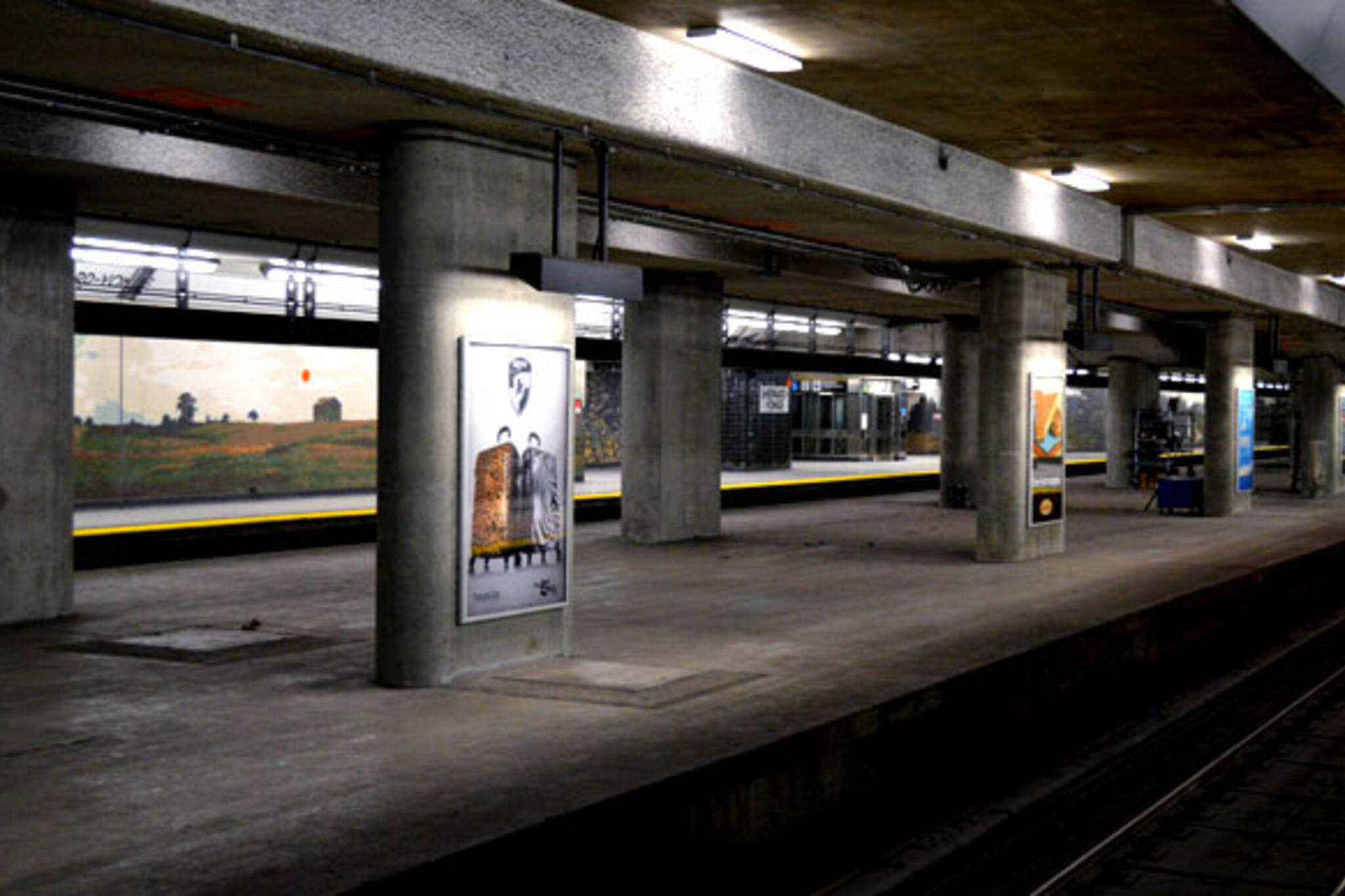
Riders of the Sheppard line (I know you're out there) might have wondered what's with the sketched-in platform between the tracks in the upper level of Sheppard-Yonge station.
The area is a ready-to-use platform (it just needs a few tiles and lights) built in case the station sees a surge in the number of riders changing between the two lines. The interchange stop is already the third busiest in the subway system, after Bloor-Yonge and St. George, but Danny Nicholson from the TTC says its unlikely the platform will see use any time soon.
"Two platforms could theoretically be required for the Sheppard Subway at Sheppard-Yonge Station, if ridership was so high that one platform is required for boarding and a second one for alighting like at Kennedy Station on the Scarborough RT," he says.
"At this point, ridership on the Sheppard line does not justify the use of the platform. You never know in the future."
Installing the concrete structure didn't add much to the cost of the line, Nicholson says. The platform simply fills what would have otherwise been a large empty space between the tracks, a byproduct of an X-shaped crossover track west of Sheppard-Yonge.
The Sheppard line was originally intended to continue west to Downsview, closing the loop between the two ends of the Yonge-University-Spadina line. As the project was scaled back these plans were dropped in favour of the current truncated spur between Yonge and Don Mills.
The concept of dedicated platforms for entering and exiting passengers is commonly known as a "Spanish solution" for its widespread use on the Barcelona metro. The first subway station in the world to use the idea was the long-closed King William Street station on the London Underground.
The Sheppard line is the least-used of all the TTC's subways - the Scarborough RT takes the prize for the quietest rapid transit line, though. Some context: the Bloor-Danforth line is 10 times busier while the Yonge line sees 14 times the number of riders.
A loner's paradise, Bessarion on the Sheppard line is the quietest underground stop on the TTC entire system. Ellesmere, the loneliest stop of them all, located under a flyover on the edge of an industrial park, is the only place on the TTC where you're less likely to be seen.
Chris Bateman is a staff writer at blogTO. Follow him on Twitter at @chrisbateman.
Image: Chris Bateman.


Discussion
41 Comments
Sort By Oldest First / Newest First
Subscribe
I'm sure plenty of people scoff at the TTC for building such a huge platform for so few people. Considering the current mess Union Station is, though, shows it's good to have an eye on the future.
Doesn't really mean much when there are only five interchanges.
It was part of a terribly flawed mentality of building separate subway lines rather than branches, or spurs, off trunk lines. Imagine for a moment that the full length of Sheppard had been built, and that the middle platform shown in the photo was actually in use. Where would those hundreds of people go? You would be completely filling a Yonge train, leaving no room for the rest of the Yonge passengers. It's one thing to have interchanges like that in a CBD, quite another to have one in the suburbs where, what, 85% of all traffic is going to continue their journey towards the core. The TTC knew there was a chance Sheppard would never be extended - why did they not plan for the possibility of a spur?
In New York and other cities, suburban spur lines are much more common and it is a tragedy that Sheppard was not constructed as such. There never should have been a Yonge station -- instead, northbound trains should have split before Sheppard, with half of the trains going to Finch and the other half veering off towards Don Mills. This is exactly how the north end of the #3 subway works in New York as it branches off the #2, or in Queens where the N branches off the R, etc. etc.-- see: http://www.mta.info/nyct/maps/submap.htm
Had the Sheppard line been built as a spur, no transfer would have been required, making it much more attractive for riders to use. Plus, every other train would still be coming down from Finch, so in the case that a train coming in from Sheppard was half empty, no problem, this would simply act as a relief valve to provide space to pick up riders at York Mills, Lawrence and Eglinton. (This is exactly how the #3 works if you stand at 96th St in Manhattan, as it comes in half-empty and absorbs the crowds that can't get on the packed #2). In that manner even if the Yonge line was extended into Richmond Hill you would still be saving seats on half the trains for actual Toronto citizens.
But no, the closed-minded engineers in charge of the TTC chose to not provide for this option, so while there is a way to branch a northbound Yonge train onto Sheppard there is no way to route a westbound Sheppard train onto southbound Yonge (you have to go past Yonge and then reverse). So now we are stuck with a useless stubway that requires a transfer.
While it is idiotic to extend Sheppard to Scarborough when a DRL is so sorely needed, there is an argument to be made for running Sheppard westbound to link up with the University line and provide some utility to the stubway. However, if this happens, IT SHOULD BE AS A SPUR LINE for the reasons I give above. This would not be all that strange -- look at how the Vancouver Skytrain crosses over itself (http://bit.ly/12Wizt7). What I am proposing is to have Sheppard be a branch off of the University line, with some trains running to Vaughan and some to Don Mills. Would look like this:
http://bit.ly/fy867O
This would help relieve the transfer pressure at Yonge -- a one seat ride down University may work better for some than a painful, not-guaranteed-to-get-on transfer at Yonge -- while making empty Sheppard trains worthwhile as a way to preserve capacity within the city and not have every train come in from Vaughan already full. Would look like this:
http://bit.ly/12Wizt7
Crazy? Like a fox. I call it the Y-U-S-S line (Yonge-University-Spadina-Sheppard). And it sure beats a stubway. Of course the city's supposed champion of subways, the Child Mayor, is too dumb to figure this out. If you are going to make a case for a reasonable, affordable small extension to a subway, this is the way to do it, not Sheppard East or Finch or some other harebrained idea.
But I'm not holding my breath for anything to happen. It's Toronto we're dealing with after all.
St. george
Yonge-Bloor
Kennedy
Yonge-sheppard
whats the other one?
Usage of the Sheppard line would probably double if they closed the loop to Downsview. I don't know what sort of moron decided to cut that link, but they were obviously a car-centric individual. It used to take me 35-45 minutes each way to ride from Sheppard/Yonge, down to York Mills station and then bus over to Wilson station every day when it could've taken me 10 minutes if the loop was closed. And riding down to St. George, transferring over and hopping back on at Bloor/Yonge didn't save any time at all.
One costly element of implementing this arrangement is the curved tunnels and flying junction to seamlessly and directly connect Sheppard West extension to the existing Downsview station (probably sharing a short segment of infrastructure with the Spadina extension).
Additionally, this arrangement will increase travel time for riders wishing to go from say Don-Mills to York University since a tranfer would be required at Downsview Station. Looking at the radius of the subway curves on the Spadina line extension as it turns west north of Downsview gives us an idea of how large the curves may be in order to comfortably turn Spadina line eastward. The tracks in the curves will certainly be costly to maintain and trains will travel through them at somewhat reduced speeds for safety, comfort, and cost reasons.
In hindsight, the option of making the subway extension into York Region a part of a continuous York Region to Don-Mills line should have being at least considered. The ridership that can be expected for the TYSSE is comparable to that of the Sheppard line if extended to Downsview. A more east-west line that travels on Sheppard then north into York Region will increase connectivity and allow the current four car trains to be used at perhaps three minute peak hour headways instead of six car trains at four minute headways.
Furthermore, with a Sheppard-York Region subway line the Spadina line can be extended directly north in the future to perhaps Steeles Avenue. The same tunnel boring machines for TYSSE would be used for Sheppard, reducing the cost of at least one or two launch or extraction shafts. The construction impacts may also be much less since a more straight alignment can be selected and soil can be extracted at Sheppard West station rather than on Sheppard West avenue. Due to the direct one ride subway connection between York Region, York University, Finch West and Yonge St, the east-west connection function of the Finch West LRT can be well served at no extra cost. The funding that is now apportioned for the Finch LRT can fund a major portion of the Sheppard West segment altogether since a larger tunneling contract can be tendered at increased economies of scale and scope.
Insummation, the benefits of a Sheppard-York Region line are many:
The rider will be more comfortable (smoother, quieter) since there will be fewer tight curves.
Maintenance costs will be less due to less curved track and wheel wear.
Reliability will be higher due to having two independent lines.
East-west travel will be faster and more direct, spuring business development on Sheppard and North York.
A Dufferin North extension of the Spadina line can relief the Yonge line by 10-25% depending on how far north it goes.
Operating costs will be less since train length will be kept to four in the short and medium term rather than running six car trains into territory that can be served with shorter trains.
Comments to this idea are welcomed.
Streetcars on this route are already taxed, and they run every 2-3 minutes. With all the new condos coming up on King West and development on King East, the whole street is going to become a huge problem transit wise.
There were problems with schedule adherence because the trailing switches were set to flip-flop between the routes (which made no sense since the facing switches were automatic based on the train's identity coil). This was done to preserve an alternating service pattern without dynamic resequencing at the terminals, although the wye could operate in FCFS mode.
As for interlining Yonge and Sheppard, that was never the design, but it was considered and scrapped for the Eglinton W. subway that was cancelled in 1995.
Offset printing, Black or color copies, Digital printing, Finishing, Computer graphics, Personalising Documents, Wide format printing. And more.
Imprimerie REPROCOM
360 rue St-Jacques O Local B-130
Montréal QC H2Y 1P5
Téléphone: 514.849.0456
Télécopieur: 514.849.9448
Courriel: info@reprocom.ca
For a Sheppard subway interlined with the Spaidina subway, it is actually easier to have the Sheppard go southbound. The key is that there would no Sheppard station at Downsview (Dufferin and Sheppard). The Northbound to Eastbound ramp would be after Wilson and before the Downsview Station. The Westbound to Southbound ramp would also be just before Downsview station. The single track could go under the current tracks and then join in from the West side just before the Wilson station. The Wilson Station being at grade makes any modifications much easier. Thus, even though it runs along Sheppard, Wilson would become the interchange station. Also, there would be a non-interchange station on the Sheppard line at Wilson Heights Blvd.
The interlining with Spadina to the north would be more difficult since it would involve changing an underground Downsview Station into an interchange station, and it would require the Westbound to Northbound (and the Southbound to Eastbound) ramp to join in a quite a deep depth.
First train: Finch-Union-Wilson-Don Mills
Second train: Finch-Union-Wilson-Vaughan
The only thing is that the frequency on the Sheppard and Spadina (from Downsview station and north), would be half as much as on the main YUS subway. It may be possible to have every second Sheppard train go Don Mills to Downsview Heights and every second Spadina train be Vaughan to Downsview Station.
The other option is:
First train: Finch-Union-Downsview-Vaughan (and return)
Second train: Finch-Union-Downsview (and return)
Then on Sheppard
first Train: Don Mills to Vaughan (and return)
second train: Don Mills to Downsview (and return)
As crazy as it sounds, especially since the Viva Green has been such a failure, apparently the 401-404-407 corridor has not only one of the highest concentrations of office employees in the GTA, but in all of Canada! On top of this, a number of high density residential and mixed use projects are well underway, including the new Downtown Markham urban growth centre.
Now I know that generally extending rapid transit along highways is not a very good practice, despite easier construction processes, but once again I think it could work here. Seneca's main campus is located at Finch, which in itself presents an argument to extend the line north simply to reach that trip generator. From here, it could continue along the 404 north to reach Highway 7 where connections to the Viva busway and the Commerce Valley Business Park is located, or it could veer northeast underground to reach trip generators like Bamburgh Circle and the Downtown Markham development.
Finally, because of the reduced density, yet high potential for intensification (especially since it would actually go somewhere now), construction costs would be very low as well.
As well, express buses, like most buses, are nothing but sardine cans that break down and have to be replaced; at least the subway cars would have lasted a lot longer, and people wouldn't have to be late to work except for whatever delays that would happen during rush hour.