City
How should the city separate its new bike lanes?
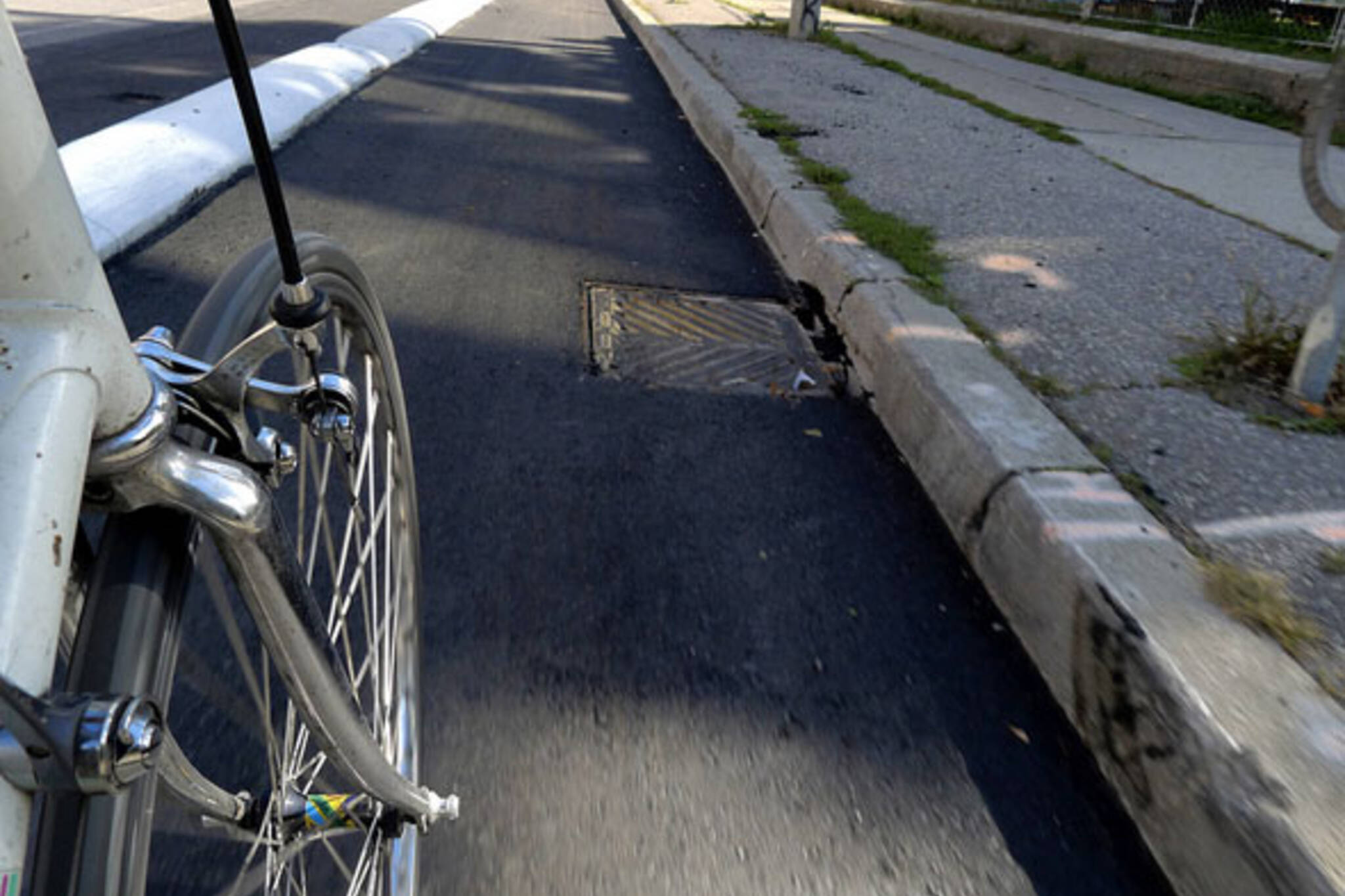
Toronto's first fully separated bike lane arrived on Sherbourne Street this fall, for the first time giving bikers the opportunity to move north and south through the eastern portion of downtown without mixing with traffic. But despite a rolled curb segregating autos and bikes, there have been numerous instances of cars using the narrow lane for on-street parking.
The curb was designed to allow emergency responders, TTC Wheel-Trans, garbage trucks, and snow removal vehicles to pass over the top while acting as a barrier to everyday traffic. Unfortunately, by making it easier for those that need to reach the curb, the city has also made it easy for drivers to illegally block bike traffic.
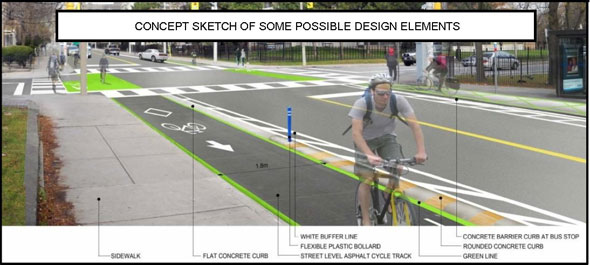
At last month's city council meeting, a similar separated cycle lane for Wellesley and Hoskin was given the green light. According to David Dunn from the city's Cycling Infrastructure and Programs department, a temporary rubber curb will be bolted to Wellesley east of Yonge in 2013. Between then and 2014 the same system of raised and separated lanes will gradually be installed between Parliament and St. George streets, the entirety of the bike track.
"For the section that will be reconstructed in 2014, both a street level or raised cycle track design will be investigated. Sherbourne provides examples of both of these types of permanent cycle track designs - "raised" from Gerrard to King and "street level" rolled curb design from Gerrard to Bloor," Dunn says in en email.
The exact look hasn't been finalized yet, but it's likely to match what's already in place on Sherbourne and under construction on Queens Quay at the expense of all on-street parking and left turn lanes.
Cities like Vancouver and Montreal separate traffic in a much more dramatic way, using concrete planters or high curbs in some cases, making it much harder for confused delivery truck drivers and motorists to blunder onto the bike track.
Given that the city has a chance to learn from the problems on Sherbourne Street should it too look at alternative ways of marking the edge of the bike lane, or should we spend that money educating drivers and ticketing those that break the rules? Is our current method the best since it allows access to the curb to those who need it?
Chris Bateman is a staff writer at blogTO. Follow him on Twitter at @chrisbateman.
Photo: "New Sherbourne Separated Bike Lane" by Martinho from the blogTO Flickr pool.


Discussion
60 Comments
Sort By Oldest First / Newest First
Subscribe
It is a combination of the clearer separation from traffic, as well as the larger width. Granted that the Hornby bike lane is bidirectional, but I thought that part of the Wellesley bike lane was going to be bidirectional as well.
http://jnyyz.wordpress.com/2011/07/14/hornby-separated-bike-lanes/
The result is you get a half-assed and ugly biked lane that does not do what it is intended to.
Why do the emergency responders in TO get priority to use the lane while in Mtl and Vancouver this is not the case? I'm pretty sure in Mtl to clear the snow from the bike lanes they simply use the same machines that clear the sidewalks.
I also think its much more effective to have one bike lane with two-way traffic. This way the other direction can be used as a passing line.
http://www.flickr.com/groups/sherbournebikelane/
If parking in the lanes is a major issue, putting no stopping signs along the barrier may help to get the point across. Another option could be to paint no stopping logos on the lanes themselves. All else fails, get the tow trucks and cops armed and ready to go at a moment's notice...
The little humps that act as separators are beyond useless.
Way to go Toronto.
Enough! Toronto needs actual separated lanes. Sherbourne is not it. Hoskin is not it. Queens Quay is not it. You need to create this image in Toronto for people to understand what a freaking separated lane is and what it does for cycling:
http://dc.streetsblog.org/wp-content/uploads/2011/04/portland-cycletrack.jpg (NYC separated bike lane)
And yes, plant some trees and grasses so that Toronto's main streets actually have some beauty to them rather than being the ugly bald cousins to the leafy sidestreets.
http://www.treehugger.com/bikes/how-not-design-separated-bike-lane.html
All you whiner bikealysts should stop c'plainin those Sherbourne lanes are great, and hopefully all te other lanes that get built in the the city are the same. It is so nice to be able to roll over those smooth humps and park my rig ( that what we call it) in that " bike lane" I'm out of traffic, never get tickets, and never have to circle to look for a spot! I get my route done early! Thanks city of Toronto, keep up the good work. Now how do we get separated bike lanes on Bloor? No even better King!!!!! I get a semi just thinking about that! Mmmmm mmmm mmmm
UPS Guy!
Keep in mind that the Portland photo seems to show 3 lanes of 1-way traffic plus one lane of street parking, in addition to the bike lanes. And the Montreal example shows 2 lanes of 1-way traffic and one lane for parking. In short Sherbourne is too narrow to be done exactly the same way. And a lot of downtown streets have the same problem.
Would people support turning Harbord into a 1-way street? I suppose not.
That being said, I've spent plenty of time riding in Montreal, Amsterdam, Munich and Berlin. I personally would prefer standard marked bike lanes over what I see in photos. I didn't like the lanes in Amsterdam as you are confined and can't easily get out of the lanes if you have to. Combined with scooters using the bike lanes and it's a bit of a shit show. Berlin's solution seems to be the best, but is not an option for us as our roads are nowhere near as wide as they have there.
The problem with the fully separated curb with posts is that it's a two way block. Cars can't get in and you can't get out. The problem with the Sherbourne solution seems to be that it's trivial for a motor vehicle to get into the bike lane, but actually dangerous for a bike to get out.
Yes. and the bike lanes could be closed in the winter for snow pile zones. As non-essential traffic, bikes could restricted to res streets and intersections only during snow fall. The lanes would have to physically blocked and cops posted to stop cyclists endangering the already slippery and narrowed roadways for the official vehicles such as cars, trucks, and transit. Finally a safe area for pedestrian and official road users (ICE vehicles).
Repaving Sherbourne and repainting the bike lanes would have been a way cheaper solution.
Nope, hold on, let's wait for a few more bikers to die in collisions until we start taking it seriously.
Drivers of motor vehicles are licensed because cars are the number one killer on our city streets.
Nothing. There shouldn't be bike lanes.
Roads are paved and paid for through taxes predominantly collected from fuel sales. Let's not forget vehicle registration and licensing fees. Cyclists pay none of these fees and as such, don't deserve a lane.
Furthermore, the amount of cyclist injuries have equal blame rider, and vehicle driver. First, the average cyclist works as a hybrid pedestrian/vehicle, or whatever will speed things up for them. They also squeeze into areas where they shouldn't be - blindspots, etc.
Second, the average driver has had zero training regarding the rights of a cyclist. Could you imagine a world where we turn 16, are given keys to a car and said, "have a good one, kid".
I also think cyclists should pay for parking as a source of revenue generating.
As for zero training, maybe not in practice during driving lessons, but drivers are supposed to know the stuff in the driver's handbook and the HTA.
I'm referring to unwritten rules. Cyclists, despite their continued lack of road awareness, are to be treated as another motorist. That includes driving far enough away from parked cars for the driver to be able to safely open their doors.
Those aren't unwritten rules - they are to be found in the city's annual cycling map and on its website. Okay, so they're more like suggestions, but just as with driving, there is a grey area not covered by laws but subject to customs and personal responsibility. Driving far enough from parked cars to avoid dooring should be common sense, but (a) it isn't always possible, (b) drivers behind cyclists who keep such a distance tend to get annoyed and (c) drivers don't necessarily think twice before opening their doors, even if they should.
This would require teaching cab drivers to respect the bike lanes, but we know cab drivers are lawless and only care about their next fare. Add to that the fact that cops let them get away with murder (actually) and one could be excused for thinking it's futile.
Now that they seem to have finished painting all the lines, pictures of bikes etc it is actually pretty clear who belongs where and I have seen far fewer trucks trying to park on the lanes. The new $110 (?) fines for doing so may help! Having two versions of the lanes should make it easier to evaluate how each works so that future lanes are even better. Are either perfect? No, but in my opinion they are both very much better than simple white lines