How does the Toronto bikeway network compare with other cities?
Chicago's official cycling website opens with a hearty letter of welcome from mayor Rahm Emanuel: "One of my top priorities ... is to create a bike network that allows every Chicagoan - from kids on their first ride to senior citizens on their way to the grocery store - to feel safe on our streets." Toronto, well, let's say we don't have that.
Endorsements from elected officials aside, it's worth taking a look at how Toronto compares with other North American cities in terms of bike lanes, parking and other important measures of cycle-friendliness now our mayor is talking us up to foreign leaders.
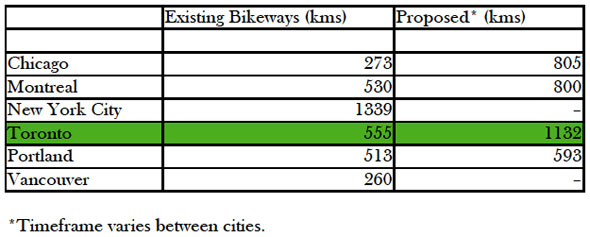
On paper, it turns out, we're competitive. When comparing the 416 with Vancouver and Montreal - our closest Canadian rivals - and Chicago, New York City, and Portland in the United States, we come up roses in terms of existing and proposed bikeways (a catch-all term for every type of bike path).
Relative to our population, though, we tend to lag behind. Portland, a considerably smaller city, rivals us in number of bike lanes yet it has a population of just 600,000 people. According to a 2011 study, "Bicycling renaissance in North America? An update and re-appraisal of cycling trends and policies" by J. Pucher, R. Buehler & M. Seinen, the Oregon city has 73 kilometres of bike lane per 100,000 people.
By comparison, Toronto has just 11 kilometres of lane per chunk of its population. Chicago and New York City trail with 8 and 9 respectively while Vancouver and Montreal more than double our figure with 26 and 27 kilometres of lanes per 100,000 people.
The number of proposed bike lanes each city is planning to install is also important. Chicago, which just hosted our mayor,
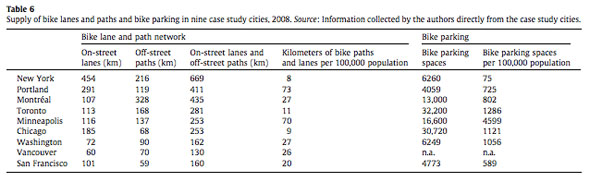
aims to significantly bolster its network and increase the number of journeys made by bike before 2015. Montreal also has a plan to double its network by 2020.Bike parking, though it always seems hard to find a space, is an area where the stats say we punch above our weight. Figures cited in the above study, though it's now four years old, show us with the most parking spaces of all the other cities in the study, which include Chicago, Montreal, New York City, Portland, and Vancouver. With population factored in, we're second to Minneapolis. Toronto usually installs 500 to 1,000 new ring and post locks each year.
Attitudes toward cycling is something a little harder to measure but it is just as important as infrastructure. Portland, a city with a large community of regular cyclists, sees roughly 6 percent of its population ride to work. At the last census in 2006, 1.7 percent of Torontonians hopped into the saddle for the same reasons. Broadly speaking, cities in the west seem to have more support for cyclists.
Vancouver, for example, has an excited video on its website introducing a new separated bike line on Dunsmuir Street. It's hard to imagine the same video being made here - especially when you see the city's mayor pull up on a bicycle to endorse the project.
So, we're a little behind the competition in terms of kilometres of bikeways but it could be worse. That said, proposed bikeways aren't bikeways. Toronto has been slow to implement cycling infrastructure and quick to remove it of late. The Jarvis Street debacle aside, perhaps the biggest obstacle to overcome is a change in attitude that makes cycling a safer, more desirable option for commuters. How do you think we can achieve this? Is licensing cyclists a way of creating an even playing field for all road users? Tell us below.
Photo: "Bike Lane" by Kiril Strax in the blogTO Flickr pool. Table: "Bicycling renaissance in North America? An update and re-appraisal of cycling trends and policies" by J. Pucher, R. Buehler & M. Seinen
Latest Videos
Latest Videos
Join the conversation Load comments