City
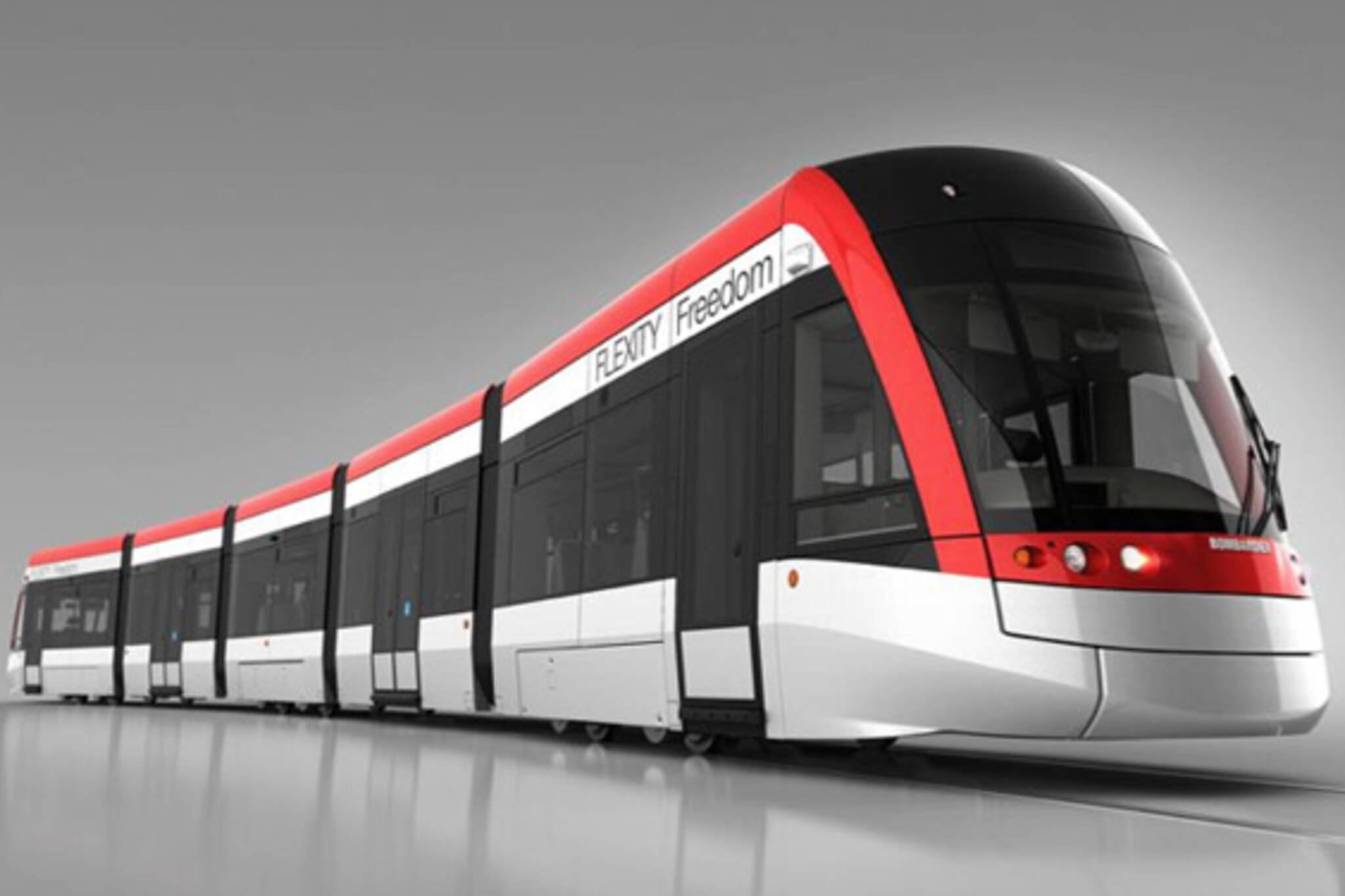
Will 2012 mark the return of Transit City?
First things first, that's a serious question. Despite the fact that Transit City was thought lost shortly after Rob Ford took his position as mayor of Toronto, more and more signs point to the possibility that, at the very minimum, there will be a significant public push to revive the former LRT-based transit plan. Speculation that it might be possible to restore the initial plans for LRT on Sheppard and Finch ramped up when David Miller, speaking with Newstalk's 1010's John Moore in September, indicated that you could just turn Transit City back on "like a switch." While that was a provocative statement, few believed that such a thing was actually possible.
Many still don't. There are, however, others out there who point toward the resistance — both from the public and on city council — to the Fords' attempted takeover of the Port Lands redevelopment as a potentially watershed moment in this mayoralty. Prior to the kickback on this issue, Ford (be it Doug or Rob) tended to get what he wanted. Could a similar campaign to revive Transit City have the same effect?
In a timely and intelligent post on his mayoral watchdog site, Ford for Toronto, Matt Elliott does a good job establishing why there might be room for cautious optimism from Transit City supporters:
"Is a Port Lands-style consensus possible with these transit plans? Early indications are good. Aside from Ford, very few councillors expressed strong objections to the on-street operation of Eglinton and other Transit City routes when they were first proposed. And there's certainly an appetite for more transit in more places, which is what we'd get if council rejected Ford's all-underground scheme for Eglinton and reverted to something resembling the Transit City plan."
Elliott is careful to note, however, that the best strategy for critics of Ford's transit "plan" will be to frame a campaign for change under the guise of compromise, a move that might encourage the mayor to cop a less stubborn approach to new transit options without the risk of full-scale embarrassment. This is smart thinking — not just because, as Elliott notes, it might "leave room for the mayor to save face," but because it would also allow his allies on council to vote for a new transit plan without completely alienating Ford.
So how does the matter get before council given that Ford ditched the transit plan he inherited without taking it to a vote? Last week, the Grid's Edward Keenan pointed out that the punitive costs associated with the cancellation of the original Transit City plans — which have been estimated at $65-million — could prove the impetus for a councillor to pass a motion asking Metrolinx to revert to the initial and only plan that was actually approved by city council back in 2009. The big question is whether or not there's the political will to vote in favour of such a call.
Some councillors who initially aligned themselves with Ford on transit have since reconsidered. Upon news that Scarborough will be without rapid transit until 2019 (and quite possibly a lot longer), Councillor Chin Lee (ward 41) had some regret-laden advice for his constituents who supported a subway extension plan that very well be dead in the water. "It's just be careful what you ask for and think of all the implications," he said. Raymond Cho (Ward 42), Keenan notes, has also done an about face since seeing what's in store for Scarberians over the next few years.
Add to this the possibility of more and more public pressure via websites like Save Transit City and a #CodeBlueTO-type campaign, and you can expect to hear the words Transit City uttered more and more often in 2012. The longer that Ford's Sheppard subway extension remains stalled, and the more complicated and expensive that it gets to bury the entirety of the Eglinton LRT, the more likely it is that something's got to give. Will this result in the restoration of the city's former transist plan? That remains to be seen. But the betting is good that a very serious movement to restore viable transit options in under-served areas is on the horizon.


Discussion
86 Comments
Sort By Oldest First / Newest First
Subscribe
THANKS GOVERNMENT OF CANADA
Second, Transit City is less expensive to build. Meaning, there is more money available for it to reach more people, with money left over to save the cutting of TTC service and other priorities.
Third, Transit City would reach more people in more parts of Toronto, providing rapid transit all over more parts of Toronto.
http://www.theglobeandmail.com/news/national/toronto/affable-toronto-mayor-pulls-few-punches/article2278699/
Tell your friends to talk to theirs, especially those residents who live in wards either represented by centrist councillors (Bailão, Colle, Luby, Lee, Matlow, McMahon, Moeser and Robinson)or those who live in areas most affected by the change of plans (residents on Finch, Sheppard, Jane, etc).
doubt it.
Transit City was never about building old-fashioned streetcar lines. The Ford campaign did a great job of obscuring that fact.
I think that the Crosstown will be revised so that part of it is at ground-level where that makes more sense. I wouldn't call that a return of Transit City though.
If you are going to introduce light-rail, it needs to have dedicated infrastructure like in Vancouver where there they move overhead. Having LRT share infrastructure with other modes of transport seems like a waste of money and unsustainable, like the situation now on King and Queen Street where none of the modes of transport move quickly at all.
North york's population 635,370
Etobicoke's population 334,491
We were to have 5 LRT lines to compliment our 3 subway lines
Calgary's population 1,071,515
Calgary has 2 LRT lines no subway
Not as much as Transit City.
And if the weather's such an issue, why not replace all the bus routes with subways too?
Great idea. How old are you? 13
If you were to leave you bunker of ignorance, you'd have noticed that bike lanes are along the sides of the streets not down the middle as you claim. But apparently lying to make your point trumps common sense.
Also, "everyone you ask" prefers subways? Well that settles it then. Forget about choosing a plan that grants the greatest number of Torontonians transit access. When it comes to city planning we need to run all ideas by friends of "The Truth," since they clearly have everyone's best interest in mind.
I'm being facetious about the buses. If people are that put off by the thought of waiting outdoors for a vehicle that carries more than buses in a route that doesn't warrant a subway line, maybe the fact that most of Eglinton will be underground and run more frequently than buses will help (although the TTC will have to stay on schedule, of course, which isn't their strong suit).
http://www.youtube.com/watch?v=D4DRtpO-r5U
35.6 per cent for former George Smitherman
David Miller defeated John Tory 43% to 38%
If a 12 percentage points vicotry isn;t considered an ass kicking in an election, i don't know what is.
Of course, every politician will tell you your neighborhood is one of the special ones. Until it isn't (Finch, Scarborough)
. Easier opponents? Arguing with little bitches is as easy as it gets. I haven't given up. Maybe I should start mocking people to appear smart. Eh go ford doh, ur the idiot, and unorignal. Now go back to living at your parents house and continue jerking off u idoit.
airplanes she says...smh
If you think that public transit causes congestion, take away the streetcars on King St (over 80% of commuters use the TTC on King) or light rail in Scarborough, put all those people in cars and see what happens to traffic!
Were there no other LRT (or streetcars for that matter) in North America, it would be one thing to argue that Transit City was some invented leftist fantasy. But it's pretty ridiculous to argue that you are somehow smarter than every transit agency and government in the 20 or so cities that have built or are building suburban LRT and downtown streetcars. I mean, if Oklahoma City, which is as hard-right Republican as it comes, wants streetcars, and freaking Houston just built surface LRT lines on arterial roads, where is your case? You can't argue with facts, and the facts are that while Transit City has some terrible flaws it generally represents a mode of building transit that is tested and proven for the context it was proposed under. And Ford is a Class-A idiot (I would say "uneducated", but, you know, he actually is) for killing it just because he doesn't understand modern transit planning nor fiscal responsibility.
Subways are the answer and Rob Ford has it right. And btw, he was voted into office on that platform. And the people voted him in hand over fist. GO FORD GO!!!!!
1) Traffic construction for subways is more complicated than for light rail, which means it is both more expensive and prone to delay.
2) I agree subways are the best option, but the city cannot afford to build subways for all the areas that can now support them. Light rail in the city is preferable to no subways.
3) Ford won a majority of all votes cast, which turned out to be just about half of the total population eligible to vote. So around %30 of the voters in this city chose him over a host of other terrible candidates. Given all the trouble he has already experienced in just over one full year in office, I think it's safe to say that the rest of the city would prefer 'someone else'.
MY friend, you are wrong. SUing subways in the downtown and along high-density corridors, and LRTs elsewhere, was a way to get rapid transit to neighbourhoods of vastly different population densities and transit needs. But Ford and his subways-or-nada mentality has screwed us on that.
http://transit.toronto.on.ca/images/streetcar-4101-07.jpg
LRT looks like this:
http://immigrationtocalgary.com/attachments/Image/16_Transportation_1_LRT_C-Train.jpg
and this
http://calgary.openfile.ca/files/files_calgary/imagecache/multimedia_zoom/files/calgary-photo-assets/LRT2.jpg
Just as fast as a subway, and operates on its own right-of-way, rarely interacting with any other traffic, at all.
I don't think Ford has the best solution by far, but given the fact that this idiotic city hasn't dug a foot of subway tunnel south of the 401 since the 1980's, at least he deserves credit for focusing the dollars where they belong. The worst thing we could do is build LRT's to bring massive amounts of new riders into a downtown system that can barely handle the current load. And don't give me this crap that Toronto "can't afford subways." There are plenty of cities around the world that continue to find a way to build subway tunnels to this day. We just need to find leadership with the vision to do so (the fact is, "Transit City" would never have even been on anyone's radar if the David Miller government hadn't used it as a Hail Mary in a desperate attempt to curry favour with suburbia after polls told them the socialists in City Hall would soon be crushed.
But regardless of that discussion, how is Ford focusing the money "where it belongs"? All he's done is make the Eglinton line needlessly expensive by insisting it gets entirely buried. He's not putting any new transit infrastructure downtown--no new subways or streetcar right-of-ways or anything. And he's made his hostility to downtown needs well known. Ford is no friend of downtowners. (Or suburbanites, really.)
The only line I can think is the 2nd Ave subway in New York and shockingly it's going to be at least 3 years behind schedule and millions of dollars over budget.
How about the 24-point victory David Miller achieved when he was elected in 2006, on a platform that included bringing rapid transit (read: LRT) to the suburbs.
http://en.wikipedia.org/wiki/Toronto_municipal_election,_2006
http://stevemunro.ca/?p=2657
Before cutting subway from the equation, consider that while it's expensive now, it's only going to become relatively more expensive in the future. Yet, if GTA continues it's widespread dense growth, subways will ultimately be necessary. And surely everyone that is happy with LRT would also be happy to alternatively use a subway if it were constructed instead? So the demand is there, and will increase if the service becomes available.
JM has a point, but honestly, how many North American major cities have only 2 subway lines?
Toronto should also consider express transit lines. Eg: Park 'n Ride from scarborough town centre, with express stops only at STC, Bloor, St George. This might be something LRT could accomplish - but it needs to be in mind when constructing the lines, to create areas to overtake non-express vehicles. This is how many other cities reduce commute times from the suburbs.
Part of the solution should be to address all of the box condos being constructed in areas with sparse to no public transport. These developments create thousands of car dependant residents. All for profit of the developer. Perhaps a portion of their profit should be paid towards a transit fund to their area? It will help a little to relieve the cost of the demand the developments are creating on the TTC, and it profits developers to promote TTC access to the area because it will increase the value of the homes. And if the cost is passed to buyers and deters them from buying the property, it's still a positive, by encouraging them to try live closer to TTC.
Now go back to living at your parents house and continue jerking off u idoit.
Was the idoit a Freudian slip. We know you do it, we know...
We get one LRT line completely underground or we get three mostly above-ground LRT lines. That's what's affordable with the provincial funding available. Pick one.
The Sheppard subway is a separate issue and it's very much looking like the money isn't there. The province isn't paying for it and Gordon Chong, the man Mayor Ford appointed with the task of looking into the financing of it now says (surprise, surprise) the private sector at best pick up 30% of the cost. That train's not leaving the station.
Eglinton-Crosstown as it exists now through routed to Scarborough Town Centre at least eliminates the god awful transfer point at Kennedy Station and doesn't subject western Scarborough residents to the average 22 km//h go-slow speeds the surface aligned ECLRT was projected to run at through the Don Mills-Kennedy section of the line.
Finch West is another bizarre choice for surface LRT given the availability of a parallel hydro corridor over 10 kilometres (Yonge to Weston) for express bus routings from Rexdale, Humber College and the Jane-Finch area. At Keele there'll be a new subway stop and east of Keele the prospect of up to 3 parallel Sheppard subway stops via Wilmington, Bathurst and Grantbrook/Senlac which TTC riders through that area could opt utilizing.
Finally a Sheppard East LRT is not economically viable east of Agincourt as density shifts to the south and north in the case of McLevin/Neilson/Sewell. And surface LRT cannot conceivably cater to the commuting of all these areas at reasonable travelling speeds and duration. Ergo if grade separated transit can conveniently link density/ridership clusters together than that's what we need to invest in.
So those out to undermine the subway/trench/elevated right-of-way rapid transit agenda do so simply because they have a hard-on for inherently slower modes of transit with multiple stops (Finch and Sheppard combined would have had 65 stops - so much for a rapid alternative to driving crosstown... Opps!) or because they've allowed themselves to be duped into thinking that LRT is significantly cheaper than grade-separated transit (60-80 million per kilometre for LRT would've added up to over $13 billion for Transit City in entirity enough coincidentally however to build us subways across Eglinton, Sheppard and maybe even jumpstart a DRL. Talk about cutting off one's nose to spite the face.
tl;dr: you're an idiot, a jerk, your arguments don't make sense, and you should kindly leave. (:
http://www.cbc.ca/news/canada/toronto/story/2006/05/03/tor-ford060503.html
No. Not at all.
Let's have a look at Detroit, the quintessential car city: Well-developed highway network, no subways, no LRT, no streetcars, one fairly useless ICTS route encircling Downtown and a basic bus system. Where's that left the city? With vast swaths of what are essentially fields from the downtown core all the way out to Detroit's equivalent of Finch Avenue. Toronto has 2.5 subway lines, 11 streetcar lines and one of North America's most comprehensive bus systems, and only the Gardiner, DVP and the Allen Road stub. The result? Toronto remained vibrant and attractive to businesses. Both Detroit and Toronto used to be quite industrial cities. Jobs in heavy industry are gone in both cities but because Toronto is lively compared to most other North American cities it's an attractive place for business. So we were able to progress beyond our industrial past whereas Detroit stagnated and is now in a downward spiral. Meanwhile cities who are building LRTs are on their way to recovery. Portland went from Detroit-esque to Toronto-esque in approx. 10 years, and they have one of the most extensive LRT systems on the continent. So no, highways and LRT are not the same, in fact they are opposites. It has nothing to do with lattes or lefties.
One LRT = many passengers.