City
The NDP take over Toronto's Stop the Meter Rally
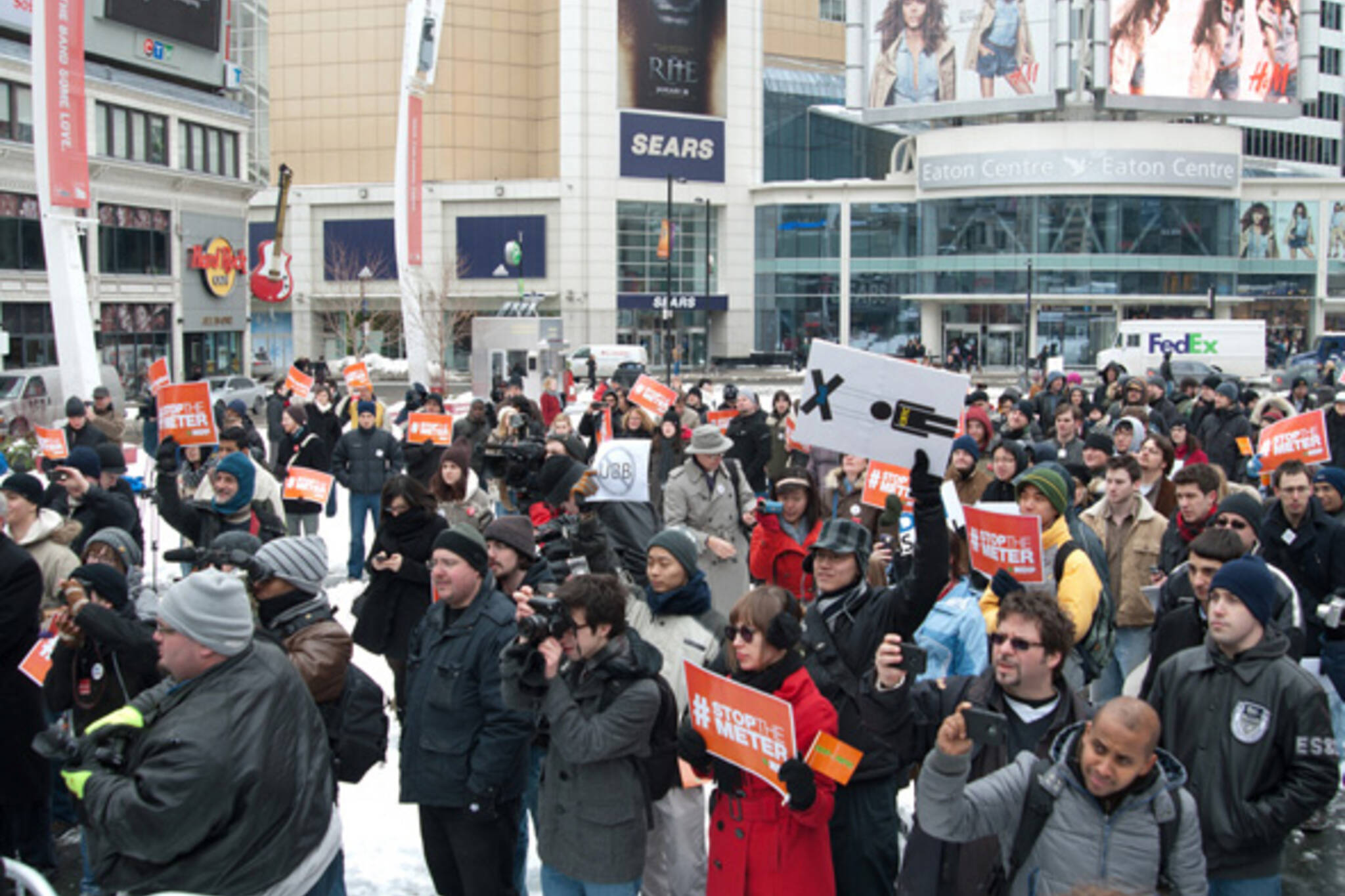
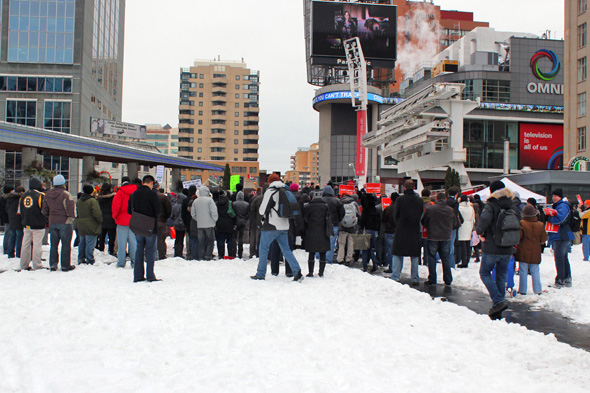
Friday's Stop the Meter protest at Yonge and Dundas Square was not quite the rally organizers were anticipating. By my guess, about 200 people of the 2,300+ who clicked "attending" on Facebook actually showed up. The reason for the low turnout is anyone's guess. The fact the rally was on a Friday, came on the same day that the CRTC announced it would delay a decision on UBB for 60 days, or the general apathy of Canadians - are all possibilities.
The staging and sound equipment was paid for by the NDP party - as was mentioned at the rally - and the NDP was quick to pass out party signs sporting "Stop the Meter" as a slogan in their trademark orange colour; leaving the rally to look, and sound, more like an NDP event than a non-partisan protest. A similar, if less conspicuous, strategy was evident at the Canadians Against Proroguing Parliament protest just over a year ago.
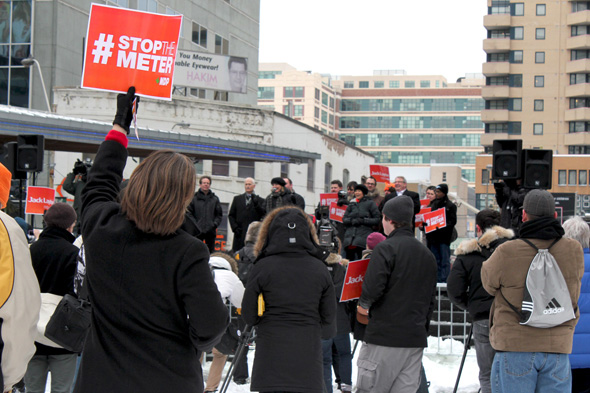
Numerous party members spoke at the event, including NDP Leader Jack Layton and NDP MP Olivia Chow. Liberal MP Dan McTeague was the only non-NDP politician present.
The low turnout hasn't, however, fazed organizers, who are plowing ahead with the planning of their next rally, which will take place on February 26th simultaneously with other rallies across the country.
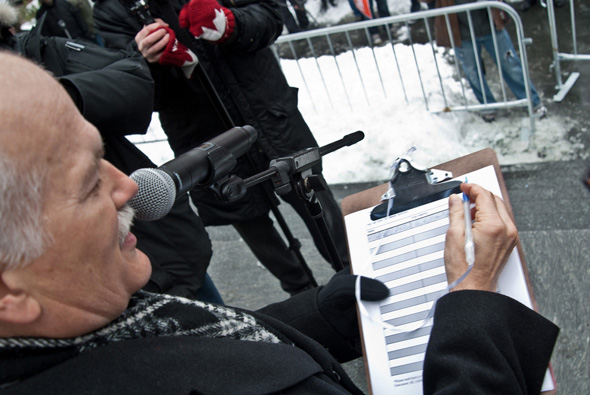
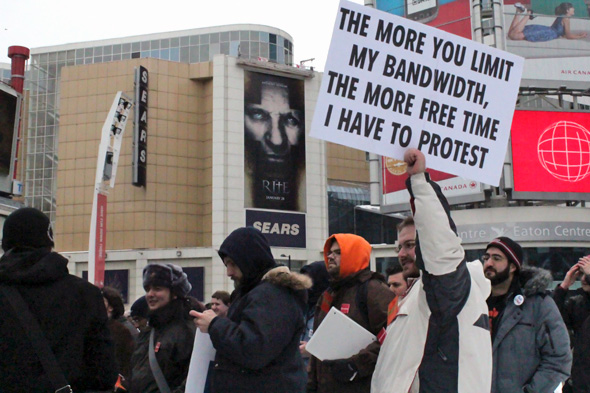
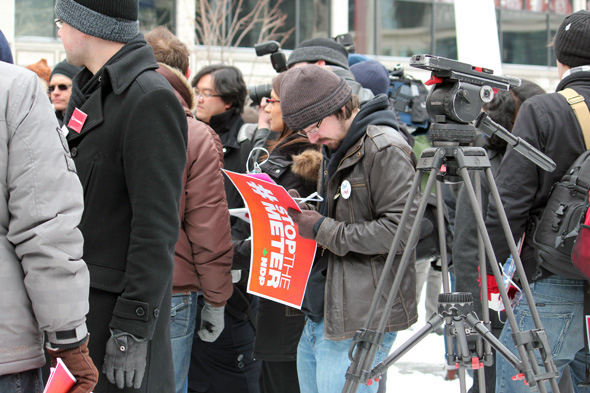
Photos one and four by GBrydson in the blogTO Flickr pool. Remaining photos by the author.


Discussion
26 Comments
Sort By Oldest First / Newest First
Subscribe
I'd love to be able to only pay for what I use.
I suspect this average individual uses one of the large ISPs, and so has already had a usage cap and high overage fees for some time. I further suspect that this average user has never hit their cap. It is therefore not obvious to this person how UBB impacts them.
(data contradicting these assumptions would be appreciated)
If you are opposed to UBB, you need to stop talking about how it hurts you, or how big of an injustice it is for you (or high-bandwidth users generally). You need to focus on educating average users about how it hurts them.
In a nutshell, they're selling the idea of paying for what you use, which sounds okay if you take it at face value. But what it does is allow them to restrict people of their usage. This of course effects high volume users more immediately, but will drastically change the freedom we all know and love about the internet.
The biggest thing is web restriction, which they are trying to make more like Cable TV by offering "packages" based on the types of services you want. You're a sports guy? Oh, you want our package! Oh, you like watching videos online? Get our exclusive "media" package which allows you to access YouTube.
Allowing UBB to continue immediately opens the doors for them to be able to restrict which sites you can and can't use. Not only that, they can monopolize the market by offering there own services as replacement to open-source business.
"Do you like Facebook? Sorry, we no longer support that website but we offer MySpace."
Or, more than likely, you'll have to pay a premium to use that.
The thing is, bandwidth is nothing. It doesn't cost these companies to allow all of there users to have unlimited, but they see dollar signs by saying it does and charging more for it. It is very similar to how our cell phones work and paying for caller ID. It actually costs the phone companies to block that service, as it is pre-programmed within the phones to display the number. However, since they told us otherwise and got away with it, we now have to pay $10-$15 extra on our "plan" because they decided to block it and make more money.
UBB is this huge step backwards for what technology and internet have done for our modern society. We can connect, talk, share, and have the freedom to access whatever we like, but the ISPs are trying to take that away and fence people in. Essentially saying we can connect, talk, share, and access whatever THEY say is okay and not what we want.
So there's that.
But the other thing people don't seem to get is the fact that everything is moving towards the internet. Our cell phones, tablet devices, MP3 players, cars and television, literally everything is quickly connecting to the other, condensing our devices but opening up a world where everything is a touch of a button. With UBB, unfortunately, that ability will come at a premium price and will be completely up to the providers on what they want to allow us to have access to.
If I can live my life OFF the internet, how does this concern me? If I believe that every keystroke I make is deeply profound, then I would also believe the universe revolves around my ass and I should get everything for free.
Fact: Canada is a massive country and it has cost Shaw, Bell and Rogers BILLIONS to wire this country. If you want California style instant communications, you are going to have to pay for it.
How would you like it if you built a house with your own money, then the government came along and said you have to rent the basement for virtually free because it's not fair that you have the nicest house on the block, so you should give part of it away? That is what the CRTC told Rogers and Bell with respect to the other, newer telecoms. Whose wiring, infrastructure, etc. are they using?
Do some of you entitled idiots not think that a $5 phone card that will work for 80 minutes to Brazil is patently bizarre? How is that even possible? Sure, Bell's 80 cents a minute is egregious at the other end, but an entire industry has cropped up around fleecing the major telecoms.
Like our banking system, if we want to play with the Big Boys, we have to pay a little more; otherwise, let's call Hilary and tell her we want to become the 51st State.
Rational - Harper has already said Cabinet will reverse the CRTC decision. Like allowing Wind, there is precedent to show that with the telecommunications industry, the Harper government is pro-consumer and pro-competition.
Lead busy lives - as per above, the battle has been won, so the other 2,200 people decided to find something more productive to do than listen to Jack.
Using your ridiculously made up number, 90% of people don't realize how much this does affect them, and will so more in the future.
"If I can live my life OFF the internet, how does this concern me?"
It doesn't. But good luck doing that, especially when you want to comment on BlogTO.
"Fact: Canada is a massive country and it has cost Shaw, Bell and Rogers BILLIONS to wire this country."
True. But they've already made that money back by selling their service for years now and now, fact: they're just trying to make extra billions off of wires already there. Essentially selling us the same service for more money because they can.
"If you want California style instant communications, you are going to have to pay for it."
I'd much prefer to have the same amount of access that any modern, forward-thinking country has. We could become like China and block Facebook, MSN, Twitter, YouTube, and other huge websites in favour of their own, which generate that company, and that company alone, money. Ever heard of the great firewall of China? Look it up. That's where we're heading.
Now if you go to Europe, the States, Japan, or practically anywhere else, the Internet is becoming an essential service because we use it in every day life. Hell, have you seen the recent grocery carts at Loblaws? They connect to the internet and download your shopping list from home.
This isn't just about home usage, which is incredibly important, but the Internet is apart of everything we do now. If you give these companies the power to monopolize the market and restrict access (like they did with cell phones), we're going to be paying an exorbitant amount of money for the same service that has been in place for years now, literally paying dollars for something that costs that company a fraction of a cent.
I am all for business and think if a company can provide a better service they can charge whatever they like. But Canada's one of the worst countries in the world for cell phones, paying gigantic prices for limited service, which makes zero sense other than the fact that Rogers, Bell ect. monopolized the market and can do whatever they like. People can't start an opposing company not because they can't compete, but because they aren't allowed. That's wrong.
Your right wing for the sake of being right wing is laughable at best. I share a lot of conservative views, but if you have any grasp on where, not only the future is going, but the present is right now, you'll see that allowing UBB to continue and progress is a slippery slope for us to go down and will destroy Canada's business market and freedom for information.
Once again you have zero idea what you are talking about.
GTFOHWTBS
Make a single coherent argument and come back.
Its true that Bell has invested a lot of money into their network, its also true that their original network of supplying copper pairs to homes was HEAVILY subsidized by the government. Bell has made its money back and plenty more.
Your analogy of 'building a home with your own money and the government makes you rent out the basement' is so far off the mark it renders the rest of your argument null and void. Its closer to say "you build a house with government money and rent it out for decades keeping all the profits to yourself, and then get upset when the government wants you to share part of the house (that they helped pay for!) with another family"
the rest of your blabbering bullshit also bereft of fact. Who is to say how much it really costs to make long distance phone calls? You trust the phone companies, the ones who make profits off you, to give you an accurate and fair price? Really? IT COSTS ALMOST FUCKING NOTHING, the real fact is you were being gouged for years paying inflated prices, an area of business that the telcos made massive profits. I think the proof is that these same telcos didn't suddenly all go bankrupt when the cost of long distance calls was considerably slashed. Just how much do you think it costs to call Brasil? Just what sort of magical powers do you think are needed to make a fucking basic transmission like that?
you're an idiot.
That's the reality of Facebook. If it says you have 400 friends, it means you really have 4 friends.
Cable television and phone lines are for many people dead technologies. Bell and Rogers are finding that more and more people are using the internet to skype, stream movies on netflix, etc and no longer really require their old services.
UBB doesn't even offer an "unlimited" option for those that do want to pay more - or at least it requires you to register as a business to get this type of connection - something the ISPs are already hip to. That isn't "pay what you use" it is a hard cap any possible way you slice it.
Like the cellular industry a couple years ago, high-speed internet service is going the same direction. UBB effectively means the companies that were re-selling Bell and Rogers connections closer to cost are less attractive as plans that people want are not available at WHATEVER COST.
Beyond that, there is some debate over the real costs of sending data online. Certainly, people are using more now than ever before, but rather than thinking that this will slow down or that it should be slowed down by higher rates for available bandwidth, the CRTC, IF it is doing anything, should be encouraging the growth and resilience of the internet - not working to ensure that people pay Bell and Rogers for obsolete technologies.
instead of suggesting that harper's call to stop this, or the CRTC's delay might have something to do with the online campaign - blogto decides to write about the poor turnout for a rally on an issue (UBB) many are now tracking, but hoping just goes away in the next 60 days...big surprise people didn't come out on a work day...that most knew was an NDP event...in the dead of february...in a city in which police currently face assault charges for their treatment of demonstrators.
we all know that the only reason for UBB is that Bell, Roger are scared of the lost profits online. they are thinking of ways of making more money for shareholders. take a look at these stocks and the amount of money they are making (and also the healthy dividends they are paying).
(and yes I am cancelling them).
However when I told them to cut off my internet when I reached my peak usage for the month, they said they couldn't because the technology doesn't exist.
Is that legal?
If I go to a gas station and ask for $10 worth of gas and the attendant puts in $20 worth of gas I am only legally bound to pay the asked for $10. Any court in Canada will agree with me on this issue. If I ask them to cut me off at my cap, by law they should have to cut me off, but they won't and as far as I am concerned are breaking the law., Are they above the law?
***Last week I recieved an anonimous email from someone saying they are taking the fight one step further and tearing down residential Cable and Bell lines thoughout the country,'
I realize this is vandalism and illegal but sure enough the next day my cable line was torn down (coincidence?)and I didn't have any services for three days til Rogers could send a technician to repair it.
I wonder whether the big guys realize how much they have pissed people off and how easy it would be to disrupt their infrastructure?
It will cost them millions in repairs if these anonimous people perform their threats.
It seems to me they're starting a telecomunications war.
And this kinda scares me because even the small ISPs depend on these lines and Rogers and Bell will not repair the lines of those residences. What a nightmare the CRTC has caused.