City
Why Rob Ford hasn't won the mayoral race just yet
As many Torontonians already know, according to the most recent Nanos poll, Rob Ford has a substantial lead in Toronto's mayoral race. But living in the U.S. during the 2008 presidential race taught me that all is not always what it seems in the exciting world of polling. Nate Silver - my favourite living statistician cum political blogger - predicted the outcome of the primary races with accuracy that earned him a place on Time Magazine's list of The World's 100 Most Influential People. What's more, his predictions often beat pollsters to the punch. How'd he do it? He used the magic of statistics!
I don't claim to be Toronto's Nate Silver, but I can bring some perspective to poll results that may have many of my citizens-in-spirit feeling downtrodden.
Polls don't catch everyone. Of course they don't! Polls take a sample of people and ask them what they think. Then, inferring from the answers provided by sampled respondents, pollsters make conclusion about the population-at-large.
Looking at the numbers, at least one trend is obvious. Of Nanos's 1012 respondents, 558 were over 50 years old and 320 of those were over 60. Does this sample accurately represent the demographic makeup of Toronto's voters? Will half the voters in the election be over 50? It's difficult to provide an answer to this question with any certainty (Toronto doesn't seem to keep easy-to-access stats on the demographics of its municipal elections), but it does seem very unlikely seeing as only about one quarter of Canadians are over 50. For over-50's to constitute half the voting population, they would have to come out in droves compared to younger voters.
How else does the sample compare to real life Toronto? Well, 740 of the 1012 respondents own homes compared to 249 renters. Two hundred and ninety-seven have "no strong allegiance," politically speaking. And 360 live in Toronto-proper (compared to 136, 279 and 246 in Etobicoke, North York and Scarborough, respectively). Again, I don't want to testify to how representative this sample is. But it is something to consider when pondering the fate of the city. If the sample tends to miss certain people systematically (i.e. young, renting, downtowners), and if those people will tend to vote for Not Rob Ford, then the poll numbers will miss the picture. Or at least draw it funny.
Now, don't get too excited, Ford-haters. The poll suggested that Ford has a solid 18 point lead over Smitherman; a lead that big probably can't be explained away on account of demographic imbalance. But under-sampling of Ford non-supporters may cause polls to vastly overestimate Ford's lead, meaning that all is not lost. Maybe someone will drop out of the race! Maybe Ford will make some political blunder, leaving his marginal supporters reeling in the wake of his buffoonery! Or maybe, at least, it won't be a landslide.
Writing by Lauren Jones.
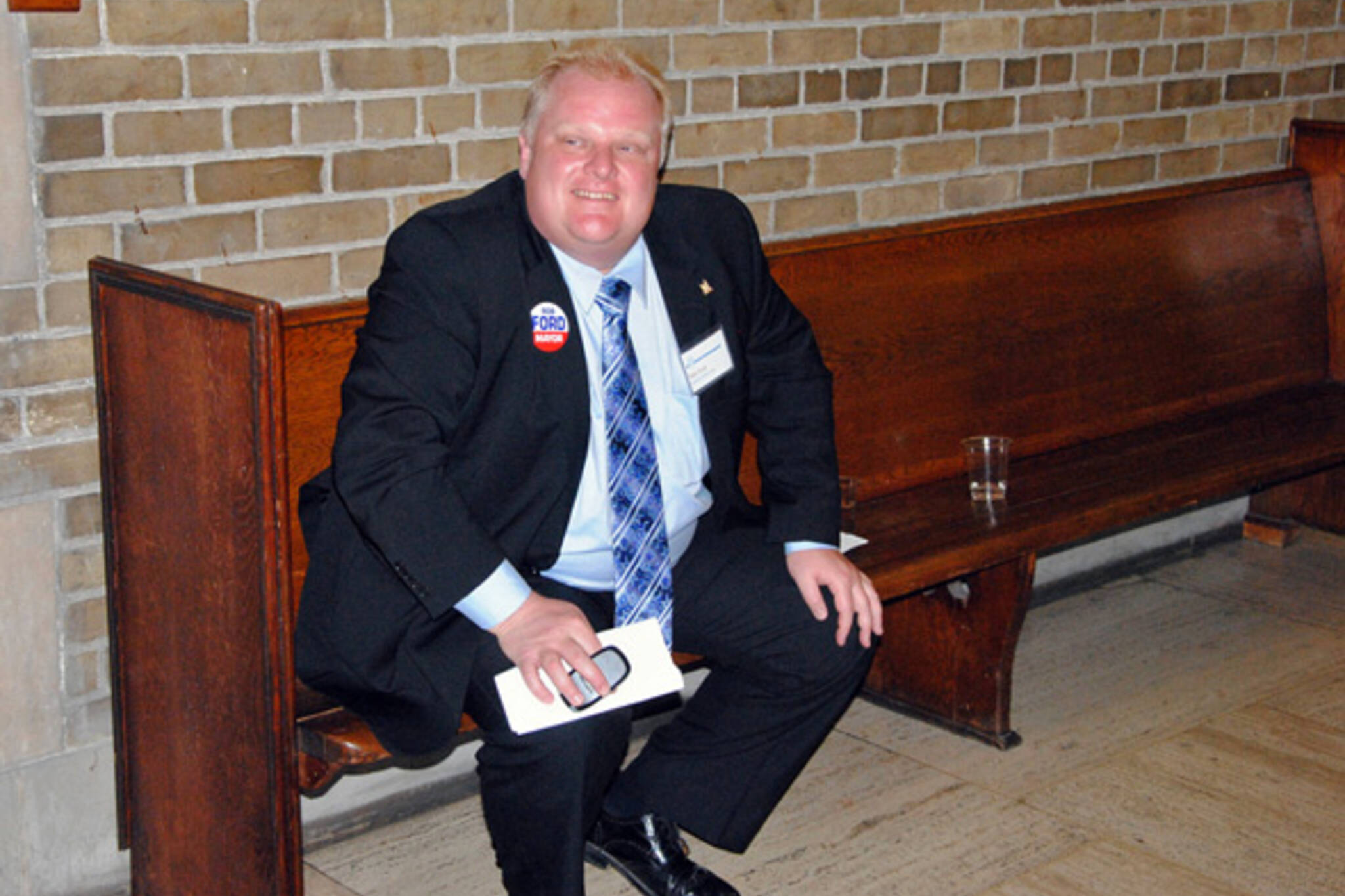
Photo by Tomasz Bugajski.


Discussion
56 Comments
Sort By Oldest First / Newest First
Subscribe
Much as I'd like to believe that recent polls are wrong, I have much more faith in them than intuitive responses to "obvious trends". Intuition has no place in polling.
I think in the end the anybody but Ford people will win the day (prob mostly for Smitherman) because Ford is such a polarizing figure. He's not going to sneak into office and then surprise people with his policies. Everyone knows what he's about. These polls are probably a good thing in that they remind people to get out and vote and not take anything for granted.
I'm far too lazy to try and dissect this poll and prove it incorrectly weighted. But I will say, that at first glance, weighting the "old" end of the spectrum more heavily than the young end (by including more of them in the phone poll) does reflect actual voting patterns.
The fact is that more than half of the young people reading BlogTO right now - yes you! - who are eligible voters, are not in fact going to bother to vote on Election Day. Furthermore, the trend is WIDENING - younger people are coming out less and less in recent elections.
You sure are clever.
Jeremy, I'm not suggesting that pollsters don't know what they're doing. In this case, they know exactly what they're doing - taking a simple random sample of voters - and they're reporting their results clearly and factually. They've done a great job. What I am saying is that simple random samples are often bad at accurately representing the population from which they are drawn; that may be a flaw of the method in this case. To get a representative sample would cost a fortune in time and resources, and is likely not feasible in political polling. I simply want people to consider a dimension of poll results that is not apparent from the information most often reported in the news.
Hardly factual, I know, but from my experiences, I'd say that phone polls don't draw from an accurate cross-section of people.
This stupid visionless city gets the governing it deserves.
As some commenters are pointing out, some pollsters may very well have crappy methods but without some indication of how well this poll was executed, I'd bet on the pollsters over a non-statistician making guesses every time.
They do.
See Elections Canada data: http://www.elections.ca/content.aspx?section=res&dir=rec/part/estim&document=index&lang=e
From the 2008 report: "Young voters in Canada continue to vote at levels well below all other age groups. While the decline in voter participation has been shown to be a result of declining turnout among youth, it is important to add that the underlying causes of the declining youth turnout remain poorly understood."
Low turnout among youth is definitely a problem that needs to be addressed, but in the meantime, the poll in question was certainly correct to take a sample of the *voting* population, rather than a sample of the entire population. Ultimately, it is only the opinions of people who vote that matter.
It's as if the media is telling them who to vote for, please make up your own minds and although these polls are usually very close, don't let <b>THEM</b> decide for you.
I'm still undecided, but make sure you go out and vote, it does make a difference.
<b><i>Daniel .. Toronto</b></i>
http://bit.ly/bKGa13
Doesn't work well with others.
He is not Leadership material.
But rather than listen to polls, why don't people actually listen to the candidates in order to decide who to vote for? If informed judgements were made, no one would be voting for Rob Ford. I wouldn't want this man in my living room, let alone running my city.
It is very interesting that more then half of the people called were over 50. This shows you that people are trying to play around with these polls to make Ford look better. Pantalone is the guy we need to elect. If you are young and at all caring about your city then PLEASE vote on OCT 25
More importantly, while this article is largely about statistics and NOT politics, or actual issues facing Toronto, its useful to point out the actual import of this election. Unlike NYC, Toronto's system of governance is one marked by a strong Council and City Manager and a weak Mayor. If such dismal turnout is expected for your apparently exciting Mayoral race, what can the city expect of the decidedly less sexy Council race? One in which the stakes are ultimately higher and coalitions and coordination are MUCH more important and difficult to achieve.
With that said, I've only been to Toronto once.
But it seems unneccesary.
Pollsters don't take a "random sample" in the way that you mean it - they take a sample which factors into account population distribution, sex, age, etc. If they didn't, their surveys would always have a huge margin of error. Random, in this case, refers to the people themselves. They haven't been pre-screened or pre-selected.
They generally call more people than they have to, to cut out outliers. They use good data, not "random" data. This is referred to as pollster "methodologies".
Nik Nanos, especially, has a his amazing methodology. That's why he consistently predicts election results with pinpoint accuracy - right back to his very first prediction, that Peter Milliken would beat Flora MacDonald for the federal seat of Kingston and the Islands, 20 years ago.
You're also wrong on the facts. Pollsters do call cell phones. Old people vote more than young people. Pollsters know a lot about "the magic of statistics" - with no offense intended, they probably know more about it than you. Let's not forget that when pollsters make bad predictions, they don't get repeat business.
The reason that pollsters like Nik Nanos make predictions in races like this one is that it's great advertisement for them. That only works when they're right.
This isn't an indictment of people who are against Ford, just a wake-up call. No surface-level analysis of people's ages can grant you the same level of analysis as 20+ years in the field of professional market research.
And anyways, as has been mentioned, a poll of the first Miller election had Hall in a similar position to Ford and look what happened.
Anyone who trusts polls because of some mathematical/scientific discourse is putting a lot of faith in something controlled and designed by interests not necessarily connected to their own.
To ensure a just and well-run Toronto, George Smitherman is the obvious choice for mayor.
http://www.fordonford.com/
If, as you suggest, Nanos uses a cluster design where they over-sample certain demographics such that their sample better represents the voting population, then there isn't a problem with the age/homeownership/politics breakdown of their respondents. In this case, their sample would quite accurately reflect the outcome we'll see in the election.
However, if they are, in fact, using a cluster design, they do a bad job of informing readers on their results document (saying they use a "random telephone survey"). In stats speak, "random sample" normally refers to a simple random sample, meaning skewed population demographics are not accounted for in sampling. As I mentioned in an earlier comment, I emailed Nanos to ask them exactly what they do, but they haven't responded.
Further, cutting out "outliers", as you suggest, would imply questionable pollster "methodology". An outlier is an observation whose value doesn't follow the general pattern of the data points. In this case, statisticians would label outliers candidate choices that were unexpected given the voter's characteristics . I certainly hope Nik Nanos isn't omitting too many of these points, as it would imply some prior theory of who should be voting for which candidate. Which is what the poll is supposed to reveal.
I also didn't claim that Nanos research doesn't include cell phone numbers in their polls (again, waiting to hear from Nanos); I merely suggested that people with a cell as their primary phone are less likely to answer.
The purpose of my article wasn't to critique Nanos's methodology - survey designs more complex than simple random samples involve time, money and easy-to-reach respondents, which are difficult to come by. Nor was it to claim that Ford won't win. It was simply to point out some important subtleties that readers should be aware of when they read poll results.
And we thought it couldn't get any worse than good ol' Adam.
Can they estimate the magnitude of these biases? Of course. Is it precise? Not a chance. Particularly when the under 30 crowd might have a different candidate than the 30-50 bracket.
I personally think - hope - that Ford will motivate the under-35s to get out and vote. Will they? I don't know. I didn't vote in '06 but I know I will this time, simply because of Ford. VOTE.
the question that hasn't been asked thoroughly is "why" are people connecting with ford? and contrary to public opinion, why is he gaining steam?
Like most politicians he's an absolute phony, he's just a different kind of phony.
I call Ford's manufactured persona his Michael Moore disguise.
It worked for Moore. Unfortunately, I fear it will work for Ford, too.