City
The new St. Clair streetcar ROW shows signs of sloppy construction and lack of standards
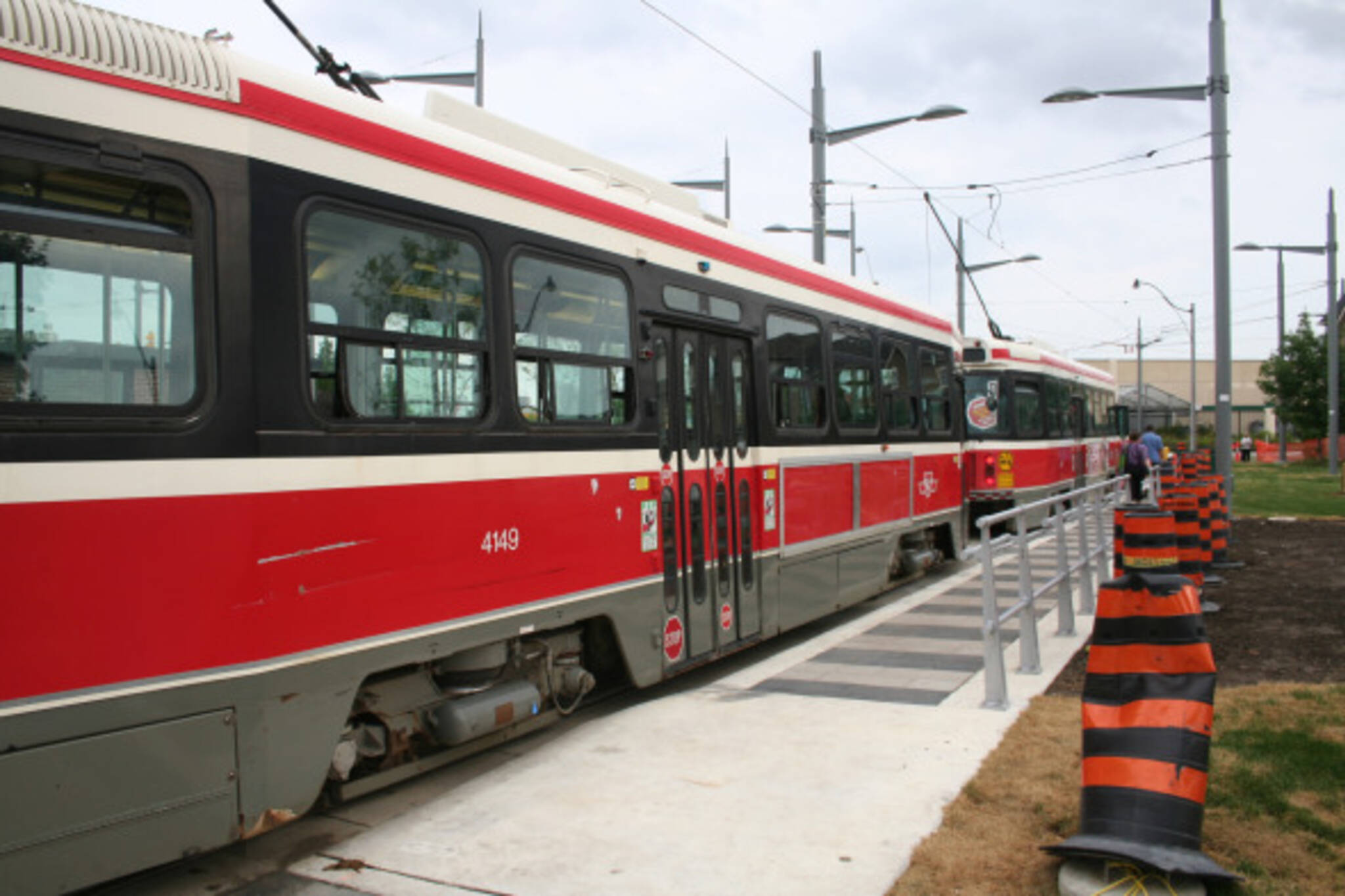
On June 28th, buried deep on the TTC's website under its construction tab, was an interesting announcement: "On Wednesday, June 30, 2010, streetcar service will resume to the community and local businesses on St. Clair Avenue West between Lansdowne Avenue and Gunns loop." In other words, for the first time in five years, streetcar service would run the entire length of St Clair. I decided to take a test drive of the newly "complete" line.
The good news is that the line is relatively fast. I hopped on Gunns Loop at 3:38. We arrived at St Clair West station at 3:54, and we coasted into St Clair station at 4:01. In other words, it took about 23 minutes to travel the whole line. Admittedly, the car I was riding in was not particularly busy. However, I took a fuller streetcar back part of the way and it ran nearly as fast.
The right-of-way (ROW) also helps improve one of the biggest headaches about streetcars: bunching caused by traffic congestion. This makes the service more consistent and reliable.
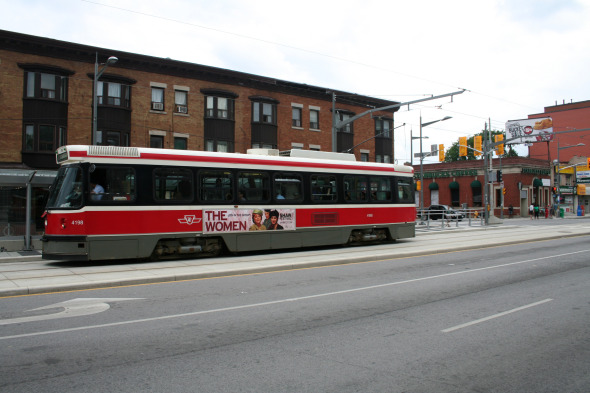
The performance of the streetcar is definitely the good. But as most people know, the St Clair streetcar ROW construction and street beautification has not been all smiles and sunshine. On this site, we've already noted the negative effect drawn-out construction had on the local businesses. This has probably improved recently - the street seemed fairly lively when I rode the streetcar.
But from an urban planning and design perspective, there is another issue with the streetscape improvements. They show a lack of professionalism. First, a caveat: these are clearly a work in progress. There are traffic cones along many sections of the street, particularly near Gunns Loop, indicating where future work needs to be done. The shelters at Old Weston Road have no glass for the roofs, but these will likely be fixed.
But what has been completed does not make the city's organizational abilities look good. Various parts of the street's furniture show shoddy construction, poor design, a strict adherence to a plan rather than common sense, a lack of funds, and likely, a politically expedited construction to avoid embarrassment at the polls.
Here is a list of things I noticed:
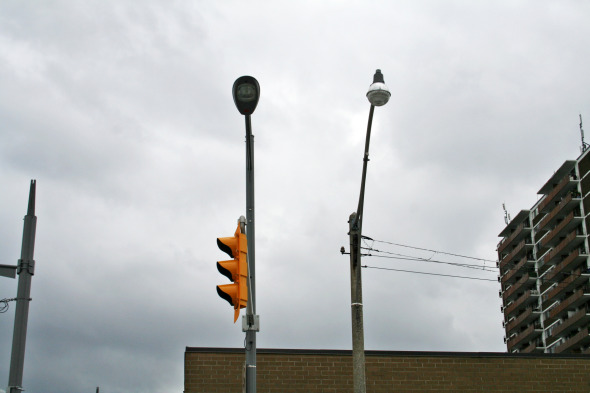
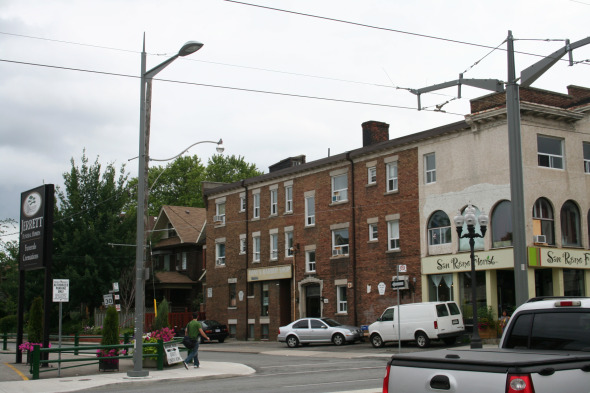
Light standards. Although it is to be expected that there will be a mixture of light standards in the city, the mixing of light standards often happens right next to one another on St. Clair: the old "acorn" light standards and the more "futuristic" ones. Although the acorn standards are generally on the side streets when they meet St Clair, sometimes they have been replaced by the new standards, and sometimes they haven't.
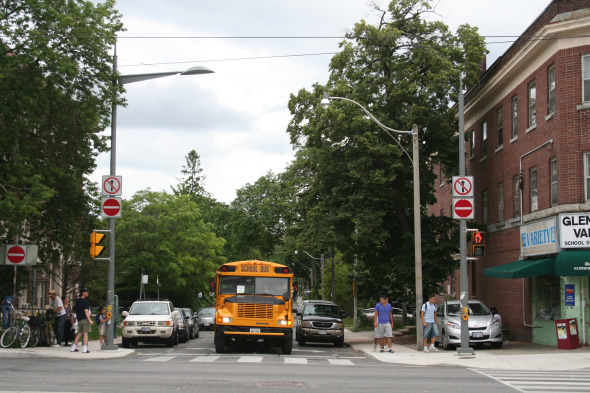
Sometimes, there are two different ones on either side of the same street. In the Corso Italia section of St Clair, there are three light standards: along with these two are the "old-timey" ones that the BIA put in. Even worse, east of Bathurst, some of the new light standards are attached to old wooden hydro poles.
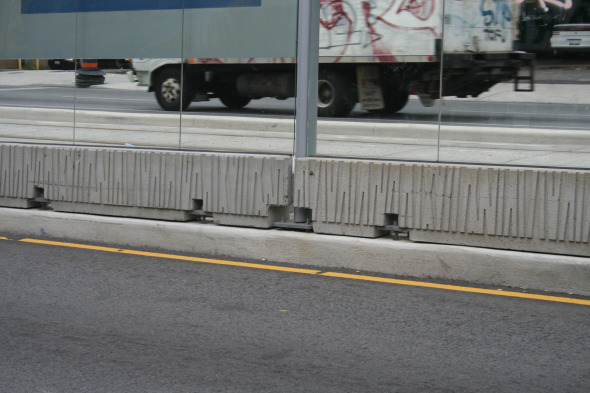
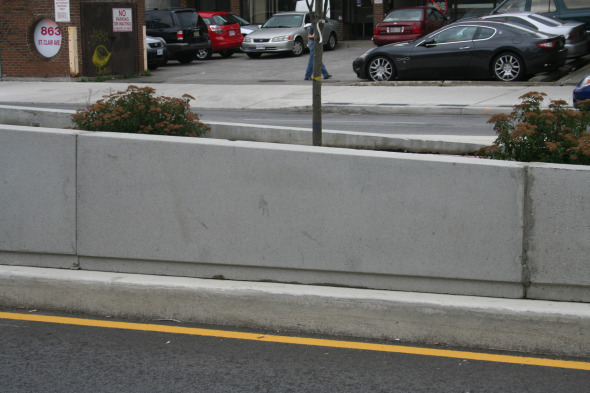
Streetcar stops. The very seventies-looking precast on the outside of the stops is already crumbled and damaged. Although some wear-and-tear is to be expected, the entire line is still relatively new. What will it look like in two years?
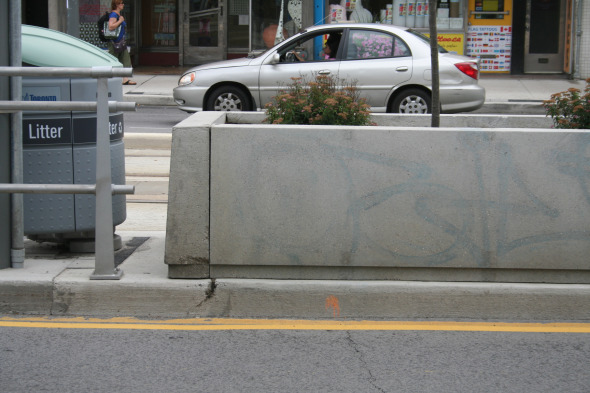
The planters for the trees at the streetcar stops look like they have been hastily assembled. The blocks that compose the planters sometimes have no gaps, and sometimes they are fairly far apart. Mortar is sometimes used, and sometimes not. Chips and cracks are already evident.
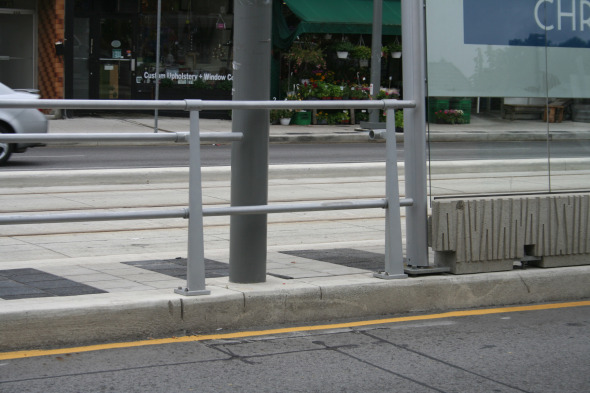
When a light standard is next to the streetcar stop's railing, the middle rail of the railing is left out. However, the holder for the rail remains. Could they not have had posts made without that middle holder?
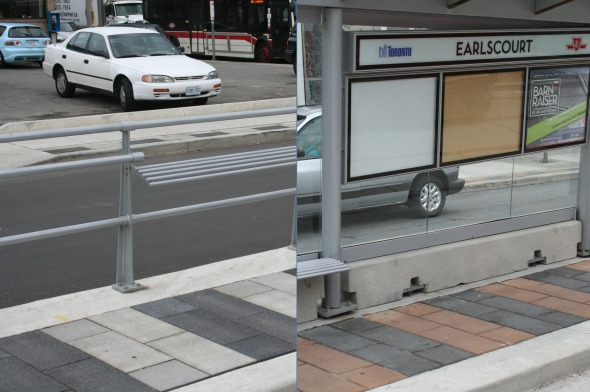
Pavers. Along the edge of the street, surrounding some of the trees, and in the streetcar stops are decorative pavers. They are usually dark grey and light grey. However, starting in Corso Italia and heading west, they become pinkish and dark grey. At about this point, the pavers are no longer used to edge the plots around the trees. Instead, pre-cast slabs are used with cutouts for the trunks. When you reach Keele, the pavers have switched back to dark grey and light grey, but the cutouts are still being used for the trees.
Although the change in colour may be a decorative choice, the fact it switches back, but the edging for the trees does not, seems to indicate some sloppiness of standards. It is also not clear - from a design standpoint - why the colour suddenly changes.
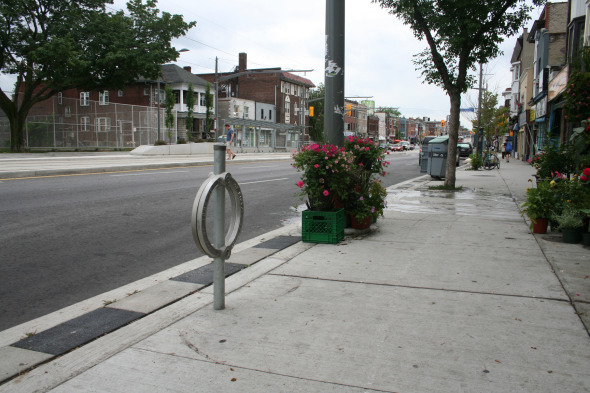
Bicycle locks. There are very few bicycle locks the entire length of St Clair, particularly around Winona. When there are bicycle locks, it appears that the business owner requested them, because there is occasionally one on an otherwise empty stretch of block. I saw a lot of bicycles locked to parking signs.
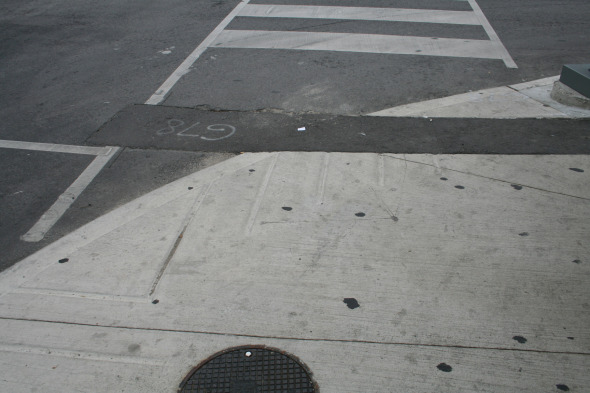
Shoddy utilities fixes. Even though these streetscape improvements are fairly brand new, I already spotted one classic utilities fix (likely Toronto Hydro): dig hole in improved pavers, repair utility, fill hole with unattractive, mismatched splotch of asphalt. With some of the city's own employees destroying work that has been accomplished by another department, how can we hope to achieve anything?
Some of these issues may seem minor, and hopefully some of them remain to be fixed. Overall, the improvements are a step forward for St Clair. But, taken as a whole, these issues with the details of the streetscape show how poorly co-ordinated the whole project was. After all, if after five years of construction and millions of dollars, the city has difficulty ensuring planters are assembled correctly, it doesn't say much about its ability to get more complicated tasks accomplished.


Discussion
29 Comments
Sort By Oldest First / Newest First
Subscribe
In the 5 years it took to achieve the
St. Clair ROW, central Berlin underwent
a major rebuild!
Other cities surge ahead and we're still
having trouble getting ticketless transit
into operation. London has its Oyster
card and Montreal has a card payment system.
Why can't we?
There is virtually nothing inspiring in
or about this city.
2. Are those cracks due to regular wear?
3. Is the choice to use mortar in some places and not others the result of an engineering choice?
4. It's harsh to say Toronto Hydro's work was shoddy. How can we know whether the problem was or whether it could have been fixed before construction started?
Bottom line: if it gets you from A to B in 23 minutes who cares what it looks like. I don't want the whole city to look like Yonge & Dundas.
"There is virtually nothing inspiring in
or about this city."
Ain't it the truth... All the travel I've always done has me wondering why Toronto is so lacking with design idea's. While Museum station was a small small step in the right direction, it doesn't take much to see examples around the world of really great stuff.
For example:
http://www.leenks.com/gallery1213.htm
http://mic-ro.com/metro/metroart.html
sure puts ours to shame.
Also, the street car does not run the entire length of St.Clair.
as i said in the past and the ttc seems to always live up to the let down, i'll beleive it when i see it.
And when you point out many of the other 'beautiful' subway stations around the world - remember that for every one that's beautiful, there are likely 15 down the line that are in a decrepit state. Toronto is more or less on average with aesthetics with every other subway line in the world - if not a bunch cleaner and safer than most. I'm still always amazed by how clean the inside of the subway cars and stations are here - things can really get a lot worse than they are (rats, garbage, graffiti...)
As for the St. Clair ROW, I completely agree - it's a complete mess. The TTC should not be designing or managing these projects. I mean - why are there poles holding up the streetcar wires? Could they not just hang them off buildings as they do everywhere else in the city. I think it'll be a great comparison once the Queen's Quay line is in - one designed by the TTC, the other by design professionals.
"localise" the transit stops and subway
stations in the same way as the guerrilla
gardeners do to bits of land?
Could a Business Improvement Area encourage
local "vernacular" designs or features to
transit stops and their subway stations
and still conform to union regulations?
Hmmmmmmmmm.
In the past 6 months, I have witnessed no less than a half dozen endless lane closures while the TTC uses those lanes to stage their track replacement; not to mention the disruption the actual track replacement itself costs! Lower Parliament has been shut for a few months already, with no notice to any of those local residents. Richmond St. was a disaster for 6 months last Fall while the TTC farted around with track replacement. Do the fans of All That Is the TTC not have eyes to see what their beloved streetcars inflict on the city as a whole?
This city is a hodgepodge patchwork of conflicting roadways and transitways. While the ROW (Rest of the World) has 6 lane arterial roads, Toronto is the only city that brags about destroying the few that we have! There is actually only ONE thru-lane at St. Clair/Yonge these days. ONE. At the hub of the city!
Way to go Toronto: shave off 5 minutes in a cross-town transit commute and add 10 to the drive. That's progress!
Plus, it should be noted that the TTC doesn't receive an operating subsidy from any higher levels of government, which many large and small transit companies do. That certainly doesn't help with its predicament when compared to the former TTC and other transit systems.
@gadfly - you live in the city and are championing wasteland-inducing 6 lane arterial roads? If you want to see how horrible a 6 lane road makes a city and how bad the traffic gets, go drive on Hespeler Road in Cambridge and have fun sitting in gridlock amongst big box stores. I grew up in Burlington and even there there's only one small portion of a road that reaches 6 lanes due to the highway interchange. They are generally avoided by even suburban planners because of the mess they create. Furthermore, the "rest of the world" in your case is the USA, a horrible example of planning on a broad scale.
Complaining about the concrete blocks and the railings and lights? COME ON. Does the streetcar run, does it have doors, can people use it? Yes? GOOD. Stop staring at the ground and get on with life.
I moved to St. Clair because of the Right-Of-Way. Granted, I had no idea how (impossibly?) long it would take for said right-of-way to be completed, but I am GLAD it is here. It makes the start of my daily commute a breeze, even … fun.
The discussion of failed design elements is completely irrelevant to that experience. But it is certainly one of the most compelling and necessary discussions to have.
If the TransitCity lines are built (or any version of dedicated on-surface rights-of-way) I shudder to think of visual-vomit stretching from Hwy 27 to Yonge Street on Finch, or across the entire city (with an underground exemption) on Eglinton!
Design is absolutely as important as form and function.
Why remove functional lighting for "futuristic lighting"?
Because "futuristic lighting" is going to be put in anyway. Save some money, develop a line-aesthetic. Each incremental increase of the Yonge, University-Spadina and Bloor-Danforth lines have a common "theme" or design concept, which I would suggest values function over aesthete, but it is unifying none-the-less.
This site seems to be like many Torontonians - better at complaining than at enjoying what this city has to offer.
I disagree with those who dismiss this article as simple complaining. I see it as a sign of someone who cares about Toronto, appreciates its public space and wants to see it improved.
Yes, the quality of the streetcar service is important but so are the street features. The Internet's big enough to engage both concerns.
More articles like this please.