City
The Gutting of the Canary Reveals Its Past, but Can it Survive the Wrath of the Pan Am Games?
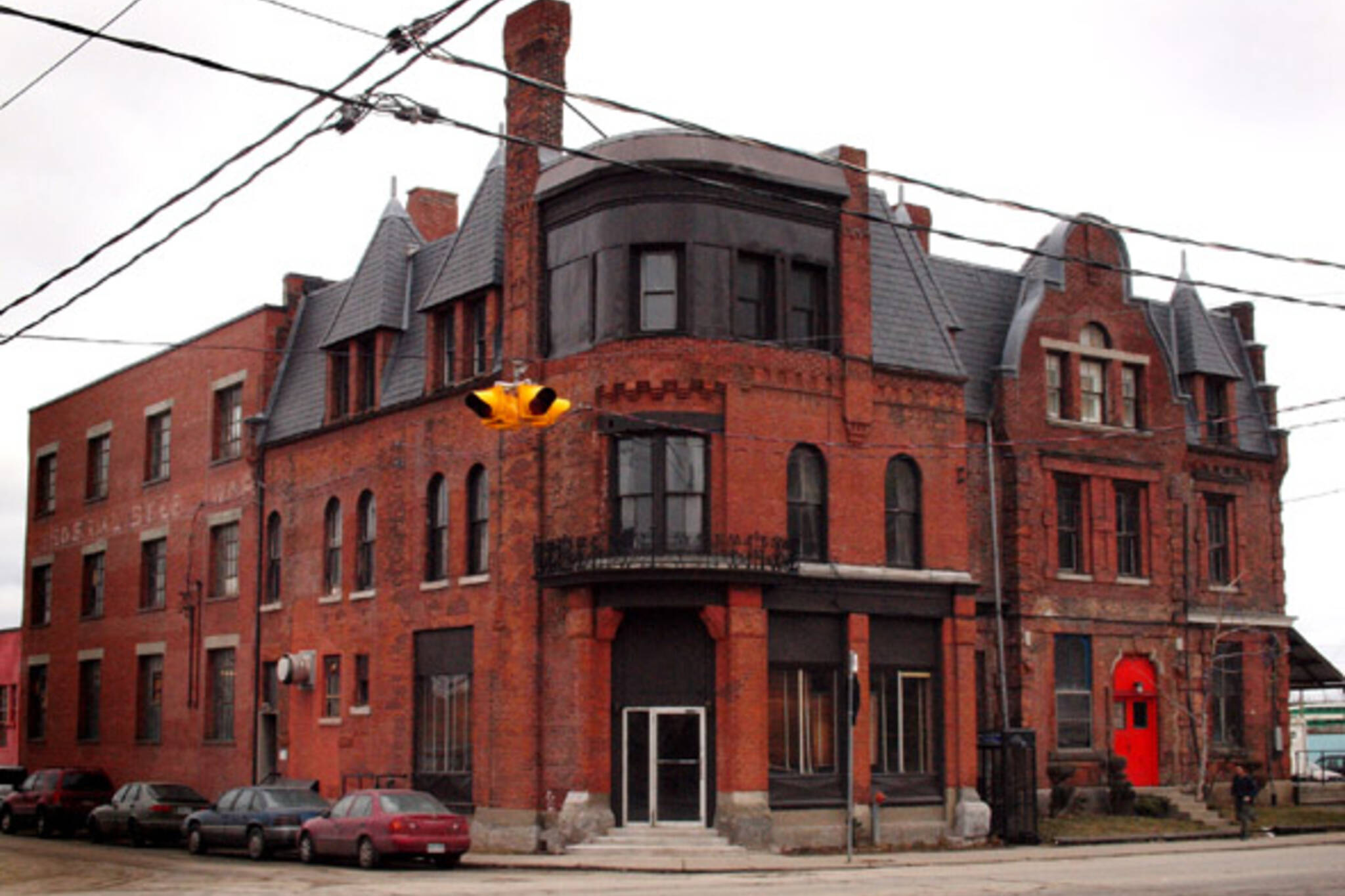
It's been almost three years since the Canary served its last open-faced turkey sandwich. Sadly, the much-photographed sign is gone, but rumours that there was something going on behind the closed blinds at the Cherry Street landmark have revealed a fascinating moment in the history of the building.
As layers of history have been peeled back, the survival of the building itself has become dubious.
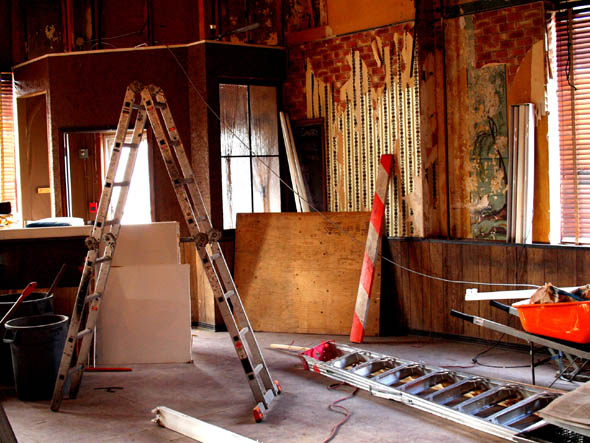
I arrived before noon to find Ken - he wouldn't give his last name - working amidst the dust and chaos of the greasy spoon's dining room, which has been gutted to the walls, with only the short order kitchen still intact, and divots on the floor where the stools and the lunch counter once stood. Ken's been living in the building for two years, but has had friends and family here for over twenty - a revolving community of artists, many of them employed in the film industry that gave the Canary its last gust of business after the industries that once surrounded the building evaporated in the '70s and '80s.
The Canary's counter and soda fountain have been on a curious journey back to where they started 50 years ago. Juxta Productions, a building tenant, are behind the pop-up store at Queen and McCaul which has been publicizing movies like the latest Harry Potter and Daybreakers, the vampire thriller for which Ken and Juxta built a bloodsucker diner using the Canary's fixtures. Ironically, it was just up the street, near Dundas and University, where the Canary restaurant operated for five years before moving out to the industrial bustle of Cherry and Front in 1965, where members of the same family ran it until it closed in 2007, a victim of the closure of the Bayview Extension and the long development limbo of the Donlands.
The space was in bad shape when Ken and his fellow tenants got permission from Ontario Realty Corporation, the building's owners, to clean it up for use as a film location and event space late last year. "It was pretty decrepit," he says. "I wouldn't have eaten here - it was pretty bad." Worst of all was the hundred or so paint cans full of congealed kitchen grease they found in a back room, which they cleaned up prior to gutting the space and opening up windows and doorways long boarded over.
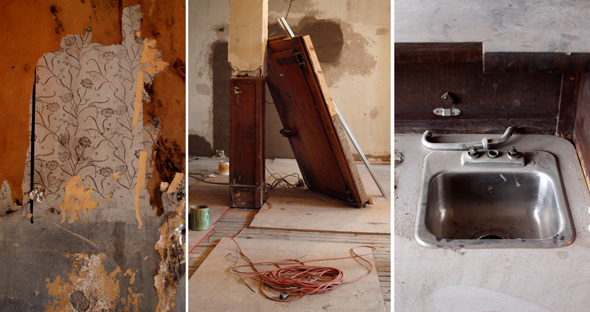
What they've revealed is the ghost of the building's former tenants. There's not much left of the Palace Street Schoolhouse, the second oldest in the city, and just a storey tall when it opened in the 1850s. By the 1890s, however, it had become a turreted and gabled Victorian hotel - the Irvine House and then the Cherry Street Hotel, and that building has emerged again under Ken's care. The Canary dining room was probably its tavern, and the space next door, which housed the diner's storerooms and walk-in fridge, was a sun-filled lobby, complete with a room-sized safe behind the check-in desk.
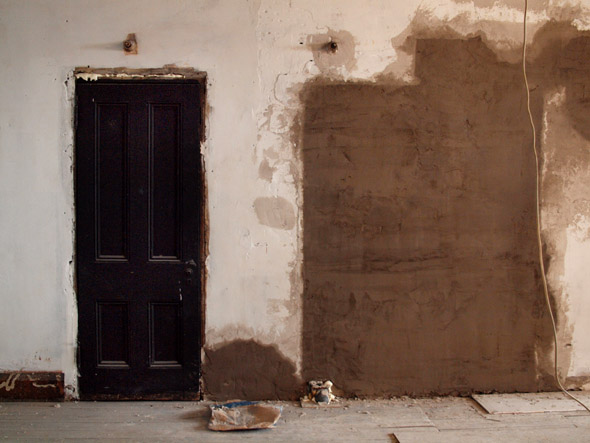
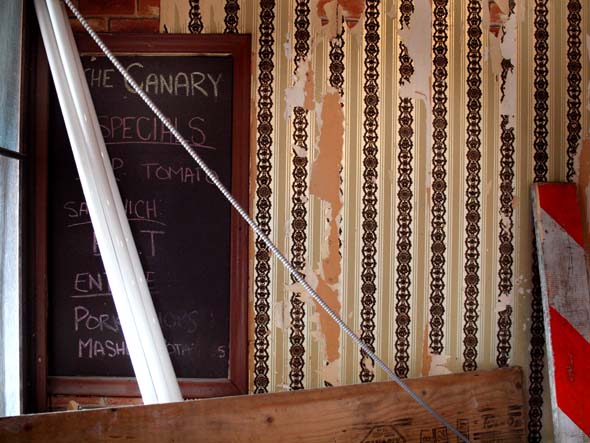
Ken has uncovered layers of wallpaper and murals, and traces of flowers stencilled onto the walls. A blackboard by the door still advertises the specials on the Canary's last day, but a grander space is emerging from the dust and grime. The building can still be glimpsed on architect's drawings for the Pan Am Games athlete's village, part of a grand entranceway, but the tenants have heard that the ORC and the Pan Am organizers have plans to tear down everything but the façade - "and wipe out 150 years of Toronto history," says Ken, noting that everyone is on a 2-year lease. "They have plans but they don't tell you very much. They're only putting band-aids on these buildings - they said they spent a million on the brickwork and new slate roof, which might be true."
Ken says they're hoping that their rehab of the space will give people a sense of the building's evocative qualities, and discourage Waterfront Toronto and the Pan Am organizers from gutting all that history away. "Maybe you can help us out," he asks as I take pictures. "Do you know anyone who needs a really nice party space?"


Discussion
23 Comments
Sort By Oldest First / Newest First
Subscribe
It would be forever to Toronto's shame if it were to fall prey to our disastrous and pathetic facadism. That's what Toronto will be if we continue to gut our history: nothing more than a pretty facade. It makes me so sad.
This building could be the grand centrepiece of the new community on the West Donlands--something really important. But all developers are thinking about (and the city that supports them) is: how can we appease the poor suckers and the most basic heritage restrictions?
Please Toronto: do the right thing for once.
I ate at the Canary a couple of times a week when I attended Inglenook Community High School up the street, and I remember it very fondly. If it suffers the fate of facading, I wouldn't be able to look at it without feeling a little sick inside.
If you agree, 409 Front sits in Ward 28. Dropping Councillor Pam McConnell a line at councillor_mcconnell@toronto.ca would be a good first step.
http://www.theglobeandmail.com/real-estate/the-race-to-build-a-pan-am-games-village-has-begun/article1370223/
The problem with tearing down old buildings is not simply about severing the emotional ties with the past (which is a legit concern). It's not even just the Jacobs-ian argument that old and even run-down buildings are necessary to provide cheaper space for marginal businesses and tenants. It's also because if a city's building stock and infrastructure is replaced every generation or two, the mistakes of one era's planning orthodoxies will be visited on the entire city. And when we have no points of comparison, we have no way of seeing our mistakes and learning from them.
I think Canada is in limbo. It has two forces, people like dionysus who believe we should look to the modern and places like Japan and there are those people who believe we should look to countries like Europe who preserve the old architecture and barely destroy old landmarks. Toronto seems to want the best of both, it's most evident with a place like The ROM (and look how ugly that turned out...) And it seems thats what they want to do yet again with the Pan Am games.
http://en.wikipedia.org/wiki/Solar
The main 1st built section is certainly nice of the old Canary bldg, but that add on to the East.. isn't anything worth 'preserving'. It's an ugly box that doesn't tie the bldg together at all. It certainly should be razed.
The question is, what will be the use/function of the main old section? The hard part of this preservation is finding double paned gas filled windows to fit their original framing. Custom made? That'll cost a fortune. That curved glass window [is it?] above the entrance?
Thankfully there are no neighbours to shoot down any truly modern designs proposed by architects.
Sounds like too many bldgs will be cheap and cheerful, only to be razed after these Pan Am games. Nice make work project, where you design twice and build twice and raze once. Is this necessary?
Design and build the bldgs of the project once, with an eye to its function post Pan Am games would be my wish. Or is that the point, shuffling money around for 'work' and calling it lookit all the employed by this project??
I don't miss that grease pit that the Canary restaurant was in the past. No sireebob!
I'm already chuffed that McGuinty hired Samsung for wind generators....
I would prefer a Canadian company get the contract.
But can we find no creative solution that avoids gutting or facading? I think many people come across a challenge like this and simply throw up their hands saying, "impossible!" When all it will take is some inventiveness and, sure, some money. Of course, there's also the other side that looks at the project and simply says, "too expensive!" And that's the end of that, as if we can put a price on history and art and culture.
I'm sure there are minimally or reasonably invasive methods of upgrading old buildings that would be appropriate here, especially given all of the money that will be thrown at the Pan Am Games anyway. I'm not even against modern updates, and I don't know exactly which features should be retained and which aren't worth keeping, but I do believe that the interior of a building is at least as important as the exterior. It's just easier to save a facade.
Unlike the other Pan Am buildings you mention that are designed simply to be torn down (if true, and I'm sure you are right), this could be a strong example of an opposite trend and an example for all of Toronto: durability, sustainability, the past and the future together. The Automotive Building just had a complete overhaul and it has held onto much of its character and integrity (despite the name change ;). I know it's mostly just a box and it's not as old, but it demonstrates the possibility of retaining and restoring a connection to our past.
for such a good article about the Canary. I wrote a story about the Canary for the GWNA newsletter (VISION) the week before it closed. I interviewed Chuck, Clark and Ana Yovanoski, who inherited the place from their father. They were the cook(s) and waitress. I took some photos and interviewed a 71 year old retired TV and photo professional who used to drive his BMW from across town. He said he had been coming there for seven or ten years just for the coffee and the conversation.
I still have the story and the photos I took from inside and out, if you would lie to have them posted here.
Richard Reinert
PS Is the Canary sign going to be reinstalled? I miss it.
I am one of the owners Ana I'm sure thos of you who came to the Canary remember me. I miss that place but more so the customers. As for the grease filled paint cans WHAT ARE YOU TALKING ABOUT. There was not any when we left. the restaurant was in are family for over 50 years. and its said to it go