Friday, May 24, 2013Light Rain 4°C
City

Morning Brew: LCBO Workers Poised to Walk Out, Toronto 18's Ambitious Plot, Guns and Parties

Posted by Jerrold Litwinenko / June 23, 2009

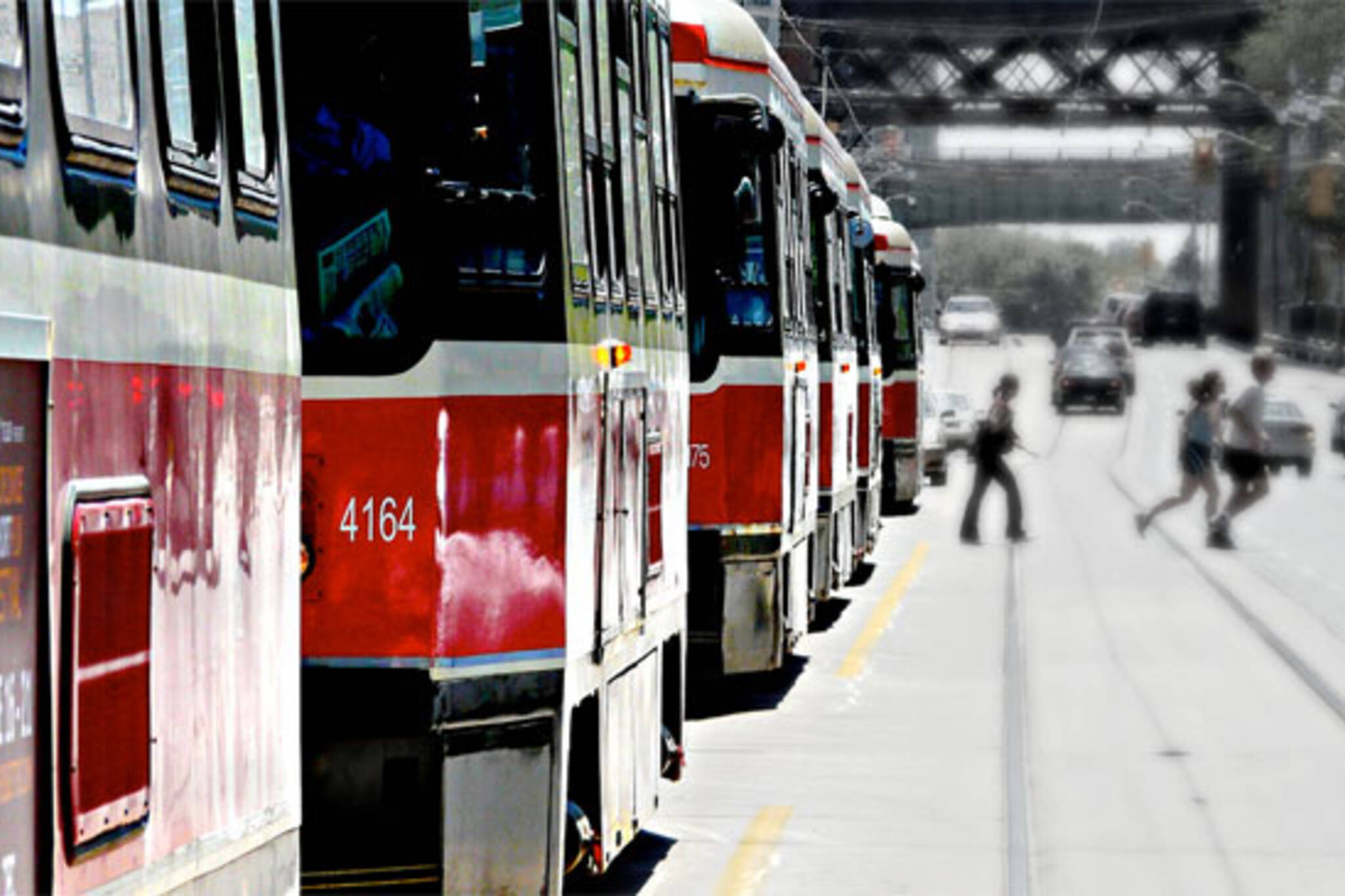
ttc streetcar queuePhoto: "Streetcar's Gonna Be Late" by St-Even, member of the blogTO Flickr pool.

What's happening in the GTA (and sometimes beyond):

The city union strike is turning some of us to drinking our sorrows away, but come Wednesday that may not even be an easy option. A walk-out by unionized LCBO workers, unhappy with trending in full-time and part-time job allocation, could shut down the vast majority of retail locations. In my opinion, they should be happy they have a job at all during this unprecedented time. And since the entire province's booze business is run by an archaic government-run monopoly, you can't buy booze legally anywhere else. I say let them strike, let the public wake up and smell reality, then revisit the 2005 Sorbara report and make it reality.

Details of the alleged bomb plots that were being planned by the infamous "Toronto 18" are being revealed. Apparently they were talking about using rented moving trucks, turning them into explosives, and attacking three very high-profile targets including the Toronto Stock Exchange, CSIS headquarters, and a military base on three consecutive days. Sounds like a terrible plan to me.

Could automated drug dispensing machines be the way of the future? Imagine approaching an ATM-like device, popping in your credit card and your prescription, having a brief video-call with a remote pharmacist, and getting your medication dispense right then and there? This could work.

What was billed as the "hottest MMVA after-party" at the Century Room in clubland ended up being a stressful situation for those in attendance (some 500-600 partiers). Police raided the club and found three guns (two loaded). Arrests were made. Why guns are needed at a party is something I'll never fully appreciate... unless of course, I join the mafia or start partying with the wrong friends.

The Ontario Ombudsman is set to release the findings of his annual report today, revealing a "treasure trove of government maladministration." Will it be any different from last year? It's hard to be an optimist when it comes to these things, but the least we can do is hope that his feedback is taken to heart and suggestions implemented.

Hope you're enjoying your garbage, folks. It could be a while before someone is willing to take it away for you.

Discussion

29 Comments

DS / June 23, 2009 at 08:50 am
user-pic
And by a "terrible idea" I hope you mean that it was a potentially catastrophic one.
jameasmallon / June 23, 2009 at 09:30 am
user-pic
"In my opinion, they should be happy they have a job at all during this unprecedented time." If you have to editorialise, and you really don't, do it better. First, we have a recession every ten to fifteen years, so it's hardly 'unprecedented'. Second, why would a union make concessions in a recession that will never be alleviated in a boom? Third, this union is chump-change compared to the Fire and Police Unions, whose members cost us more than half of the city budget, and each make a far better wage. Union bashing is cheap and popular, but the fact remains as fewer Canadians are in unions since the seventies, income-disparity has grown.

And Jerrold, when you reply, try to be entertaining instead of petulant, for a change.
FreeOurBeer / June 23, 2009 at 09:40 am
user-pic
If you'd like to read all about our problematic alcohol system, with a special focus on beer, visit www.FreeOurBeer.org.
Torontonian / June 23, 2009 at 09:45 am
user-pic
let the public wake up and smell reality, then revisit the 2005 Sorbora report and make it reality.
------------------

I think you mean the Sorbara report.
Jerrold / June 23, 2009 at 09:47 am
user-pic
@jameasmallon

Unemployment is currently at staggering 9.4% in Ontario. It's affecting almost 1 in 10. Where people aren't losing their jobs, they're taking salary cuts, reduced hours, and more. I consider that unprecedented. If you don't, that's cool. Curious... are you a union member? Is the recession not affecting your employment?

My feelings about the LCBO union issue specifically stem from my feeling that the organization shouldn't even exist in the first place. It's unnecessary to have government involved in retail sales of alcohol. Regulation, yes. Being the sole buyer and seller (i.e a monopoly), no.

Feel free to agree or not, but don't insist on me being your monkey because I won't be :P
Greg Smith / June 23, 2009 at 10:18 am
user-pic
"Curious... are you a union member?"

Jerrold, if being a union member invalidates a pro-union point of view, why shouldn't the same apply to non-union members with anti-union views? It seems to me that everyone argues these issues from a position of self-interest. FWIW I <em>am</em> a union member, albeit one who had been pro-union for many years prior.

"In my opinion, they should be happy they have a job at all during this unprecedented time." & "Unemployment is currently at staggering 9.4% in Ontario. It's affecting almost 1 in 10."

Because you seem to accept that there is some unspecified (lower) level of unemployment at which job action is not unacceptable, a more valid figure to consider isn't total unemployment now, but excess unemployment at present over and above the structural level when the economy is not in recession. That would drop your number to somewhere between 1 in 15 and 1 in 20.

How low must unemployment fall before it is alright for those with jobs to resist worsening terms of employment -- especially those actually in a position to do so successfully (i.e. union workers)?

"Where people aren't losing their jobs, they're taking salary cuts, reduced hours, and more. I consider that unprecedented."

If the fact that one set of workers are facing cuts to compensation, how would the situation be improved by expanding the impact of those cuts to thousands of additional workers? To me, that sounds like making a bad situation worse, either out of spite or on the basis of a confused version of solidarity that requires democratizing hardship rather than prosperity.
Ryan L. / June 23, 2009 at 10:20 am
user-pic
"Second, why would a union make concessions in a recession that will never be alleviated in a boom?"
<br><br>
Perhaps this could be part of the deal. Accept the concessions only under the guaruntee that they will be reviewed in a year. If the city is doing better financially and they refuse to give them back (or at least partially), then feel free to strike away. They'd have a valid excuse that time, and would probably get more public support.

"Unemployment is currently at staggering 9.4% in Ontario. It's affecting almost 1 in 10."
<br><br>
In reality, it's worse than that. That 9.4% only includes people who are actively seeking work. Those who have given up aren't counted, nor are those who have opted to be a stay at home Mom/Dad after losing their jobs. Statscan has shown the 'discouraged' workers rising in numbers disproportionately to the rise in unemployment. ie, a larger percentage of unemployed are giving up than when it was last measured and if it wasn't for that, I'm sure that 9.4% would easily be over 10, potentially 11%.
<br><br>
Also, like you pointed out, statscan has also shown a disproportionate loss of full time jobs and an <b>increase</b> in part time jobs.


Greg Smith / June 23, 2009 at 10:21 am
user-pic
Err, that should be "If the fact that one set of workers are facing cuts to compensation <b>is bad</b>, how would the situation be improved..."
adhamilton / June 23, 2009 at 10:49 am
user-pic
There are jobs where unions are vital; where people are doing dangerous things or where they are likely to be taken advantage of. The trouble is that too many unions have gone far, far beyond this instead using their clout to make demands that are ridiculous when you compare them to similar nonunionized positions. Why should an LCBO cashier, who needs no skills or education for his/her job more than how to read an ID and scan a barcode be making two to three times as much as your average grocery store clerk who is doing virtually the same job? Why should they be promised full time work and job security? If they want full time work and job security gain skills or education that are valuable to society and society will reward you. Now, this is not true for ALL unions. There are many that represent careers that are undervalued and underpaid but cashiers and delivery persons are not one of them.
RBeezy replying to a comment from jameasmallon / June 23, 2009 at 10:51 am
user-pic
Hmmm... sounds like you have a surrogate Mom Jerrold.

Unions striking during recessionary times is an obscene conceit.
StrikeTO / June 23, 2009 at 10:59 am
user-pic
My problem isn't with the unions per se, it is with monopolies. I say have a union... no problem. But the Union has to compete with the private sector for a contract to provide the services it wants to provide. If they can provide a service that provides sufficient value for the wages/benefits they would demand, great. Otherwise, someone else is happy to pick up their slack.

Or, alternatively, if we're going to have unions be a monopoly in providing service, declare all of them essential services.

Same goes with the LCBO.
spyder replying to a comment from RBeezy / June 23, 2009 at 11:02 am
user-pic
Agree.
Ryan L. / June 23, 2009 at 11:04 am
user-pic
Unions were created to stop greedy rich companies from taking advantage of their workers. So what happens when those companies are not so rich anymore? Unions were not designed for the current situation.
m / June 23, 2009 at 11:22 am
user-pic
The cops, firefighters got a raise in their contracts last year. They also got to keep banking their sick days. What's good for the goose is good for the gander. If you're anti union, good then hire mall cops. If you think tough economic times call for concessions, ok then pay your firefighters less. I don't care if you're pro union or anti union, just be fair.
Greg Smith replying to a comment from adhamilton / June 23, 2009 at 11:29 am
user-pic
"Why should an LCBO cashier, who needs no skills or education for his/her job more than how to read an ID and scan a bar code be making two to three times as much as your average grocery store clerk who is doing virtually the same job?"

Perhaps this is due in part to the vastly higher profitability of an LCBO outlet versus a grocery store (in this case largely due to the monopoly that Jerrold so despises, but I'm not so interested in debating that point). If the same work for one retailer facilitates higher profitability for the employer, it doesn't seem unreasonable to me that such work would be compensated at a correspondingly higher level. LCBO cashiers do have additional responsibilities that do not apply to grocery workers; namely, making important (in my view) decisions about which customers ought not to be sold alcohol due to age, intoxication, or intent to supply minors. Not that I think this should, in itself, command massive wage premiums; however, I do think it is misleading to suggest that the jobs are "virtually" identical. Also, for what it’s worth, I have experienced consistently better customer service and higher levels of product knowledge at my local LCBO than at any of the various non-LCBO alcohol vendors (Wine Rack, Vintages, etc.) or any chain grocery store. It seems that those higher wages do translate to a better customer experience, but I would imagine that this experience varies across individual LCBO stores.

Really -- is it clearly the case that LCBO workers make way too much, or that grocery store cashiers make way too little? If there is such a thing as an appropriate wage, I would suggest that it's somewhere in the middle. Funny how many people are quick to suggest that <em>others</em> are obviously overpaid for their no-skill, no-education job... no matter how robotic their own work may be, and no matter how ridiculously inapplicable their post-secondary education is to their own, higher-paying, PSE-mandatory work.

I'm also not sure if comparing LCBO clerks to grocery clerks is particularly illustrative of the excesses of unionism, as there are many unionized grocery workers (mostly UFCW?). It might actually demonstrate how collective bargaining arrives at wages that reflect the employer's ability to pay, which is itself based on the profitability of the employer's operations. You don't have to agree, but I think it's worth pointing out the ways in which the real world is more complicated than the simple picture you have painted.

Collective bargaining isn't just about fixing a few highly dangerous workplaces, it's about shifting from total control of employment by the employer (i.e. servitude with very minimal statutory obligations, which is the historical model underlying the standard non-union employment relationship under law) to a structured relationship with clear and fair complaint procedures (i.e. for grievances) in the face of any unjust or arbitrary treatment (not simply physical safety) along with fairly negotiated terms of employment. In my view, a workplace where employees have no say whatsoever in the terms of their employment beyond "take it or leave it" is inherently one in which workers are taken advantage of.
Mike W replying to a comment from m / June 23, 2009 at 11:30 am
user-pic
You're comparing police and firefighters to garbage workers and LCBO cashiers.

Sorry, I've got nothing against garbage men, but they're not risking their lives or saving anyone.

If I serve food I don't expect to get paid management salary and job security.
Greg Smith replying to a comment from Mike W / June 23, 2009 at 11:40 am
user-pic
No, Mike, it seems that m refers specifically to city workers (who are more than just "garbage men" BTW) by comparing them to the cops and firefighters. Comparing LCBO workers to city employees via an appeal to fairness would indeed be nonsensical, because it is a different employer, and there's nothing in m's post to suggest that m has done so.

As for risk -- the city's ability to afford raises for its employees shouldn't be contingent on the level of risk in the job. If the city can't afford raises, it shouldn't do so, but neither should the risk involved in emergency services mean that the city should throw fiscal realities to the wind and not bargain with those groups just as rationally as with others. The truth, I think, is that the city knows it must try to squeeze concessions from the presently striking workers because the cops, etc., cannot strike and thus have an arbitrator standing between the city and its cost-cutting objectives. Those who suggest that no public sector workers should have the right to strike should keep that in mind.
BillW replying to a comment from m / June 23, 2009 at 11:42 am
user-pic
This is the best argument you have? Everyone should be treated equal? Because a cop and a fire fighter, or a paramedic requires the same skill set a garbageman? Because there's no such thing as "seniority" in a union membership? Cops, fire, medics should definitely be paid better than a trash collector because they have a much more difficult job. No way would I replace a trained and qualified police officer with Paul Blart; I would, however, happily replace city protected sanitation workers with a private firm, like they do in Etobicoke, like they do all over the province. But the day city council and the Mayor out and out refused to even consider contracting out for unskilled labour like this is the day they handed the keys of the city over.
Katie / June 23, 2009 at 11:56 am
user-pic
Privatizing the LCBO is a terrible idea and here just four reasons why:

1) the LCBO is one of the largest purchasers and retailers of alcohol in the world. It provides a wider selection at better prices and, most importantly, at the same price to all citizens in Ontario regardless of their location so that the bottle of red that you buy in Toronto costs the same as the bottle you buy in Meaford or Kenora.

2) The LCBO returned $1.3 billion in profit to the province in its last fiscal year - in additon to nearly $1 billion in tax revenue. This money goes to the Government of Ontario's Consolidated Revenue Fund that, in turn, funds Ontario school boards, hospitals, roads, social programs, etc. Looking out my window at Toronto's crumbling infrastructure, I don't think this is money we, the citizens of Ontario, can afford to give away.

3) Ontario's past experience with privatization demonstrate that it's a bad idea - short-term gain over long-term value. The $3.1 billion privatization-happy Mike Harris sold Highway 407 for made less than $1.5 billion for the province once the costs of land and construction were deducted. 10 years later, the highway is worth $10 billion - money that should be going to the people of Ontario. Instead, this privately-owned highway continues to COST Ontario's tax-payers thousands of dollars EVERY DAY as a result of the sweetheart licence plate denial for non-payment clause Harris legislated for 407 ETR. Thanks to Mike Harris, your tax dollars subsidize SNC Lavalin's profit margin. Think about that before rushing to sell-off the LCBO.

4) Privatizing the LCBO won't make booze cheaper in Ontario. For one, Ontario practices 'social-pricing' on alcohol to prevent the situation you have in Europe where price-slashing supermarket specials on beer, wine and spirits have fueled a crisis in binge drinking, particularly among teens and 20-somethings. Private or public, the $$$ you pay for the cheapest bottle of wine or scotch will stay the same. Nor will privatization lower the taxes that the government levies on alcohol. Instead, privatization will raise prices as smaller, privately-owned companies enter the market (as happened Alberta and BC) to reflect increased operating costs as well as the increased price of liquor itself without the LCBO's monopolist advantage to leverage better wholesale prices from suppliers. As it stands, LCBO prices are generally competitive compared to both New York State and Quebec (and better than Alberta). And if you think your bottle of Moet is too expensive in Toronto compared to NYC, I honestly have no sympathy for you whatsoever.

The LCBO provides good value for money to the people of Ontario. While I don't support a strike, anyone who thinks privatizing the LCBO is a good idea is looking to make a buck off your booze. And while that's going to happen anyway, I'd rather that money go to the public purse than Joe Whoever's back pocket.
Greg Smith replying to a comment from BillW / June 23, 2009 at 12:33 pm
user-pic
Bill, you seem to have confused a call for equal <em>relative</em> pay increases -- 3% increases for everyone -- with a call for equal <em>absolute</em> pay. The former is the kind of fairness m suggested.
James / June 23, 2009 at 12:33 pm
user-pic
Reason # 5 - LCBOs are pretty
Ryan L. replying to a comment from m / June 23, 2009 at 01:20 pm
user-pic
Because of the emergency services status as 'essential service', they've given up their right to strike in exchange for greater influence at the bargaining table.

They are given more because they're legally entitled to more due to their unique situation.
Cabfrancophone replying to a comment from Katie / June 23, 2009 at 01:25 pm
user-pic
Did you cut and paste this from the LCBO's web site, or are you so familiar with their common defense strategy that you can spit this stuff out in your sleep?

<i>1) the LCBO is one of the largest purchasers and retailers of alcohol in the world. It provides a wider selection...</i>

false. they do provide a very wide selection but it's almost exclusively mass produced stuff. Finding anything niche from a small producer in Ontario --- even that's made IN Ontario --- is near impossible. The LCBO decides what to buy and sell and leaves the consumer with no opportunity to veer from what the LCBO chooses for us to access. That's a tough nut to swallow for a sophisticated drinker and meaningless to the average $10 two oceans wine drinker. They rely on consumer ignorance of whats out there.

<i>2) The LCBO returned $1.3 billion in profit to the province in its last fiscal year - in additon to nearly $1 billion in tax revenue. This money goes to the Government of Ontario's Consolidated Revenue Fund that, in turn, funds Ontario school boards, hospitals, roads, social programs, etc. Looking out my window at Toronto's crumbling infrastructure, I don't think this is money we, the citizens of Ontario, can afford to give away.</i>

This can still occur via legislated tax and duty collectio without the need for a bloated union employed retail chain. Shifting overhead and logistics burdens to private retailers would save the LCBO even more millions (no need for stores or province-wide distribution and 7000 overpaid staff).

<i>3) Ontario's past experience with privatization demonstrate that it's a bad idea - short-term gain over long-term value. The $3.1 billion privatization-happy Mike Harris sold Highway 407 for made less than $1.5 billion for the province once the costs of land and construction were deducted. 10 years later, the highway is worth $10 billion - money that should be going to the people of Ontario. Instead, this privately-owned highway continues to COST Ontario's tax-payers thousands of dollars EVERY DAY as a result of the sweetheart licence plate denial for non-payment clause Harris legislated for 407 ETR. Thanks to Mike Harris, your tax dollars subsidize SNC Lavalin's profit margin. Think about that before rushing to sell-off the LCBO.</i>

Liquor sale hasn't been privatized sine the 1920s and the insanity of 407 sale has nothing to do with liquor privatization. Apples to oranges.

<i>4) Privatizing the LCBO won't make booze cheaper in Ontario. For one, Ontario practices 'social-pricing' on alcohol to prevent the situation you have in Europe where price-slashing supermarket specials on beer, wine and spirits have fueled a crisis in binge drinking, particularly among teens and 20-somethings. Private or public, the $$$ you pay for the cheapest bottle of wine or scotch will stay the same. Nor will privatization lower the taxes that the government levies on alcohol. Instead, privatization will raise prices as smaller, privately-owned companies enter the market (as happened Alberta and BC) to reflect increased operating costs as well as the increased price of liquor itself without the LCBO's monopolist advantage to leverage better wholesale prices from suppliers. As it stands, LCBO prices are generally competitive compared to both New York State and Quebec (and better than Alberta). And if you think your bottle of Moet is too expensive in Toronto compared to NYC, I honestly have no sympathy for you whatsoever.</i>

Wait, privatization won't lower taxes and levies? You mean the government will still collect those millions of dollars to give back to social causes? You just defeated your own argument.

The social responsibility angle is a total lie. Putting beer and wine and spirits on sale doesn't make the community turn into crazed drunk lunatics. Impose minimum taxation and pricing standards, but let private retailers create competition and let the MARKET dictate pricing. Let the MARKET dictate product demand. Allow small Ontario winemakers to sell their locally produced product in retail stores without having to go to the wineries.
badbhoy replying to a comment from Katie / June 23, 2009 at 01:30 pm
user-pic

It always seems that those who are in favour of maintaining the LCBO monopoly suggest that those who are against are looking to eliminate the LCBO. Who said this is the only option? Keep the LCBO in business and let them compete in an open market against other licensed retailers. Perhaps other retailers will favour certain brands at lowers prices and maintain different hours at the expense of the superior selection and customer service offered at the LCBO. The consumer then has a choice and this will dictate who will survive and adapt. Last time I checked that is how most businesses successfully operate in a free market.
mikeb replying to a comment from Cabfrancophone / June 23, 2009 at 01:39 pm
user-pic
Amen, Cabfrancophone.
Just to add some more...

1. Jurisdictions with private liquor retail and similar populations have much better selection of beer, wine and alcohol than Ontario with the LCBO. Go to the San Francisco Bay Area, Chicagoland and New York and you will see. Prices are less in most jurisdictions as well.

Frankly a bottle of First Growth Bordeaux should cost more in Kenora than in Toronto-a steak sure does. Booze should not cost the same everywhere in Ontario, nothing else does. There’s transportation, demand and other costs to factor in. As an urbanite I’d be happier subsidizing the food of people in smaller communities than their alcohol purchases.

2. Retailing the same volume of alcohol sales by private or public stores has no affect on tax generated by the sale of alcohol. As to the “profit” earned by the LCBO, when it’s a monopoly run by the government it is an unlegislated tax. Raise the legistlated liquor taxes slightly if necessary to compensate. License fees will be generated from retail stores that want to sell alcohol. The licensees would have to pay taxes on their profits. Selling the LCBO would be a big one time payoff.

3. Having bad experiences with privatization like the 407 does not mean that the government needs to screw up privatising the LCBO. The recent the E-health project problems don’t mean that the government should get out of the health business. There are already many LCBO Agents in smaller communities that are already semi-privately run by locals with great success (and won’t be on strike).

4. Experiences in competitive markets like the US, Australia, New Zealand, and most of Europe in the world would indicate that booze will be cheaper than it currently is in Ontario. Combating binge drinking? Are you kidding? Have you ever been up north? Public/private ownership of the retail chains is very low on the causes of societal ills like the binge drinking or alcoholism. Social pricing has not been a great success in places like Sweden To use your example of competitive pricing--buy a 40 oz bottle of Canadian Rye in any of the lower 48 states and tell me how much less you paid compared to the LCBO. Part of that price difference is legislated taxes, but some is monopolistic gouging by a government monopoly.

If retail is such great thing for the government to be in why doesn’t the Ontario government get into the business of selling food, cigarettes or other sundries? It is not in society’s interest that’s why. There is very little public interest at all to do so.
Roger / June 23, 2009 at 04:28 pm
user-pic
Re: The Century Room gun-toting MMVA after-party crowd....

While this appalls me, it doesn't surprise me much. Are the bouncers not doing their jobs properly? I'm glad I avoided that party. I'll be sure to avoid the Century Room too now.
Rich / June 23, 2009 at 11:42 pm
user-pic
<i>In my opinion...</i>

Look, if I want to read Metroblogging Toronto, I know where to find it, ok?
Andrew replying to a comment from jameasmallon / June 24, 2009 at 01:36 am
user-pic
What?! You weren't called a Troll?
Franko replying to a comment from Katie / June 24, 2009 at 09:05 am
user-pic
Wow, I can have fun with this...

1. Tesco - private retail chain in the UK, world's largest Alcohol buyer. Google it to find out, can people still stop pushing this flse claim?
2, When Alberta privatized their liquor stores, they ended up making MORE tax revenue than when they ran the stores. You see when you let someone else (private system) pay for the warehouse, distribution, retail stores, advertising, management and administration, all you have to do is collect taxes. You also get the benefit of tax revenue without having to pay anything first. Today, the LCBO has to BUY the alcohol first, store it, ship it, and retail it, and only when it's sold do they make any money. That could be 6 months after the goods are paid for.
3. This point doesn't make any sense. If that's the case, the government should take over all businesses in the province and run the place like the old soviet union...how did that work out?
4. The sad reason stuff costs more here isn't just the tax, it's that the MONOPOLY system makes it so expensive to do business, that producers are charging MORE for product sold here in the first place, in order to pay for all the Airmiles, rebates, and glossy LCBO advertising that you have to commit to. Alberta is private, if one store doesn't carry your product, the three acorss the street probably will.

As for is Alberta cheaper - don't trust me, see for yourself.
http://www.liquorstoresgp.ca/flyer.cfm
And keep in mind this is ONE store out of 1,000.

Add a Comment

Other Cities: Montreal