City
Boxed Out: OMB Dismisses Big Box Development in Leslieville
The Ontario Municipal Board has backed the City Council and rejected plans for a massive retail complex in Leslieville. The decision wraps a near five-year fight between the developer Smart!Centres and the city and community developers. A 56-page report from the OMB sided with the city, saying the proposed development didn't provide a positive use for the vacant lands and would likely 'destabilize' the area's employment.
SmartCentres planned to build 700,000 square foot retail complex - rumoured to be anchored by a Wal-Mart - on the piece of land occupied by the Toronto Film Studios on Eastern Avenue between Carlaw Avenue and Leslie Street. Part of the plan would incorporate around 1,800 parking spaces.
The community had other ideas. Locals groups criticized the proposal, saying it would increase traffic in the area, tear apart small business, and create low-wage jobs. In its report, the OMB focused on this last point.
The area in question is designated as an "Employment District". Part of Toronto's official plan calls for maintaining these 'employment districts'. One of the city's policies is to ensure that these districts, "create and sustain well-paid, stable, safe and fulfilling employment opportunities for all Torontonians." Wal-Mart fails on almost every one of these requirements.
But I think the face-off between the community and the developer highlights a major problem facing cities across North America. Mainly, how do city leaders handle the migration of major, 'suburban' retail chains into urban centres? As the housing market continues to cool, and retail operators have largely reached a tipping point in suburban or retail expansion, the next obvious move is to look towards city centres.
Local officials and community activists fear that as major retailers move into our cities, they'll rip apart small businesses, turning our cities into 'suburbities'. They also think the low-page, benefit-less jobs offered by retail giants aren't a viable or healthy alternative to traditional working class employment.
But I think both sides are being a bit short-sighted. On the one hand, the well-off residents in Leslieville can simply get in their cars are drive to the suburbs when they want to bargain hunt at places like Wal-Mart. The poorer residents may not have this option. So, they're stuck in the neighbourhood they may have been living in for more than 10 or 20 years, lacking the consumer opportunities offered to their wealthier neighbours.
It's great that middle and upper class residents don't want to return home from shopping in the suburbs, only to drive by a replica retail complex. But actively taking this opportunity from other, less fortunate residents, doesn't seem like a positive way to build a community. Plus, if a Wal-Mart did open up, how many unemployed workers would be lining up to hand in their CV?
But those in favour of the complex have to concede that the jobs being offered by places like Wal-Mart and Home Depot are low-quality. Filling your cities with massive retail complexes while watching corporate headquarters relocate to the suburbs is hardly considered good planning. Small businesses also employ thousands of residents in the city. Allowing corporate behemoths to come in and price out local shopkeepers will destroy the vibrancy of a city.
City officials and community activists may have won this case, but they would be silly to think the war is over. Like it or not, corporate retailers are going to continue with their quest to expand their operations in cities across the country. Finding a way to incorporate them into the fabric of city life is going to be a major challenge for both city officials and developers. But it's one they're going to have to face.
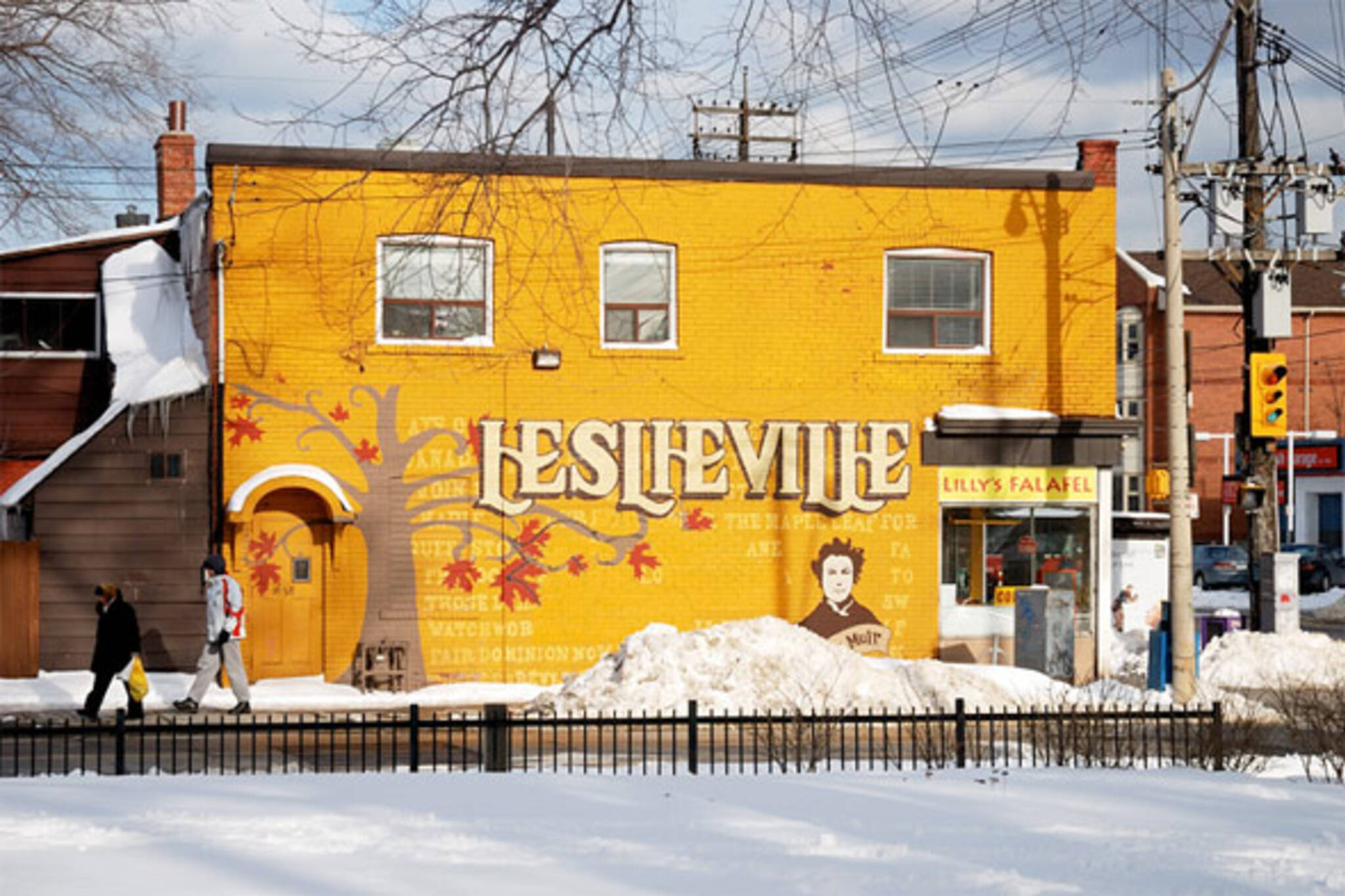
Photo by of blogTO Flickr Pool member archoneus


Discussion
39 Comments
Sort By Oldest First / Newest First
Subscribe
The recession is gonna happen whether or not Wal-Mart comes in and destroys my neighbourhood.
> So, they're stuck in the neighbourhood they may have been living in for more than 10 or 20 years, lacking the consumer opportunities offered to their wealthier neighbours.
There's a Zellers and a great dollar store in Gerrard Square Mall.
Good news to hear about this.
I love the juxtaposition of the tired slams on "corporate retailers" while bemoaning the flight of corporate headquarters to the suburbs. What a load of leftist twaddle. Ignoring the fact that no retailer is operating as a sole proprietorship, so they are all "corporate" no matter how small, and that stores will hire residents whether or not they're mom & pop stores, I'd like some actual numbers demonstrating higher salaries at smaller stores and that they provide a net benefit to the city as a whole.
Small retailers are generally worse since they have no economies of scale and must charge much higher prices to customers, reducing the city's overall utility. They are also worse places to work, since they offer minimal opportunities for advancement as the owners are the managers. I celebrate every time an independent retailer goes broke, because it's one less badly run, stocked, serviced and priced store.
It's funny people arguing that we don't need "corporate stores" since anyone who wants to can just drive to their existing locations. What happened to the green public transit advocates? Or are you all only capable of spouting reflexive leftism instead of being able to stick to a coherent plan?
I was looking forward to that WalMart as a shopping option. I guess I'll have to continue making semi-quarterly trips to Dufferin Mall.
The now cancelled Home Depot foray on Queen West sounds just as bad, but the HD fronted well on the street rather than turning its back on the neighbourhood like SC's proposal.
Also, Leslieville is awesome. QE is the new QW.
Leaving aside the wisdom in that choice, if the government wants to subsidize low-income earners, there are a lot more ways to do it than to pick and choose which investments are acceptable in zoned-employment districts.
The ammount of money a production spends with local business is mind boggling. It's one of the most profitable, clean industries in ontario. Labour, rentals supplies, it's almost all local.
You may think the subsidies are worth it, but that doesn't contradict my point.
And whether they spend locally (and you assume a different enterprise does not) is beside the point. If the goal is to stimulate the local economy, the same effect could be achieved by handing the money directly to them. In any event, its an empirical point that hasn't been measured, so your conjecture isn't very helpful.
They rape and pillage the area and then thier gone. Its too volitile of an industry, thier pockets aren't nearly deep enough to withstand covergency with the nasdaq.
I have an MBA and I have no idea what you just tried to say there, Jamie.
Nobody needs another Wal-mart.
-Hours slashed to barely nothing. Students and other part time workers are now getting as low as a single four hour shift every two weeks.
-<b>Full Time jobs are being phased out</b>. There will be <b>no</b> advancement for people working there. Of a staff of formally 200 (not including the restaurant) where I used to work they've reduced the senior jobs to manager, assistant manager, 4 supervisors (fashion, hardlines, cash, nightshift) and human resources (who technically is the same level as regular workers). Any other senior employees have lost their title and when gone will not be replaced.
Regardless of the wage, nobody can survive when they only get 16 hours a week. How is this better than jobs offered by local businesses? Who cares if you'll never be manager because the current manager is the owner? You'll probably still get paid better as a sales clerk in one of these stores than you'll get as a supervisor at a Zellers or Walmart (Assistant managers at Zellers start at around 28,000 a year)
If you haven't worked retail, then don't make such ridiculous claims that Walmart is a better opportunity than local businesses. If you had, you'd know that is most definitely not the case.
So in your scenario, 4 hours a week over two weeks is still better than the indy alternative.
This whole issue is mind blowing to me, as far as I'm concerned, these anti-big box peeps have no real argument other then NIMBY. They don't want the existing residents to be a PART of this change or have any stake in it. From a socio-economic standpoint, this is so sad, really. A horrible blow to the lower class of the area, the traditional resident.
new jobs are better than no jobs.
I assure you that the number of stores in that strip employ far more people than a Walmart Supercentre does.
Secondly, the actual retail employment isn't even the biggest issue. With the economy going down the shitter and people losing manufacturing jobs left and right, you think it's a good idea to support a company that is single handedly responsible for about half of that?
"The manufacturing sector and its workers were hardest hit by the growth of Wal-Mart's imports. Wal-Mart's increased trade deficit with China eliminated 133,000 manufacturing jobs, 68% of all jobs lost. Overall, the Wal-Mart trade deficit displaced and 308,100 jobs in 2006. On average, 77 U.S. jobs were eliminated for each one of Wal-Mart's 4,022 U.S. stores in 2006."
You're worried about losing your job in uncertain times, I get it, but probably the dumbest thing you can do at a time like this is spend your money at a place like Walmart just so you can save a couple cents. There is even a term used for the job loses in manufacturing and retail everytime Walmart expands. "The Walmart Effect"
developer is proposing a large development there, and it undermines the potential for sustaining employment in a pretty depressed area of the GTA.
I thinks the folks who live in Riverdale, Cabbagetown, the Beach as well as Leslieville should be happy and hopeful.
Shit, we won.
Check out the National Post from March 4th - the filmport has already filled up as a result of government help, leading to new jobs. Pesky facts...always getting in the way.
I know exactly what you're talking about - there wasn't a Honda dealership in my neighborhood, so I ended up having to buy a Ferrari! How inconvenient!
I am not convinced that small retailers that exist in storefronts and little mom&pop shops are great jobs and support this city's tax base on a square footage basis, when compared with other types of development, but they do contribute a certain character and life-affirming benefit in small doses. On the other hand, huge car-dependent developments tend to disintegrate noble less-profit-viable, but truly stimulating environments - like Queen West is currently -- and don't contribute a wealth of great jobs anyway (but in this recession, a job is a job). These Queen West-type areas are financially unsustainable and below-average prop.tax contributing neighborhoods that are practically charity zones where storefronts and apts above are paying way less than the actual value of the property (likely because there is no mortgage and therefore just utilities and prop.taxes are being paid by charitable owners). But they are essential to small-money, big-value enterprises like studios, galleries, int'l dining, low-mid-class boutiquery.
So where is a viable model and how should people live? I propose core-mississauga - around square one., for example. A good selection of high density living and working enviros that support high-education/experience paying jobs. Easy car and ok-but-not-great-and-maybe-improving transit access. Roadways don't get as congested. Walkable? not so much - but walking is 4 months a year only, really. Eventually a bit of street scene at the base of some of the buildings, maybe. The ideal lifestyle: own a car and drive it only when necessary, maybe once a week or less, take transit, and own a property. To do this, you need a good job. Now show some interest in the street, night, and art life of mississauga and the artsy fun communities will come. Mississauga in 15 years will be the ideal mix of a dynamic city and a model urban environment. We just need a bit of 'fill-in' character. Make it and they will come.
he started the concept ... all the stuff there is crap
you can shop there if you like go ahead